

 Français
Business bank account comparison: the best option for freelancers and SMEs
This business bank account comparison helps freelancers and SMEs compare offers and choose the one that optimizes costs and services.

Choosing your business bank is a decision that’s far more strategic than a simple administrative formality. It’s a partner that directly affects your cash flow, your management time, and even your ability to seize growth opportunities. Whether you run an SME or work as a sole trader, the right business account can really make the difference.
The different types of business banks on the market
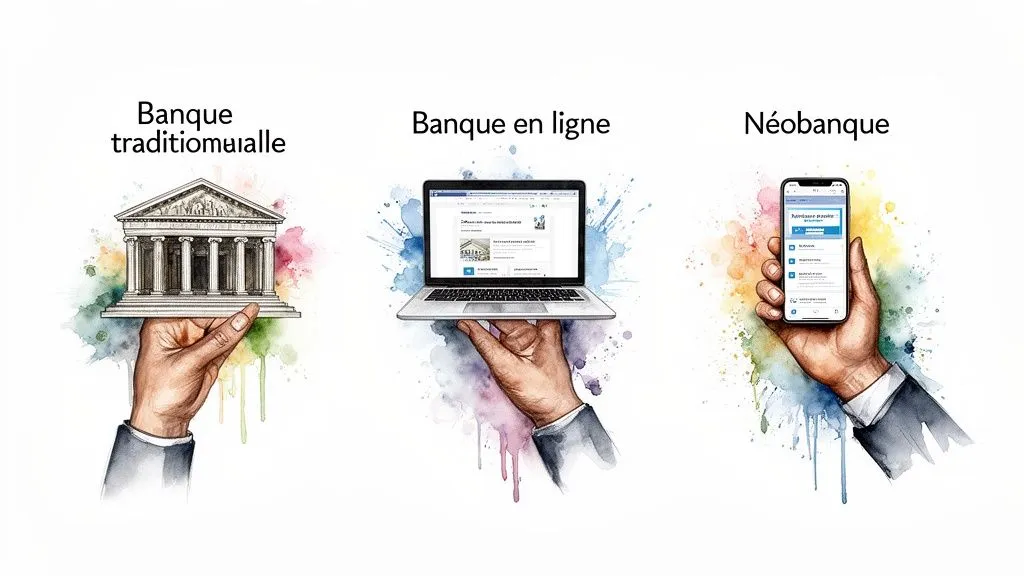
Before diving into a numbers-based comparison, it’s crucial to understand the three major families of players sharing the market. Each has its own DNA and targets very different entrepreneur profiles.
In France, the business banking landscape is quite distinctive: five giants (BNP Paribas, BPCE, Crédit Agricole, Crédit Mutuel, and Société Générale) alone hold more than 80% of the market. This historical concentration makes the arrival of new specialized players all the more relevant, as they shake things up with often more agile offers. To learn more, you can check out an analysis of the French banking sector on ESGF.com.
The three main banking families
Identifying which category fits you is the first step toward making a smart choice.
-
Traditional banks with branches: This is the historic solution. Their strength? Human contact, a dedicated advisor who knows your file, and a very wide range of services, especially for complex financing such as equipment loans or factoring. This is often the choice of businesses that need solid support, that finance heavy projects, or that regularly handle cash and checks.
-
Online banks: Often subsidiaries of large groups (think BoursoBank Pro or Hello bank! Pro), they offer an excellent middle ground. You get the solidity and security of a large bank, but with the flexibility and much lower fees of digital banking. This is the ideal compromise for entrepreneurs who want controlled costs without giving up classic banking products like credit.
-
Neobanks and online business accounts: These 100% digital players, such as Qonto or Shine, have bet everything on simplicity and efficiency. Their strengths are ultra-transparent pricing, a mobile-first user experience, and built-in management tools that save you precious time (invoicing, expense management, etc.).
The real question to ask yourself is: what do I actually need day to day? An in-person meeting to negotiate a large loan, or an ultra-smooth app to manage my expenses in a few taps from my smartphone?
This distinction is really the starting point of our business bank account comparison. The table below summarizes the strengths and weaknesses of each model to help you see things more clearly.
| Type of institution | Main strengths | Points of caution | Ideal profile |
|---|---|---|---|
| Traditional bank | Dedicated advisor, extensive financing offer, easy handling of cash and checks. | Often higher fees, longer administrative processes, sometimes dated interfaces. | SMEs, craftspeople, retailers with financing or deposit needs. |
| Online bank | Very competitive fees, access to classic banking products (credit, savings), financial solidity. | Less personalized support, little to no service in a physical branch. | Freelancers and micro-businesses looking for the best service-to-price ratio. |
| Neobank | Very low, transparent fees, express account opening, built-in management tools, continuous innovation. | No credit, no cash/check deposits, customer support exclusively online. | Sole traders, freelancers, startups, and digital businesses. |
The criteria for a relevant business bank account comparison
Choosing a business bank isn’t just about price. To build a business bank account comparison that actually holds up, you need to dig much deeper than the headline offer displayed in big letters on the homepage. What works for your freelance colleague won’t necessarily be the right solution for you. The real value of a bank is measured by its ability to fit the actual needs of your business, both today and tomorrow.
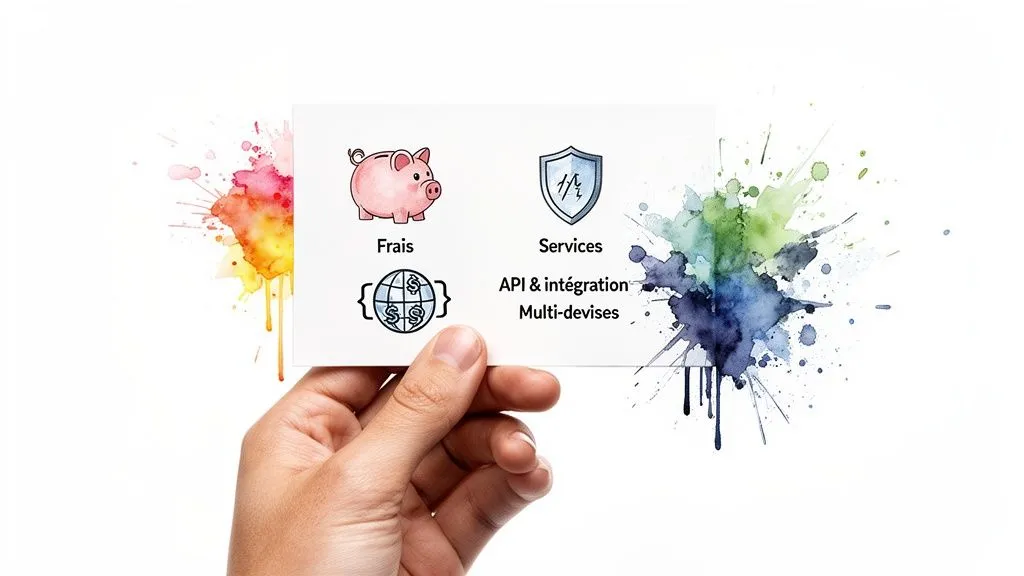
To avoid getting it wrong, the secret is to adopt a method, a kind of personal analysis grid. It’s the best way to avoid gimmicks and focus on what has a direct impact on your daily life: your cash flow, your time, and your efficiency.
Decoding the fee structure beyond the monthly price
The monthly subscription is just the tip of the iceberg. The real cost is often hidden in the details and ancillary fees, the ones that can quietly blow your budget. A careful analysis is therefore essential.
Here are the points to scrutinize:
- Account maintenance fees: Included in the plan or billed separately? That’s the basics.
- The cost of bank cards: The first card is often free, but if you need cards for your employees or virtual cards to secure your online payments, how much do they cost?
- Transaction commissions: These fees, charged on each debit transaction, can add up fast. Even a rate that seems low, like 0.1%, can amount to a huge sum if your business handles large volumes.
- Fees on transfers and direct debits: Look closely at the number of SEPA transfers included each month. And are instant transfers, increasingly useful, subject to a surcharge? If you work internationally, what about transfers outside the SEPA zone?
An account advertised at €9.90/month can ultimately cost you more than another at €19.90/month. It all depends on your actual usage. If you make a lot of transfers beyond your plan or need several cards, the calculation over a full year changes everything.
Assessing the services and features that make the difference
Once the pricing is clear, we get to the heart of the matter: features. This is where the real added value of a modern business account lies, the part that will genuinely simplify your life.
Ask yourself the right questions relative to your line of work. For example, if you run an e-commerce business selling abroad, efficient multi-currency management isn’t optional, it’s a necessity. Exchange rates can eat into your margins without you even noticing. To get a sense of cost differences between countries, the World Bank’s International Comparison Program (ICP) data is very telling. You can explore the ICP data here to better grasp these dynamics.
The critical importance of integrations and automation
We now reach a crucial, often underestimated point: your bank’s ability to communicate with your other management tools. A good connection turns a simple bank account into a genuine dashboard for your business.
The goal is clear: automate repetitive tasks so you can focus on what really matters. Bank synchronization with a management tool like Bizyness, for example, lets you automatically reconcile your invoices with your incoming payments. No more manual entry, saving time and reducing errors.
To help you structure your analysis, here’s a table summarizing the essential points.
Selection criteria analysis grid
This table summarizes the key comparison points for choosing a business bank, with practical questions for each criterion.
| Comparison criterion | Key points to check | Importance for sole traders | Importance for SMEs |
|---|---|---|---|
| Fee structure | Hidden fees, transaction commissions, cost of transfers beyond the plan. | Very high | Very high |
| Services & limits | Included insurance, payment and withdrawal limits, multi-currency management. | Medium to high | High |
| Integrations (API) | Connection with accounting software and management tools (e.g., Bizyness). | High | Very high |
| Customer support | Availability (7 days a week?), channels (phone, chat), presence of a dedicated advisor. | Medium | High |
By following this approach, your business bank account comparison becomes a genuine strategic tool. You’ll then be certain to choose a financial partner that not only matches your current reality but will also be able to support your company’s growth.
Scrutinizing the best business banks right now
Now let’s get to the heart of the matter: this famous business bank account comparison. To help you see things clearly, I’ve broken down several standout offers on the market for you. My goal isn’t to give you a dry list of features, but to show you what will really make a difference for you, day to day, in your life as an entrepreneur.
The era of entrusting absolutely everything to your traditional bank is over. The trend is clearly toward multi-banking. A very telling study shows that the share of products held with one’s main bank has dropped by 11 points. In plain terms, savvy entrepreneurs no longer hesitate: they seek a home loan from a traditional bank while managing their daily flows on a much more agile neobank. For the curious, all the details are in Bain & Company’s full study.
Neobanks, the market’s most agile players
These 100% online players have completely reshuffled the deck. They’ve set the bar very high in terms of user experience and price transparency. They’re perfect for freelancers, startups, and small businesses that above all want efficiency and simplicity.
Qonto, the European leader thinking big
Qonto quickly established itself as the reference. Its offer is truly comprehensive and its interface a model of its kind. This goes well beyond a simple business account; it’s a genuine cockpit for your finances.
- What makes the difference: Clearly, its team management. You can grant tailored access to your employees, order multiple cards (physical or virtual) with dedicated limits, and track every expense live. It’s a real comfort.
- The point of caution: Even though the pricing is attractive at first, the bill can climb quickly if you make a lot of transfers or if your team grows beyond the plan’s limits. Be sure to estimate your volumes carefully.
- Who it’s for: Growing SMEs, startups, and any company that needs to delegate expense management without losing control.
Shine, the independent’s copilot
A subsidiary of Société Générale, Shine was designed from the start for sole traders and freelancers. The idea is to support them well beyond banking, especially on the administrative side.
- What makes the difference: Shine includes tools to create invoices and even estimate social security contributions (URSSAF). For a freelancer, that’s pure gold. Their business-creation pack is also a real plus when getting started.
- The point of caution: The offer shows its limits if your structure grows very fast or if you start having complex international needs.
- Who it’s for: The sole trader or freelancer looking for an all-in-one solution to focus on their craft, not paperwork.
Business accounts with very specific strengths
Some players have chosen to stand out with highly focused features that address very precise needs.
Revolut Business, the international champion
If you work with clients or suppliers abroad, Revolut Business is often the solution that comes to mind first. Its currency management is quite simply its DNA.
- What makes the difference: Being able to hold and exchange more than 36 currencies at ultra-competitive rates, and make international transfers without breaking the bank on hidden fees. For an online seller or agency invoicing abroad, the benefit is direct and very real.
- The point of caution: Customer support is 100% online. You need to be comfortable with that. Another point: the IBAN isn’t French by default, which can still cause friction with certain administrations or for direct debits.
- Who it’s for: Businesses juggling multiple currencies, online shops, and digital nomads.
Choosing a multi-currency account isn’t just about the number of currencies available. The real calculation to make is: actual exchange rate + transfer fees. It’s on this total transaction cost that players like Revolut Business widen the gap with traditional banks.
Indy, automated accounting (and the free account)
Indy burst onto the scene with a bold promise: a free business account directly connected to its smart accounting tool.
- What makes the difference: The perfect integration between banking and accounting. Every transaction is automatically categorized, and the tool can even generate your tax filings (VAT, tax return). It’s a huge time saver.
- The point of caution: The free plan obviously has its limits. The business model relies on selling more advanced accounting options. And be careful, it doesn’t replace the advice of a chartered accountant for complex tax situations.
- Who it’s for: Self-employed professionals and sole traders under the BNC regime who want to put their accounting on autopilot without breaking the bank.
Online banks, the happy medium
Backed by large groups, these banks combine the best of both worlds: highly competitive online pricing and the solidity of a well-established institution.
Hello bank! Pro, the power of the BNP Paribas network
Hello bank! Pro offers a simple, clear, and effective proposition, benefiting from the entire BNP Paribas infrastructure. It’s an excellent compromise if you like digital but want to keep a foot in the “physical” world.
- What makes the difference: The ability to deposit checks and cash directly at BNP Paribas network ATMs. For a retailer or craftsperson, that’s a priceless advantage.
- The point of caution: The built-in management tools (invoicing, expense reports) are much less developed than at specialized neobanks like Qonto or Shine.
- Who it’s for: Craftspeople, retailers, and self-employed professionals who still need, even occasionally, physical banking services.
To help you visualize all this, here’s a small summary table highlighting the key points of each offer.
Comparison of business bank offers
This table summarizes the main features of the solutions we’ve just analyzed, to give you a quick and effective overview.
| Bank | Monthly fee (starting from) | Card type included | Accounting integration (API) | Ideal for |
|---|---|---|---|---|
| Qonto | €9 excl. VAT | Mastercard One | Yes (very advanced) | SMEs, startups, teams |
| Shine | €7.90 excl. VAT | Mastercard Basic | Yes (simplified) | Sole traders, freelancers |
| Revolut Business | €0 (Free) | Debit card | Yes (advanced) | International businesses |
| Hello bank! Pro | €10.90 excl. VAT | Visa | Limited | Craftspeople, retailers |
This business bank account comparison shows it clearly: there’s no miracle solution that suits everyone. The best choice is the one that fits your business, your stage of development, and how you work. Really take the time to weigh each criterion against your own needs. That’s how you’ll find the financial partner that will genuinely support your growth over the long term.
Which business bank for which type of company?
Finding the best business account isn’t a race to the lowest price or the longest feature list. Above all, it’s a question of fit. The ideal account is one that perfectly matches the realities of your line of work. A business bank account comparison only makes sense when confronted with concrete situations, because every business and every sector has its own battles to fight.
Choosing your bank is a bit like choosing your tools: a freelance graphic designer and a construction craftsperson will never have the same needs. So you need to start from your daily operations to find the solution that will really save you time and money, rather than the other way around.
To guide you, here’s a simple decision tree that will point you toward the right category of bank based on your priorities: international, physical operations, or all-digital.
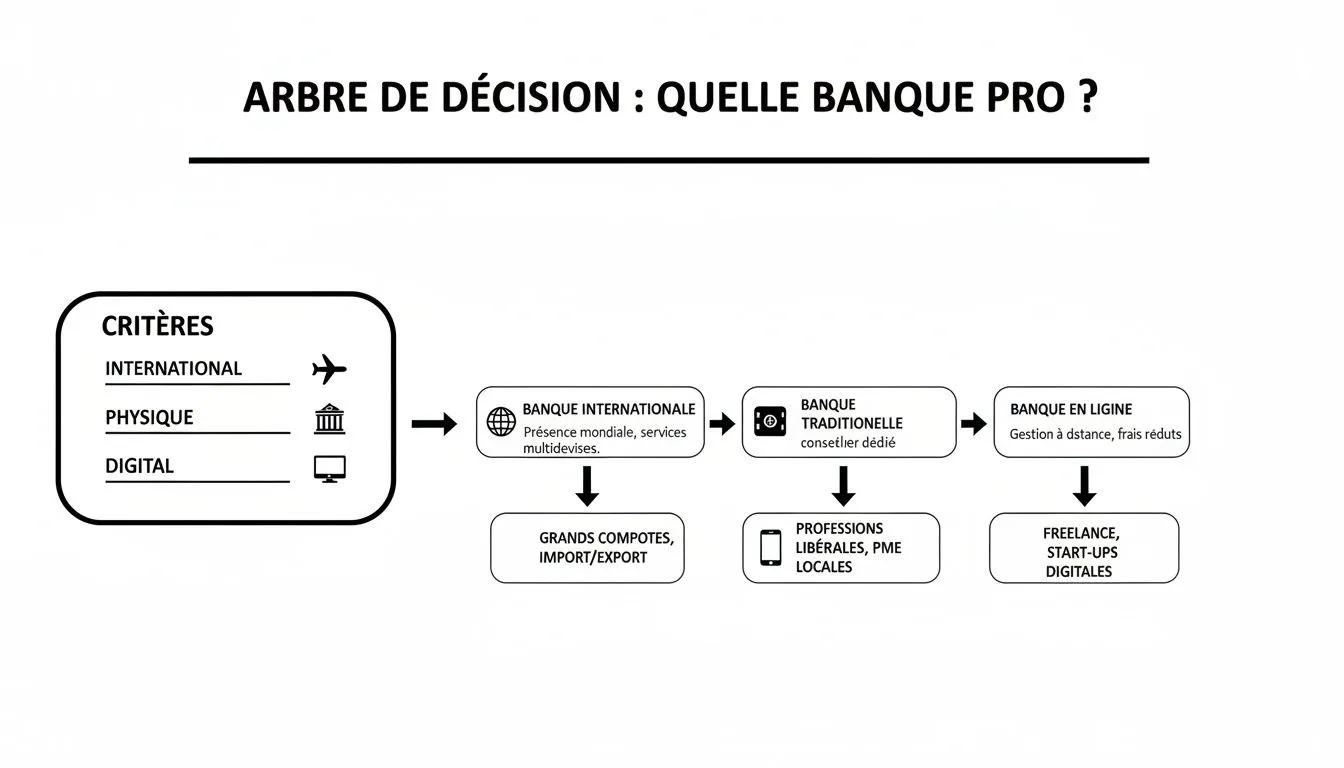
This diagram makes it clear: the very first question to ask concerns the nature of your financial flows. Are they mostly digital? Do you need to visit a branch? Or do your transactions cross borders?
The digital freelancer or sole trader
This profile seeks simplicity, minimal fees, and formidable efficiency. Their daily routine often boils down to incoming transfers from clients and online payments for software subscriptions or subcontractors. For them, admin work is a chore.
- Key needs: A very low-cost account, a solid mobile app, built-in invoicing tools, and ultra-fast account opening.
- Shine: This is the solution designed for the self-employed. Its help with URSSAF declarations and its invoicing tools really make the difference.
- Indy: Perfect for those who want to crush fixed costs. Its free offer, which includes automated accounting, is simply unbeatable on the market.
For sole traders, the choice is even more strategic. To dig deeper into the topic, feel free to read our full guide on which bank to choose as a sole trader, which breaks down the subtleties of this status.
The e-commerce seller trading internationally
Here, we’re operating on a completely different scale. Managing payments in foreign currencies becomes the crux of the matter. Exchange fees and transfer delays can eat into margins and directly impact customer satisfaction.
- Key needs: A multi-currency account, competitive exchange rates, fast and low-cost international transfers, and smooth integration with payment platforms like Stripe or PayPal.
- Revolut Business: This is its DNA. The ability to hold multiple currencies and pay foreign suppliers without hidden fees is a huge advantage.
- Qonto: Also offers SWIFT transfers, all within a very clear interface for easily tracking international operations.
The classic mistake? Underestimating the impact of “small” recurring fees across hundreds of transactions. Over a year, an exchange rate just 1% less favorable can translate into thousands of euros in losses for an e-commerce business with a good sales volume.
The local craftsperson or retailer
For this profile, physical contact remains essential. Cashing checks, depositing cash, or using a card payment terminal are everyday actions. And that’s something many neobanks simply can’t do.
- Key needs: The ability to deposit checks and cash, an attractive card terminal offer, and if possible, a reachable advisor to discuss financing (a new vehicle, equipment, etc.).
- Hello bank! Pro: This is the ideal compromise. You get the flexibility of an online bank while still being able to use the BNP Paribas branch network for your deposits.
- Blank: One of the few neobanks that allows check deposits, in addition to offering management tools genuinely designed for craftspeople.
Some trades, such as beauty professionals, have even more specific needs, like tip management or mobile payment solutions. The choice of bank should take this into account.
The micro-business or SME with a small team
As soon as you start hiring, expense management gets more complex. You need to be able to provide payment cards to employees, manage expense reports, and keep tight control over budgets.
- Key needs: Multiple bank cards (physical and virtual) with adjustable limits, a system for managing expense reports, and different access levels for employees and the accountant.
- Qonto: The undisputed leader in this niche. Their platform is built for team management, with a very high level of customization in permissions and expense tracking.
- Bizyness: Although it’s a management tool, its seamless synchronization with banks like Qonto enables end-to-end automation, from an employee’s payment all the way to accounting reconciliation.
Ultimately, the right approach isn’t to look for “the best bank” in absolute terms. It’s about finding the one that most intelligently addresses the 3 or 4 major challenges of your own business.
The impact of your bank on your financing plans
Choosing your business bank isn’t just about day-to-day management. It’s a strategic choice that will weigh heavily on your ability to finance your growth. The bank you choose today will be the partner that says “yes” or “no” to your expansion plans tomorrow.
Every institution, whether traditional or 100% online, evaluates a financing request through its own lens. Your relationship with the banker and, above all, your business account’s history are at the heart of this analysis. Healthy, transparent management of your finances is your best argument.
Traditional banks vs. neobanks: who finances what?
On the financing front, approaches are radically different. This is even one of the main points of divergence.
Traditional banks keep a head start for structured, long-term financing projects. A loan to buy equipment, finance a commercial property, or obtain a substantial cash credit line remains their area of expertise.
Their strengths are well known:
- The relationship with a dedicated advisor: This is a major advantage. Having a contact who knows your company, its history, and its potential can make all the difference in defending a case internally.
- History analysis: Years of account activity build trust and prove the solidity of your business model.
- A full range of products: They have an arsenal of solutions, from classic business loans to leasing, including factoring to handle cash flow difficulties.
For their part, neobanks play a different tune. While they generally don’t offer bank credit in the classic sense, they excel at more agile, short-term financing solutions. They rely entirely on technology to analyze your flows in real time and provide near-instant answers, often via specialized partners.
The choice, then, isn’t binary. An SME can perfectly well rely on its traditional bank for a mortgage while, at the same time, using a neobank to obtain fast cash financing based on its latest invoices.
Your account history: your passport to credit
A well-kept business account is living proof that your company is viable. A solid history, with regular income and controlled expenses, sends an extremely positive signal to a banker. It’s the basis of their risk analysis. Good cash flow management is therefore not just vital day to day, it’s crucial for your future.
The numbers speak for themselves: access to financing is a major issue for small businesses. According to the Banque de France, outstanding financing for micro-businesses reached €263 billion, up 2.0%. Credit is out there, but the doors don’t open the same way for everyone. To dig deeper, feel free to check out the statistics on business financing from the Banque de France. Your bank really is the key that can open, or close, those doors for you.
How to connect your business account to automate your management
Choosing the right business bank is the first step. But the real magic happens at the second, equally decisive step: turning that account into a genuine command center for your business. The idea is no longer just to glance at your balance, but to make your financial data actively work for you.
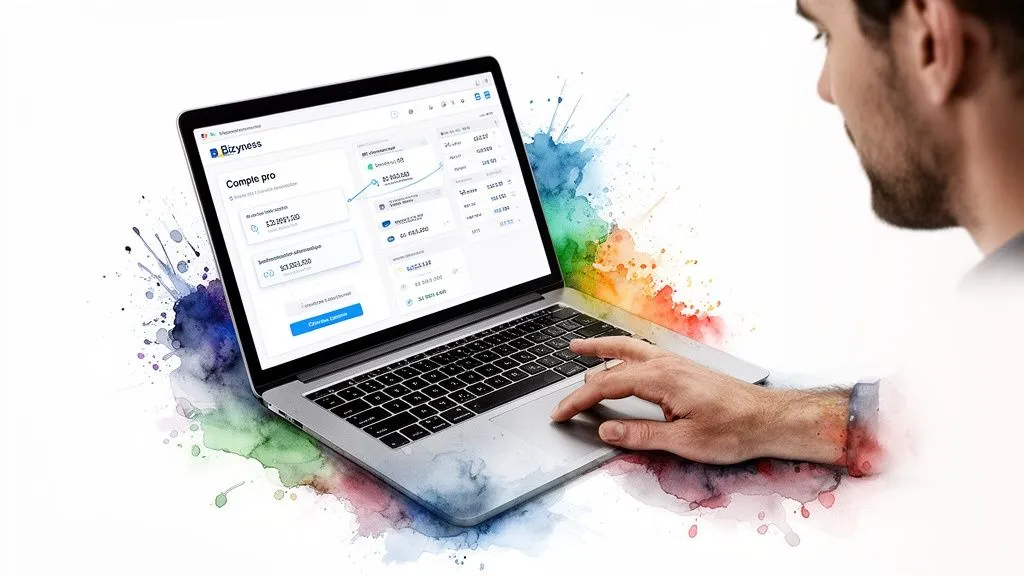
Connecting your business account to a management tool like Bizyness completely changes the game. Thanks to bank synchronization, every transaction is imported automatically and securely. Say goodbye to manual entry, oversights, and errors that waste a huge amount of time every month.
This automation is the starting point for much healthier management. Imported transactions can be instantly linked to your invoices and quotes, radically simplifying an often-dreaded task. To fully understand how it works, our guide on automatic bank reconciliation explains in detail how this technology makes your accounting more reliable.
The concrete benefits of integration
The effect on your day-to-day management is immediate and very real. You gain clarity and efficiency on several fronts:
- Real-time visibility: Your financial dashboard is always up to date, effortlessly. You know exactly where your cash flow stands, which helps you make better decisions and anticipate more effectively.
- Hassle-free pre-accounting: Transactions are categorized automatically. This preparatory work greatly simplifies life for your accountant, resulting in fewer back-and-forths and potentially lower fees.
- Lighter administrative management: The ecosystem can go beyond simple accounting. To optimize financial management and streamline processes, it’s worth looking at how to integrate payroll management solutions easily.
Bank synchronization is much more than a simple time saver. It turns an administrative burden into a genuine strategic asset. You get a precise overview to run your business with peace of mind.
By connecting your account, you’re not just simplifying your day-to-day life. You’re laying solid, automated foundations to support your company’s growth with confidence.
The questions every entrepreneur asks before choosing a business bank
Choosing a business bank always raises a lot of very concrete questions. Let’s go through the most common ones together so you can make your decision with peace of mind.
Specifically, what documents are needed to open a business account?
The list of documents can vary a bit from one institution to another, but the core requirements stay the same. If you’re a sole trader, a simple ID and proof of registration (your SIRENE registration notice, for example) will generally do.
For a company such as a SASU, EURL, or SARL, you’ll be asked for a few additional documents:
- Your company’s signed articles of association.
- Proof of publication of your legal notice.
- The declaration of the company’s beneficial owners.
How long will it actually take to open my account?
This is where neobanks and online banks score points. With them, opening an account can be incredibly fast, often wrapped up within 24 to 72 hours once your complete file is submitted. At a traditional bank, the process easily stretches to one or two weeks, largely because it almost always involves an in-branch appointment with an advisor.
A quick friendly tip: prepare all your documents in digital format before you start. A complete, well-scanned file is the secret to a smooth, express account opening, especially with online players who automate much of their verification process.
How can I switch business banks without complicating everything?
Switching banks is much simpler than you’d imagine, mainly thanks to the bank mobility assistance service. Your new bank can handle most of the transfer for free, such as migrating your recurring transfers and direct debits. On your end, you’ll just need to communicate your new IBAN to your clients and to URSSAF.
Take your business management to the next level. Bizyness synchronizes your business account, automates your invoicing, and simplifies your pre-accounting so you can focus on what really matters. Discover how Bizyness can transform your daily life at bizyness.fr.
