

 Français
The complete guide to the progress invoice
Master the progress invoice. Our guide explains what it's for, the legal rules, and how to use it to optimize your business cash flow.

Imagine you’re having a house built. Would you pay the entire amount before the foundations are even poured? Of course not. This is exactly the principle behind the progress invoice, also known as a progress billing or milestone invoice. The idea is simple: bill a project as it takes shape, turning one huge final payment into a series of smaller, more manageable, regular installments.
Why the progress invoice is much more than a piece of paper

Don’t think of the progress invoice as a mere administrative formality. It’s a genuine steering tool for the financial health of your long-term projects. It quickly becomes indispensable in sectors like construction, skilled trades, or any service that stretches over months, even years.
This approach changes everything for your cash flow. Instead of crossing your fingers while waiting for the final payment, you benefit from a steady stream of revenue. This regular income lets you calmly cover your running costs: materials to order, wages to pay, subcontractors to settle. In short, you can breathe.
A transparency that builds trust
One of the greatest strengths of this method is the clarity it establishes with your client. Each invoice precisely details the work completed over a given period. The client knows exactly what they’re paying for, which avoids unpleasant surprises and endless discussions at the end of the job. Trust is strengthened as a result.
Progress billing is like an ongoing financial dialogue with your client. It replaces the uncertainty of a single, distant payment with the security of regular installments, based on concrete progress validated by both parties.
This method sets a clear, structured framework from the outset. To be valid, a progress invoice must of course follow certain rules, such as referencing the initial quote, detailing the work completed, indicating the percentage of completion, and of course, the amounts excluding and including VAT. The frequency at which these invoices are issued is agreed in advance, in the contract binding you to your client. For a complete overview, feel free to look into the legal obligations surrounding this type of invoice.
Comparing the progress invoice with a standard invoice
To make things clearer, nothing beats a quick comparison table. It highlights the key differences between a progress invoice and a standard invoice, helping you know which one to use depending on the context.
| Feature | Progress invoice | Standard invoice |
|---|---|---|
| When to issue it? | At key milestones or regular intervals (e.g. monthly) during a long project. | Once, upon full delivery of the goods or at the end of the service. |
| What is the amount? | A fraction of the total project amount, based on the progress of the work. | 100% of the amount agreed for the service or product sold. |
| Main objective | Ensure a steady cash flow and track project progress. | Close a transaction and obtain payment for completed work. |
| Ideal for… | Construction sites, IT projects, long consulting engagements, etc. | Product sales, one-off services, quick repairs. |
This table clearly shows that these two documents don’t play in the same category. Each has its own purpose, suited to quite different situations.
Your benefits at a glance
In short, incorporating progress billing into your practices lets you:
- Secure your cash flow thanks to predictable incoming payments.
- Limit the risk of unpaid invoices, since each stage is validated and paid as it happens.
- Guarantee total transparency for your clients, who track progress in real time.
- Better manage the overall profitability of your projects.
Ultimately, what might seem like an administrative burden turns out to be a powerful lever for ensuring the stability and growth of your business.
Understanding the legal framework and mandatory mentions
A progress invoice is not just a simple piece of paper. It’s a document that legally commits your business and must comply with a number of rules to be valid. Think of it as the official record of a construction milestone: to be beyond dispute, every piece of information must be spelled out clearly.
Neglecting these rules means risking delayed payments, creating tension with your client, or even running into trouble with the tax authorities. Fortunately, these obligations are full of common sense and serve a simple purpose: guaranteeing total transparency between you and your client.
The essential information on your invoice
Every progress invoice must be a sharp, precise snapshot of your project’s progress at a given moment. For it to be compliant, several elements are simply non-negotiable.
Here’s the checklist of mentions to check carefully before every send:
- The identity of both parties: Your company name, address, SIRET number, and of course, the same information for your client. No room for imprecision here.
- The numbering and date: Each invoice must have a unique number following an unbroken chronological sequence. The issue date is just as crucial.
- The link to the initial quote: A mention such as “Progress invoice no. X relating to quote no. Y” is essential. It anchors this partial payment to the overall contract your client signed.
- A detailed description of the work: List precisely the services you carried out during the period concerned. The more specific you are, the less room there is for ambiguity or questions.
Think of your progress invoice as an official status report. The clearer and more detailed it is, the less room your client has to interpret or dispute it. It’s a genuine mark of professionalism that secures your business relationship.
To dig deeper into the topic, feel free to check out our complete guide on mandatory mentions on an invoice. It covers every legal aspect to guarantee flawless compliance.
The figures: the heart of your invoice
Beyond the administrative information, the financial section is obviously what matters most. This is where rigor is your best ally.
You must absolutely include:
- The percentage of completion: This is the figure that justifies the amount you’re claiming. It must reflect the actual progress of the work, ideally validated in advance with the client.
- The amounts excluding and including VAT: Clearly break down the pre-tax amount of the services, the applicable VAT rate, the VAT amount, and the total including all taxes.
- The overall financial summary: This is essential for visibility. Indicate the total contract amount, the sum of previous invoices already paid, and the balance that will remain due after this new installment.
Managing the retention guarantee
In construction, this is a very common practice. The retention guarantee (retainage) is a sum, legally set at 5% of the total project amount, which your client withholds to cover themselves in case of defects discovered upon completion of the work.
This retention must be clearly stated on each progress invoice. You deduct it from the amount payable on each interim invoice. Only at the very end of the project, once the reserves are lifted, can you invoice this amount and recover it. Precise management of this line item is therefore vital to avoid unpleasant cash-flow surprises at the end of the project.
How to create a progress invoice, step by step
Drawing up a progress invoice may seem daunting, but it’s actually a very logical process. It simply involves translating the concrete progress of your work into a clear, accurate financial document. To avoid misunderstandings and get paid quickly, the best approach is to follow a rigorous method.
Let’s break down the process together, from gathering information on site to sending the final document. Each step is essential to ensure your invoice is compliant and your billing is clear.
This infographic summarizes the three key moments well: first, you gather the information, then you calculate progress, and finally, you generate the document.
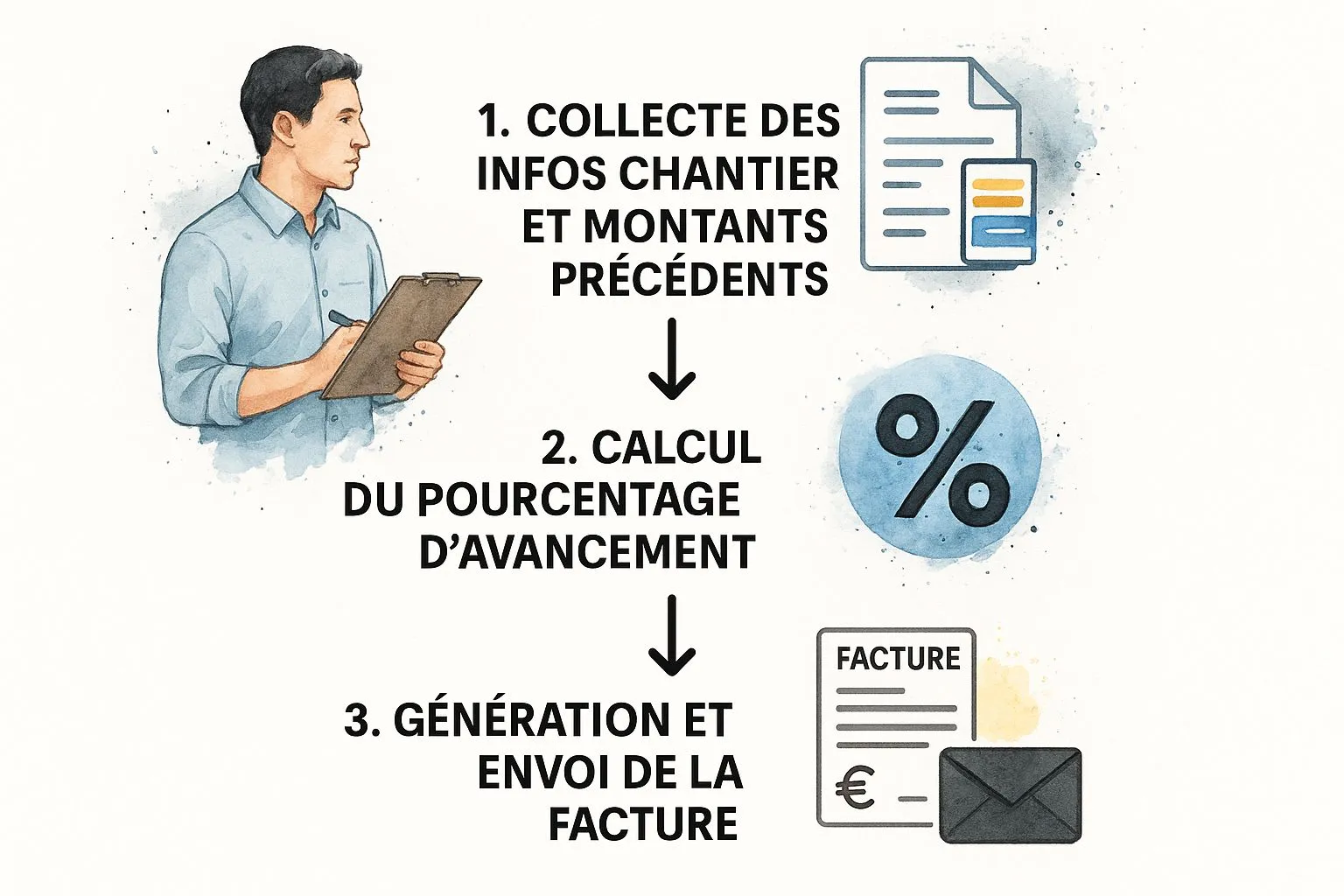
As the image shows, everything starts with rigorous information gathering. This is the foundation of accurate, hard-to-dispute billing.
Step 1: Assess the actual progress of the work
This is the starting point, and arguably the most important: objectively determining the project’s percentage of completion. Forget rough estimates. Your calculation must be based on observable facts and, ideally, validated with your client, for example during a site meeting.
Several methods are available to you:
- By quote line item: You assess the percentage completed for each line of your initial quote (for example: masonry at 80%, plumbing at 50%).
- By agreed phases: If the project is broken down into major stages (phase 1, phase 2…), you invoice as soon as a phase is completed and validated.
- Pro rata to time spent: Very common for service work, you bill based on the hours or days worked relative to the total estimated.
The key is transparency. Your client must understand and accept your calculation method. That’s the best way to avoid disputes and disagreements.
Step 2: Draft the body of the invoice
Once you’ve calculated progress, it’s time to draft the document. Simply use the signed quote as a base and structure your progress invoice clearly.
Your document must absolutely contain:
- A reference to the initial quote: Clearly state the number of the quote or contract concerned. This is the contract that binds you.
- A breakdown of the services: List the work completed during the period you’re billing for, specifying the percentage of completion for each line.
- The amount calculation: For each line, apply the percentage of completion to the total amount of the service to obtain the amount due for the period.
Think of your progress invoice as an itemized activity report. Each line should tell part of the project’s story and justify the payment you’re requesting. It’s a genuine proof of professionalism that strengthens trust.
This rigor in drafting is essential, whether you run a construction SME or work as a freelancer. In fact, if you’re self-employed, our dedicated guide will help you learn how to create a sole trader invoice that follows all the rules.
Step 3: Calculate the final amount due
The final calculation is the summary step. It must be flawless. Don’t just add up the services for the period; present a complete financial summary that gives your client an overall view.
Here’s the breakdown to present, in order:
- Total contract amount (excl. VAT): Recall the total value of the project.
- Cumulative progress amount (excl. VAT): Calculate the total amount of work completed from the start up to the invoice date.
- Amount of previous progress invoices (excl. VAT): Deduct the sum of all progress invoices already issued.
- Amount of the current progress invoice (excl. VAT): This is the result of the subtraction (cumulative progress minus previous invoices).
- Applying VAT: Apply the corresponding VAT rate to the current invoice amount.
- Deducting the retention guarantee (if applicable): If your contract includes a retention guarantee, often 5%, this is where you deduct it from the total amount including VAT.
The result gives you the “net amount due” from your client for this period. By presenting things this clearly, you anticipate questions and speed up payment.
Put theory into practice with our progress invoice templates
Knowing what a progress invoice is, is one thing. Knowing how to create one quickly and without errors is even better. To save you from starting with a blank page and spending hours aligning everything in a spreadsheet, we’ve prepared ready-to-use templates.
These progress invoice templates, available in Word and Excel, are designed to be professional, clear, and fully compliant with regulations. All you have to do is choose the format that suits you best and customize it.

Tools designed for your day-to-day reality
Whether you’re a building tradesperson, a construction project manager, or a service provider on long engagements, your needs aren’t quite the same. That’s why our templates are flexible and adapt to different contexts.
To guide you step by step, each template comes with annotations. They explain what each field is for, from mandatory legal mentions to the precise calculation of progress. The idea is to give you the confidence you need to fill in your invoice without ever second-guessing yourself.
Relying on a well-designed template isn’t a sign of weakness, it’s proof of efficiency. You save precious time and secure your billing on a structure that has proven itself. This leaves you more energy to focus on your core business.
The life cycle of a progress invoice: a concrete example
To make things clearer, let’s take the example of a kitchen renovation project with a total budget of €10,000 excl. VAT. Here’s how the billing might unfold:
- Progress invoice no. 1 (30% completion): Demolition is done, the new plumbing is installed. You issue a first invoice for €3,000 excl. VAT.
- Progress invoice no. 2 (70% cumulative completion): The kitchen units and countertop are installed. You bill the new increment, i.e. 40% of the project, for an amount of €4,000 excl. VAT.
- Final invoice (100% completion): The finishing touches are done, and the client has accepted the completed work. It’s time to issue the final invoice for the remaining 30%, i.e. €3,000 excl. VAT. This last invoice settles the accounts and officially closes the project.
This breakdown lets you secure your cash flow at every major milestone, it’s as simple as that.
Checklist for a compliant progress invoice
Before clicking “send,” one last look is always a good idea. To help you, here’s a short checklist to make sure you haven’t forgotten anything essential. A clear, complete invoice is the best guarantee of getting paid faster.
| Item | Status | Important note |
|---|---|---|
| Reference quote number | ☐ | Essential — it’s the contract that binds you to your client. |
| Progress of work (%) | ☐ | The percentage must be clear, justified, and reflect the reality on site. |
| Financial summary | ☐ | The total project amount, what has already been billed, and the balance still due. |
| Details of the services covered | ☐ | Be precise about the tasks completed that justify this invoice. |
| Complete legal mentions | ☐ | Check your company’s information and the client’s (address, SIRET, etc.). |
With these templates on hand and this checklist in mind, you have everything you need to manage your progress invoices professionally. It’s a big step toward calmer, better-controlled business management.
Steer your cash flow with progress billing

The progress invoice is much more than just a line on your administrative to-do list. It’s a genuine strategic lever that can change the game for the financial health of your project and your business. Its great advantage? Turning a single, often distant and uncertain, cash inflow into a series of regular, predictable payments.
By issuing a progress invoice every month or at the end of a key milestone, you establish a steady cash flow. This regular inflow is what lets you fund the project as it progresses: paying for materials, wages, subcontractors… No more of those “cash-flow dry spells” that can endanger even the most solid businesses on paper.
Anticipating for better financial control
This way of billing gives you a level of financial visibility you’d never otherwise have. Rather than flying blind while waiting for the final payment, each progress invoice becomes a milestone, a reliable marker of what’s coming into the till. As a result, you can plan your investments, manage your inventory, and anticipate your working capital needs with much greater peace of mind.
In a context where costs can skyrocket, this kind of foresight isn’t a luxury, it’s a necessity. Take energy costs, for example. In 2022, the energy bill for French industrial companies soared to 26 billion euros, an increase of 89% compared to 2019. For more details, INSEE’s analysis of energy in industry is very insightful. Just as these companies need to plan for their expenses, you need to secure your revenue.
Thinking of progress billing as a financial GPS for your projects is a fitting image. Instead of waiting to reach your destination to know where you stand, you get regular checkpoints confirming that everything is on track, both on site and in the books.
An asset for negotiation and trust
Building progress billing into your contracts also strengthens your business position. Proposing a clear payment schedule upfront, tied to actual progress, is proof of professionalism and transparency. It’s a gesture that reassures your client considerably and can help you secure better payment terms.
Finally, let’s not forget that this method is an excellent tool for tracking the profitability of your projects in real time. This is a crucial aspect of running your business effectively. If financial management interests you, our article on tax optimization for sole traders could give you other useful pointers.
Frequently asked questions about the progress invoice
Even after a thorough overview, the progress invoice can still raise a few questions. That’s perfectly normal. Let’s dive together into the most common questions to clear up any remaining gray areas.
The idea is to give you clear, directly applicable answers so you can manage your billing with confidence, whether it’s about distinguishing between accounting documents or dealing with a disagreement with a client.
Progress invoice or deposit invoice: which one should you choose?
This is a common point of confusion. Both documents allow you to collect money before a project is finished, but they play very different roles.
A deposit, is a bit like a reservation payment. It’s a fixed percentage of the total amount, paid before the very first bit of work begins. It serves to seal the agreement and officially commit both parties. It’s simply an advance on the overall amount.
The progress invoice, on the other hand, is quite different. It doesn’t correspond to an advance, but rather to payment for work that has already been carried out and validated at a specific point in time. In short, the deposit secures the start of the project, while the progress invoice pays for what has actually been accomplished along the way.
Can you issue a progress invoice without a prior quote?
The answer is a categorical no. It’s more than a bad idea, it’s a risky practice to avoid at all costs. A progress invoice doesn’t exist in a vacuum; it’s directly tied to an initial contract, which is almost always a detailed quote, dated and signed by your client.
Without a quote or contract to serve as a reference, your progress invoice has no legal value. The quote is your shared roadmap: it defines the scope, prices, deadlines… It’s this document that allows you to objectively measure and justify the progress of the work.
Trying to issue a progress invoice without this contractual foundation exposes you to an almost certain dispute. Your client would be entitled to challenge the amounts, and they’d be right to. Think of the quote as your best insurance policy.
How do you handle VAT on this type of invoice?
Value Added Tax (VAT) is handled in exactly the same way as on a standard invoice. You must include it on every one of your progress invoices.
The principle is simple: you calculate the pre-tax (excl. VAT) amount of the services performed during the period concerned, and apply the applicable VAT rate to it. This collected VAT must then be declared and remitted to the tax authorities, in accordance with your tax regime. The very final invoice, the balance invoice, will summarize the total VAT paid throughout the project.
What should I do if my client disputes the level of progress?
A disagreement over progress is a classic situation. No need to panic. The first step is always discussion. Pick up the phone or, even better, propose a meeting on site. The goal is to assess together, quote in hand, where things stand and understand what’s causing friction.
If the conversation doesn’t resolve the situation, put things in writing to formalize the exchanges. If the sticking point persists, calling in an independent expert or a mediator can be a wise decision. The most important thing is to document everything and, if necessary, pause the disputed portion of the work until a solution is found.
Simplify your life and the creation of all your invoices, including progress invoices, with Bizyness. Our tool automates your billing, handles VAT for you, and gives you a clear view of your cash flow. Free yourself from admin work to focus on your core business. Discover how Bizyness can transform your management today.
