

 Français
 Purchase order guide: practical and legal aspects
Learn everything about purchase orders: legal value, mandatory information and tips to manage them efficiently and secure your sales.
A purchase order is much more than a simple piece of paper. It’s the document that turns a discussion or verbal agreement into a solid commercial commitment. Concretely, it’s the buyer who sends it to the seller to say: “OK, it’s confirmed, I want to buy this, at this price and under these conditions.”
This document lists everything in minute detail: the nature of the products or services, the exact quantities, and the price everyone has agreed on. You could say it’s the materialization of a handshake, a contract that puts the terms of the exchange in writing.
Understanding the essential role of the purchase order

Don’t see it as a mere administrative formality. The purchase order is a true cornerstone of your business relationship. It comes right after the negotiation phase (often initiated by a quote) and just before you start preparing the delivery and the invoice. It’s the document that officially kicks off the sale.
Think of it as a house’s construction blueprint. Before laying the first brick (the delivery), the architect (the seller) and the homeowner (the buyer) validate every detail on the plan: the number of rooms, the materials, the total cost… This plan ensures everyone is on the same page and that there won’t be any unpleasant surprises once the work is done.
Securing the transaction for each party
The purchase order isn’t there to serve just one person; it protects both the seller and the buyer. It’s a token of mutual trust.
For the seller, it provides real security:
- It’s a firm, written confirmation of the order, which greatly limits the risk of the client changing their mind at the last minute.
- It constitutes solid legal protection if a disagreement arises later over the products or the pricing.
- It’s also a valuable tool for managing inventory and planning production.
And for the buyer, the benefits are just as clear:
- They have the guarantee that the negotiated conditions (price, quantity, etc.) will be honored.
- They hold proof of their order, essential for internal tracking and accounting.
- Expectations are clearly defined, which avoids misunderstandings about deadlines or the content of the service.
The purchase order is the first step toward calm, professional sales management. It clarifies expectations, prevents disputes, and turns a simple discussion into a mutual, documented commitment, well before the final invoice is issued.
In short, knowing how to create and manage your purchase orders is a key skill for structuring your business. This preventive document lays healthy foundations, ensures total clarity, and reduces the risk of friction, allowing everyone to work with peace of mind.
What is the legal value of a purchase order?
A signed purchase order isn’t just another piece of paper in your books. It’s much more than that. In France, as soon as both parties have validated it, this document becomes a genuine contract. It seals the commercial agreement and gives it legal force.
Think of it as concrete proof of each party’s commitment. It’s a bit like signing a lease for an apartment: the landlord must provide you with the housing, and you must pay the rent. For a sale, the principle is exactly the same.
It turns into a proper contract
Everything often starts with a proposal, usually a quote. When your client accepts it by sending back a signed purchase order, you agree on two essential things: “the thing and the price.” This act, simple as it may seem, gives rise to what lawyers call a synallagmatic contract.
The term may sound intimidating, but the idea is simple: it’s a contract where each party has obligations toward the other.
- For you, the seller: You are legally required to deliver the product or perform the service, in accordance with everything that was agreed: quality, quantity, deadlines…
- For your client, the buyer: In return, they commit to accepting delivery and, of course, paying the full amount under the conditions you set.
It’s this reciprocity that gives the purchase order its full strength. No one can back out without risking legal action.
Signing a purchase order is not a mere formality. It’s the precise moment when the sale is legally concluded. This document materializes the agreement and will serve as a reference should anything go wrong.
And if one party doesn’t hold up their end?
A signed purchase order is a serious commitment. If one of you fails to honor their part of the contract, the other has concrete means to defend themselves.
Let’s imagine a classic case: you deliver goods that are perfectly compliant, but your client refuses to pay. With the signed purchase order in hand, you have irrefutable proof of the agreement. You can then take action:
- Formal notice: A registered letter with acknowledgment of receipt to officially demand payment. This is the first step, and it’s often enough.
- Payment order (injonction de payer): If that’s not enough, it’s a simple, fast legal procedure to obtain a court decision compelling your client to settle their debt.
- Legal action: As a last resort, you can bring the case before the commercial court to force performance of the contract and even claim damages.
And it works both ways! If you fail to deliver on time or the service isn’t compliant, your client can rely on that same purchase order to demand that you keep your promises, negotiate a discount, or even cancel the sale.
The economic weight of purchase orders
The importance of this document can also be measured on a large scale, especially in the public procurement sector. Trying to estimate the total volume of purchase orders issued in France each year is a real headache. The figures vary enormously. A Senate report already spoke of a “statistical black hole.” INSEE estimated it at 235 billion euros, but other analyses, including all sectors, suggest the amount could approach 500 billion euros per year. You can dig further into the transparency of public procurement in France to see the scale of the phenomenon.
These staggering figures show just how crucial it is for every entrepreneur to master this tool. At its core, the purchase order isn’t a constraint but your best ally. It protects your cash flow, sets clear terms with your clients, and gives you the legal security needed to grow your business with peace of mind.
Mandatory and recommended information: drafting your purchase order correctly
To be truly effective, a purchase order must be much more than a simple formality. It’s a genuine legal fortress for your business. Every missing piece of information can turn into a source of dispute. That’s why the law requires a core set of essential information, while business experience recommends adding more to head off problems.
Think of this document as your transaction’s ID card. It must instantly answer key questions: Who is selling? Who is buying? What? For how much? And under what conditions? Forgetting even one of these elements leaves the door open to misunderstandings and complications.
The essential foundations: what the law requires
The law is very clear about the information that must absolutely appear on your commercial documents. These details aren’t negotiable; they guarantee the legal validity of the agreement. They’re very similar to those found on other documents, and for good reason: they ensure the clarity and traceability of the exchange. If you want to dig deeper, our guide on the mandatory information on a quote is an excellent complementary read.
Here’s the basic checklist you must scrupulously follow:
- The identity of both parties: The name, address, legal form (SAS, SARL, sole trader/micro-entrepreneur…) and SIREN number of your business, as well as those of your client.
- The document reference: A unique purchase order number for easy tracking and the issue date to mark the starting point of the agreement.
- The order details: A clear description of the products or services so there’s no room for doubt. State the nature, reference, brand, etc.
- The exact quantity: The number of units, the weight, the volume, or the time planned for a service.
- The unit price excluding tax (before VAT): The cost of each item or service before VAT is applied.
- VAT information: State the applicable VAT rate(s) (20%, 10%, 5.5%…) and the total tax amount. If you’re not liable for VAT (as with a micro-entrepreneur), you must state this with the appropriate legal wording.
- The total amount due (excluding and including tax): The client must be able to see the total cost before and after tax at a glance.
- The delivery date or timeframe: Be realistic and set a clear expectation for receiving the goods or completing the service.
Recommended clauses to reinforce your agreements
Beyond the strict legal framework, a few well-thought-out clauses can turn a standard purchase order into a genuine commercial shield. They help anticipate problems and clarify the rules of the game, often to your advantage.
Adding recommended clauses is a bit like taking out optional coverage on an insurance policy. You hope you never need it, but the day a problem arises, it can save you from a very costly and complicated situation.
These additions, while not mandatory, are a sign of great professionalism and can spare you a lot of headaches.
To help you see things more clearly, let’s compare mandatory information with what’s simply recommended but very useful.
Comparison table: mandatory vs recommended information on a purchase order
This table compares the information legally required on a purchase order with what, while optional, is strongly advised to secure the transaction.
| Type of information | Example | Mandatory or Recommended | Why does it matter? |
|---|---|---|---|
| Identification | Name, SIREN, address of the seller and buyer | Mandatory | Ensures legal validity and clearly identifies the parties. |
| Product description | ”1 x Ergonomic office chair, Ref. CH-01” | Mandatory | Avoids any confusion about the subject of the sale. |
| Price and VAT | Unit price excl. tax, 20% VAT rate, Total incl. tax | Mandatory | Financial clarity, essential for accounting and the client. |
| Payment terms | ”30% deposit on order, balance due within 30 days” | Recommended | Secures your cash flow and sets clear expectations. |
| Late payment penalties | ”Penalty rate of 3x the legal interest rate” | Recommended | Discourages late payers and protects you legally. |
| Retention of title clause | ”Goods remain our property until paid in full” | Recommended | Lets you recover your goods if the client doesn’t pay. |
| Reference to terms and conditions | ”Signature constitutes acceptance of our terms and conditions available overleaf” | Recommended | Makes your terms and conditions enforceable against the client. |
In short, the mandatory information forms the legal basis of your document, while the recommended information acts as the safeguards that protect your business day to day.
Protect your cash flow and your goods
Here are a few smart clauses to add to your purchase order templates without delay:
- Payment terms: Don’t stop at the amount. Specify how and when the client must pay. By bank transfer? By check? Is a 30% deposit required to launch the order? Is the balance due on delivery or within 30 days? Every detail matters.
- Late payment penalties: This is a powerful deterrent. State in black and white the consequences of late payment, while staying within the legal framework (interest rate and fixed compensation).
- The retention of title clause: If you sell physical goods, this clause is your best friend. It states that you remain the owner of the goods until they are paid for in full. If something goes wrong, it gives you the right to recover your stock.
- Cancellation conditions: Define the rules if the client changes their mind. What are the deadlines? Are there fees? This is the best way to avoid endless discussions and abuse.
- Reference to the Terms and Conditions of Sale: This is probably the most important item. State that signing the purchase order constitutes acceptance of your terms and conditions, and specify where to find them (on the back of the document, via a link…). This is the document where all the details of your commercial policy are laid out.
Quote, purchase order, invoice: each document has its role
In the life of a business, commercial documents follow one another like scenes in a play. Quote, purchase order, invoice: each has its own role and comes into play at a very specific moment. Mixing them up risks misunderstandings with your clients, payment delays, or even weakening your position in the event of a dispute. That’s why understanding their logical sequence is a real pillar of sound, professional management.
Think of this process as a well-oiled conversation in three steps. The quote is the initial question: “Shall we work together on these terms?” The purchase order is the firm, definitive answer: “Yes, I agree, let’s go!” The invoice, finally, is the logical conclusion: “Mission accomplished, here’s what you owe me.”
Each document marks a turning point in the client relationship, moving a simple proposal to the status of a completed and paid transaction.
The quote: the first point of contact
Almost everything starts with a quote. Careful, this document is not a contract, but a formal commercial proposal. It must be clear and detail what you’re selling (products or services), at what price, and under what conditions (delivery timeframes, offer validity period, etc.).
Legally, its scope is limited. As long as the client hasn’t signed it, it commits no one, neither you nor them. It’s an invitation, a door open to negotiation. Your client can accept it as is, ask for adjustments, or simply decline it.
The purchase order: the official commitment
This is where things get serious. Once your client is convinced by the quote, they confirm their agreement by sending back a signed purchase order. This is the pivotal moment. With their signature, the buyer confirms they accept your offer, under the terms you had set.
This document then becomes a contract binding both parties. On your side, you commit to delivering the goods or performing the service. On their side, the client commits to receiving and paying. It’s the act that turns a simple discussion into a contractual obligation.
At this stage, it’s essential not to get confused. To go further on this point, feel free to check out our article breaking down the differences between a quote and an invoice.
The invoice: the signal for payment
The invoice comes at the very end of the process, once the work is done or the products have been delivered. It’s both an accounting and a legal document, proving that your client owes you money. It summarizes what was supplied and officially requests the buyer to settle the amount due.
Unlike the quote and the purchase order, the invoice is a supporting document that you absolutely must keep for your accounting. It’s what triggers the payment deadline countdown and will serve as the basis if you ever need to launch a debt collection procedure.
This infographic perfectly summarizes the difference between the mandatory information and what’s simply good practice to add on a purchase order.
You can clearly see that while the law imposes a common foundation, it’s the clauses you add (such as payment terms) that will really reinforce your transactions day to day.
A mechanism at the heart of the economy
Managing these documents isn’t just an administrative formality, it’s an essential cog in the economy. 2024 was in fact marked by intense activity in the public sector. Between July 2023 and June 2024, French public administrations awarded 186,767 public contracts, representing a total value of 168.8 billion euros. Even though this figure is down slightly, it clearly shows the colossal economic weight of purchase orders and formalized purchasing processes. For those interested, you can explore more details on public procurement trends.
In short, the cycle is simple and clear: the quote proposes, the purchase order commits, and the invoice claims payment. Mastering this sequence isn’t just about being compliant, it’s also about running your business with confidence and peace of mind.
Knowing which document to issue at the right time is a key skill for any entrepreneur. You’ll avoid misunderstandings, secure your cash flow, and strengthen your business’s professional image. Your clients, for their part, will appreciate a clear framework with no unpleasant surprises.
Optimizing your purchase order management with Bizyness
Managing your purchase orders by hand, with spreadsheets or Word documents, is a bit like trying to cross a big city with an old paper map. You can get there, sure, but it’s slow, error-prone, and frankly inefficient. Switching to digital management with a tool designed for it, like Bizyness, completely changes the game. It turns an administrative chore into a smooth, almost automatic process.
The idea isn’t just to replace paper with a screen. It’s about rethinking the whole process to gain speed, reliability, and peace of mind. A good piece of software centralizes all your information, eliminates duplicate data entry, and gives you a clear, real-time view of where things stand.
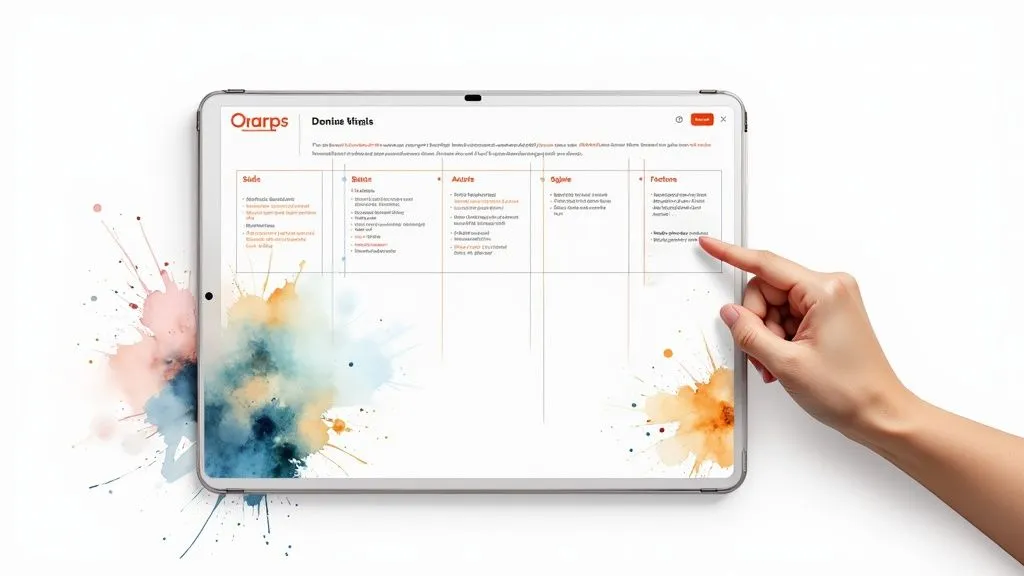
This image sums up the philosophy well: in just a few clicks, the information from a quote is carried over to create an already-filled-in purchase order, ready to send. That’s real optimization: saying goodbye to repetitive tasks to focus on your core business.
From creation to signature in just a few clicks
One of the biggest strengths of a tool like Bizyness is its ability to turn an accepted quote into a purchase order in a single click. No more tedious copy-pasting and the risk of making mistakes when re-entering a price or a reference. All the data — client, items, pricing, terms — is transferred automatically.
Once the document is ready, customizing it is a breeze. You can add your logo, adjust the payment terms, or insert a short note for your client.
But it’s in sending and validation that the time savings are truly spectacular. With Bizyness, you send the purchase order by email directly from the platform, including an electronic signature option. For your client, it’s extremely simple: they receive the document, review it, and sign it online in a few seconds, whether on their computer or their smartphone.
The electronic signature isn’t a gadget. It gives your purchase order genuine legal value while cutting the approval time from several days to just a few minutes.
Centralized tracking so nothing is left to chance
Once your purchase orders are sent, how do you know where things stand? Who has signed? Who needs a follow-up? Without a good tool, you quickly find yourself juggling a shaky Excel file or sticky notes everywhere.
With Bizyness, you have a single dashboard showing the status of every document in real time. At a glance, you can see which purchase orders are:
- Pending: sent, but not yet approved by the client.
- Signed: accepted and ready for the next step.
- Invoiced: already converted into an invoice.
- Cancelled: rejected or cancelled for one reason or another.
This visual tracking lets you steer your business with much greater precision. You can anticipate your workload, better plan your deliveries, and immediately spot the bottlenecks slowing down your sales cycle. For truly effective management, more and more businesses rely on software hosted on cloud services suited to businesses.
This centralization of data has, moreover, become the norm, even in the public sector. Since the order of March 22, 2019, and even more so since January 1, 2024, public buyers have had to publish key data about their contracts on open platforms, which clearly shows how important traceability has become.
Converting to an invoice, the finishing touch of automation
The final step, and often the most satisfying one, is turning the signed purchase order into an invoice. This is where automation really shows its value.
In Bizyness, this step is also done in a single click. The software carries over all the information from the purchase order to generate a fully compliant invoice, with a new number and all the required legal notices. This is essential, as it guarantees perfect data consistency from start to finish. Our complete guide on invoicing shows you in detail everything you can do.
The benefits of this approach are clear:
- Considerable time savings: What used to take several minutes now happens instantly.
- Zero risk of error: By eliminating manual entry, you avoid typos in amounts or references.
- Perfect traceability: The link between the quote, the purchase order, and the invoice is recorded, which greatly simplifies your accounting.
- Enhanced professionalism: Sending an accurate, consistent invoice moments after approval speeds up payments and builds your clients’ trust.
Ultimately, adopting a tool like Bizyness isn’t just about managing purchase orders. It’s about optimizing your entire sales process, from the first proposal all the way to payment collection.
Frequently asked questions about purchase orders
Navigating the jungle of commercial documents can quickly become a headache. Even knowing what a purchase order is for, very concrete questions come up day to day. Especially when a hiccup throws a wrench in the works. Let’s untangle together the points that trip you up most often.
This FAQ is here for exactly that: clear, direct answers for the situations you encounter every day. The idea is to give you the right reflexes to react professionally and stay on solid legal ground.
Is a signed purchase order really mandatory?
From a purely legal standpoint, the answer is no, not always. Between professionals, a spoken word or a simple email exchange can be enough to seal an agreement. This is the principle of consensualism. Except, of course, for certain heavily regulated sectors or high-value contracts where a written document is required as proof.
But commercially, that’s a different story. A signed purchase order is simply essential. Doing without it is a bit like starting to build a house without having approved the plans: a very risky bet. It’s black-and-white proof that everyone agrees on the service and the price.
Without this document, how do you prove what was agreed if your client disputes it? It solidifies the transaction, protects your cash flow, and gives your business a much more professional image. Treating it as a mere option would be a beginner’s mistake.
What to do if a client doesn’t pay after signing?
A signed purchase order is a firm commitment to pay you. If your client turns a deaf ear, you’re not without options. The trick is to escalate gradually to maximize your chances of recovering your money.
Here’s the step-by-step approach:
- A friendly reminder: A simple phone call or a polite email is often enough. It happens, people forget. Stay courteous, but firmly restate the deadline.
- A reminder letter: If the first attempt goes unanswered, put it in writing. First a simple letter, then a registered letter with acknowledgment of receipt, restating the payment obligation and enclosing a copy of the signed purchase order.
- Formal notice: This is the final warning before things get serious. This letter, sent by registered mail with acknowledgment of receipt, sets a final deadline for payment. From this point on, late payment penalties officially start accruing. The purchase order is your key piece of evidence.
If, despite all this, payment still doesn’t arrive, you can then launch a judicial debt collection procedure, such as a payment order. Before a judge, the purchase order will be your number-one piece of evidence of good faith.
Faced with an unpaid invoice, a signed purchase order is not just a piece of paper. It’s your legal shield, the argument that turns a simple request into a legitimate, undisputable debt.
Can a signed purchase order be cancelled?
Once signed, a purchase order carries the value of a contract. Cancelling it isn’t as simple as snapping your fingers. It all depends on the context and, above all, on who your client is.
-
For an individual client (B2C): The law protects them. They have a 14-day right of withdrawal for any purchase made remotely (online, by phone) or outside your shop. Once this period has passed, they can no longer back out, unless you yourself failed to honor your commitments (major delivery delay, non-compliant product…).
-
For a business client (B2B): Here, the rules change. The right of withdrawal doesn’t exist between professionals. Cancellation is only possible if your own Terms and Conditions of Sale allow it. It’s up to you to set the rules of the game: cancellation possible within X days for a fee, or cancellation simply not possible once production has started.
If your terms and conditions are silent on the matter, then the client is legally bound and cannot back out. Of course, a friendly agreement is always possible, but you’re fully entitled to ask for compensation for the time lost and the costs incurred.
Don’t let paperwork hold back your growth any longer. With Bizyness, create, track, and convert your purchase orders into invoices in just a few clicks. Discover how to simplify your management today.
