

 Français
Quote vs. invoice: understanding the difference quickly
Quote vs. invoice: learn what sets them apart and how to use them correctly in your business.
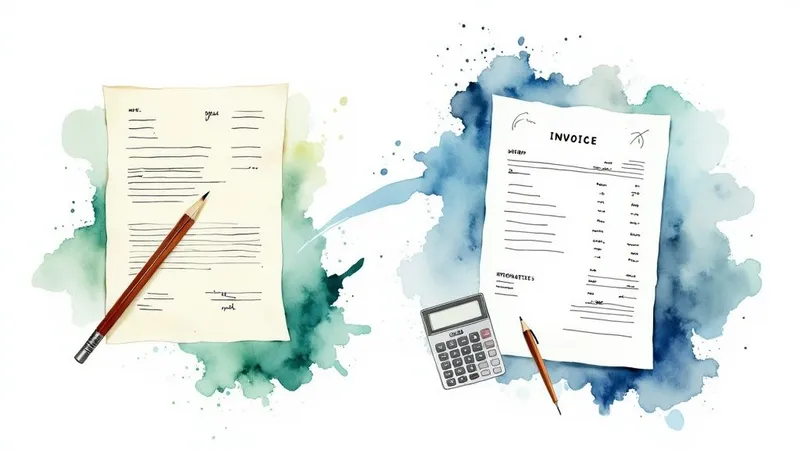
For any budding entrepreneur, grasping the difference between a quote and an invoice is one of the first rules of the game. It’s an essential foundation. To put it simply, imagine the quote as a restaurant menu: it shows you the dishes and their prices before you’ve even ordered anything. The invoice, on the other hand, is the bill brought to you at the end of the meal — the document asking you to pay.
Understanding the fundamental distinction between a quote and an invoice
A quote is, above all, a proposal — a commercial offer that secures a future transaction. It precisely details the services or products you’re offering, along with an estimated price. This document only commits your client once they’ve signed it, often with the note “approved”. At that point, and only at that point, it turns into a genuine contract.
The invoice, on the other hand, comes much later in the process. It’s an accounting document that closes out the transaction. It proves that the service was actually performed or the product delivered, and it creates a payment obligation for your client. For you, it’s a cornerstone of your bookkeeping and cash flow management.
The role of each document
To picture the journey of a sale, it helps to see that each document has its own role, at a very specific moment:
- The quote opens the dance. It initiates the business relationship. It sets a clear framework for discussing, negotiating, and ultimately agreeing on the terms of the project, which avoids plenty of misunderstandings down the line.
- The invoice closes the exchange. It formalizes the end of the engagement, serves as legal proof of what the client owes you (your receivable), and forms the basis for calculating VAT and tracking your revenue.
This distinction really sits at the heart of sound business management. In France, the difference between a quote and an invoice is defined by their functions and their legal obligations. The quote is often optional (except in certain sectors) and is used to propose a price before work begins. The invoice, meanwhile, is a legally mandatory document issued after the service, attesting to the client’s debt. You can find more details on invoicing obligations on Quadient.com.
In short: the quote proposes, the invoice demands. One is a kind of handshake sealing an agreement, the other is the official conclusion that triggers payment.
The infographic below shows you at a glance this key difference between the proposal phase (the quote) and the payment request (the invoice).
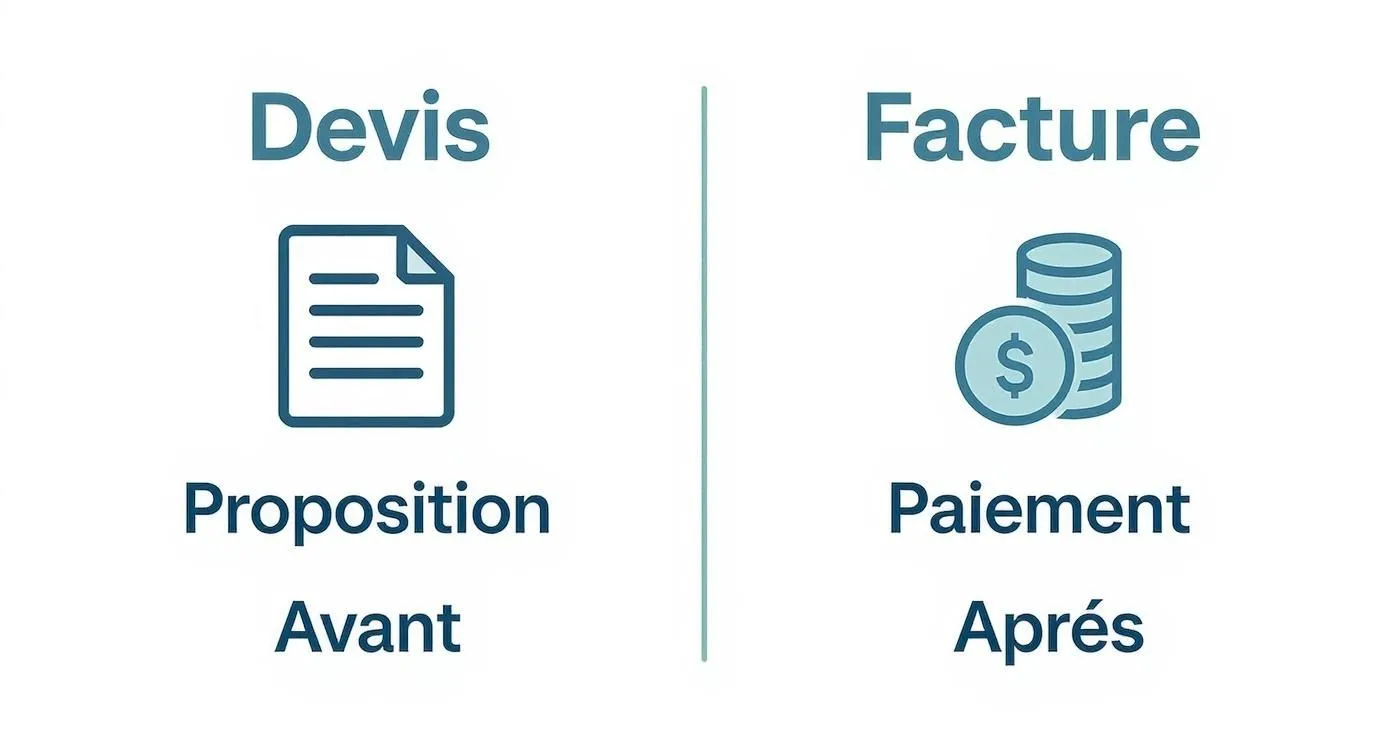
It’s very clear that the quote always sits before the service, while the invoice always comes after. This is what marks the shift from a simple commercial agreement to a genuine financial obligation.
To sum it up even more clearly, here’s a quick recap table.
Quick comparison table: quote vs. invoice
This table summarizes the fundamental differences between these two documents essential to your business.
| Criterion | Quote | Invoice |
|---|---|---|
| Timing of issuance | Before the service or sale | After the service or sale |
| Main purpose | Propose a detailed commercial offer | Request payment of a receivable |
| Legal value | Becomes a contract once signed | Accounting document and legal proof |
| Mandatory nature | Often optional (mandatory above certain amounts/in certain sectors) | Always mandatory (with few exceptions) |
| Consequence | Commits both parties to the terms of the contract | Creates a payment obligation for the client |
This visual summary will help you never confuse the two again and use the right document at the right time.
The quote: far more than a price, a commitment that secures your sales
Don’t think of the quote as a mere formality. It’s a genuine sales tool, the cornerstone of your client relationship. Think of it as a roadmap: it details your offer, sets a framework of trust, and gets everyone on the same page about the rules of the game. In short, it’s what turns a promising conversation into a well-defined project.
The big difference from an invoice is timing. The invoice comes after the fact, to record what has been done and paid for. The quote, on the other hand, lays the groundwork. Its role is to clarify everything upfront for the client: the nature of the services, their scope, and of course, their cost. It’s a sound basis for discussion that avoids misunderstandings and unpleasant surprises.
When does a quote become a legal obligation?
Often, offering a quote is simply a sign of professionalism. But be careful, in certain cases the law requires it. The goal is simple: to protect the consumer, especially when the price of a service is hard to estimate upfront.
The law requires a quote notably for:
- Repairs and building work: as soon as the estimated amount exceeds €150 including tax. This applies to trades such as plumbing, electrical work, or masonry.
- Personal services: for any service exceeding €100 including tax per month.
- Certain healthcare services: for example, hearing aids or optical medical equipment.
Even if you don’t fall into one of these cases, make it a habit to issue one anyway. It’s a professional reflex that reassures your clients enormously and secures your future collaboration by putting it in writing.
The details you must never forget on a rock-solid quote
For a quote to hold up legally, it must contain a series of key pieces of information. The slightest omission could render it void in the event of a dispute, so rigor is your best ally.
A quote isn’t just a price list. It’s a genuine pre-contract. Once signed, it commits your business and your client to the nature and cost of the service. It’s a legal act.
Here are the essential elements to include:
- The heading “Quote” or “Commercial proposal” in large print, at the top of the document. No room for doubt.
- Your company details: name, legal name, address, and of course your SIREN/SIRET number.
- Your client’s details: their name and address.
- The issue date and the validity period of your offer (generally between 1 and 3 months).
- The detail of each service: line by line, with quantity and unit price (before tax).
- The totals: the amount excluding VAT and including all taxes, clearly stating the VAT rate(s) applied.
- The schedule: the start date and estimated duration of the work or delivery.
To make sure you don’t leave anything to chance, take a look at our full guide on the mandatory details on a quote.
The magic moment: when a quote turns into a contract
This is where the full power of the quote reveals itself. When your client puts down their signature, ideally with the handwritten note “Approved” or “Quote received before work begins”, the document completely changes nature. It’s no longer a proposal — it’s a fully-fledged contract.
From that moment on, things are clear. You commit to carrying out the service under the agreed conditions, and your client commits to paying you the agreed amount. It’s this signature that protects you against last-minute changes of mind and guarantees your payment.
The invoice: the key document in your bookkeeping

If the quote was the promise, the invoice is its fulfillment. Once your work is complete, this document takes over to formalize the transaction and, above all, to trigger your payment. Its role is twofold, and it’s fundamental to the health of your business.
On one hand, the invoice is an absolutely essential accounting record. It proves your revenue, forms the basis for your turnover declaration and, if applicable, for VAT calculation. On the other hand, it’s legal proof of the debt your client owes you. It’s the act that turns a service or a sale into a legally recognized right to payment.
Needless to say, rigor is a must. A poorly drafted or incomplete invoice can not only delay payment but also cause you trouble with the tax authorities.
The mandatory details for a properly drafted invoice
Unlike the quote, which offers a certain amount of flexibility, the invoice is governed by very strict rules. Every piece of information matters, and a single omission can render the document void in the eyes of the law. To make sure it’s valid, check that all of the following elements appear on it.
Here’s the list of essential information:
- The word “Invoice” must appear clearly in the header, without ambiguity.
- A unique invoice number following a logical, unbroken sequence (for example: INV-2024-001, INV-2024-002…).
- The issue date of the invoice.
- Your full contact details and those of your client (name, address, SIRET number for professionals).
- The detailed description of the services or products sold, matching what was agreed in the quote.
- The total amounts excluding VAT and including all taxes, clearly stating the VAT rate applied to each line.
For a point-by-point breakdown of every requirement, feel free to check out our full guide on the mandatory details on an invoice.
Payment terms: the crux of the matter for your cash flow
One key point radically distinguishes the invoice from the quote: it introduces the notion of a payment deadline. This is the date by which your client must have paid you. It’s a crucial element for your cash flow, and it must be clearly stated in writing.
An invoice isn’t just a summary. It’s an official payment order that protects your business in the event of a dispute or late payment.
Be sure to also include the late payment penalties that will apply in the event of non-payment by the due date. This is a mandatory mention that has a real deterrent effect and gives you legal recourse. Late payments are a scourge for small businesses; nearly 25% of business failures in France are directly linked to these cash flow issues.
To put it simply, the difference between a quote and an invoice is this: the quote proposes and seals an agreement, while the invoice confirms that the work is done and demands payment. Impeccable invoice management is therefore the best guarantee of a healthy client relationship and a solid financial position.
How to turn a quote into an invoice without making mistakes

The quote is signed, the work is done. Well done! All that’s left is to get paid. You might think turning a quote into an invoice is child’s play, but it’s a step that requires absolute rigor to avoid mistakes that would delay your payment.
The classic mistake? Simply changing the document’s title, replacing “Quote” with “Invoice”. This is a very bad habit that can quickly cause chaos in your bookkeeping. An invoice is a full-fledged accounting document, with its own lifecycle.
The right approach is to create a new document. It will of course carry over all the information from the approved quote, but it will also have its own mandatory details.
The step-by-step process
For everything to be in order, the conversion must follow a clear logic. The key word is consistency. Your invoice must be a perfect reflection of what your client signed, unless adjustments were agreed upon together along the way.
Here’s how to make the transition smoothly:
- Create a new invoice based on your quote. Most management tools, like Bizyness, do this for you in a single click. It’s magic.
- Give it a unique invoice number. This number must follow your own sequence (for example, INV-2024-056) and be different from the quote’s number. Don’t mix things up.
- State the issue date of the invoice. This is what starts the clock on the payment deadline.
- Carry over the quote’s information. You transfer the client’s details, the description of services, and the agreed prices exactly as they were. No surprises.
- Add a reference to the original quote. A short sentence like “Invoice following on from Quote No. [quote number]” is enough to link the two and ensure perfect traceability.
The habit to adopt: Never edit a signed quote to turn it into an invoice. Always create a separate document. It’s the only way to keep irrefutable proof of the original agreement and maintain sound bookkeeping.
Handling special cases (which happen all the time)
In real life, a project evolves. Between the moment the quote is signed and the final invoicing, things can change. Let’s look at how to handle the most common situations.
How do you invoice a deposit?
If your quote mentioned a deposit, you must issue a deposit invoice as soon as you receive the payment. This first invoice will have its own number. When it comes to the final invoice, known as the balance invoice, you simply deduct the amount of the deposit already paid.
What if extra services were added?
Did the client ask for a little something extra along the way? You have two options, provided you have their agreement of course:
- Draw up an amendment to the original quote: This is the most formal method. You get this addition approved in writing before including it in the final invoice.
- Add a line to the invoice: You can also clearly detail these “additional services” with their cost directly on the invoice. Transparency is your best ally in avoiding any dispute.
By following this method, the difference between a quote and an invoice stays crystal clear in your day-to-day management. And clear documents mean faster payments.
Quotes and invoices: the practical guide for sole traders
Sole trader (micro-entrepreneur) status is often synonymous with simplified administration, and that’s true! But be careful, “simplified” doesn’t mean “non-existent”. Good administrative management is the foundation of a business that lasts. And it all starts with a solid grasp of the difference between a quote and an invoice.
As a sole trader, you have one major particularity: VAT. Most of the time, you start out under the VAT exemption scheme, meaning you don’t charge VAT to your clients. This information must be crystal clear on all your documents.
The mention that changes everything
On every one of your quotes and invoices, one short sentence is mandatory: “VAT not applicable, art. 293 B of the French Tax Code”. This explains to your client why your prices are shown excluding VAT and keeps you compliant with the tax authorities. Never forget it!
Even with this lighter regime, there’s one golden rule you must never break: keeping your documents.
Properly keeping and tracking your documents
The law is strict on this point. You must keep a copy of all your accounting documents for 10 years. This includes the quotes your clients have signed and, of course, all the invoices you’ve issued. It’s your evidence in the event of an audit, the proof of your income.
To avoid drowning in paperwork (even digital paperwork), a bit of organization is essential:
- Clear numbering: Every invoice must have a unique number following a logical sequence. The simplest approach? A sequence that never breaks, for example INV-2024-001, INV-2024-002, and so on.
- An eye on payments: A simple spreadsheet or a dedicated tool will do the job. What matters is knowing at a glance who has paid you and who hasn’t yet.
- Stress-free follow-ups: Is a client running late? No need to panic. A short, friendly reminder email is often enough to settle the situation. Just be proactive.
If you want to dig deeper, our full guide on invoicing for sole traders will give you even more tips.
Get ahead with e-invoicing
It’s a hot topic, and for good reason: e-invoicing is set to become the norm. The timeline has been pushed back, but the reform will eventually apply to everyone, including sole traders. It’s best to start preparing calmly now.
In fact, according to INSEE, in 2022, already 28% of businesses with fewer than 20 employees had adopted it. You can find more information on key e-invoicing figures on Seqino.com. Equipping yourself now with a good online invoicing tool means being ready for the big day, without stress or extra effort.
The questions every entrepreneur asks about quotes and invoices
Even with the definitions in mind, real-world situations often raise very concrete questions. That’s normal! Let’s demystify a few points that can cause confusion and look at how to react in common situations.
Does a signed quote really count as a contract?
Yes, and this is a crucial point to understand. People sometimes tend to see a quote as a simple piece of paper, less “official” than a proper contract. Big mistake!
As soon as your client signs the quote and adds the note “approved” (or a similar phrase), the document changes status. Legally, it becomes a contract binding you to each other.
Specifically, this creates obligations for both parties:
- On your side: You commit to carrying out the service or delivering the goods exactly as described (quality, deadlines, price). That’s your promise.
- On your client’s side: They commit to paying you the agreed amount once the work is complete. That’s their end of the deal.
Always keep in mind that this signed quote is your main protection in the event of a problem. It’s irrefutable proof of the agreement made between you and your client.
Oops, an error on an invoice already sent — what do you do?
The rule is simple and absolute: no, you never edit an invoice that has already been issued and sent. Think of it as a snapshot of your transaction at a given moment; it’s fixed, with its unique number and date. Trying to modify or delete it would be a management error.
So how do you fix it? The official and only procedure is to create a new document: a credit note.
It’s also sometimes called a “credit memo”. This document’s sole purpose is to cancel or correct a previous invoice, whether for the full amount or just part of it. It’s essential that the credit note clearly states the number of the original invoice it corrects.
This practice ensures clear, traceable bookkeeping. It’s a non-negotiable requirement in the eyes of the tax authorities, who need to be able to follow the trail of your transactions without any break.
My client refuses to pay even though the quote is signed…
This is the scenario every freelancer dreads. It’s frustrating, stressful, but above all, it’s not a dead end. This is exactly the situation where a signed quote becomes your best ally. If you’ve held up your end of the deal, you’re in the right.
Here’s how to proceed, escalating step by step:
- The friendly reminder: Start gently. A simple phone call or a friendly email. Everyone forgets things sometimes.
- The formal follow-up: If the friendly reminder gets no response, move on to a simple follow-up letter, then a registered letter with acknowledgment of receipt. It’s more official and leaves a written record.
- The formal notice: Here, the tone changes. This is the final warning before things get serious. This letter sets a final payment deadline and warns that legal action will be taken if the debt isn’t settled.
- Legal action: As a last resort, if nothing works, you can initiate a payment order procedure. Before a judge, your signed quote will be the key piece of evidence proving your good faith and your client’s commitment.
Rigorous management of these documents isn’t just an administrative burden — it’s what protects your business and secures your cash flow.
Don’t let paperwork slow down your growth any longer. With Bizyness, automate the creation of compliant quotes and invoices in just a few clicks. Turn a quote into an invoice, track your payments, and focus on what you do best. Try Bizyness for free today!
