

 Français
Receipted invoice template to download
Download our free receipted invoice template (Word, Excel). Learn how to fill it in, its legal value and the mandatory information.
Picture this: you’ve just settled a hefty invoice for a service. How do you prove, beyond doubt, that you owe nothing more? That’s exactly where the receipted invoice comes in. It’s the document that officially closes the transaction and brings peace of mind to everyone involved.
What is a receipted invoice and why does it matter so much?
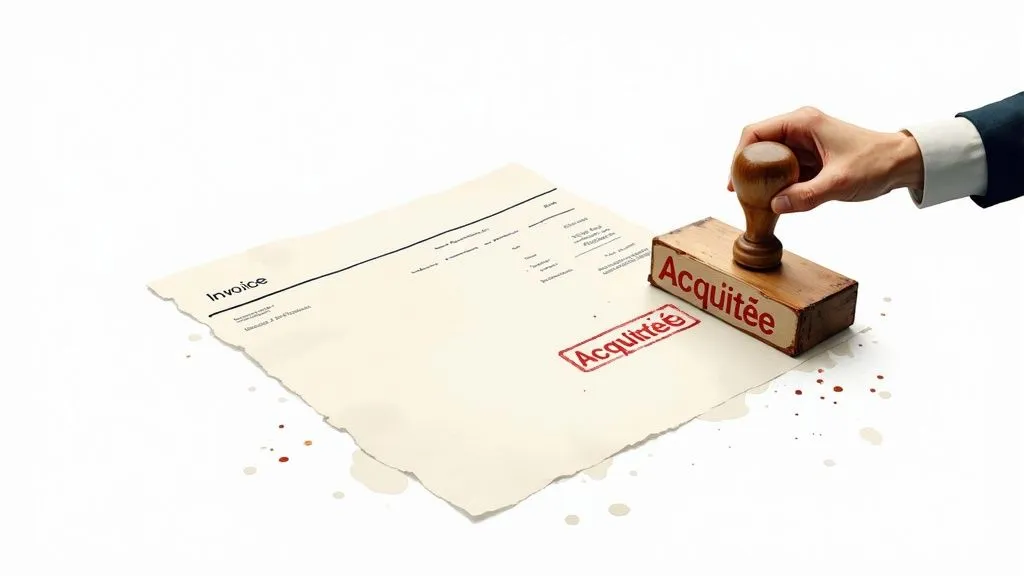
Think of a receipted invoice as the final seal that locks in a business deal. It isn’t a new document — it’s simply the original invoice with a special note added by the supplier once the full payment has been received. It then becomes rock-solid proof of payment, a genuine shield against potential disputes.
So it’s not just an administrative formality. For the supplier, it’s an essential accounting record. For the client, it’s proof they’ve settled their debt. In France, this document carries real legal weight, since it certifies full payment between a seller and a buyer. Typically, it includes the words “paid in full” (acquittée), the date, and the payment method. For more on its legal standing, resources such as this article on proof of payment in France on leblogdudirigeant.com are very useful.
Timing is everything
The moment this note is added is absolutely crucial — it’s what gives the document its value. The “paid in full” mention must only be added after the funds have actually been received in full. Never, ever before.
A supplier who rushes to mark an invoice as paid before the money is in their account is taking a huge risk. If the payment ultimately doesn’t come through, they will have created a document that could undermine their own claim.
A receipted invoice is an update to the original invoice. It must therefore keep the same invoice number to ensure continuity and accounting traceability.
Who can issue it?
The responsibility for marking an invoice as “paid” always falls to the creditor — that is, the supplier or service provider. They, and only they, can certify that the full amount owed has been received.
This simple table sums up why the document benefits everyone.
Roles and benefits of the receipted invoice
| Party involved | Main benefit | Concrete example |
|---|---|---|
| The client | Definitive proof of payment | A client can present the receipted invoice to stop any mistaken payment reminder or to prove good faith during an audit. |
| The supplier | Accounting and administrative closure | The supplier files the record as “paid” and ensures their books reflect a healthy situation, with no outstanding receivables. |
In short, once issued, the receipted invoice becomes a valuable document that secures the business relationship and simplifies management for both parties.
A free receipted invoice template to download
Enough theory, let’s get practical! To save you precious time, we’ve designed a ready-to-use receipted invoice template. Download it and you’ll be assured of staying compliant, without the hassle.
Whether you’re a Word enthusiast, an Excel pro, or you prefer the simplicity of a PDF, we’ve thought of everything. Each version is designed to be customized in a snap. Just add your logo and your company details, then fill in the sale information. That’s it.
A template that’s already compliant and easy to adapt
Our goal? To give you a turnkey solution that works right away. That’s why this receipted invoice template already includes all the mandatory legal information. No more stressing about forgetting a detail that could cost you dearly.
- Several formats available: Word (.docx), Excel (.xlsx), or PDF.
- Instant customization: Spaces set aside for your logo and contact details.
- Peace of mind: All the legal fields are already there.
Download the format that suits you best. Within minutes, you’ll have a receipted invoice that clearly and professionally proves payment, helping to secure your business relationships.
For a sole trader, well-organized invoicing is the backbone of a healthy business. Our template fits right in. If you want to go further and master the whole process, take a look at our guide on invoicing for sole traders.
How do you fill in a receipted invoice correctly so it’s valid?
Turning a standard invoice into solid proof of payment isn’t something to improvise. It’s a bit like affixing an official seal to a contract: even a small omission can undermine its value. Think of this step not as an administrative chore, but as the finishing touch that legally locks in your transaction.
To be valid, your receipted invoice must first carry all the information from the original invoice (number, date, identity of both parties, etc.). Next, you add the specific mentions that certify payment. It’s the combination of these two layers of information that creates an unassailable document.
This visual sums up perfectly the three key steps to drawing up a receipted invoice by the book.
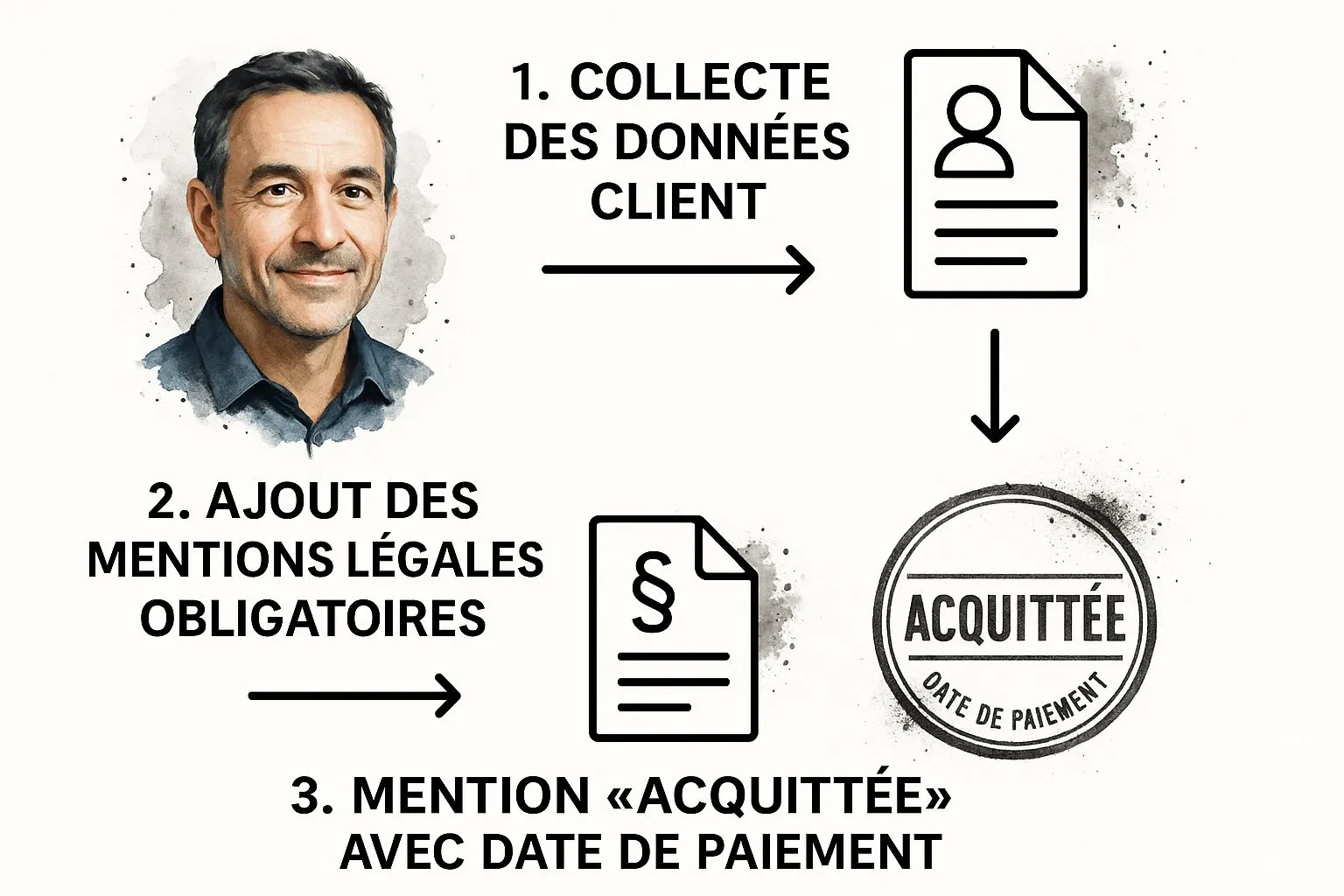
As you can see, the “paid in full” mention is really the final building block — the one that seals the transaction once all the necessary information has been gathered.
The information to add for full compliance
For a receipted invoice template to be flawless, a few crucial pieces of information absolutely must be added. The simplest way is to do it directly on the original invoice, by hand or with an ink stamp.
Here’s what should never be missing:
- The explicit mention: Clearly write “Paid in full on…”. This is the standard wording, and it’s unambiguous.
- The exact payment date: Note that this is the day the money actually arrived in your account, not the day your client issued the transfer.
- The payment method: Specify how payment was made. Bank transfer, cheque (note the number if you have it), cash, card… Be precise.
- Your signature: This is essential. The supplier’s signature (you or a company representative) authenticates the document and officially confirms receipt of the funds.
Adding these elements turns a simple invoice into a payment receipt. An invoice that just says “paid,” with no date or signature, doesn’t carry the same evidentiary weight. It’s this attention to detail that makes all the difference in the event of a tax audit or a dispute.
When and how should you actually use this document?

Of course, understanding the definition is one thing, but instinctively knowing when to request or issue a receipted invoice is what makes the difference day to day. See this document as far more than a scrap of paper; it’s your safety net, the irrefutable proof that protects you in key situations.
Take the most obvious case: cash payment. It’s a direct transaction, with no bank trail. The receipted invoice then becomes the only tangible proof that money actually changed hands. It protects the client against a possible claim and the seller in the event of an audit.
Situations where a receipted invoice saves the day
Its usefulness isn’t limited to cash payments. Here are a few concrete examples where it becomes your best ally:
- Getting a reimbursement (insurance, health cover): Your mechanic gives you a receipted invoice after a repair. That’s the document you’ll send to your insurer to prove you paid for the service and trigger your reimbursement.
- Justifying expenses for grants: A nonprofit receiving a subsidy must be able to show exactly how the funds were used. Receipted invoices from its suppliers are the perfect supporting documents.
- Securing a transaction between private individuals: For the sale of a valuable item, this document formalizes the exchange. It protects the buyer from any future dispute over payment.
From a purely practical and legal standpoint, it’s essential to keep it carefully. In France, all accounting documents, including receipted invoices, must be kept for 10 years.
Imagine a tax audit. Immediately producing a receipted invoice for a disputed expense can end the discussion in seconds. It’s the ultimate proof that the expense was indeed paid.
For sole traders, rigorous management of supporting documents is the foundation of sound bookkeeping. This is especially true for tax matters. If you’d like to dig deeper, our article on managing VAT as a sole trader will give you all the keys.
The evolution of the receipted invoice in the digital age

The good old receipted invoice, with its famous “Paid” stamp and handwritten note, is going through a real revolution. As e-invoicing becomes the norm everywhere, this paper proof of payment is reinventing itself. But rest assured, this doesn’t mean it’s disappearing. Instead, we’re seeing it transform into a version 2.0 — more integrated and automated.
The idea is no longer to scribble on a document. It’s now about building payment status directly into digital workflows. In practice, instead of hunting for a pen, your invoice’s status switches automatically from “Pending” to “Paid” as soon as your software, like Bizyness, matches it against the transaction in your bank account.
The benefit? Unmatched reliability and traceability. This status becomes a near-tamperproof digital marker, viewable in real time by you and your client.
The receipted invoice facing new legal requirements
This shift isn’t just about technology — it’s also regulatory. The major turning point is the arrival of mandatory e-invoicing, set for 2026. This reform will require all invoices between VAT-registered businesses to pass through an official portal. The receipted invoice template will therefore need to adapt for even greater traceability.
In practice, the digital “paid in full” mention will become the standard for certifying payment. Automated management of the entire process, from purchase order to payment (the well-known procure-to-pay cycle), will become standard practice for businesses. To learn more about these trends, take a look at these insights on business invoicing on billup.com.
In short, proof of payment isn’t disappearing. It’s going digital and merging with the invoice lifecycle, bringing considerable gains in security and efficiency.
This new system will rely on dedicated platforms:
- The Public Invoicing Portal (PPF): The State’s centralized platform for managing all invoice flows.
- Partner Dematerialization Platforms (PDP): Certified private companies that will offer e-invoicing services compliant with the law.
These platforms will automatically track payment statuses, making the concept of a “receipted invoice” fully digital and integrated. Anticipating this transition is therefore crucial to ensure your business stays compliant and keeps pace.
Proof of payment: a legal safeguard above all
Why dwell on a simple payment receipt? To really grasp what’s at stake, it helps to remember what trade looked like before the bank traceability we know today. The receipted invoice wasn’t just a piece of paper — it was genuine insurance.
Back then, the handwritten “paid in full” note, along with a signature, was often the only tangible proof that a debt had been settled. This simple act closed the transaction and protected both the client and the seller against potential disputes or unwarranted claims. The written word was what counted as proof.
The shift from paper to digital: security remains the priority
While the tools have changed, the purpose remains the same: securing exchanges. Today, the receipted invoice sits at the heart of digital transformation, notably as a way to more effectively fight VAT fraud.
A receipted invoice is far more than a mere accounting formality; it’s an act with legal weight. Drafting it correctly, whether on paper or in digital form, protects your business and ensures the validity of your proof of payment in the event of an audit.
This shift isn’t new. The 2020 finance law laid the groundwork for what’s coming: starting in 2026, e-invoicing will become mandatory for all transactions between VAT-registered businesses. These invoices will have to pass through a dedicated public portal, as you can read in these details on e-invoicing on itesoft.com.
This legal framework explains why every detail matters. Complying with the mandatory information on an invoice isn’t just an administrative constraint — it’s the very condition that makes your document valid in the eyes of the law.
Your frequently asked questions about the receipted invoice
To make things clearer, let’s go through the questions that come up most often. The goal is to give you simple, practical answers so this document holds no more secrets for you.
”Paid” or “receipted” invoice: what’s the real difference?
It’s easy to mix up the two, but be careful — their value is not the same at all. The “Paid” mention is more of a note for yourself, a marker in your accounting software to track where you stand. It’s handy internally, but it has nothing official about it.
The receipted invoice, on the other hand, is the real deal. It’s a document with genuine legal value. To be valid, it must include specific information such as the date, the payment method, and your signature. That’s what turns it into official proof, one you can present to the tax authorities or even to a court if needed. Its legal weight is far stronger than a simple “paid” checkbox.
To put it simply: “paid” is information for you, “receipted” is proof for everyone. If you want peace of mind on the legal front, always make it a habit to properly issue a receipted invoice.
Can a receipted invoice be sent by email?
Absolutely! Email works perfectly well. You can scan the original invoice after signing it, or simply edit your PDF to add the payment confirmation. This is a fully valid method.
For the signature, you have a choice:
- Insert an image of your handwritten signature directly into the file before saving it as a PDF.
- Use a certified electronic signature, if you have a professional solution.
A quick tip: keep the sending email carefully. It serves as additional proof, showing the exact date and time of transmission. It’s always a plus for traceability.
What should I do if a client asks me for a receipted invoice for a simple deposit?
Careful, this is a trick question! The answer is a firm no. A receipted invoice certifies that the full amount has been paid. If you issue one for a mere deposit, you’re officially declaring that you’ve received everything… which could legally prevent you from claiming the remaining balance.
The right approach is to issue a deposit receipt. This document should clearly state the amount received and the date, while clearly specifying the balance still due. The “paid in full” mention should only appear on the final invoice, once you’ve confirmed that the full amount is in your bank account. This is an essential nuance for protecting your cash flow.
Manage your invoices, deposits and receipts effortlessly with Bizyness. Our tool automates the creation of compliant documents and tracks your payments in real time, letting you focus on what really matters: your business. Simplify your management today on Bizyness.
