

 Français
 Guide: VAT collected vs VAT deductible for e-commerce in 2026
Master VAT collected and VAT deductible, plus the 2026 e-commerce rules (OSS/IOSS), with this clear, practical guide.

Managing VAT properly takes more than knowing the rates. Above all, you need to understand the fundamental difference between collected VAT and deductible VAT. In practice, it’s fairly simple: one is the tax you charge your customers on behalf of the state, the other is the tax you recover on your business expenses.
Grasping this mechanism is the key to controlling your cash flow and avoiding unpleasant surprises.
Understanding the VAT flow to better manage your cash flow

For an online seller, VAT is neither a gain nor a loss. Your business simply acts as an intermediary, a tax collector for the state. It’s a financial flow to manage.
To picture it clearly, imagine VAT as a river running through your business.
Collected VAT on your sales is the water you gather and temporarily hold. That money isn’t really yours; it’s a debt you owe to the tax authorities.
Conversely, deductible VAT on your purchases (advertising costs, software, stock) is water you’ve already paid upstream. It’s therefore a claim you hold against the state.
In short, VAT should be neutral for your business. You don’t gain from it on your sales, and you don’t lose from it on your purchases. Your only job is to calculate the difference between what you’ve collected and what you’ve paid.
Why does this distinction matter so much for your cash flow?
Clearly distinguishing between collected VAT and deductible VAT is vital to the health of your e-commerce business. Poor anticipation of this flow can quickly create cash-flow tension when filing time comes, and nobody enjoys that.
This management is essential for three reasons:
- It protects your liquidity: The amount owed to the state, the famous VAT due, can be substantial. Anticipating it means you won’t have to dip into funds earmarked for stock or marketing.
- It saves you from unpleasant surprises: By closely tracking both sides of the balance, you always know where you stand. No more VAT-filing stress!
- It can even make you money: Rigorous tracking lets you spot a VAT credit immediately. This happens when you’ve paid more VAT than you’ve collected. The state then owes you money, and you can request a refund.
To lay solid groundwork, this table sums up both concepts at a glance.
Collected VAT and deductible VAT at a glance
This table compares the two fundamental VAT concepts to clarify their role, origin, and impact on your business.
| Criterion | Collected VAT | Deductible VAT |
|---|---|---|
| Origin | Charged to your customers on your sales of goods or services. | Paid to your suppliers on your business purchases. |
| Role | A debt owed to the state. You collect it on its behalf. | A claim on the state. You can recover it. |
| Financial flow | Temporary money inflow into your cash position. | Money outflow you can get reimbursed. |
| Objective | Pay it back in full to the tax authorities. | Deduct it from collected VAT to reduce the amount owed. |
With this overview, you now understand the dynamics at play better. Now let’s get practical: how do you actually calculate these two amounts?
Calculating the VAT to pay with concrete examples
Theory is nice, but let’s get practical. Specifically, how do you calculate this famous VAT owed to the state? It all rests on one simple formula, but one every online seller needs to have in mind.
The key formula for VAT owed: VAT due = Collected VAT - Deductible VAT
This simple subtraction is the heart of the whole system. If the result is positive, you pay that amount to the tax authorities. If it’s negative, congratulations, you have a VAT credit. But for the calculation to be accurate, you first need to pin down each of these two amounts.
Determining your collected VAT
Collected VAT is simply the tax you apply to your selling prices and that your customers pay you. The calculation looks simple: Net selling price x VAT rate. The real difficulty is never getting the rate wrong.
In France, several VAT rates apply. As an online seller, it’s crucial to apply the right rate to each product in your catalog:
- Standard rate of 20%: The default rate. It applies to nearly all products sold online: clothing, electronics, cosmetics, etc.
- Intermediate rate of 10%: Less common in e-commerce, it mainly concerns services such as food delivery.
- Reduced rate of 5.5%: This rate applies to products deemed essential, such as some food items, and especially books (print and digital).
- Special rate of 2.1%: Very rare, reserved for very specific cases such as certain medicines.
Applying the wrong rate is a common mistake that can prove costly during a tax audit. Properly organizing your product catalog is therefore not optional.
Identifying your deductible VAT
Deductible VAT is your breathing room. It’s the VAT you yourself paid on all your business purchases. Think of it as an advance you made to the state that you can now recover. To do so, two golden rules apply: the expense must be strictly related to your business, and you must have a properly issued invoice that states the VAT. To make sure your invoices are valid, mastering the rules of invoice numbering is an essential prerequisite.
What are the typical expenses of an online seller that allow VAT to be deducted?
- Advertising costs (Google Ads, Meta Ads, TikTok Ads).
- Marketplace commissions and payment processor fees (Amazon, Cdiscount, Stripe, PayPal).
- Software subscriptions (Shopify, Bizyness, marketing tools…).
- Purchase of merchandise stock.
- Shipping costs on your restocking purchases.
Be careful, not everything is deductible. Tax authorities are fairly strict about expenses resembling a personal benefit, such as housing costs, passenger transport, or customer gifts exceeding a certain threshold.
Concrete example for a Shopify store
Let’s take the example of “MaJolieBoutique,” which sells fashion accessories through its Shopify store. Let’s look at its numbers for the month of January.
-
Sales for the month: It did great and sold €5,000 excl. VAT worth of accessories. The VAT rate is 20%.
- Collected VAT: €5,000 x 20% = €1,000. This is the money it collected on behalf of the state.
-
Expenses for the month: To generate that revenue, it had to invest.
- Shopify subscription: €36 excl. VAT, i.e. €7.20 of VAT.
- Meta Ads advertising: €500 excl. VAT, i.e. €100 of VAT.
- New stock purchase: €1,500 excl. VAT, i.e. €300 of VAT.
- Total deductible VAT: €7.20 + €100 + €300 = €407.20. This is what it can recover.
The final calculation of the VAT owed for January is therefore:
- VAT due = €1,000 (collected VAT) - €407.20 (deductible VAT) = €592.80.
MaJolieBoutique will therefore need to pay €592.80 to the state for its January activity. To dig deeper into the different methods, feel free to check out our complete guide on calculating VAT.
What to do in case of a VAT credit?
Sometimes the calculation flips: deductible VAT is higher than collected VAT. This is a very common scenario when launching a business, when you’re investing heavily (purchasing initial stock, setup costs, large ad campaigns) before you’ve built up a significant sales volume.
In this case, you have a VAT credit. In practice, it’s the state that owes you money. You then have two options:
- Carry-forward: This is the default option. You keep this credit and use it to reduce the VAT amount owed on your upcoming filings, until it’s exhausted.
- Refund: If you meet certain conditions (notably a minimum amount), you can ask the authorities to refund the credit directly to your bank account.
How does VAT translate into accounting?
Accounting can seem a bit scary. You picture columns of numbers, complex terms… But in reality, it’s just the numerical record of everything happening in your business. Every sale, every purchase, every VAT filing: it’s all logged to track money flows with pinpoint precision. And you don’t need to be a chartered accountant to understand the logic.
By grasping the basics, you gain enormous control. You can check the consistency of your numbers, communicate more easily with your accountant and, above all, better understand the financial reports you generate, for example with a platform like Bizyness. It all rests on specific accounts, defined by the French General Chart of Accounts (Plan Comptable Général, PCG).
To clearly visualize how VAT flows from your sales through to your filing with the state, take a look at this diagram.
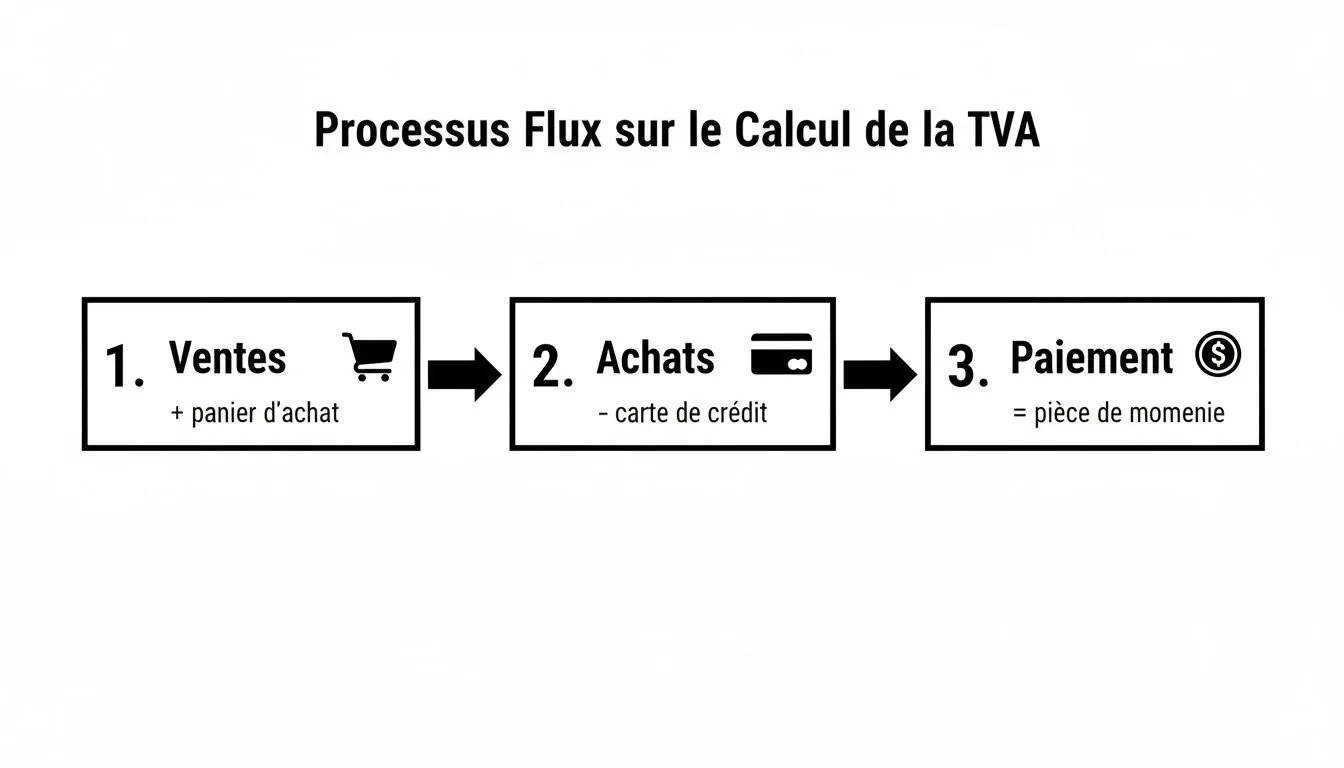
You can clearly see how VAT on your sales (collected) and VAT on your purchases (deductible) come together to result in a single amount to settle with the tax authorities.
The essential accounting accounts for VAT
In accounting, every operation has its own numbered “file.” For VAT, there are three accounts you absolutely need to know:
- Account 44571 - Collected VAT: This is where you record all the VAT charged to your customers. Think of it as your debt to the state.
- Account 44566 - Deductible VAT on other goods and services: Here, you record the VAT you paid on your business expenses (advertising costs, software subscriptions, etc.). This is your claim on the state.
- Account 44551 - VAT payable: This account is the finish line. It nets your collected VAT against your deductible VAT to display the net amount you actually owe.
All these transactions are recorded in “accounting journals,” a kind of ledger detailing your business’s financial life.
In practice, for an e-commerce sale
Let’s say you sell a product for €120 incl. VAT. With VAT at 20%, this price breaks down into €100 excl. VAT and €20 of VAT. Here’s how it translates into an accounting entry:
- Credit account 707 (Sales of goods) with €100. That’s what you actually earned.
- Credit account 44571 (Collected VAT) with €20. That’s the amount you hold for the state.
- Debit account 411 (Customers) or 512 (Bank) with €120. That’s the total amount paid by your customer.
You can clearly see that out of the €120 received, only €100 belongs to you. The remaining €20 merely passes through your account.
What about a business purchase?
Now let’s say you pay for a software subscription costing €60 incl. VAT. The invoice shows €50 excl. VAT and €10 of VAT. The accounting entry works the other way around:
- Debit account 622 (Fees to intermediaries and professional fees) for the amount excluding tax: €50. That’s the actual cost of this subscription to you.
- Debit account 44566 (Deductible VAT) with €10. That’s the money the state “owes” you.
- Credit account 401 (Suppliers) or 512 (Bank) with €60. That’s the amount leaving your cash position.
In the end, this expense will have cost you only €50, since the €10 of VAT is recoverable.
The key moment: filing and account reconciliation At the end of the month or quarter, it’s time to file. The accounting operation consists of “emptying” the VAT accounts to keep only the balance. You transfer the amount of collected VAT (account 44571) to account 44551 (VAT payable), and do the same with deductible VAT (account 44566). The final balance of account 44551 then represents the exact amount you owe to the tax authorities. Managing all these entries is centralized in a key document, the Accounting Entries File (Fichier des Écritures Comptables, FEC). To learn more, check out our dedicated article on creating the Accounting Entries File.
Managing international VAT: a challenge for online sellers
Selling online has broken down borders, that much is obvious. But watch out, tax borders are very real. Expanding internationally is a fantastic growth opportunity, but it comes with new complexity: managing foreign VAT. To stay compliant and avoid unpleasant surprises, it’s crucial to understand the rules of the game.
First reflex to have: think about the VAT on your own costs. The commissions paid by marketplaces like Amazon or Cdiscount, or your subscriptions to platforms like Shopify, are business expenses. The VAT attached to them is deductible VAT you can recover. Not tracking it means leaving money on the table.
The €10,000 threshold and the One-Stop Shop (OSS)
For your sales to individuals (B2C) within the European Union, everything revolves around one key figure: the €10,000 threshold. As long as your total annual sales to other EU countries stay below this amount, you can invoice using French VAT. This is a huge simplification, especially when you’re starting out.
However, once you cross this threshold, things change. You then need to apply the VAT rate in force in your customer’s country. A buyer in Germany? You invoice with German VAT. A customer in Italy? Italian VAT applies.
This is where the One-Stop Shop, or OSS, becomes your best ally. Rather than having to register for VAT in every country where you sell, this system lets you centralize everything. You declare and pay all foreign VAT through a single portal, in France. It’s a radical administrative simplification.
Picture the situation concretely:
- Situation: A French online seller sells through Shopify to customers in Germany (VAT at 19%) and Spain (VAT at 21%).
- Without OSS: They would need to register with both the German AND Spanish tax authorities. That means two separate filings, in two different languages, with two payments to make. A real headache.
- With OSS: They simply declare the sales made in Germany and Spain on their French OSS portal. They make a single transfer to the French tax authorities, who then handle passing on the corresponding amounts to their European counterparts.
The IOSS scheme for imports
Another mechanism worth knowing is the IOSS (Import One-Stop Shop). It applies to sales of products worth less than €150 that you import from a non-EU country to deliver to a customer within the EU (for example, dropshipping from China).
Before IOSS, the end customer often ended up paying VAT to the carrier at delivery, plus handling fees on top. A very poor experience that generated a lot of dissatisfaction. IOSS solves this problem by letting the seller collect VAT directly at the time of payment, at the destination country’s rate.
The benefits are obvious:
- Transparency for the customer: The displayed price is the final price. No more unpleasant surprises or hidden fees at delivery.
- Faster delivery: Customs formalities are simplified, considerably speeding up parcel delivery.
These one-stop shops are increasingly used. Sales declared via OSS/IOSS jumped by +27.4% in 2024, proof of their massive adoption by internationally focused businesses. If you want to dig deeper into the topic, the detailed DGFIP statistics are very enlightening.
Why an automated solution is no longer optional
Between the different VAT rates across Europe, the constant monitoring of the €10,000 threshold, and the OSS/IOSS filings, managing all of this manually is a Herculean task. It’s not only time-consuming but also extremely risky. A calculation error or an oversight can quickly become very costly in penalties.
This is where an automated solution like Bizyness changes the game. The platform connects to your stores (Shopify, Amazon, etc.) and analyzes every sale. It automatically determines the destination country, whether the customer is a business or an individual, and applies the correct VAT rate without you lifting a finger.
Bizyness monitors your international revenue for you and alerts you well before you reach the famous €10,000 threshold, giving you time to get organized. When it’s time to file, the tool provides the exact figures to report for OSS/IOSS. No more hours spent on complex spreadsheets. It’s also worth knowing that certain cross-border transactions can be subject to specific rules, as you’ll discover in our guide on VAT reverse charge. In short, automation turns this chore into a simple, secure process.
What if you automated your VAT management with Bizyness?

After looking at manual calculations, accounting entries, and the pitfalls of international sales, one thing is certain: managing VAT can quickly become a full-time job. The slightest rate mistake or an unnoticed threshold breach opens the door to penalties and stress. This is precisely where a specialized tool can change everything.
Forget the afternoons spent on spreadsheets checking every transaction. Imagine a system that does all this thankless work for you. That’s exactly what Bizyness was designed for: turning this complex task into a simple, automated process, so you can focus on what really matters, growing your e-commerce business.
How Bizyness centralizes and automates your flows
The secret of Bizyness lies in its ability to plug directly into all your sales channels. Whether you’re on Shopify, Amazon, WooCommerce, or using Stripe, the platform connects to your tools to bring all your financial data together in one single place.
In practice, everything happens behind the scenes, 100% automated:
- Data collection: Bizyness pulls in every order in real time. It identifies the product, the amount, the buyer’s country, and whether they’re an individual or a business.
- Smart application of VAT rules: Based on this information, the platform automatically applies the correct VAT rate. No more headaches over European rates or intra-community B2B sales.
- Generation of accounting entries: Every sale and every expense is immediately translated into clean accounting entries, which clearly distinguish collected VAT from deductible VAT and post them to the right accounts.
But the goal isn’t just to stack up data. The real challenge is to provide you with reliable information, ready to use for your filings.
Bizyness doesn’t just sort your transactions. It does the heavy lifting by preparing the exact figures for your VAT filings, whether for standard forms (CA3/CA12) or one-stop shops like OSS.
Reliable VAT filings, effortlessly
One of the biggest friction points for any online seller is preparing the VAT filing. With Bizyness, this step becomes much less stressful. The platform provides you with a clear, detailed VAT report. It calculates the VAT amount due for you by rigorously subtracting deductible VAT from collected VAT.
This automation becomes especially meaningful when you look at the numbers. For example, VAT revenue forecasts for 2024 were overestimated by 5.5% (i.e. €11 billion), which shows just how difficult it is to anticipate these flows manually. Bizyness protects you from this uncertainty by giving you a clear, real-time view.
Day to day, the benefits are very concrete:
- Huge time savings: No more hours wasted exporting files and consolidating them in Excel.
- Near-zero risk of error: Automation eliminates typos and calculation mistakes. Your tax compliance is far better under control.
- Alerts that save the day: Bizyness monitors important thresholds, like the €10,000 one for OSS, and warns you before you exceed it.
With this approach, your bookkeeping is no longer a chore, but a genuine steering tool. Beyond solutions like ours, technologies such as artificial intelligence in accounting also open up fascinating avenues to go even further. Adopting a tool like Bizyness simply means giving yourself peace of mind so you can focus on what matters: selling more, and selling better.
Frequently asked questions about VAT in e-commerce
Between the collected VAT on what you sell and the deductible VAT on what you buy, an online seller’s day-to-day is shaped by taxation. To help clarify things, we’ve gathered the most frequent questions to help you approach these topics with more confidence.
Can I really deduct VAT on all my purchases?
That’s an excellent question, and the answer is a nuanced “no.” In principle, you can deduct VAT on an expense if it is incurred in the direct and exclusive interest of your business.
Fortunately, most of your regular business expenses fall into this category:
- Purchasing your stock or raw materials to manufacture your products.
- Your advertising budgets, whether on Meta Ads or Google Ads.
- Subscriptions to your essential tools, such as Shopify or a management platform like Bizyness.
- Commissions paid by marketplaces and payment processors.
Be careful though, tax authorities knowingly exclude certain expenses. This notably includes costs related to a passenger vehicle (even if used for work) or most accommodation expenses. The key is vigilance: carefully keep every compliant invoice to justify any deduction.
What happens if I forget my filing through the OSS one-stop shop?
Forgetting to file through the OSS one-stop shop isn’t a simple administrative slip. The consequences can quickly become a real headache. By not declaring the VAT you charged your customers in the EU, you expose yourself to penalties from every country where you sold.
In practice, this means you could receive letters from the German tax authorities, then the Spanish, then the Italian… each demanding its due with late-payment interest. You then lose the whole point of the one-stop shop, which is precisely to centralize everything.
You would then have to sort out your situation country by country. This is a process that can prove long, complex, and above all very costly. Rigor is therefore not optional here.
I’m under the VAT exemption scheme (franchise en base), do I need to worry about deductible VAT?
Indeed, the VAT exemption scheme (franchise en base) changes things completely. On one hand, it’s simple: you don’t charge VAT to your customers. But there’s a flip side. You also can’t recover VAT on your own business purchases.
The VAT you pay on your expenses becomes a pure cost. It increases the real cost of your purchases, often by 20%. At the very start of your business, when expenses are low, this isn’t necessarily a bad trade-off. But as your e-commerce business grows and your expenses increase, it becomes crucial to run a simulation. You might find that switching to the standard VAT regime is far more profitable, as it would open the door to recovering this famous deductible VAT.
Turning complex VAT management into a simple, automated process is possible. With a platform like Bizyness, you can connect your stores, let the system apply the correct VAT rates without a second thought, and prepare your filings in just a few clicks. Discover how to free up your time and secure your compliance at https://www.bizyness.fr.
