

 Français
 VAT exempt: the guide to mastering the VAT exemption scheme
Discover how the VAT-exempt scheme works. Our practical guide explains the thresholds, invoicing rules and benefits for your business.
When we talk about being VAT exempt, we touch on a key aspect of running a business, especially for smaller structures. Concretely, this means you don’t charge this tax to your customers. And, logically, you don’t owe anything to the State either.
This mechanism, known as the VAT exemption scheme (franchise en base de TVA), is a real administrative breath of fresh air, designed to simplify the lives of entrepreneurs.
Let’s break down VAT exemption together

Far from being an abstract tax concept, VAT exemption has a very direct impact on your daily business. Let’s take a simple example. Imagine you sell a service for €100. If you’re subject to VAT, you have to add 20% (i.e. €20) and invoice your client €120. That €20 isn’t for you: it’s an amount you collect on behalf of the Treasury.
Now, if you benefit from the exemption scheme, it’s much simpler. You invoice €100, full stop. Your selling price corresponds directly to your revenue.
The benefit is twofold. First, your accounting is significantly lighter. Second, you gain a meaningful competitive advantage. For an individual customer, who cannot reclaim VAT, your offer is immediately 20% cheaper than that of a competitor who has to charge the tax.
The principle behind the VAT exemption scheme
Of course, this simplified scheme isn’t available to everyone. It’s conditioned by your revenue. The French system has set precise ceilings so that only the smallest businesses can benefit from it.
As long as you stay under these thresholds, everything is fine. But there’s an important trade-off to know: if you don’t charge VAT, you also can’t reclaim it on your own business purchases. The VAT you pay on your computer, your software or your raw materials becomes a permanent cost for your business.
Staying under the exemption thresholds isn’t just a matter of compliance. It’s a genuine strategic decision that affects your pricing policy, your margins and the market you’re targeting.
The VAT exemption thresholds
To see things more clearly, you need to have the figures in mind. Here’s a table summarizing the revenue thresholds (excluding tax) not to exceed in order to remain under the VAT exemption scheme, and therefore be exempt from declaring and paying it.
| Type of activity | Exemption threshold | Increased tolerance threshold |
|---|---|---|
| Services and liberal professions | €36,800 | €39,100 |
| Goods sales activities | €91,900 | €101,000 |
| Lawyer and author-artist activities | €47,700 | €58,600 |
Be careful: if you exceed these thresholds, you lose the benefit of the exemption from the first day of the month in which the threshold was exceeded. It is therefore absolutely crucial to monitor your revenue closely.
These thresholds vary to fit the reality of each profession. Good invoicing management is therefore key to success, especially when it comes to remembering to include the correct legal notices on your documents. To learn everything about this topic, feel free to read our dedicated article on the “VAT not applicable” notice.
Are some activities always exempt?
Absolutely. While the exemption scheme is a matter of revenue, there’s another form of exemption that has nothing to do with your income. Certain activities are indeed exempt from VAT by nature. Here, it doesn’t matter whether you’re a small freelancer or a large company; it’s the sector of activity that determines it.
The difference is crucial. Take a marketing consultant: they must keep a constant eye on their income so as not to cross the exemption thresholds. Conversely, a general practitioner will never have to worry about VAT, even if their revenue skyrockets.
Why such a distinction? This so-called structural exemption is enshrined in the French General Tax Code (CGI). It mainly targets activities of general interest or areas where applying VAT would simply be a headache.
Medical and paramedical professions
The healthcare sector is the first example that comes to mind. Almost all care provided to individuals is not subject to VAT. The goal is simple: not to make care more expensive for patients.
This exemption notably covers:
- Doctors, whether general practitioners or specialists.
- Dental surgeons.
- Midwives.
- Physiotherapists, nurses, speech therapists, and other regulated paramedical professions.
- Psychologists, psychoanalysts and psychotherapists.
- Ambulance transport of patients.
Be careful, however: this exemption only covers acts with a therapeutic purpose. Anything falling under purely cosmetic medicine or surgery, not covered by social security, is indeed subject to VAT at the standard rate of 20%.
Education and training
The education sector also benefits from a broad VAT exemption. The objective is clear: to facilitate access to knowledge for everyone.
In the field of training, being VAT exempt is not automatic. To benefit from it, the organization must be officially recognized as a provider of continuing professional training, which requires precise administrative steps.
Here are the services generally exempt:
- School and university education (public as well as private under contract).
- Private lessons given by individuals working on their own account.
- Continuing professional training, provided it is delivered by accredited organizations.
If you’re an independent trainer, it’s therefore essential to carefully check whether your activity falls within this scope in order to invoice legally.
Other very specific sectors
Beyond healthcare and education, a few other sectors escape VAT by nature, often due to very specific regulations.
Examples include:
- Banking and financial operations: Most of the services your bank offers (account management, granting a loan, etc.) are not taxed.
- Insurance operations: Insurance contracts and broker services are also exempt.
- Non-profit activities: Under certain strict conditions, services provided by non-profit associations to their members escape VAT.
- Renting unfurnished housing: Renting an apartment or house unfurnished for residential use is exempt.
These structural exemptions have a major impact on entire segments of our economy. However, it’s important to keep in mind that being VAT exempt doesn’t mean the end of all tax obligations! Some of these businesses may, for example, be subject to the payroll tax.
To go further on the different cases of VAT application, you can find out more about VAT rates here. One thing is certain: checking whether your activity is concerned is an essential step from the moment you set up your business.
The impact of VAT exemption on your prices and purchases
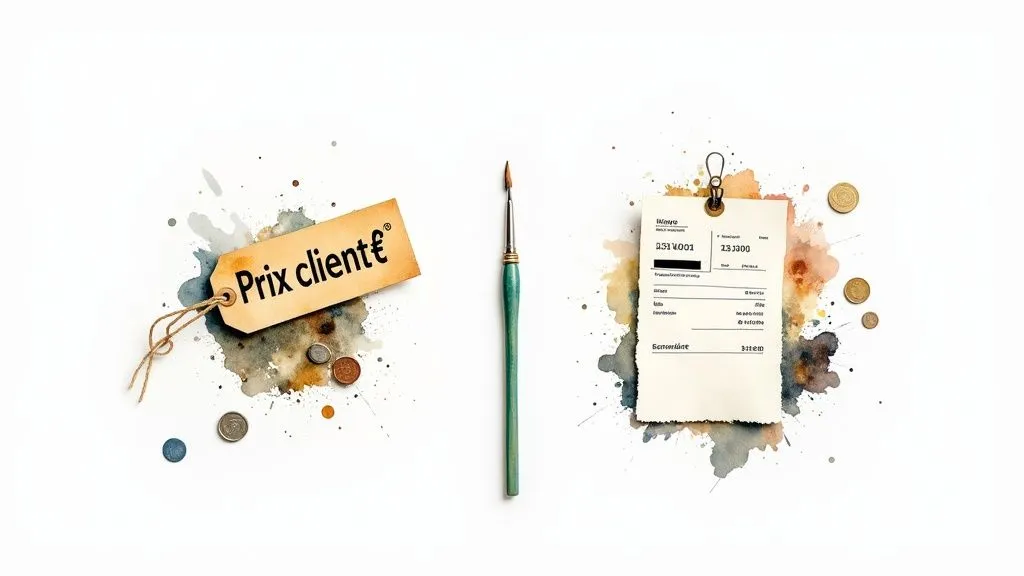
Being VAT exempt, particularly through the exemption scheme, isn’t just a line on a form. It’s a real strategic choice that will completely change how you set your prices and manage your expenses. You could say it’s a coin with two sides: one very shiny side for your competitiveness, and another that can weigh heavily on your costs.
The obvious advantage is, of course, the selling price. Not having to charge VAT puts you in a strong position, especially if you’re targeting individual customers. For them, the price you announce is the price they pay, full stop. Your service therefore becomes, as if by magic, 20% cheaper than that of a competitor who is subject to VAT (for an equivalent margin).
But watch out for the flip side of this coin. In exchange for this advantage, you lose the right to reclaim VAT on absolutely all your business expenses. Every euro of VAT you pay to your suppliers turns into a pure cost that directly eats into your profit.
An unbeatable selling price for individuals
When your customers are mainly individuals (B2C), VAT exemption becomes your best commercial weapon. An individual never reclaims VAT, so their only reference point is the final price, the one written at the bottom of the quote, tax included.
Let’s take an example to make this clearer:
- You (VAT exempt): For a service, you’re aiming for €500 in revenue. So you invoice €500. The client pays you exactly €500.
- Your competitor (subject to VAT): To earn the same €500, they must invoice €500 excluding tax. To that, they add 20% VAT, i.e. €100. Their final invoice for the client thus comes to €600 including tax.
For equal quality of service, you are €100 cheaper. This gap is often what tips the balance in your favor.
To see concretely how taxation influences quotes in certain professions, our guide on the cost of an interior designer is an excellent example. It clearly shows how the tax structure affects the final amount presented to the client.
The hidden cost of your business purchases
The main drawback of the exemption becomes apparent as soon as you start investing or incurring significant expenses. The VAT you pay on everything you buy for your business remains your responsibility. It is not recoverable.
When you’re exempt, VAT on your expenses is no longer a simple cash flow that passes through your accounts. It becomes a full-fledged operating cost, which directly reduces your margin.
Imagine you’re a graphic designer and you need a powerful new computer to work with.
- The computer is listed at €2,000 excluding tax, which gives a price of €2,400 including tax (with €400 of VAT).
- If you’re exempt, this machine actually costs you €2,400.
- If you’re subject to VAT, you can deduct that €400 of VAT. In the end, the computer only costs you €2,000.
The €400 difference is a direct, hard cost for the entrepreneur under the exemption scheme.
So, how do you know if this scheme is right for you? The calculation is fairly simple. You need to weigh the pros and cons: on one hand, the advantage on your selling prices; on the other, the extra cost of non-deductible VAT on your purchases. If your expenses are minimal and your customers are individuals, exemption is often an excellent deal. On the other hand, if you invest heavily and work mainly with businesses (which reclaim VAT on their end), it would probably be smarter to opt for the standard VAT scheme.
How do you invoice when you’re VAT exempt?
Invoicing while VAT exempt isn’t just about removing a line from a template. It’s a genuine exercise in precision. Think of the invoice as a legal document: it engages your responsibility, and the smallest mistake can be misinterpreted by the tax authorities. Even without fraudulent intent, an oversight can put you in an awkward position during an audit.
To secure your business, every invoice must therefore be impeccable. It’s not enough to simply omit VAT; you must above all justify its absence with precise legal notices. This is what proves to your clients and to the tax authorities that you are fully compliant.
The legal notice that changes everything
The French General Tax Code is very precise on this point. If your business is under the VAT exemption scheme, a specific notice must absolutely appear on every one of your invoices.
The standard wording, the one that leaves no room for doubt, is as follows: “VAT not applicable, art. 293 B of the CGI”. This is the article of law that defines the exemption scheme. Displaying it on your documents shows that you know your subject well and that your situation is entirely legal.
Where should you put it? The simplest and clearest option is to add it at the bottom of the invoice, right next to the total amount. Make sure it is clearly visible and doesn’t get lost among other information. This is the formal proof that the absence of VAT is deliberate and justified.
A simple omission of this notice can have serious consequences. An inspector might think you deliberately hid VAT and demand a reassessment. You would then be forced to pay VAT you never even collected.
The checklist for a bulletproof invoice
Beyond this crucial notice, an invoice without VAT must of course comply with all the other accounting obligations. To make sure you don’t leave anything to chance, here’s a small checklist to run through before each send:
- Zero VAT, everywhere: Make sure no VAT rate or calculation line appears. The “Excluding Tax” amount is your “Including Tax” amount. They must be identical.
- The legal notice, clearly visible: Is the phrase “VAT not applicable, art. 293 B of the CGI” present and easy to read?
- Flawless numbering: Do your invoices follow a chronological order with no gaps in the sequence? This is essential.
- All the info is there: Your details, the client’s details, the date, the breakdown of products or services… Don’t neglect any of the usual mandatory notices.
These few habits may seem a bit tedious, but they’re your best insurance against problems. If you want to dig deeper into the topic with templates and practical advice, our guide on invoicing without VAT and its specific rules is here for that.
What if a business client asks you to add VAT?
This happens more often than you’d think. A business client, who is used to reclaiming VAT on their purchases, may be thrown off by your invoice and ask you to “correct” it to show the tax.
Your response must be both firm and educational. You cannot under any circumstances add VAT if you are not liable for it. That would be illegal, since you don’t have the authorization to collect it on behalf of the State.
Calmly explain to your client that your business is under the exemption scheme and that, in accordance with the law, your invoices do not include VAT. Simply mentioning article 293 B of the CGI is usually enough to end the discussion. It’s even a good opportunity to show that you’re a professional who knows their legal framework.
Sole traders: the dilemma between exemption and opting for VAT
When you start out as a micro-entrepreneur (sole trader), the status is almost automatically associated with the VAT exemption scheme. By default, that’s true, you are VAT exempt. It’s a great administrative simplification, but be careful: is it really always the smartest choice for your wallet? Not necessarily, especially if your business requires you to invest quite a lot.
Let’s take concrete cases. A photographer who needs to buy quality lenses, a craftsperson who buys their machines, or even a developer who pays for expensive software licenses… For them, the VAT on these purchases represents a significant amount. And since they can’t reclaim it, this amount directly eats into their margin.
This is precisely where a strategic choice comes into play: giving up the exemption and voluntarily opting to become liable for VAT. It may seem a bit counterintuitive, but you’ll see that it’s often a very sound calculation.
Why choose to charge VAT when you’re not required to?
The main benefit is clear: by choosing to become liable, you gain the right to reclaim VAT on all your business expenses. That computer that costs you €2,400 including tax? In reality, it now only costs you €2,000 excluding tax. On thousands of euros of investment, the savings quickly become very significant and can really ease your cash flow.
This option is particularly relevant if you recognize yourself in one of these profiles:
- You’re starting out with large investments: all the equipment needs to be purchased at once.
- You have significant recurring costs: raw materials, software subscriptions, subcontracting, etc.
- Your customer base is mainly made up of professionals (B2B): for them, whether you charge VAT or not makes no difference, since they reclaim it on their end. So you have no commercial disadvantage.
Switching to VAT isn’t just a burden, it’s a real management tool. You turn a hard cost (VAT on your purchases) into a simple cash flow. The result: you free up money to invest in and grow your business.
What are the consequences of this choice?
Obviously, this decision is not trivial. By becoming liable for VAT, you shift into a different tax dimension and new obligations appear.
The first, and most obvious, is that you will now have to charge VAT to your clients. If you work in B2B, this is transparent. On the other hand, for your individual customers, your prices will jump by 20% overnight. You lose the competitive advantage that the exemption gave you. You therefore need to be sure your market is ready to accept this increase.
Next, your administrative management will get somewhat more complex. You’ll need to set up VAT returns (monthly or quarterly) and pay the State the difference between the VAT you’ve collected and the VAT you’ve paid. This requires more rigor in your accounting. To fully understand how it all works, feel free to read our complete guide on VAT for sole traders.
This simple decision tree will help you visualize the reasoning to apply to your invoices.
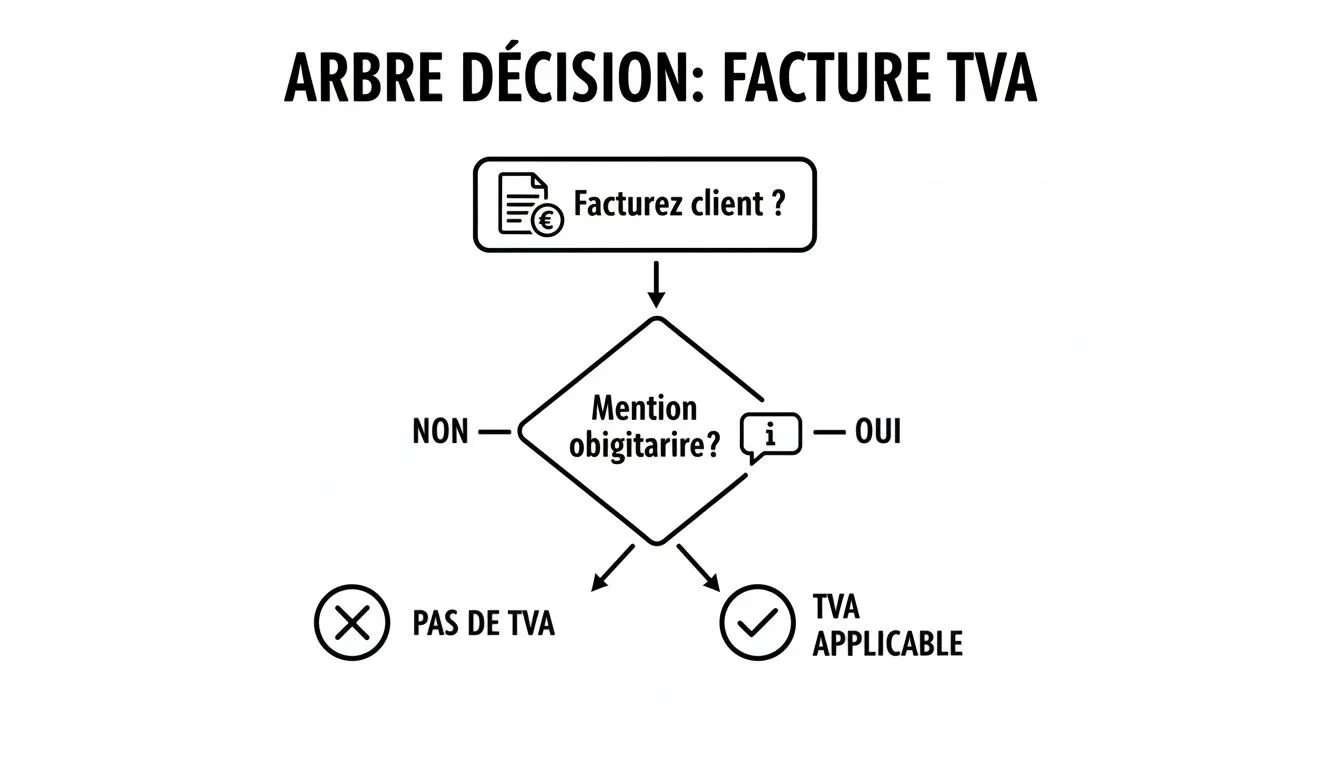
As you can see, whether you’re exempt or not, a clear legal notice is always required on your invoices.
So, how do you make the right choice? The table below highlights the advantages and disadvantages of each scheme to help you see things more clearly.
VAT exemption or opting for VAT for a sole trader
| Criteria | Exemption scheme (Exempt) | Opting to become liable for VAT |
|---|---|---|
| Administrative simplicity | Very simple: no VAT return, no collection. | More complex: regular returns, rigorous bookkeeping. |
| Selling price | More competitive for individual customers (no VAT to add). | Higher for individuals (price excluding tax + 20% VAT). Neutral for business customers. |
| VAT recovery | Impossible. VAT paid on purchases is a permanent cost. | Possible. VAT on business expenses is deductible, which lowers their real cost. |
| Ideal for… | Activities with few expenses, an individual customer base, or testing a project. | Activities with heavy investments, high recurring costs, or a B2B customer base. |
| Invoice notice | “VAT not applicable, art. 293 B of the CGI” | Display of the VAT rate and amount. |
This table clearly shows that the decision depends entirely on your business model and your ambitions.
To illustrate, let’s put this into numbers with a simple example.
-
Scenario 1: A craftsperson stays under the VAT exemption
-
Their revenue: €30,000
-
Their raw material purchases: €10,000 including tax (including €1,667 of VAT they cannot reclaim)
-
Their income before social contributions: €30,000 - €10,000 = €20,000
-
Scenario 2: The same craftsperson decides to opt for VAT
- They invoice their clients €30,000 excluding tax, i.e. €36,000 including tax (€30,000 + €6,000 of VAT collected).
- They reclaim the VAT on their purchases: their raw materials therefore cost them €8,333 excluding tax.
- Their income before social contributions: €30,000 - €8,333 = €21,667
The math is quickly done: in this specific case, opting for VAT earns them an extra €1,667. It’s a purely business decision, and one worth thinking through carefully. If you’re a sole trader looking for other resources, these resources for entrepreneurs might also interest you.
How Bizyness helps you manage your VAT (without pulling your hair out)
Keeping an eye on your revenue so as not to cross the VAT exemption threshold is somewhat of a nightmare for many entrepreneurs. It’s the kind of manual, repetitive task where the slightest mistake can be costly. Honestly, who has time for that?
Fortunately, today, a good invoicing tool like Bizyness can handle it for you. Think of it as a tax co-pilot: it watches the numbers while you focus on what really moves your business forward. The idea is to stop being at the mercy of your bookkeeping, and instead master it.
Compliant invoices, without even having to think about it
The first thing you do when creating your Bizyness account is to indicate that you’re under the VAT exemption scheme. From there, the software takes over. Every invoice you issue will automatically carry the mandatory legal notice: “VAT not applicable, art. 293 B of the CGI”.
No more need to check, copy-paste, or worry about forgetting it. It’s simple, it’s automatic, and it guarantees you’re always compliant with the tax authorities.
That’s the real power of a modern tool: it builds the rules of the game directly into your daily routine. Compliance is no longer an effort, it’s just how your invoices are made, by default.
A dashboard to see the scheme change coming
The real game-changer is real-time tracking of your revenue. The Bizyness dashboard gives you an ultra-clear view of your income. At a glance, you know exactly where you stand relative to the famous exemption thresholds.
Concretely, this changes everything for managing your business:
- Charts that speak for themselves: You instantly see if you’re approaching the ceilings. No more guesswork.
- Smart alerts: The system warns you well before you reach the red zone. This gives you time to breathe and decide what to do next.
- Decisions based on real data: With this information, you’re the one who decides. Should you slow down invoicing a bit? Or is it the right time to calmly prepare the switch to VAT?
The Bizyness dashboard brings everything together to give you this 360° view, as you can see here.
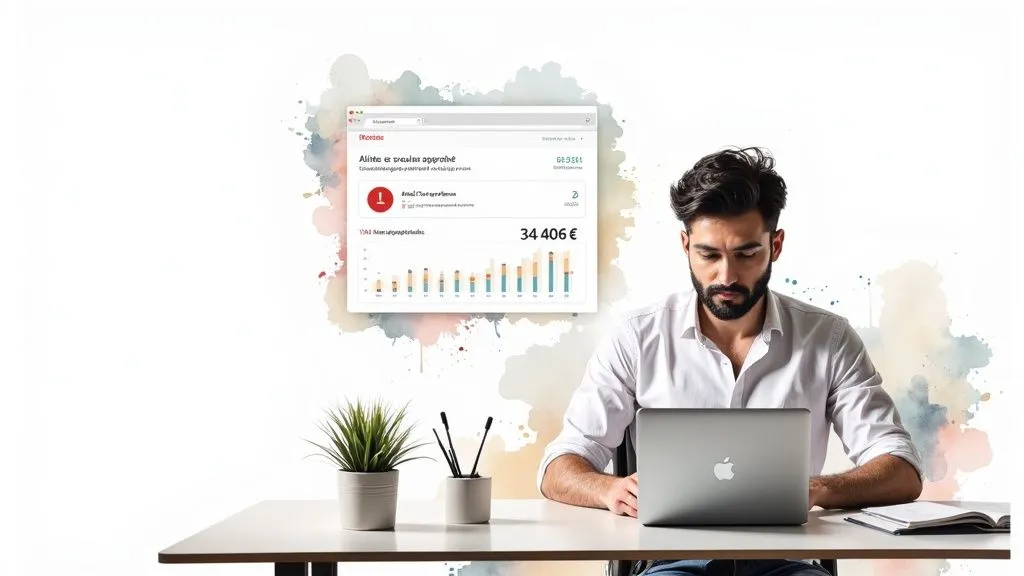
This is what turns simple numbers into real strategic decisions for your business.
And on the day you need to switch to the standard VAT scheme, whether by obligation or by choice, Bizyness makes it easy for you. A few clicks in the settings, and the software adapts. It starts applying the correct VAT rates to your new invoices and lays the groundwork for your returns. A smooth, stress-free transition, so you can take this key step with confidence.
Answering your questions about VAT exemption
Navigating the ins and outs of VAT isn’t always simple. Exemption, in particular, raises quite a few very concrete questions. To wrap up this guide, let’s answer the most common questions directly. The goal? To help you see things clearly and run your business with peace of mind.
Can a sole trader be VAT exempt?
Yes, absolutely! It’s even the default setup. When you launch your micro-business, you’re automatically placed under the VAT exemption scheme. Concretely, this means you’re VAT exempt as long as you don’t exceed certain revenue ceilings.
This is actually one of the big advantages of the status: welcome administrative simplicity when starting out. You’ll only need to start worrying about collecting and declaring VAT if you cross the thresholds or if you decide, for strategic reasons, to voluntarily switch to the standard scheme.
What happens if I exceed the exemption thresholds?
Watch out, the cutoff comes quickly. If you exceed the thresholds, you immediately lose the benefit of the exemption. The rule is final: you become liable for VAT from the first day of the month in which the threshold was exceeded.
In practice, you must immediately start applying VAT to your invoices. Worse, you’ll even have to go back and amend the invoices already issued during that month to add the tax. This is why tracking your revenue in near real time is absolutely essential to avoid being caught off guard.
Can a company based abroad be VAT exempt in France?
Here we enter more technical territory. In principle, a foreign company that has no establishment in France but carries out taxable sales or services there must register for French VAT.
But there are exceptions and mechanisms to simplify things, such as the reverse charge of VAT by the French business customer. For e-commerce, the rules are different again, with the one-stop-shop system (IOSS/OSS). Every situation is unique, and it’s often necessary to consult a tax specialist to avoid mistakes.
How can I be sure my activity is exempt by nature?
As we’ve seen, some professions are exempt from VAT not because of an income threshold, but because of the very nature of their activity. To find out if this applies to you, there’s only one authoritative reference: the French General Tax Code (CGI).
To give you an idea, the best-known sectors are:
- Healthcare: care provided by doctors, nurses, physiotherapists, etc.
- Education: from primary school to accredited professional training.
- Banking and insurance operations.
- Certain non-profit association activities, provided they are non-lucrative.
If you have any doubt, the best approach is to contact your local business tax office (SIE) or your accountant. That’s the only way to be certain you’re compliant.
A crucial point never to forget: exemption linked to the nature of the activity is permanent, whereas the VAT exemption scheme depends on your revenue. These are two quite distinct things.
All these rules, whether exemptions or reduced rates, have a direct impact on the State’s coffers. The VAT gap, which represents the difference between what the State should collect and what it actually collects, was estimated at €12.784 billion in 2022 for France. Part of this shortfall is explained by these exemption policies. If you’re interested in the topic, you can consult the full analysis on the European Commission’s website.
Managing your invoices, keeping an eye on VAT thresholds and staying compliant with the law shouldn’t cost you time and energy. With Bizyness, you can automate a good part of these tasks and finally focus on what matters most: growing your business. Discover how to simplify your life by visiting https://www.bizyness.fr.
