

 Français
The complete guide to VAT for tradespeople
Simplify VAT for tradespeople. Discover the schemes, thresholds and tips for smooth, optimized tax management. The practical guide.

Tackling VAT as a tradesperson can feel a bit intimidating at first. Yet once you’ve grasped the principle, it’s much less complicated than it seems. Think of it this way: you become a tax collector on behalf of the State. You charge your customers a tax, and then you hand it over. Once you’ve got this mechanism down, it becomes a simple part of your day-to-day management, far from being a source of stress.
Getting started: the basics of VAT explained

Let’s get straight to the point. Value Added Tax, or VAT, is what’s called an indirect tax. In plain terms, when you sell a service or a product, you start from a price excluding tax (net). You add VAT to it, and you get the total amount including tax (gross) that your customer will pay you.
This money you collect for VAT never really belongs to you. It’s just passing through your hands. At regular intervals, you must declare what you’ve collected and pay it over to the tax authorities. That’s the basic principle.
The good news is that the VAT you pay yourself on your business purchases (materials, tools, fuel…) is “deductible”. In concrete terms, you can subtract it from the total amount you owe.
The different schemes: which path for your business?
To match the reality of every tradesperson, the tax authorities have set up several VAT schemes. Each has its own rules, notably based on your revenue. Here are the three main options available to you:
- VAT exemption scheme (franchise en base): This is the perfect scheme to get started. As long as your revenue doesn’t exceed a certain threshold, you don’t have to charge VAT or declare it. It’s simplicity itself. The only downside: you can’t recover VAT on your own purchases.
- The simplified real scheme: An excellent compromise if your business is growing. It lets you deduct VAT on your expenses and is managed with a single annual return, accompanied by two half-yearly instalments.
- The standard real scheme: This scheme is aimed at tradespeople with higher revenue. It requires a monthly (or quarterly) return, which allows very precise, responsive tracking of your VAT-related cash flow.
The most important thing to remember is that VAT is not an expense for your business. It’s a financial flow that you manage on behalf of the State. Good organization is therefore essential.
This guide was designed to be your GPS through the world of VAT. We’ll break down each scheme, clarify the rates that apply to your projects, and give you concrete tips. No more tax jargon giving you headaches! The goal is to give you a clear picture so that VAT for tradespeople becomes a management tool, not a burden. To go further on managing your finances, feel free to check out our advice on accounting for tradespeople, an ideal complement to mastering your numbers.
Choosing the right VAT scheme for your business
Choosing the right VAT scheme is a bit like choosing the right tool for a job: it’s a key decision that shapes much of what follows. For a tradesperson, it’s one of the most important tax choices, because it will directly influence your invoicing, your cash flow, and the time you’ll spend on paperwork.
There are three main options on the table, each with its own rules. Understanding them means making sure you avoid mistakes, stay compliant, and build a solid foundation for your business’s growth.
So let’s look together at which scheme is right for you.
The exemption scheme: the ideal entry point
For many tradespeople starting out, the VAT exemption scheme is the natural starting point. Think of it as a waiver: as long as your revenue stays under a certain threshold, you simply don’t have to worry about VAT.
In concrete terms, you don’t charge it to your customers. Your invoices are simpler, since they show a net amount and carry the mention “VAT not applicable, art. 293 B of the French Tax Code”. No more VAT returns, and bookkeeping is kept to a minimum.
This system gives you a significant competitive advantage, especially if you work with private individuals. Your final price will mechanically be lower than that of a competitor who has to add 20% VAT. That’s a strong argument when you’re starting out.
It’s no coincidence that in 2023, around 51% of self-employed workers in the trades sector opted for the micro-entrepreneur status, which benefits from this scheme. For services, the threshold not to exceed is €36,800, while for the sale of goods, it’s set at €94,300. To dig deeper into the topic, you can check out this analysis of the trades market.
But watch out, there’s a flip side. No VAT charged also means no VAT recoverable on your purchases. Every euro of VAT you pay on your materials, your tools, or your fuel becomes a straight cost for your business.
The simplified real scheme: the middle ground for growth
Is your business growing? Are you investing more and more? The simplified real scheme then becomes very appealing. It’s the perfect balance between administrative simplicity and the benefits of collecting VAT.
With this scheme, you start charging VAT. In return, you gain an essential right: the right to deduct the VAT you pay on all your business expenses. This advantage changes everything for your cash flow, especially if you buy a lot of raw materials or regularly renew your equipment.
Think of it like a scale. On one side, the VAT you collect for the State. On the other, the VAT you pay out on your purchases. The real scheme lets you subtract the second from the first, and you only pay over the difference.
On the management side, it stays flexible. You only have a single annual return to file (form CA12), supplemented by two instalments during the year. You avoid the burden of a monthly return while still benefiting from VAT deduction. It’s the ideal solution for the tradesperson who has exceeded the exemption thresholds but doesn’t yet need the complexity of the standard scheme.
The standard real scheme: precision for established businesses
For tradespeople with higher revenue, or those who want ultra-precise cash flow tracking, there’s the standard real scheme. It’s the most demanding option administratively, but also the one offering the most control.
Here, the pace changes: you must file a VAT return (form CA3) every month. If your annual VAT is less than €4,000, you can opt for a quarterly return instead. This frequency gives you a very clear, real-time view of what you owe or what the State owes you.
This overview shows clearly how the options fit together, depending on the maturity and needs of your business.
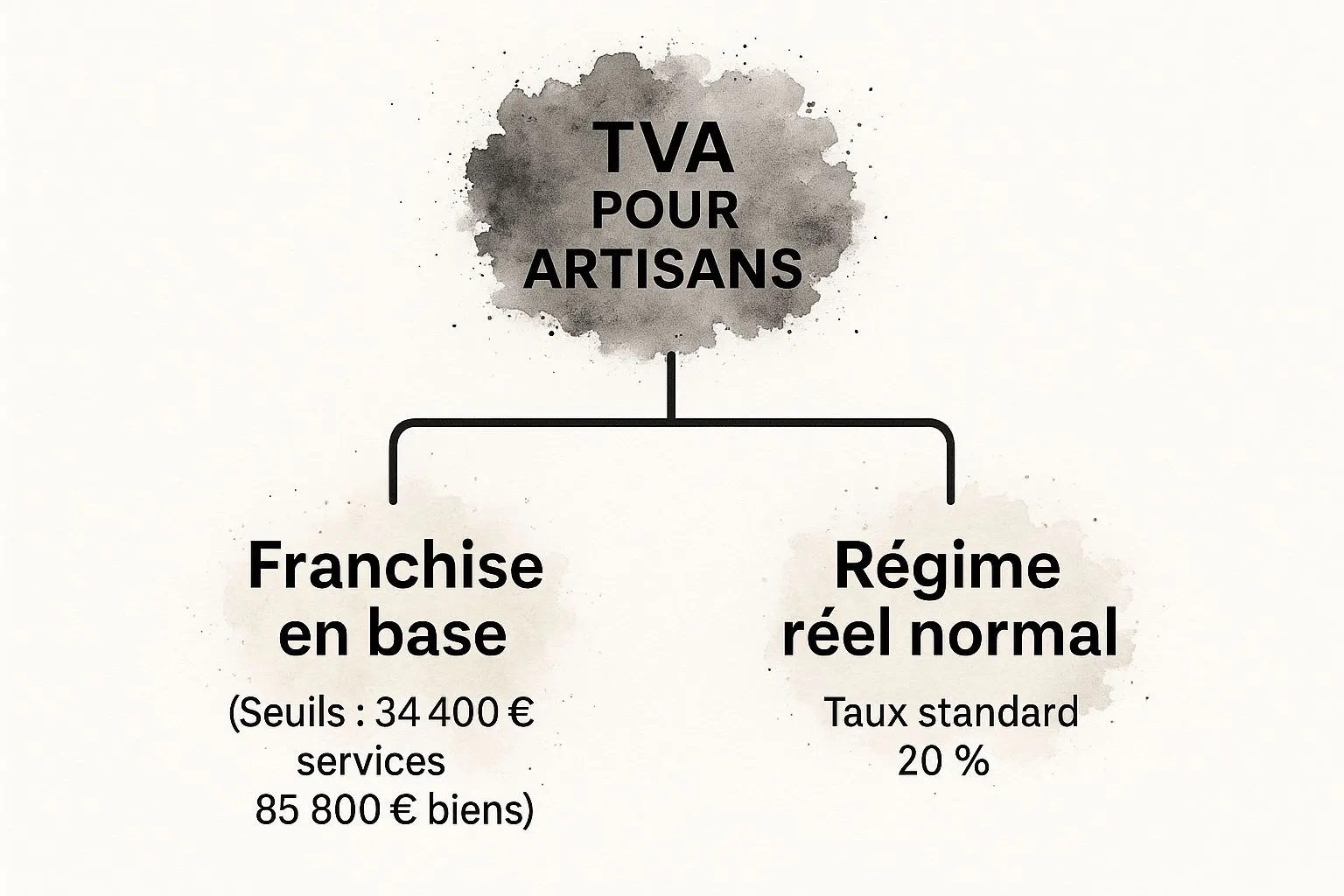
The main advantage of the standard real scheme is its responsiveness. If you have a VAT credit (you’ve paid more VAT on your purchases than you’ve collected on your sales), you can request a refund very quickly. No need to wait until the end of the year. For managing your cash flow as accurately as possible, especially in the case of major investments, this is a major advantage.
Choosing the right VAT scheme for tradespeople is never set in stone. It should live and evolve with your business. The key is to anticipate threshold crossings and always align your tax strategy with your growth strategy.
To help you see things more clearly, here’s a summary table of the three options.
Comparison of VAT schemes for tradespeople
This table compares the features, revenue thresholds, advantages and disadvantages of each VAT scheme to help tradespeople make an informed choice.
| Criterion | Exemption scheme | Simplified real scheme | Standard real scheme |
|---|---|---|---|
| Principle | Exemption from VAT declaration and payment. | Annual return with half-yearly instalments. | Monthly (or quarterly) return. |
| 2024 thresholds | < €91,900 (sales) / < €36,800 (services). | Between the exemption thresholds and €840,000 (sales) / €254,000 (services). | > €840,000 (sales) / > €254,000 (services) or by option. |
| Advantages | Administrative simplicity, more competitive sale price for private customers. | Balance between simplicity and VAT recovery, flexible cash flow management. | Precise cash flow tracking, fast VAT credit refund. |
| Disadvantages | Cannot recover VAT on purchases, can be a deterrent for business customers. | Less responsive than the standard scheme for VAT credits. | Heavier administrative burden, requires rigorous bookkeeping. |
| Ideal for… | Starting a business, tradespeople working mainly with private individuals. | Growing businesses with regular purchases and investments. | Established businesses, making significant investments or working with professionals. |
This comparison highlights the fact that there’s no absolute “best” scheme. The optimal choice depends entirely on your situation, your ambitions, and the nature of your clientele.
Keeping a close eye on your revenue thresholds is essential!

Staying under the VAT exemption scheme may seem comfortable, but this comfort has its limits: the famous revenue thresholds. You shouldn’t see these thresholds as obstacles, but rather as indicators on your business’s dashboard.
Ignoring them is a bit like driving without ever checking your fuel gauge. You risk running out at the worst possible moment, and the consequences can be tricky to manage. Mastering these ceilings is therefore crucial for any tradesperson who wants to steer their growth calmly, without unpleasant tax surprises. The idea isn’t to slow down your development, but to anticipate it so you can make the right decisions at the right time.
Understanding the two-threshold rule
When it comes to the exemption scheme, there isn’t just one but two thresholds to keep an eye on: the base threshold and the increased threshold. This is an important nuance that gives you some room to manoeuvre.
- The base threshold: This is the “classic” limit of the exemption scheme. For craft services, it’s €36,800 net. For the sale of goods, such as jewelry making or crafting objects, it’s €91,900 net.
- The increased threshold (or tolerance threshold): Think of it as a safety net. It’s set at €39,100 for services and €101,000 for sales.
As long as your annual revenue stays under the base threshold, no worries, you remain under the exemption scheme. If you exceed it in one year but stay under the increased threshold, you enter a “tolerance period”. You can keep the exemption for the current year, but on one condition only: that your revenue in the previous year (N-1) was well below the base threshold.
The real turning point is exceeding the increased threshold. If you cross it, even during the year, the change of scheme is immediate. VAT becomes mandatory on your invoices from the first day of the month in which the threshold was exceeded.
Let’s imagine a jewelry maker (sale of goods) who generates €95,000 in revenue in year N. If in N-1 she had billed less than €91,900, she can quite happily remain under the exemption scheme for the whole of year N. However, if in October of year N her revenue reaches €102,000, she switches over: she’ll have to charge VAT on all her sales from October 1st.
How to set up simple, effective tracking
You don’t need expensive accounting software to track your revenue. A simple, carefully maintained spreadsheet does the job perfectly, as long as you’re rigorous and update it regularly.
Here’s a simple method to never be caught off guard:
- List your invoices: Every month, get into the habit of noting the date, number, and net amount of each invoice you issue in your spreadsheet.
- Calculate the running total: Add a column that automatically adds up revenue since January 1st. This gives you a clear, real-time view of your progress.
- Set visual alerts: To make it even clearer, set up your spreadsheet so the running-total cell changes colour. For example, it could turn orange when you reach 80% of the base threshold, and bright red as you approach the increased threshold.
This proactive tracking lets you stop being caught off guard by the situation. Seeing that you’re approaching the threshold gives you time to anticipate the move to the simplified real scheme: notify your customers, update your quote and invoice templates, and perhaps adjust your prices accordingly.
This discipline matters even more as the context evolves. In Nouvelle-Aquitaine, which had 155,449 trade businesses at the start of 2025, around 38% of tradespeople are service providers. Since 2023, the reform of the National Business Register (RNE) has required better qualification of activities right from registration, which has a direct impact on tax status and VAT obligations. These changes call for even more precise tracking of thresholds. To learn more, you can check out the key figures for the regional trades sector.
In short, good management of VAT for tradespeople starts with impeccable tracking of these thresholds. It’s the key to turning what can seem like a tax constraint into a genuine strategic tool for your growth.
Applying the right VAT rate without getting it wrong
Once you have to charge VAT, the big question arises: which rate should you apply? This is a crucial step. A mistake can eat into your margin, but can also put you in an awkward position with your customers and, of course, the tax authorities.
Fortunately, the logic is quite simple to follow once you’ve got the keys in hand.
The starting point is the standard rate of 20%. This is the default rule for most of your services and the sale of new equipment. But where it gets interesting for a tradesperson, especially in construction, is with the reduced rates. They’re a real asset for making your quotes more competitive.
The craft construction sector is a heavyweight: it accounts for nearly 37% of French trade businesses and generates around 46% of overall revenue. In this context, VAT is a major issue that directly influences the profitability of every project. You can also take a look at the economic data for the craft construction sector to better grasp its importance.
The standard rate of 20%: the general rule
Think of the 20% rate as your safety net. It applies to all work that doesn’t tick the very specific boxes for reduced rates. It’s simple, it’s the baseline.
In concrete terms, you’ll use it for:
- Work on new buildings or those less than two years old.
- Outdoor developments, such as installing a gate, building a terrace, or garden maintenance.
- Extending a home that increases the floor area by more than 10%.
For example, if a customer asks you to build a garage attached to their house or install a swimming pool, it’s indeed the 20% rate that will appear on your invoice.
The intermediate rate of 10% for renovation
This 10% rate is the best friend of finishing-trade tradespeople! It covers the vast majority of improvement, alteration and maintenance work, with one golden condition: the home must have been completed more than two years ago.
It covers projects that are very common in your day-to-day work:
- Repairing a roof or plumbing.
- A complete renovation of a kitchen or bathroom.
- Replacing windows (with no particular energy-performance requirement).
Let’s imagine you’re redoing all the wiring in an apartment built in the 1980s. Your invoice will show VAT at 10%. To go further, our guide on calculating the VAT rate will give you other illustrative examples.
The reduced rate of 5.5% for energy performance
Here’s the most advantageous rate: 5.5%. It was designed to encourage energy-renovation work. It’s a powerful sales argument for convincing your customers to invest in greener, more economical solutions in the long run.
Here, the conditions are a bit stricter. The home must still be over two years old, and the work must clearly improve its energy performance.
This applies, for example, to:
- Installing a heat pump, a pellet or biomass boiler.
- Thermal insulation work (walls, attics, floors).
- Fitting high-performance double- or triple-glazed windows.
An essential point to watch: to apply the 10% or 5.5% rates, your customer must absolutely provide you with a signed VAT certificate before you issue the final invoice. This document confirms that the work is indeed eligible and protects you in the event of an audit. Never forget it, since you’re jointly liable for its validity.
By mastering these three VAT rates for tradespeople, you not only secure your invoicing, but you also position yourself as an expert who knows how to guide your customers towards the best solutions.
Deductible VAT: turn it into a real ally for your cash flow
If you’re a tradesperson subject to VAT, you may tend to see this tax as a mere administrative constraint. Yet it’s a two-way mechanism that, once well understood, can become a genuine lever for your cash flow. The concept is simple: the VAT you pay on all your business purchases can be deducted from the VAT you charge your customers.
Picture a scale. On one side, you place the VAT you’ve collected from your customers (output VAT). On the other, you put all the VAT you’ve paid on your business expenses (input/deductible VAT). Your return simply comes down to calculating the difference between the two.
By managing this closely, you move from a simple bookkeeping chore to a genuine financial strategy. Every purchase invoice you carefully keep becomes a piece of the puzzle that directly lightens your tax burden.
What you can actually deduct
The principle is fairly broad, but there’s one golden rule: the expense must be strictly necessary for carrying out your trade. Good news, this covers the majority of your everyday purchases, and the amounts can add up quickly.
Here are the main categories of expenses where you can recover VAT:
- Raw materials and supplies: Often your biggest expense item. We’re talking about wood, paint, cabling, plumbing… everything you use to produce your work.
- Equipment and tools: The purchase of your new machine, your power tools, or even your personal protective equipment (PPE) is covered.
- Subcontracting costs: Do you call on a fellow tradesperson for help on a job? The VAT on their invoice is deductible for you (except in the specific case of the reverse-charge mechanism).
- Overhead expenses: Think of your workshop rent, your electricity bills, your phone and internet plans, or your invoicing software subscription.
- Fuel: This is an important point. VAT on diesel and superethanol E85 is deductible at 80% if you have a passenger vehicle, and at 100% for a commercial vehicle. For petrol, it’s 80% in all cases.
As you can see, VAT for tradespeople isn’t just about collection. It’s also a smart game of deduction.
Careful, not everything is deductible!
Of course, there are limits to prevent abuse. The tax authorities have set clear rules, and it’s worth keeping them in mind to avoid unpleasant surprises when filing your return.
The rule to remember is simple: if an expense is personal in nature or not directly related to your business, the VAT isn’t recoverable.
Here are a few classic examples of non-deductible VAT:
- Expenses related to your personal home, even if you’ve set up your office there.
- Passenger transport costs such as train or plane tickets.
- The purchase and upkeep of most passenger vehicles (note, this differs from fuel).
- Business gifts exceeding €73 gross per year and per recipient.
Making this distinction is the foundation of sound bookkeeping and protects you from a potential tax reassessment.
VAT credit: a breath of fresh air for your cash flow
And what if the scale tips the other way? This happens, especially in months when you make major investments. The amount of your deductible VAT (what you’ve paid) can then exceed that of your output VAT (what you’ve charged).
In this case, you get a VAT credit. You then have two options:
- Carry it forward to future returns: You keep this credit and use it to avoid paying the VAT you’ll owe the following month or quarter. This is a carry-forward.
- Request a refund: If the amount is significant, you can ask the tax authorities to transfer the sum directly into your business account. It’s an excellent way to replenish your cash flow right after a major investment.
How to file and pay your VAT with confidence
https://www.youtube.com/embed/D3CG-zLTlOI
Understanding the VAT rules is one thing. Knowing how to actually file and pay it is even better! For tradespeople, this step can seem daunting at first, but rest assured: it’s mostly a matter of organization. Once you’ve got the hang of it, it becomes a simple formality.
Everything happens online, directly on your professional account on the tax authority’s website. The form and filing frequency won’t be the same depending on your scheme. Let’s take a closer look so you can handle this task with confidence.
The simplified real scheme: an annual return (CA12)
If you’re under the simplified scheme, your main VAT appointment happens once a year. You’ll need to fill out the CA12 return before the second working day following May 1st. This document is a comprehensive summary of all the VAT you’ve charged and all the VAT you’ve paid on your business purchases over the past year.
The secret to not being overwhelmed by the CA12? Anticipation. Whatever you do, don’t wait until the last minute to gather your figures. Good tracking of your invoices, month after month, will save you unnecessary stress and a huge amount of time.
Alongside this return, the tax authorities don’t wait a full year to collect VAT. You’ll therefore pay two instalments during the year, one in July and the other in December. The amount of these instalments is calculated based on the VAT you paid the previous year, which helps smooth out the cash-flow effort.
The standard real scheme: monthly tracking (CA3)
For those under the standard real scheme, the pace is faster. VAT is declared and paid every month using the CA3 form. One small exception: if your total annual VAT is less than €4,000, you can request to file this return quarterly instead.
This more frequent rhythm has a real advantage: it gives you a clear, near-instant view of your VAT situation. You always know exactly where you stand, which is excellent for managing your cash flow as precisely as possible. It’s particularly handy if you often have VAT credits to recover.
In concrete terms, to fill out your returns, the process is fairly simple:
- Log in to your professional account on the impots.gouv.fr website.
- Go to the “Déclarer la TVA” (File VAT) section.
- Fill in the boxes for your revenue excluding tax (for output VAT) and your expenses (for deductible VAT).
- The calculation of the amount to pay or the credit in your favour is automatic.
- Confirm your return and proceed to online payment.
Whether the process is annual or monthly, it will eventually become second nature. If you’re just starting out, don’t hesitate to get help the first time to find your footing. By the way, many micro-entrepreneurs ask themselves these same questions too, even though their situation is a bit different; you can learn more about VAT for micro-entrepreneurs for comparison. Ultimately, good organization is really the key to turning this administrative obligation into a simple routine.
The questions every tradesperson asks about VAT
Managing VAT for tradespeople is often a headache. To help you see things more clearly, we’ve compiled the questions that come up most often, with simple, direct answers. The idea? To save you time and peace of mind.
Juggling your tax obligations is part of the job. Having the right reflexes on these key points saves you a lot of trouble and helps secure your business for good.
As a micro-entrepreneur, do I charge VAT or not?
No, that’s actually one of the pillars of the micro-entrepreneur scheme. As long as you’re under the VAT exemption scheme, all your invoices must be issued net of tax.
To keep everything above board, don’t forget to add the legal mention: “VAT not applicable, art. 293 B of the French Tax Code” on every one of your invoices. If you start charging VAT, whether by choice or because you’ve exceeded the thresholds, you must switch to a real taxation scheme.
What if I’m late filing my VAT return, is that a big deal?
An oversight can happen to anyone. The problem is that the tax authorities don’t take deadlines lightly. A simple delay triggers interest of 0.20% per month, plus a 10% surcharge on the amount of VAT owed.
The best advice we can give you: react immediately. File your return and pay what you owe as quickly as possible so the bill doesn’t keep climbing.
Is VAT the same for a private customer and a business customer?
For you, yes. The mechanism is the same. Whether your customer is a private individual or another business, you apply exactly the same rates and the same rules on your invoices.
Where everything changes is for your customer. A business can recover the VAT you charge them by deducting it from their own return. A private individual cannot. That’s why it’s essential that your invoices for professional customers are flawless, otherwise they risk having trouble recovering their VAT.
A major exception to know in the construction sector: the VAT reverse-charge mechanism for subcontracting. If you work for another business as a subcontractor, you don’t charge VAT. Your invoice is issued net of tax and must carry the mention “Reverse charge”. It’s the business that hired you (the main contractor) that will handle declaring and paying it all.
This somewhat particular rule was put in place to simplify things on projects with many different parties involved. Beware, it only applies to construction/property work, and it’s a crucial point to watch for all tradespeople in the building sector.
Managing VAT, quotes, invoicing… it can quickly become a full-time job. Bizyness was created precisely to simplify the lives of tradespeople by taking care of all this paperwork. You focus on your core trade, we take care of the rest. Discover how Bizyness can transform your administrative management.
