

 Français
The complete guide to 'VAT not applicable'
Everything you need to know about the 'VAT not applicable' mention (art. 293 B of the French Tax Code). Our guide for sole traders explains the thresholds, invoices and obligations.

If you come across the mention “VAT not applicable” on an invoice, it simply means the business sending it to you benefits from a rather convenient tax regime: the VAT exemption scheme (franchise en base de TVA). In short, it is exempt from collecting and remitting VAT to the State.
It’s a real boost for sole traders (micro-entrepreneurs) and small businesses. It considerably lightens the paperwork and can even make their pricing more competitive.
What “VAT not applicable” really means

Imagine starting your business without having to worry about VAT returns. That’s exactly what the VAT exemption scheme allows. You bill your clients for the net amount of your service or product, without adding tax on top. This can be a real advantage for winning over clients, especially individuals who, either way, never reclaim VAT.
Of course, there’s a flip side. In exchange for this simplification, you cannot reclaim VAT on your own business expenses. Equipment purchases, software subscriptions, supplies… the VAT you pay on all of that becomes a cost you cannot deduct.
The legal framework behind this simplicity
This mechanism is well governed by law, specifically by article 293 B of the French General Tax Code (CGI). It was designed as a genuine enabler for freelancers and sole traders. The idea is simple: free you from periodic VAT returns so you can focus on what really matters — growing your business. To see how this information is included in official documents, you can take a look at the company’s legal notice.
Think of it as an administrative fast lane, designed to lighten the burden on small businesses and encourage people to take the leap. It’s a gateway into entrepreneurship that removes one of the most dreaded accounting headaches.
The VAT exemption scheme is more than just a mention on an invoice; it’s a strategic choice that directly impacts your pricing policy, your margin and your day-to-day administrative management.
Here are the key points to remember about this regime:
- Tax-free invoicing: Your clients pay the price shown, with no tax added.
- No VAT recovery: The VAT you pay on your business purchases is not refunded.
- Simplified management: You are freed from the obligation to file VAT returns.
- Mandatory mention: Every invoice you issue must carry the legal mention: “VAT not applicable, art. 293 B of the CGI”.
The VAT exemption scheme at a glance
To help you see things more clearly, this table summarizes the direct implications of the VAT exemption scheme. It will let you quickly assess whether this regime suits your situation.
| Aspect | Advantage for your sole trader business | Drawback to consider |
|---|---|---|
| Pricing | More competitive prices, especially for individual clients (B2C). | Less attractive for business clients (B2B) who cannot reclaim VAT on your invoices. |
| Management | Huge simplification: no VAT return to manage. | Obligation to closely monitor your revenue so as not to exceed the thresholds. |
| Cash flow | No need to advance VAT to the State. | VAT on your own purchases (investments, supplies) is not deductible and weighs on your margins. |
In short, this regime is often ideal at launch, when investments are limited and the priority is getting started without drowning in accounting. But it’s crucial to weigh the pros and cons carefully based on your business and your growth ambitions.
What is the VAT exemption scheme?
Far more than a simple mention to add to your invoices, the VAT exemption scheme is a tax mechanism designed to ease the life of small businesses. Think of it as a helping hand from the administration to let you get started without drowning in paperwork.
The principle is simple: if you’re eligible, you’re exempt from declaring and paying VAT to the State. In practical terms, that means less accounting, fewer returns to file, and therefore far less risk of making a mistake.
For the State, VAT is an essential source of revenue. By granting you this “exception,” it sends you a strong signal: focus on growing your business, we’ll deal with the tax side later.
The role of article 293 B of the CGI
The legal foundation of this whole system is article 293 B of the French General Tax Code (CGI). It’s not just legal jargon — it’s this precise text that gives you the right not to charge VAT. It’s thanks to this article that you can legally issue tax-free invoices.
The mention “VAT not applicable” on an invoice therefore means that the business benefits from this special regime, because it does not exceed certain revenue thresholds. The advantage is being able to offer prices without VAT. The trade-off is that it’s impossible to reclaim VAT paid on your own business purchases.
It’s therefore a genuine simplification tool, but you need to understand how it works to use it wisely.
The VAT exemption scheme is not a tax loophole. It’s a first step designed to make it easier to launch and get through the early years of a business.
The balance of the tax system
This mechanism fits into a logic of balance. On one hand, it gives you a significant competitive advantage, especially if your clients are individuals (B2C) who, either way, don’t reclaim VAT. Your prices can be more attractive than those of competitors who are required to charge 20% more.
On the other hand, this advantage comes at a cost: you cannot deduct VAT on your own expenses. Every euro of VAT you pay on your computer, your software or your raw materials becomes a final cost for your business. This can quickly eat into your margin.
This regime is therefore a genuine strategic choice. It depends on your business model, your clients and the amount of your investments. For sole traders, mastering the rules of VAT for micro-entrepreneurs is crucial to avoid unpleasant surprises. It’s about finding the right balance between administrative simplicity and cost optimization.
Staying within the revenue thresholds
To keep invoicing with the “VAT not applicable” mention, there’s one indicator you need to watch closely: your revenue. Far from being a mere administrative constraint, tracking your revenue is a genuine dashboard that lets you steer and anticipate the growth of your business.
Think of these thresholds as growth milestones. As long as your revenue stays below them, your management stays simplified. Once you cross them, you move up a gear and it’s time to switch to the VAT regime.
Understanding the exemption caps
The amount of this famous cap depends directly on the nature of your business. There are two main categories, each with its own annual limits.
- Trading and accommodation activities: If you sell goods or offer accommodation (such as gîtes or guest rooms), your reference cap is €91,900 per year.
- Services and liberal professions: For all service activities (consultants, graphic designers, developers, etc.) and liberal professions, the threshold is much lower: €36,800 per year.
It’s simple: if your revenue for the previous year (N-1) did not exceed these amounts, you remain under the VAT exemption scheme for the entire current year (N).
This decision tree shows you at a glance whether VAT applies to you or not.
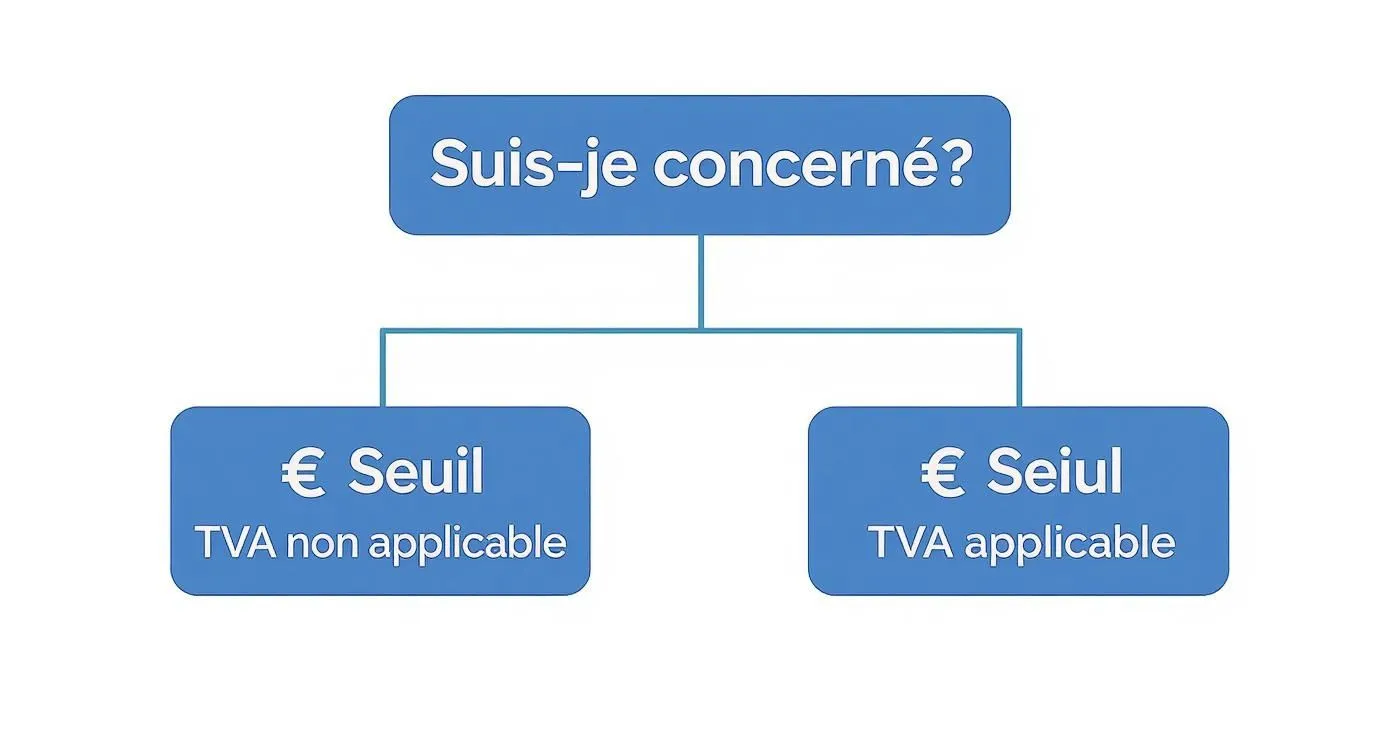
As this diagram clearly shows, staying below the thresholds is condition number one for keeping the “VAT not applicable” mention and maintaining lighter-weight management.
The tolerance threshold mechanism
Fortunately, the tax administration has built in some flexibility so as not to penalize a good year or sudden growth. This is where the “tolerance threshold,” also called the “increased threshold,” comes in. It gives you some leeway before you’re forced to switch to the VAT world.
The tolerance threshold is a bit like your safety net. It lets you exceed the base threshold for one year without immediately losing the benefit of the exemption, provided you stay within limits the following year.
To help you visualize this, here’s a summary table of the different thresholds that determine whether you can remain under the VAT exemption scheme.
Revenue caps for the VAT exemption scheme
| Type of activity | Exemption threshold | Increased (tolerance) threshold |
|---|---|---|
| Sale of goods and accommodation | €91,900 | €101,000 |
| Services and liberal professions | €36,800 | €39,100 |
How does this work in practice?
If your revenue falls between the base threshold and the increased threshold for one year, don’t panic — you keep the exemption. But be careful: if you exceed the base threshold again the following year, you become liable for VAT starting January 1 of that second year.
The real change happens if you exceed the increased threshold during the year. In that case, the switch is immediate. You must start charging VAT to your clients from the first day of the month in which you exceeded it. Regular, ideally monthly, monitoring of your revenue is therefore essential so you’re not caught off guard and can calmly prepare for this important transition.
What to do if you exceed the thresholds?
Crossing the VAT thresholds might seem intimidating, but think of it as good news instead: your business is growing! It’s a sign that things are going well. This transition remains above all an administrative formality, but it does require some rigor to handle it smoothly.
The golden rule to remember is simple: from the first day of the month in which you exceed the increased threshold, you switch to the VAT world. There is no grace period. In practical terms, if you exceed the threshold on the 15th of the month, all invoices issued from the 1st of that same month must be corrected to include VAT.
This responsiveness is essential. Delaying, even by a few days, can quickly lead to complications with the tax administration and penalties. It’s best to act right away!
The steps to follow immediately
Your first move? Contact your Business Tax Office (SIE). This is step one for officializing your change of status. By notifying them, you trigger the process that will make you a VAT collector in the eyes of the State.
Once this step is done, the tax administration will assign you your intra-community VAT number. This number is much more than just a string of digits — it becomes essential for:
- Invoicing legally: It must appear on all your new invoices.
- Trading in Europe: It’s required for all transactions with businesses located in the European Union.
- Declaring your VAT: It’s your official identifier for filing your periodic returns.
To better understand how the tax works, our guide on calculating VAT will shed light on the different steps and the right habits to adopt.
Communicating the change to your clients
Switching to VAT will mechanically increase your rates by 20% (or the applicable rate). For this to go smoothly, clear and transparent communication with your clients is crucial. It’s the key to preserving your relationship of trust.
The best advice: plan ahead! When you feel you’re approaching the thresholds, start preparing the ground. Let your clients know that a price increase, corresponding to the application of VAT, is likely in the near future.
Simply explain to them that it’s a direct consequence of your business’s growth, a legal step and not a choice on your part. For your business clients (B2B), the message is simple: this VAT is deductible for them, so the impact on their actual cost is nil. For individuals (B2C), this advance notice will spare them a bad surprise and justify the increase. Present it as a milestone of growth, not just a price hike.
Frequently asked questions about “VAT not applicable”
Even with the best explanations in the world, the VAT exemption scheme always raises very concrete questions. That’s entirely normal! To help you see more clearly in your day-to-day life as a sole trader, here are direct answers to the most frequent questions.
Can I invoice clients abroad without VAT?
Yes, no problem at all. Whether you’re under the VAT exemption scheme doesn’t depend on the location of your clients. Whether your client is in France, in another European Union country, or anywhere else in the world, the rule stays the same.
Just remember to always include the famous mention “VAT not applicable, art. 293 B of the CGI” on your invoices. Note, however, that there are a few special cases, particularly for certain digital services sold to individuals within the EU, which can have specific rules. But for the vast majority of cases, the principle of VAT non-application remains valid.
Disaster, I forgot to include the mention on an invoice! What am I risking?
Don’t panic, this is an administrative mistake that can happen. If the tax administration notices during an audit, it will probably ask you to correct the invoices concerned. For a business client, this can mainly create confusion, as they might think you’re subject to VAT and expect to reclaim it.
The most important thing is to be rigorous to avoid it happening again.
Pro tip: create yourself an invoice template where the mention is already built in. It’s the simplest solution to never forget it again and to make sure your documents are always compliant.
Do I need an intra-community VAT number?
As a sole trader under the VAT exemption scheme, the answer is no… in principle. You don’t need one to invoice your clients, even those located in the EU.
However, you will need to apply for one from your Business Tax Office (SIE) in one specific case: if you purchase services from a business based in the European Union for an amount exceeding €10,000 in one year. This number will of course become mandatory the day you exceed the exemption thresholds and start charging VAT.
If you’d like to explore other aspects of business management, take a look at our resources dedicated to finance.
Make your life easier and ensure compliance in one click. With Bizyness, the “VAT not applicable” mention is added automatically to your invoices, giving you more time to focus on your core business. Discover how at https://www.bizyness.fr.
