

 Français
VAT on bank fees: the essential guide for your business
Discover everything about VAT on bank fees and optimize your business's financial management. Click to learn more!

Decoding VAT on bank fees without getting lost
Think of running your business as a big financial puzzle. Each piece corresponds to an expense or a receipt. VAT on bank fees is one of those pieces, often set aside because it seems complex and hard to place. Yet understanding its logic is crucial for putting together a clear, optimized view of your finances. The stakes are concrete: every euro of VAT reclaimed is a euro that goes straight back into your cash flow.
To see things clearly, you first need to accept a simple reality: not all the fees your bank charges you are treated the same way by the tax authorities. Article 261 C of the French General Tax Code draws a clear line. On one side, purely financial operations are mostly exempt from VAT. On the other, service fees your bank charges you are indeed subject to it.
This distinction is the cornerstone of your entire reclaim process. It’s a bit like sorting your expenses: you need to learn to identify what’s “reclaimable” from what isn’t.
Banking services subject to VAT
This first category covers all services where your bank behaves like any other supplier. You pay for a clearly defined service, and that service is therefore subject to VAT, generally at the standard rate of 20%.
Here are the most common examples you’ll find on your bank statements:
- Account maintenance fees: This is the bank’s compensation for the day-to-day management of your business account.
- Your business debit/credit card fee: The annual or monthly cost of using your payment method.
- Renting a card payment terminal: Essential if you accept card payments at a physical point of sale.
- Certain specific services, such as investment or wealth management advisory.
These fees represent real opportunities to reduce your costs. To reclaim VAT on these items, the method is the same as for your other business purchases. If you want to master the details, our guide on calculating VAT can help you see things more clearly.
Financial operations exempt from VAT
On the other side, a good portion of bank fees is directly tied to financial operations. As such, the law exempts them from VAT. In practice, this means no tax is applied, and therefore there’s nothing to deduct.
This exemption mainly covers:
- Overdraft interest: The interest you pay when your account is overdrawn.
- Intervention fees: Charges billed by the bank following a transaction that causes an irregularity on your account.
- Fees related to credit operations, such as arrangement fees for obtaining a business loan.
- Commissions charged on transfers or direct debits.
The purpose of this exemption is to avoid placing an additional tax burden on transactions considered fundamental to how the economy functions. The rule of thumb to remember is simple: a service is taxed, while a purely financial operation is not. Keeping this principle in mind will be your best compass for analyzing your bank statements.
Who can reclaim VAT on bank fees: your situation
Your legal status and your tax regime are the two determining factors for reclaiming VAT on bank fees. Contrary to popular belief, this right isn’t reserved for large companies. In reality, any professional who is liable for and subject to VAT can claim it, whether they run an SARL or work as an independent consultant.
The central question isn’t “What’s my status?” but rather “Am I liable for VAT?” If you charge VAT to your clients, then the VAT you pay on your business expenses, including certain bank fees, can be deducted.
Choosing your tax regime when setting up your business is therefore a crucial moment. Take the example of Marie, a sole trader in consulting. For several years, she stayed under the VAT exemption threshold (franchise en base). During that time, she couldn’t deduct any expenses, which weighed on her profitability. By switching to the standard VAT regime, she was able to start reclaiming this tax on her fees and thereby improve her cash flow. The reverse is also true: going back to the exemption regime makes you lose this right.
Your tax regime under the microscope
The French tax system offers several options, each with specific VAT rules. It’s essential to understand which category you fall into.
- Micro-entrepreneur (with VAT exemption / franchise en base): This is the simplest scenario. You don’t charge VAT, so you can’t reclaim it. This regime offers lighter administration, but no possibility of deducting your fees.
- Micro-entrepreneur (under the standard VAT regime): If you exceed the exemption thresholds or voluntarily opt for the standard regime, you become liable for VAT. From that point on, reclaiming becomes possible. To learn more about this switch, our guide on VAT for sole traders covers all the steps in detail.
- Sole proprietorship (EI) under the standard VAT regime (simplified or normal): Whether your income falls under BIC (industrial and commercial profits) or BNC (non-commercial profits), if you’re under the standard regime, you’re liable for VAT and can therefore deduct it.
- Companies (SARL, SAS, EURL, etc.): By default, companies are subject to corporate tax (IS) and the standard VAT regime. Reclaiming VAT on bank fees is common practice and an integral part of their accounting.
To make things clearer, the table below summarizes VAT reclaim possibilities based on your situation.
| Legal status | Tax regime | VAT reclaim | Specific conditions |
|---|---|---|---|
| Micro-entrepreneur | VAT exemption (franchise en base) | No | Not liable for VAT. No invoicing, no deduction. |
| Micro-entrepreneur | Standard VAT regime (by option or threshold exceeded) | Yes | Must charge VAT and keep cash-basis accounting. |
| Sole proprietorship (EI) | Simplified or normal standard regime | Yes | Liable by default. Reclaiming is standard practice. |
| Company (SAS, SARL, EURL…) | Simplified or normal standard regime (IS or IR) | Yes | Liable by default. Reclaiming is built into the accounting. |
This table highlights an essential point: reclaiming VAT isn’t tied to the size of your business, but to your tax regime. Switching to the standard regime is often the gateway to optimizing your costs.
The infographic below helps you classify the most common bank fees and quickly visualize which ones are generally subject to VAT.
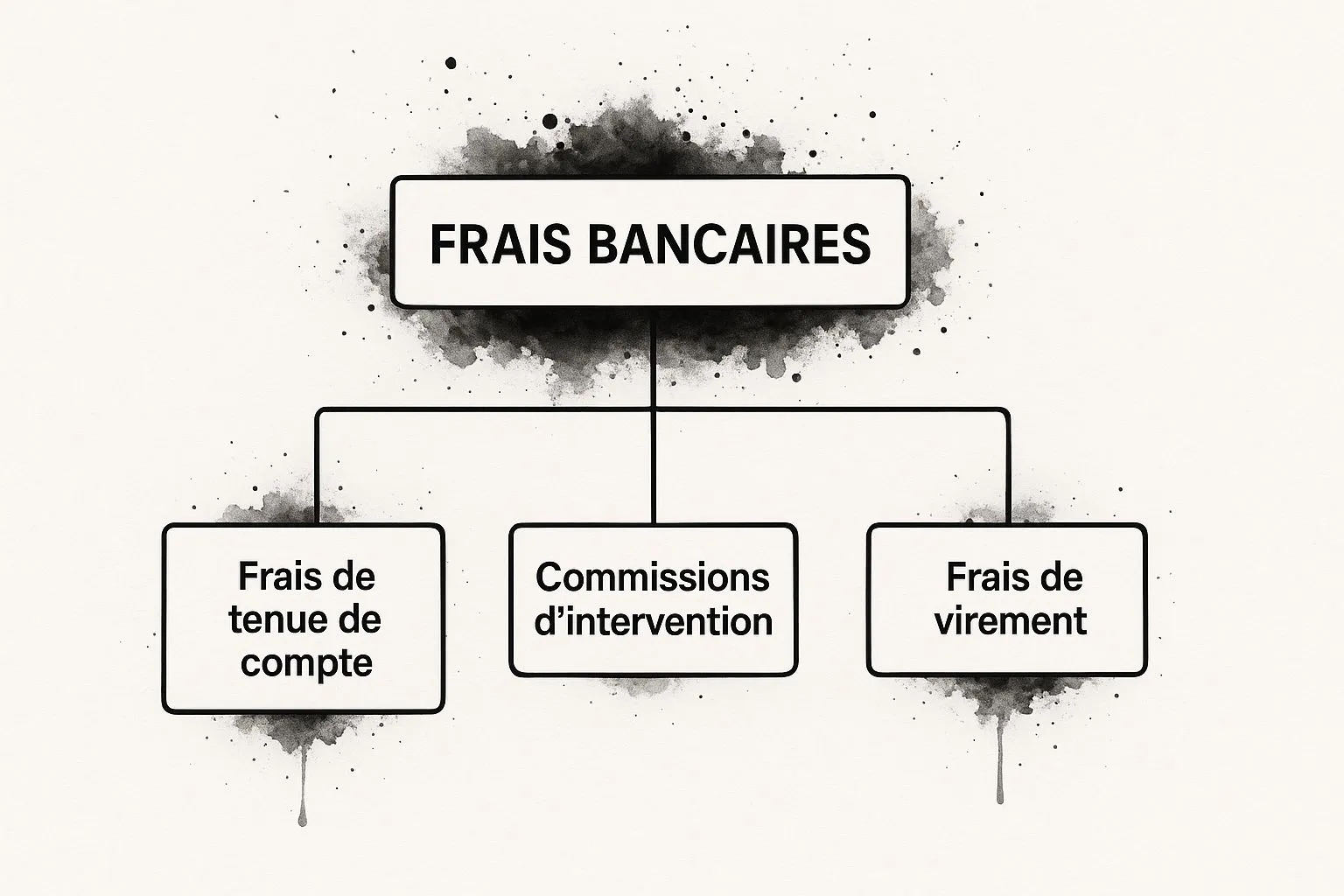
This diagram clearly highlights the difference between fees tied to a service (like account maintenance) and those corresponding to purely financial operations (like overdraft interest). This distinction is the basis for identifying what you can actually reclaim.
Identifying reclaimable bank fees on your statements
Turning your bank statements into a fiscal goldmine requires a trained eye and a methodical approach. To master reclaiming VAT on bank fees, you need to learn to decode this sometimes austere document and uncover the opportunities within it. Think of it as a treasure hunt: every line is a clue that can lead you to significant savings. The goal is no longer to passively endure your statements, but to actively analyze them to optimize your cash flow.
How to read your account statements
The first step is to distinguish between two broad families of fees: those subject to VAT and those exempt from it. This distinction, based on the nature of the transaction, is fundamental. Pure services, where the bank acts as a classic supplier, are generally taxable. Conversely, purely financial operations are most often exempt.
To guide you through this analysis, here’s a list of common fees and their usual VAT treatment:
- Account maintenance fees: This is a management service, so subject to VAT. Reclaiming it represents a direct savings lever.
- Business debit/credit card fee: The cost of your payment method is a service subject to VAT.
- Transaction commissions: Calculated on the total debit transactions, they’re considered a service and are therefore subject to VAT.
- Overdraft interest: This compensates a form of credit (the overdraft) and is therefore exempt from VAT.
- Intervention fees: Charged in case of irregularities, they’re exempt from VAT.
This distinction matters even more since some costs keep rising. For example, a recent study revealed that in 2025, account maintenance fees in France are expected to rise by 6.8%, affecting 86% of customers. The average annual cost would climb to 22.10 euros. To dig deeper into the topic, you can check out the findings of the CLCV survey.
Tips for error-free identification
The best practice is to carefully examine every line of your statement. Banks are required to clearly indicate the VAT amount when applicable. You should normally see a line or column specifying the pre-tax amount, the VAT rate (generally 20%), and the total including tax.
The official website Service-Public.fr provides precise information on businesses’ VAT obligations, as shown in this screenshot.

This official resource recalls the basic principles of deduction, emphasizing the importance of using goods and services for the needs of your own taxed operations. If a fee line on your statement doesn’t mention VAT, it almost certainly relates to an exempt operation. When in doubt, never hesitate to ask your bank advisor for a detailed supporting document. This rigor will ensure you don’t miss any reclaim opportunity.
Organizing your VAT reclaim step by step
Moving from theory to practice requires a structured approach. To properly reclaim VAT on bank fees, it’s not enough to know which fees are eligible; you also need to set up a reliable system to leave nothing to chance. It’s a bit like following a recipe: having the right ingredients is one thing, but following the steps in the right order is what guarantees a successful dish.
Picture the case of Thomas, the head of an SME. Previously, the end of every quarter meant long hours spent combing through his statements, constantly worried about making a mistake. By adopting a clear method, he turned this tedious task into a simple, profitable process. You can do the same.
Create your tracking dashboard
The first step is to equip yourself with a tracking tool. A simple spreadsheet like Microsoft Excel or Google Sheets works perfectly well. The idea is to list, month by month, the bank fees subject to VAT, detailing the pre-tax amount, the VAT amount, and the total including tax.
This tool will give you a clear, instant view of the amounts you can declare. Here’s a simple structure to adopt for your table:
- Column 1: Transaction date
- Column 2: Fee description (e.g., Business card fee)
- Column 3: Pre-tax amount
- Column 4: VAT amount (generally 20%)
- Column 5: Status (Supporting document received Y/N)
With this organization, you’ll know at a glance where you stand and which documents are missing.
Identify and keep the essential documents
The tax authorities are clear: no proof, no deduction. For VAT on your bank fees, certain documents are absolutely essential. These include detailed account statements, which must clearly show the VAT amount for each billed service. Add to that service contracts, for example for renting a payment terminal, and the specific invoices your bank may issue for certain services.
To help you see things clearly, here’s a checklist of documents to keep depending on the situation.
| Type of fee | Required documents | Retention period | Notes |
|---|---|---|---|
| Business card fee | Monthly account statement mentioning VAT | 10 years | The description must be clear. If VAT doesn’t appear, request a supporting document from your bank. |
| Card payment terminal (TPE) rental | Monthly or quarterly invoice from the provider | 10 years | The initial contract can also serve as proof, but periodic invoices are essential. |
| Fees on specific operations (international transfers, etc.) | Commission invoice or detailed transaction notice | 10 years | Make sure your company’s name appears clearly on the document. |
| Overdraft and debit interest | Account statement or interest breakdown | 10 years | VAT generally doesn’t apply to overdraft interest, but keep the document for accounting purposes. |
Keeping these documents is a legal obligation. The simplest approach is to digitize everything and organize the files in a dedicated folder on your computer or a secure cloud service. This habit will protect you in case of loss and greatly simplify preparing your returns or handling any audits.
Avoid common administrative mistakes
Certain mistakes, even small ones, can jeopardize your right to reclaim. One of the most common is not having a supporting document in your company’s exact name. A simple card receipt isn’t enough; the document must show your company’s registered name.
Similarly, it’s essential not to mix personal and business expenses. Using a bank account exclusively dedicated to your business greatly simplifies sorting and justifying fees. For sole traders, this separation is crucial, especially if you’re considering switching from the micro-entrepreneur regime to the standard regime. If this topic concerns you, our article on VAT for micro-entrepreneurs details the implications of this change.
Real cases of successful VAT reclaims
There’s nothing like concrete examples to really grasp the mechanics of VAT on bank fees. Let’s look together at practical cases of entrepreneurs who managed to turn what seemed like a simple expense line into a genuine saving. These stories show how attentive management can have a direct, positive impact on your cash flow.
Sophie’s realization, independent consultant
Sophie is a digital marketing consultant, operating as a sole proprietorship under the standard VAT regime. During her first two years in business, she saw her bank fees as an unavoidable cost, impossible to optimize. A line appeared every month on her statements: “Business account maintenance fee: €24 including tax.” Convinced this was a financial operation exempt from VAT, she paid it no attention.
It was during a conversation with a colleague that she had a realization. He explained to her that account maintenance fees and her business card fee weren’t financial operations, but genuine service provisions. And whoever says service provision, says VAT. Intrigued, Sophie pulled out her statements. She then noticed that the €4 of VAT was indeed mentioned every month. What’s more, her annual business card fee came to €144 including tax, which included €24 of reclaimable VAT.
The steps taken: Sophie immediately set up a simple tracking table. Every month, she notes down the relevant fees and the corresponding VAT amount.
The results: In a single year, she was able to reclaim €72 (€48 for account maintenance and €24 for her card). A small amount, certainly, but one that, added to other small optimizations, helped improve her margin. Her main obstacle was a lack of information, a problem she solved with a simple check.
TechCorp startup’s proactive optimization
TechCorp is a young SAS operating in the technology sector. From its founding, its director set up particularly rigorous cash flow management. For him, reclaiming every euro of VAT was a priority.
The company subscribes to several advanced banking services that generate significant fees:
- Renting payment terminals (TPE) for events: €600 excluding tax per year.
- Fees for maintaining several foreign currency accounts: €480 excluding tax per year.
- Transaction commissions on large flows: around €1,200 excluding tax per year.
The strategy: The CFO configured his management software to automate the classification of these expenses, an approach similar to what a tool like Bizyness enables. Every invoice or bank statement is scanned, and the VAT is automatically extracted and recorded.
The results: Thanks to this systematic approach, TechCorp reclaims more than €450 in VAT per year, on bank fees alone. The initial obstacle was the complexity and variety of fees, but automation made the process reliable. It turned a potentially tedious administrative task into a regular savings lever.
Avoiding costly mistakes in VAT reclaiming
Learning from others’ mistakes is often the least painful way to make your own practices more reliable. In the race to reclaim VAT on bank fees, certain pitfalls are common and can have significant financial consequences. Ignoring these pitfalls means risking losing money or being exposed to a tax reassessment.

The blur between personal and business
One of the most common mistakes, especially among sole traders, is mixing personal and business expenses. Take the example of Élise, a freelance graphic designer. During her first year, she used her personal debit card to pay for her stock photo subscription as well as her account maintenance fees. When it came time to file her VAT return, she had a hard time justifying the business nature of these expenses, which compromised her ability to reclaim the corresponding VAT.
The preventive solution: The golden rule is strict separation of accounts. From the moment you launch your business, open a bank account exclusively dedicated to it. This approach not only simplifies accounting and justifying fees, but also makes the VAT reclaim process much clearer and more defensible.
Neglecting supporting documents
Jean-Marc, who runs a small plumbing business, learned this lesson the hard way. For two years, he relied solely on his standard bank statements to justify his VAT reclaims. The problem? These documents didn’t systematically detail the VAT applied to the services billed by the bank. During an audit, the tax authorities rejected part of his deductions, for lack of compliant invoices. He thus lost the right to reclaim on nearly two years’ worth of certain fees.
Here are the pitfalls to avoid when it comes to supporting documents:
- Relying solely on the card receipt: This receipt is rarely sufficient. It doesn’t contain all the legal information required on an invoice.
- Not requesting a detailed invoice: If VAT doesn’t appear clearly on your statement, get in the habit of systematically requesting a detailed document from your bank.
- Poorly keeping your documents: The law requires keeping accounting records for 10 years. Digitizing and rigorous filing, for example using a tool like Bizyness, are your best allies for not losing anything.
These examples show that rigorous organization isn’t just a simple administrative constraint. It’s genuine insurance against mistakes that can be costly, and a guarantee that secures every euro of VAT you’re entitled to reclaim.
Your personalized action plan to optimize VAT
Now that the theory is covered, let’s move on to practice. For your knowledge of VAT on bank fees to turn into real savings, you need a clear roadmap. This action plan is designed to guide you step by step, starting with the most direct actions to improve your cash flow. The goal is simple: put in place an effective method that saves you time, not the other way around.
1. Your starting checklist (Impact: High / Ease: Simple)
Before diving into the details, it’s essential to confirm your situation. This first crucial step takes only a few moments and lays the groundwork for your entire process.
- Check your tax regime: Are you under the standard VAT regime (simplified or normal)? If you’re under the VAT exemption (franchise en base), reclaiming isn’t possible.
- Confirm your company’s VAT liability: Do you charge VAT to your own clients? This is the basic condition for having the right to deduct what you pay.
- Isolate your bank account: Do you use a bank account 100% dedicated to your business? If not yet, make it your priority. This will greatly simplify justifying your expenses in case of an audit.
2. Set up a tracking system (Impact: High / Ease: Medium)
Organization is your best ally for not letting anything slip through. A good tracking system will save you hours of catching up and mistakes that can be costly.
- Create a monthly tracking table: A simple spreadsheet is enough. List, month by month, the bank fees subject to VAT (card fee, account maintenance fees, etc.). For each line, note the date, description, pre-tax amount, and VAT amount.
- Automate the collection of supporting documents: Get in the habit of downloading your detailed bank statements every month. File them in a dedicated digital folder. If a taxable fee doesn’t clearly show VAT, contact your bank right away to get a supporting document.
- Set reminders: A simple calendar alert at the end of each month can make all the difference. Consistency is key to keeping this task from becoming a chore.
3. Establish active monitoring (Impact: Medium / Ease: Simple)
The tax landscape and banking offers aren’t set in stone. Staying informed helps you anticipate changes and seize new optimization opportunities.
- Analyze your annual statements: Take the time to carefully read the annual fee summary your bank sends you. It’s the perfect document for spotting new taxable services you might have missed throughout the year.
- Question your advisor: During your annual meeting with your bank advisor, ask directly: “Which of the services I pay you for are subject to VAT?”
By adopting this structured approach, managing VAT on bank fees becomes a mastered routine rather than a mental burden. To go further and make this tracking almost entirely automatic, tools like Bizyness can sync your bank transactions and prepare your VAT return with no effort on your part. Discover how Bizyness can simplify your management today.
