

 Français
Mastering VAT on clothing in 2026 for your e-commerce business
2026 guide to VAT on clothing: master the rates, OSS/IOSS and special schemes to ensure compliance and boost your online sales.

In France, the general rule is simple: new clothing is subject to a VAT rate of 20%. That’s the essential starting point for any e-commerce seller in fashion. But the tax reality is much more nuanced and, believe me, knowing the details can really make a difference for your business.
Understanding the VAT rules for clothing

Let’s approach VAT not as a constraint, but as a strategic lever. Mastering it means securing your margins, avoiding tax reassessments, and even gaining a competitive edge. The idea is to turn what looks like a tax headache into a competitive advantage.
Concretely, VAT (Value Added Tax) is a tax that you, as the seller, collect on behalf of the state. Every time a customer buys on your site, part of the price you receive doesn’t belong to you: you have to remit it. It’s a cash flow that must be managed with absolute rigor.
The standard rate of 20%: the basics to know
To begin with, keep in mind that selling new clothing in mainland France is subject to the standard VAT rate. Whether you sell on Shopify, PrestaShop, or a marketplace, this rate applies to the vast majority of your transactions.
In France, this rate is 20%, in accordance with Article 278 of the French General Tax Code (CGI). This is no small matter: with taxable revenue of over 25 billion euros in 2024 for the textile and clothing sector, it’s a major contributor. For an overview, feel free to explore the different VAT rates in France that can apply in other contexts.
Beyond the 20% rate: exceptions to know
Stopping at the 20% rate would be far too simplistic a view and would make you miss out on real opportunities. The world of fashion is full of special cases.
The complexity of VAT is not an obstacle, but a card to play. Knowing the rules allows you not only to stay compliant, but also to optimize your margins and your commercial offering.
To give you an idea, here are a few situations every e-commerce seller should keep in mind:
- Repair services: Offer to repair clothing? This service benefits from a reduced rate, an excellent way to ride the sustainability wave.
- Secondhand goods: The resale market is booming. It’s governed by a very specific VAT scheme, the margin scheme, which changes the game entirely.
- International sales: Selling to individuals in the EU opens up new horizons, but also new rules, notably via the OSS one-stop shop.
This guide is precisely here to help you see things clearly. The goal is simple: to give you the keys to manage your VAT with peace of mind, configure your tools correctly, and focus on what you do best: selling.
Here is a summary table to help you quickly visualize the main rates that matter to you.
Summary of VAT rates for the clothing sector in 2026
This table offers a clear and quick overview of the different VAT rates applicable to clothing depending on the nature of the product or service.
| Type of product/service | Applicable VAT rate | Context of application |
|---|---|---|
| New clothing and accessories | 20% (Standard rate) | B2C and B2B sales in mainland France. |
| Secondhand clothing | Rate on the profit margin | Special margin scheme, calculated on the difference between purchase and sale price. |
| Repair/alteration services | 10% (Intermediate rate) | Services aimed at repairing or altering an existing garment. |
| Children’s clothing (0-14 years) | Varies by country (e.g. 9% in Ireland) | Reduced rates applied in certain EU countries, subject to distance-selling rules. |
| Samples with no commercial value | 0% (Exemption) | Items provided free of charge for promotional purposes, under strict conditions. |
This summary highlights the importance of not applying a single rate to your entire catalog. Properly categorizing your products and services is the first step toward optimized tax management.
Applying the right VAT rate for sales in France and Europe
Knowing which VAT rate to apply is really the crux of managing your e-commerce business. For selling new clothing in France, the rule seems simple: the standard rate of 20% applies.
But concretely, what does that mean for your day-to-day cash flow?
Imagine: a customer orders a t-shirt for €30 including tax from your shop. This displayed price is not the amount that lands directly in your company’s pocket. You need to break this amount down to see it clearly.
Of these €30, the VAT portion you collect on behalf of the state is actually €5. The calculation is as follows: €30 / 1.20 = €25. Your actual revenue, excluding tax, is therefore €25 on this sale. This is the base on which you’ll then calculate your margin.
From selling in France to shipping across Europe
As long as you sell only to individual customers in France, it’s simple: it’s 20% on all your sales. But things get a bit more complicated as soon as you start shipping your collections to other countries in the European Union.
To make life easier for e-commerce sellers going international, a threshold has been put in place. Remember this figure: €10,000. This is the total annual revenue from your B2C sales in other EU countries.
As long as the total of your annual sales to individuals in the EU (excluding France) does not exceed this famous threshold of €10,000, you can continue to charge French VAT at 20%.
This is a real breath of fresh air for young shops. This mechanism lets you test the potential of markets like Germany or Spain without immediately diving into the complexity of different European tax systems. You declare this VAT simply through your usual French VAT return.
Exceeding the €10,000 threshold: a turning point for your business
The real shift happens when your European success pushes you past this €10,000 mark. From the very first sale that takes you over this amount, the rules of the game change entirely.
From that moment on, you’re no longer allowed to apply French VAT to your European sales. You’re required to charge VAT at the rate in force in the country where your customer lives.
For example:
- A sweater sold to a customer in Germany? You’ll need to apply German VAT of 19%.
- A dress shipped to Spain? That’ll be Spanish VAT of 21%.
- A scarf headed to Ireland? VAT climbs to 23%.
Each sale must then take into account the local rate of the destination country. It’s easy to imagine the administrative headache of managing this manually for every country! To better understand these principles, our article on the amount of VAT in France will give you a solid foundation.
It’s precisely to avoid this administrative maze that the VAT one-stop shop, or OSS (One-Stop Shop), was created. This tool becomes your best ally. Instead of having to register for VAT in every country where you sell, the OSS lets you centralize everything. You file a single quarterly return in France for all the European VAT collected, and the administration then takes care of remitting the amounts to the right countries. Anticipating this transition is the key to smooth international growth.
Selling in Europe: how the OSS and IOSS one-stop shops make life easier
When your clothing e-commerce business starts winning over customers beyond our borders, VAT management can quickly turn into a headache. Fortunately, the European Union has set up two mechanisms that change the game: the OSS and IOSS one-stop shops.
Think of these one-stop shops as a single management center for all your European VAT. Gone are the days when you had to register for VAT in every country where you sold (Germany, Spain, Italy…). Now you can declare and pay all this VAT from a single portal, in France. It’s a real breath of fresh air for e-commerce sellers.
OSS for your B2C sales in the European Union
The OSS (One-Stop Shop) is the tool that will matter to you as soon as your sales to individuals in the EU exceed the €10,000 annual threshold. As we’ve seen, once this threshold is crossed, you must charge VAT at the rate of your customer’s country. The OSS is precisely the solution for handling this obligation without drowning in paperwork.
Concretely, how does it work?
- Registration: You simply sign up for the OSS one-stop shop from your professional account on the impots.gouv.fr website.
- Sales: You sell your clothing as usual across Europe, making sure to apply the VAT rate of each customer’s country (for example, 19% in Germany, 21% in Spain). Your CMS, whether Shopify or WooCommerce, needs to be properly configured to handle this automatically.
- Filing: Each quarter, you fill out just one OSS return. It summarizes all your sales, country by country, with the corresponding VAT amounts.
- Payment: You make a single transfer to the French tax administration. It then takes care of remitting the amounts owed to each member state.
This decision tree perfectly illustrates the moment when the OSS becomes a logical step for your business.
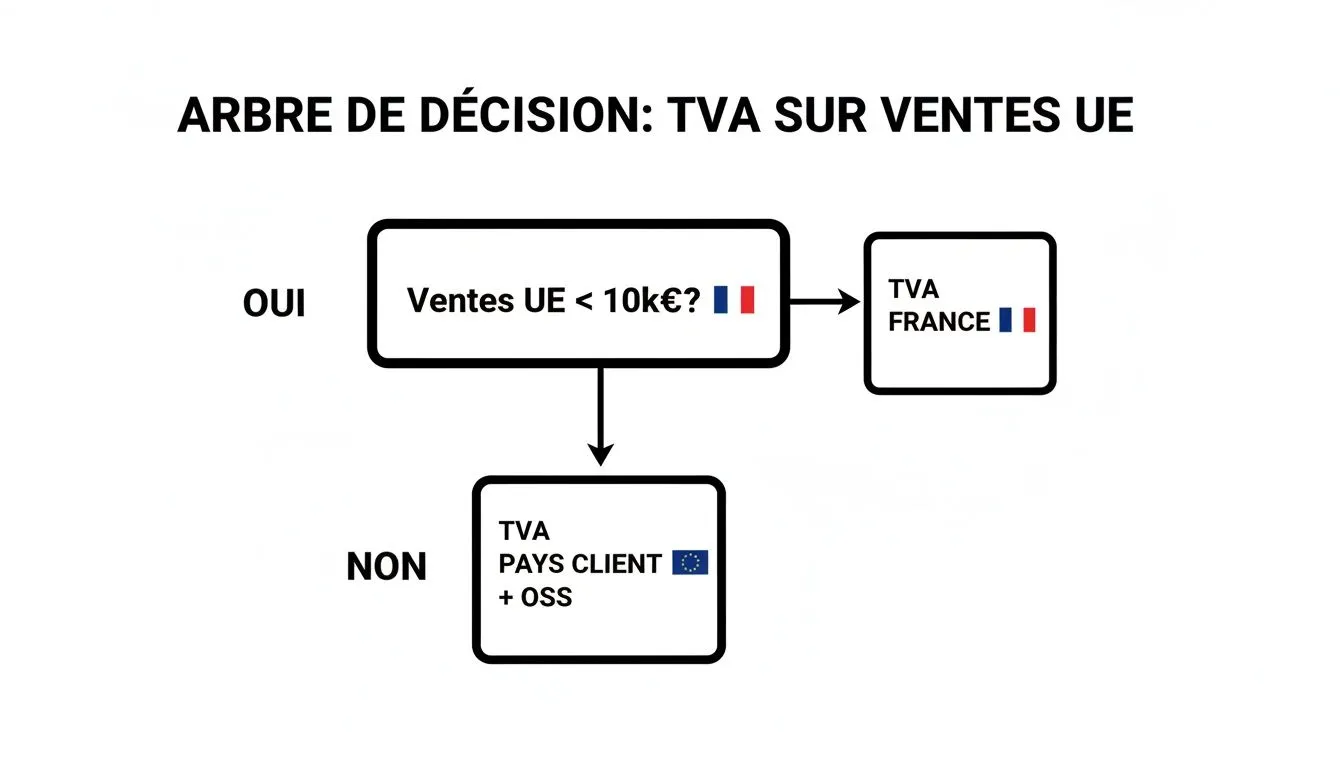
The diagram shows it clearly: the €10,000 threshold for B2C sales in the EU is the tipping point. Below it, you stay on French VAT. Above it, you switch to the customer’s country VAT, and the OSS becomes your best ally.
IOSS for low-value imports
If your business model relies on dropshipping, or if you import low-value items from a non-EU country (such as China) to sell in Europe, then the IOSS (Import One-Stop Shop) is what you need to know about. It’s the little sibling of the OSS, but designed specifically for imported parcels.
This system applies to shipments whose intrinsic value does not exceed €150. The benefit of the IOSS is that it lets you collect VAT at the very moment of sale. The advantages are immediate:
- No bad surprises for the customer: The price displayed and paid is the final price. No more unexpected customs or VAT charges on delivery that hurt the buying experience.
- Faster deliveries: Since the VAT is already paid, customs clearance is much smoother.
The process works very similarly to the OSS. You register for the IOSS one-stop shop, you charge the VAT of your customer’s country at the time of order, then you declare and pay this collected VAT each month via a single return. To better understand these flows, feel free to read our guide on the difference between collected VAT and deductible VAT.
Real-world scenarios for e-commerce sellers
To make everything crystal clear, let’s look at two typical examples in the VAT on clothing sector.
Example 1: Shopify seller shipping to Belgium
A French t-shirt brand, selling on Shopify, generates €15,000 in annual revenue from its Belgian customers. Having exceeded the €10,000 threshold, it must charge Belgian VAT of 21%. Thanks to the OSS, it declares and pays this VAT via its French portal, without ever having to obtain a Belgian VAT number.
Example 2: Dropshipping costume jewelry
An entrepreneur sells necklaces at €45 each, shipped directly from a Chinese supplier to customers in Germany. Using the IOSS, he charges the 19% German VAT at the time of purchase. The result: his customer receives the parcel faster and with no fees to pay to the delivery carrier.
These one-stop shops aren’t just simple administrative formalities. They’re real levers for securing your international growth and offering a better experience to your customers. By adopting them, you turn a tax constraint into a competitive advantage for your fashion e-commerce business.
Take advantage of reduced rates and special schemes

While the 20% rate applies to most new clothing, the world of VAT on clothing hides a few useful gray areas. These aren’t mere administrative exceptions, but real opportunities for your e-commerce business.
By understanding how to use them, you can not only reduce your tax burden but also offer a more attractive proposition and carve out a niche in the market. Two mechanisms, in particular, deserve your full attention: the reduced rate for repairs and the margin scheme for secondhand clothing.
Repair: a durable and tax-smart asset
With growing environmental awareness, offering a repair service has become much more than a simple after-sales service. It’s a strong selling point, and the tax authorities encourage it with a welcome incentive.
Since 2015, repair, alteration, or sewing services on clothing and household linen have benefited from a reduced VAT rate of 5.5%. This measure, found in Article 278-0 bis of the CGI, was designed to support the circular economy. To learn more, the legislative work on the subject is quite enlightening.
Be careful though, this reduced rate only applies to labor. If you supply parts (a new zipper, buttons), these supplies remain subject to the standard rate of 20%. So make sure to clearly separate these two elements on your invoices.
Take the example of an e-commerce seller who, alongside new jeans, offers an alteration service in partnership with a local workshop. By billing this service at 5.5%, they offer a more affordable service, in line with consumer expectations, while optimizing their taxation. It’s an excellent way to stand out.
Secondhand goods and their margin-based VAT scheme
The resale market is booming. If you’re thinking about launching a vintage collection or buying back secondhand items, you absolutely need to know about the VAT margin scheme.
This mechanism is specifically designed for secondhand goods bought from individuals not liable for VAT. Its principle is simple but remarkably effective: instead of calculating VAT on your total selling price, you calculate it only on the margin you make.
Concretely, how does it work?
- Purchase: You find a superb vintage jacket from an individual for €20. Since it’s an individual, there’s no VAT to recover on this purchase.
- Sale: You list this jacket for sale on your online shop at €70.
- Margin: Your gross margin is €50 (€70 - €20).
- VAT calculation: This is where the magic happens. VAT is calculated only on these €50. The VAT to remit to the state will therefore be: €50 - (€50 / 1.20) = €8.33.
Without this scheme, you would have had to collect VAT calculated on the total selling price, i.e.: €70 - (€70 / 1.20) = €11.67. The margin scheme directly saves you cash and protects your profitability.
To apply this scheme, rigorous bookkeeping is essential. You need to be able to trace, for each item, its purchase price and its selling price.
Integrating these models into your business isn’t just a simple tax adjustment; it’s a genuine strategy. You reach a new customer base, strengthen your brand image, and make your business more solid and diversified. Behind the apparent complexity of these schemes lie real growth opportunities for your e-commerce business.
Managing VAT as a sole trader (micro-entrepreneur)
Launching your clothing brand as a sole trader (micro-entrepreneur)? Excellent choice! This status is highly valued for its simplicity when starting out, notably thanks to a significant tax advantage: the VAT exemption threshold (franchise en base). It’s a genuine asset for staying competitive from your very first sales.
Concretely, this scheme allows you not to charge VAT to your customers. The price displayed in your shop is therefore the final price, which mechanically makes your items cheaper for the consumer. A significant advantage for gaining a foothold in the market.
Be careful though, this advantage is conditional on staying under certain revenue thresholds.
Understanding the VAT exemption threshold
Think of the VAT exemption as a kind of tax “trial period.” The state lets you focus on launching and growing your business, without immediately burdening you with collecting and filing VAT.
For a goods-selling business like yours, two thresholds need to be watched closely:
- The exemption threshold: This is the main ceiling not to exceed to keep this advantage.
- The increased threshold: A tolerance limit. If you go beyond it, the switch to VAT becomes immediate.
This scheme is very common. According to INSEE, among the roughly 120,000 sole traders in clothing e-commerce in 2025, about 70% benefit from the exemption. But as sales take off, VAT management becomes a central issue. To dig deeper into the topic, our full guide on VAT for sole traders is here for you.
Anticipating exceeding the thresholds
The most encouraging sign for your shop is of course rising revenue. Paradoxically, that’s also what brings you closer to the end of the VAT exemption. It’s crucial to anticipate this moment to avoid unpleasant surprises.
For selling clothing, here are the thresholds to know for 2026:
The VAT exemption threshold is set at €94,300 in annual revenue. As long as you stay below this amount, no VAT to charge. A tolerance threshold (or increased threshold) is set at €101,000.
If your revenue falls between these two amounts for two consecutive years, you’ll become liable for VAT starting January 1 of the following year. On the other hand, if you blow past the numbers and exceed the increased threshold of €101,000 during the year, you must apply VAT from the first day of the month in which you exceeded it.
This transition to VAT is a sign of success, but caution is needed. VAT errors cost sole traders €200 million in fines every year. A figure that’s a reminder of the importance of rigorous management. For more details, feel free to check the information on VAT rates and transactions on Compta-online.com.
Steps to become liable for VAT
Switching to the standard VAT regime may seem intimidating, but with a bit of organization, the transition happens painlessly.
Here are the key steps to follow:
- Request your VAT number: This is your very first mission. Contact your local business tax office (Service des Impôts des Entreprises, SIE) to obtain this famous intra-community VAT number. It’s essential for what follows.
- Update your invoicing: All your invoices must now clearly show the VAT rate, the amount excluding tax, the VAT amount, and the amount including tax. Don’t forget to add your new VAT number.
- Configure your online shop: Whether you’re on Shopify, WooCommerce, or another platform, you’ll need to configure the VAT rates. For new clothing in France, it will be 20%. The calculation must apply automatically to your customers’ carts.
- Declare and pay VAT: You’re entering a new cycle. You’ll need to declare the VAT collected (monthly or quarterly) to remit it to the state, while deducting the VAT you’ve paid yourself on your business purchases (fabrics, equipment, etc.).
Your checklist for bulletproof VAT compliance
Theory is good. Practice is better. To make sure VAT management never becomes a headache, the secret lies in organization and rigor. Think of this checklist as your personal roadmap for securing your fashion e-commerce business and sleeping soundly at night.
Each point has been designed to be directly applicable, whether your shop runs on Shopify, PrestaShop, or another solution. Now’s the time for a quick audit to make sure everything is in order.
1. Setting up rates in your back office
Everything starts behind the scenes on your site. This is where you need to configure the rules so the right VAT rates apply automatically, without you having to think about it with every order. It’s your safety net.
- The standard rate of 20%: Check that it’s properly set as the default for all your new clothing sold to customers in France. This is the basics.
- The reduced rate of 5.5%: If you offer services, such as clothing repair, make sure to create a specific rule. This rate should only apply to these services, not to the products themselves.
- European rates: Selling in Europe? Your system must be able to juggle the VAT rates of each country (for example, 19% in Germany, 21% in Spain). This is absolutely crucial once you cross the €10,000 threshold in annual EU sales.
Precise configuration from the start will save you a lot of headaches. Some automation tools can even manage this complexity for you, updating rates as legislation evolves.
2. The compliance of your invoices
An invoice isn’t just an order summary. It’s a legal document that must contain very specific information. If it’s not compliant, the tax authorities can reject it, and you could lose your right to deduct VAT.
Think of every invoice as a business card for your professionalism. It must be flawless, both to reassure your customer and to satisfy the tax authorities.
To keep everything in order, it’s essential to understand how to invoice a customer in France and properly incorporate VAT. Here are the points to never forget:
- Your intra-community VAT number.
- The VAT rate applied to each item in the order.
- The total amount of VAT collected.
- The excluding tax and including tax amounts, clearly distinguished.
3. Monitoring thresholds and returns
Managing VAT is a marathon, not a sprint. You need to keep a constant eye on your numbers to make sure you always comply with the rules, especially regarding revenue thresholds.
Keep an eye on the distance-selling threshold:
Set up an alert in your dashboard to monitor the famous €10,000 threshold for cumulative B2C sales in the EU. By anticipating when you’ll exceed it, you’ll have plenty of time to register for the OSS one-stop shop, stress-free.
Prepare your returns calmly:
Whether you’re filing your monthly or quarterly VAT return (the CA3 form) or the OSS return, anticipation is your best ally. Good accounting software can work wonders: it centralizes your sales data in real time and prepares your returns. This way you avoid hours of manual calculations and the risk of human error, while freeing up valuable time for what really matters: growing your brand.
FAQ on VAT and clothing
VAT on clothing is often a headache. To help you see things more clearly, we’ve gathered here the most frequently asked questions from fashion e-commerce sellers, with simple, direct answers so you can move forward with confidence.
Is a gift card for clothing subject to VAT?
It all depends on the card! For a “single-purpose” gift card, which can only be used to buy products subject to the same VAT rate (new clothing at 20%, for example), the tax applies when the card is purchased.
On the other hand, if your card is “multi-purpose” — meaning it can be used to buy both an item at 20% and a service at 5.5% (such as an alteration) — VAT is not due when the card is purchased. It will only be collected when your customer uses it for a specific product.
Should VAT be charged on shipping costs?
Yes, without hesitation. The rule is simple: shipping costs follow the VAT scheme of the main product. Concretely, if you ship a parcel containing only new clothing taxed at 20%, the shipping costs will also be subject to VAT at 20%.
It’s a matter of tax consistency for the transaction as a whole.
What VAT applies to a garment sold as a bundle with a customization service?
Here, two scenarios need to be distinguished. If the customization is an optional service that the customer can choose or not (embroidery billed separately, for example), then you can apply two separate rates: 20% on the garment, and a reduced rate on the service if it’s eligible.
Be careful, if you offer an inseparable “all-in-one” package, such as a “customized t-shirt,” it’s the VAT rate of the main element that prevails. The entire bundle will therefore be taxed at 20%. Caution is advised when structuring your offers.
How should VAT on product returns be handled?
When a customer returns an item to you, the standard procedure is to issue a credit note (facture d’avoir). This document simply cancels the original sale, and therefore the VAT you had collected at that time.
This credit note allows you to correct your accounting. The amount will be deducted from the VAT you owe to the state on your next return. This is a crucial step to avoid paying tax on a sale that, in the end, never happened.
To automate the complex management of VAT on your clothing, from invoicing to filing, Bizyness centralizes and secures all your financial flows. Discover how the platform can simplify your accounting at https://www.bizyness.fr.
