

 Français
 VAT Rate Calculation: A Practical Guide and Essential Tips
Learn how to calculate the VAT rate efficiently. Our guide helps you master VAT rate calculation for accurate, error-free invoices.
VAT rate calculation can seem intimidating, but it really comes down to two simple logics. Either you start from a tax-excluded price (net) to find the tax amount, or you extract it from a tax-included price (gross). But before reaching for the calculator, it’s worth understanding the mechanism.
VAT basics: what you need to know before you calculate

Before diving into the numbers, let’s go back to basics. Value Added Tax (VAT) is a consumption tax. In practice, it’s your end customer who pays it. Your business simply acts as a collector on behalf of the government.
So you invoice a gross price, which breaks down into two parts: your net selling price (what you actually earn) and the VAT you owe to the tax authorities. It’s a simple balancing act, but mistakes happen easily.
The different rates you need to know
In mainland France, there isn’t just one VAT rate — there are four. Your first task is to identify the one that applies to your business, because getting it wrong can be costly.
To help you see things clearly, here’s a table summarizing the main rates and their most common use cases.
The essential VAT rates in mainland France
This table summarizes the VAT rates you need to know and illustrates their applications with concrete examples to help you choose the right one.
| Rate Type | Rate | Concrete examples of application |
|---|---|---|
| Standard rate | 20% | The default rate for most goods (clothing, electronics) and services (consulting, hairdressing). |
| Intermediate rate | 10% | Very common in food service, hotels, passenger transport, and certain renovation work. |
| Reduced rate | 5.5% | Applies to essential goods: food, books, cinema tickets, gas/electricity subscriptions. |
| Special rate | 2.1% | Reserved for very specific cases such as the press or medicines reimbursed by social security. |
This overview shows how important it is to properly categorize your products or services in order to invoice correctly.
Applying the right rate isn’t optional — it’s mandatory. A mistake can not only lead to tax penalties, but also distort your pricing strategy and put you at a disadvantage against competitors.
By the way, did you know this system was invented in France? VAT was introduced on April 10, 1954, making France the very first country to adopt this modern form of taxation. For the curious, the history of VAT rates on tvacalc.com traces this evolution well.
VAT calculation formulas, decoded for you
You don’t need an accounting treatise to handle VAT. Day to day, it all comes down to three basic formulas that let you switch between net (tax-excluded) and gross (tax-included) prices. Once you get the hang of it, it’s a real breeze.
Whether you’re selling a product, invoicing a service, or a repair job, these calculations will quickly become second nature.
Calculating VAT from a net price
This is the most common scenario: you start from your base price and need to add VAT. The formula couldn’t be simpler.
Formula: Net amount × VAT rate = VAT amount
Let’s take a concrete example. A consultant invoices a day’s work at €500 net. With VAT at the standard rate of 20%, the calculation is straightforward: €500 × 0.20 = €100 in VAT. The client will therefore pay a total of €600 gross (€500 + €100).
Going directly from net price to gross price
To save time, especially on a quote, you can calculate the final amount in a single step. This is far more efficient than doing two separate calculations.
Simply multiply the net amount by (1 + the VAT rate). Depending on the rate, that gives:
- For a 20% rate: Net amount × 1.20
- For a 10% rate: Net amount × 1.10
- For a 5.5% rate: Net amount × 1.055
Going back to our consultant at €500 net: €500 × 1.20 = €600 gross. Fast, clean, and error-free.
Finding the VAT from a gross price
Sometimes the situation is reversed. You have a receipt or invoice with a gross price, and you need to isolate the net amount and the VAT portion, often for your bookkeeping.
This reverse calculation is absolutely crucial. It lets you determine precisely the VAT you’ll be able to reclaim on your business purchases. A small mistake at this stage, and your entire VAT return could end up wrong.
Formula: Gross amount ÷ (1 + VAT rate) = Net amount
Imagine buying equipment for €240 gross, with VAT at 20%. The calculation is: €240 ÷ 1.20 = €200 net. So you instantly know that this invoice includes €40 of VAT that you’ll be able to deduct.
To better visualize how these three calculations fit together, take a look at this infographic.
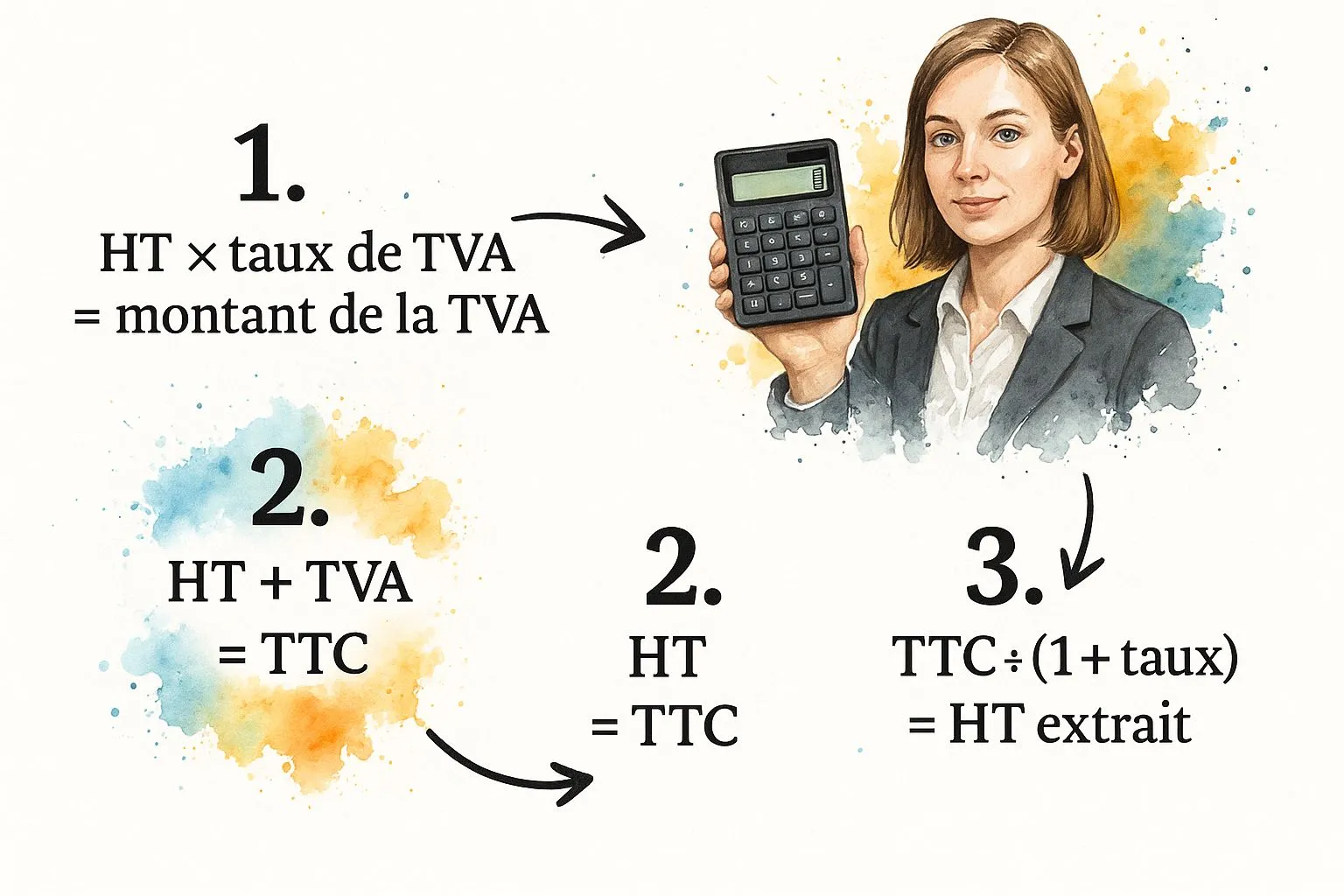
As the image shows, no matter your starting point (net or gross), there’s always a simple formula to find the other values. And if you want to run quick simulations, our online net-to-gross converter is there to save you time.
How to choose the right VAT rate
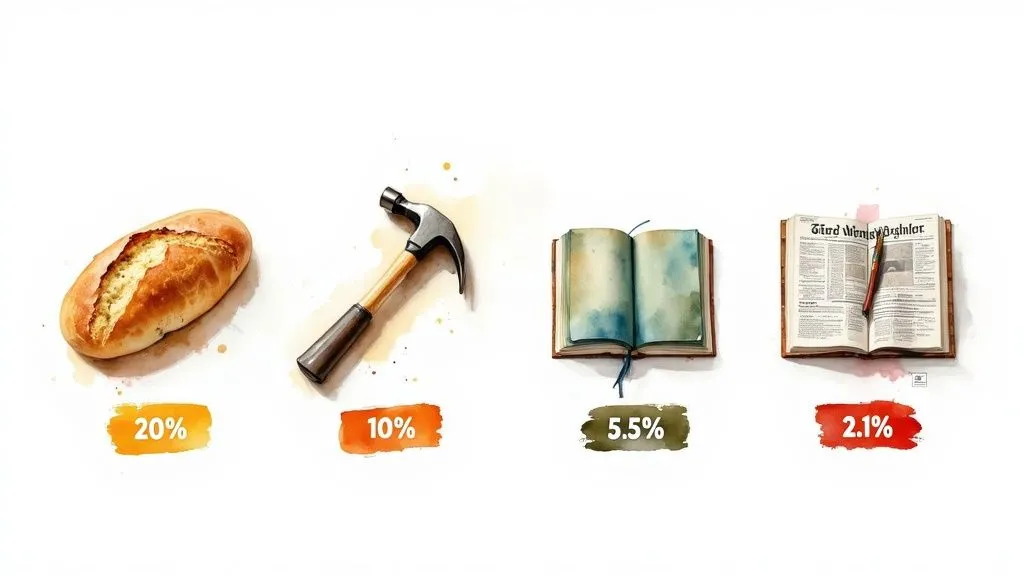
Applying the wrong VAT rate is a mistake I see often, and it can really hurt in the event of a tax audit. To avoid the risk of a tax reassessment, you absolutely need to take the time to identify the right rate for each product or service you sell. VAT rate calculation isn’t an exact science, but it is a matter of precision.
Let’s take a concrete example that will resonate with many construction tradespeople. Are you carrying out renovation work on a home that’s more than two years old? You must apply the intermediate rate of 10%. On the other hand, if it’s new construction, or if you’re simply selling materials without installing them, you go straight to the standard rate of 20%. The difference is subtle, but it changes everything on the final invoice.
A restaurant owner faces the same headache every day. On a single bill, several rates can coexist: food and non-alcoholic drinks are at 10%, but the slightest alcoholic drink bumps the corresponding line up to 20%.
Watch out for specific cases and exceptions
In certain sectors, things get even more complicated. The general rule has its limits, and extra vigilance is needed.
- Digital content creators: An e-book is treated like a printed book, so it benefits from the super-reduced rate of 5.5%. But watch out — if you sell an online course in video form, the tax authorities consider it a standard service, taxed at 20%.
- International transactions: Are you invoicing a business client based in another EU country? In most cases, the reverse-charge mechanism applies. It’s a fairly technical topic, but our guide on intra-community VAT calculation is there to help you understand it.
Keep in mind too that these rates aren’t set in stone. As a bit of trivia, France’s standard VAT rate went from 16.66% at its creation in 1968, to 20% since 2014.
My expert tip: Do you have an invoice that mixes services at different rates? Get into the habit of detailing each line with its own applicable rate. It’s clearer for your client, simpler for your bookkeeping, and completely transparent with the tax authorities. Better safe than sorry!
A major exception: VAT exemption (franchise en base)
If you’re a micro-entrepreneur (sole trader), you may have the option to opt for VAT exemption (franchise en base de TVA). In practice, as long as your annual revenue doesn’t exceed certain thresholds (for example, €37,500 for services in 2024), you simply don’t have to charge VAT.
It’s a real convenience for day-to-day management. The downside is that you also can’t reclaim the VAT paid on your own business purchases. If this applies to you, never forget to add the mention “TVA non applicable, art. 293 B du CGI” on all your invoices. It’s mandatory.
VAT calculation mistakes you should never make
Even with the right formulas in mind, VAT rate calculation is scattered with small pitfalls that can quickly turn a simple invoice into an accounting headache. To avoid tedious corrections and unnecessary back-and-forth with the tax authorities, a bit of vigilance is needed.
One of the most insidious mistakes is rounding. Applied carelessly, line by line on a long invoice, it can create a discrepancy of a few cents on the final total. That might seem trivial, but these micro-discrepancies, added up across hundreds of invoices, end up creating real imbalances in your bookkeeping.
My practical tip: always calculate your net and VAT totals using exact amounts, with all decimal places. Only round at the very end, on the total amounts (Total net, Total VAT, Total gross). It’s the only way to guarantee perfect consistency.
Watch out for mixed invoices
Another classic pitfall involves invoices that mix goods and services subject to different VAT rates. It’s tempting to apply a single rate to simplify things, often the highest one. That’s a mistake that can cost you dearly, especially in the event of a tax audit.
Take the case of a tradesperson renovating a kitchen. Their invoice will include:
- Installation and labor (subject to the 10% rate if the home is more than two years old).
- The sale of new appliances they supply (subject to the standard rate of 20%).
Applying 20% to the entire invoice unfairly penalizes the client and artificially inflates the amount of VAT you collect. The only correct and rigorous method is to carefully break down each line of the invoice with its own rate.
Omissions that cost you
Finally, beyond the numbers, certain purely administrative mistakes can have serious consequences. They can, for example, invalidate your client’s right to deduct VAT and put you at fault. Forgetting mandatory information on your invoices is a very real risk.
Among the most common:
- Missing intra-community VAT number (yours and your business client’s).
- Omitting the mention “TVA non applicable, art. 293 B du CGI” for micro-entrepreneurs under the VAT exemption scheme.
- Insufficient detail on services, making it impossible to clearly identify which VAT rate applies to which item.
Taking a minute to carefully re-read each invoice before sending it isn’t a waste of time. It’s real insurance against future problems.
Gain peace of mind by automating your VAT calculations
Doing your VAT calculations by hand is a bit like crossing a minefield. It’s slow, stressful, and the slightest slip can quickly turn into an administrative headache. We’ve all had that moment of doubt when filling out a VAT return. Fortunately, today, this chore can become a mere formality.
A good invoicing tool, like Bizyness, changes everything. No more juggling formulas and a calculator. The principle is childishly simple: you create your invoice, choose the product or service you’ve already set up, and the software does the rest. It applies the correct VAT rate, calculates the net amount, the tax, and the gross total. All without you having to think about it.
The concrete benefits of automation
The value of such a tool goes far beyond simple calculation. It’s a strategic decision that has a direct impact on how you run your business.
Specifically, here’s what you gain:
- Guaranteed tax compliance: VAT rates are constantly kept up to date in the software. The risk of error becomes almost nil, which protects you in the event of a tax audit.
- A huge time saving: All the time spent checking and double-checking your calculations can now go toward far more important things, like finding new clients or developing your offerings.
- Real peace of mind: Knowing that your invoices are accurate and compliant frees you from a significant mental burden. It lets you focus on what you do best: your craft.
This screenshot from Bizyness perfectly illustrates just how simple and visual creating an invoice becomes.

As you can see, the net, VAT, and gross fields fill in instantly. The process is smooth, intuitive, and error-proof. If you want to dig deeper into the topic, take a look at our full guide on automatic VAT calculation.
Invoicing software isn’t an expense — it’s an investment. Every hour you don’t spend on admin is an hour you can put toward growing your business.
Beyond VAT alone, exploring the principles of task automation can really help you gain efficiency in every aspect of your day-to-day as an entrepreneur. It’s a habit worth building to make your life simpler.
Your frequently asked questions about VAT rate calculation
Even with a good guide, there are often specific cases that deserve clarification. I’ve gathered here the answers to the questions that come up most often about VAT rate calculation.
Micro-entrepreneur: do I really have to charge VAT?
The short answer is: in principle, no. As long as your revenue stays below the VAT exemption thresholds, you don’t have to apply it on your invoices. It’s a real advantage that considerably simplifies day-to-day management.
That said, this simplicity comes with a trade-off: you can’t deduct the VAT on your own business purchases. And above all, never forget the mandatory mention on your invoices: “TVA non applicable, art. 293 B du CGI”.
Oops, I made a VAT mistake on an invoice I already sent. How do I fix it?
To err is human, but in accounting, you can’t just erase and rewrite. Once issued, an invoice is final. The only clean method recognized by the tax authorities is to issue a corrective invoice. This is called a credit note.
This credit note simply cancels the erroneous invoice (in part or in full). You can then issue a new invoice, this time with the correct information. It’s the only way to keep your bookkeeping clear and traceable.
A quick reminder to keep things straight: output VAT is the VAT you add to your invoices on behalf of the government. Input VAT is the VAT you pay on your business purchases. What you owe the government is the difference between the two (output minus input).
Tired of asking yourself all these questions? Let a specialized tool like Bizyness handle the calculations and your invoices for you. Try our solution for free and spend more time on what really matters: your business.
