

 Français
 VAT rates in France: understanding every rate
VAT rates in France explained: discover the different rates, their applications, and clear examples covering 20%, 10%, 5.5% and 2.1%.
In France, the existence of several VAT rates is far from being a pointless administrative headache. It’s a genuine fiscal strategy. The State uses it to modulate taxation, easing the burden on essential goods while taxing everyday consumer goods and services more heavily.
Why several VAT rates coexist in France
Let’s dive into the world of Value Added Tax (VAT), without the dense jargon. Think of VAT not as a rigid tax, but rather as a dial the government adjusts to steer the economy. This flexibility is at the heart of French fiscal policy.
The idea is to juggle two priorities: on one hand, funding public services (schools, hospitals, roads), and on the other, preserving the purchasing power of French households. Imagine for a moment a single rate for everything… Everyday expenses, like food or transport, would weigh far more heavily on the budgets of lower-income households.
A tool for social and economic policy
Having several rates therefore allows for finer, fairer taxation. By applying a reduced rate to essential goods, the State ensures that the essentials remain affordable for everyone.
This approach gives rise to a multi-speed structure that we’re about to break down. Each rate has its own rationale, stemming from specific political and societal choices.
The underlying logic is fairly simple: the more a product is considered essential to life, culture, or health, the lower its VAT rate. It’s a form of progressivity applied not to income, but to consumption.
The French system is therefore organized around four main rates, each targeting well-defined categories of goods or services.
- The standard rate at 20%: This is the “default” rate. It applies to the vast majority of products and services we consume.
- The intermediate rate at 10%: Found in sectors such as catering, passenger transport, or home renovation work. Areas that matter for the economy and our daily lives.
- The reduced rate at 5.5%: This applies to goods considered essential. Think food, books, gas and electricity subscriptions, or certain energy-efficiency renovation work.
- The super-reduced rate at 2.1%: Reserved for very specific cases, notably medicines reimbursed by Social Security and the TV licence fee.
Understanding this framework is the very first step to properly managing VAT in your business. Each VAT rate has a precise justification, and we’re now going to go through them one by one.
The standard rate of 20%: the default rule
When it comes to VAT, there’s one basic rule you need to know inside out: the 20% rate. This is the so-called “standard” rate, the one that applies by default to the vast majority of sales and services in France.
Think of it as the factory setting of the tax system. If no legal text specifies that a product or service benefits from a more favorable rate, then the applicable VAT is 20%. This is the rate that funds a large share of our public services, such as schools, hospitals, or roads.

In practice, where do we find it?
To grasp just how widespread the 20% rate is, you only need to take a look at your daily life. It’s absolutely everywhere.
This standard rate applies to a myriad of products and services we consume every day:
- Home and personal equipment: Your new smartphone, that pair of shoes you couldn’t resist, the living-room sofa, or your washing machine.
- Most services: A visit to your hairdresser, your lawyer’s fees, or a graphic designer’s work on your logo.
- Vehicles and fuel: Buying a new car, or even a used one if sold by a professional.
- Certain leisure and catering products: This is the rate applied to alcoholic beverages consumed in a bar or restaurant, unlike food, which benefits from a reduced rate.
These few examples show just how deeply this rate is embedded in our economy. It applies to everything that isn’t classified as an essential good or a product/service the State wishes to encourage through lighter taxation.
For an entrepreneur, there’s a golden rule to remember: when in doubt, the 20% rate prevails. If there’s no clear legal provision granting a reduced rate for your activity, you must invoice at the standard rate.
Mastering this principle is the first step to avoiding invoicing mistakes. When starting out or diversifying your offering, the first reflex should be to check whether an exception applies. If the answer is no, the 20% rate applies without question. It’s simple, but it demands rigor.
After the standard 20% rate, which applies by default to most goods and services, let’s turn to another essential VAT rate: the intermediate rate of 10%.
Think of it as a genuine economic tool. The State uses it in a targeted way to give a boost to sectors considered strategic for our daily lives, employment, and the economy as a whole. It’s a kind of “lightened” VAT for specific areas.
Its scope is fairly broad, but it isn’t applied at random. The idea is to make certain essential services more affordable while supporting activity in key industries.
The sectors that benefit the most
This 10% rate covers services that are an integral part of our everyday lives. Its impact is direct on the consumer’s wallet, making these services more attractive.
Here are the main areas where you’ll encounter it:
- Catering and hospitality: This is the rate applied to your restaurant bill, the sandwich you buy at the bakery for lunch, or your hotel stay. One subtlety to note: alcoholic beverages remain subject to the standard 20% rate.
- Passenger transport: Whether you take the train, bus, metro, or a taxi, your tickets and fares benefit from this reduced rate.
- Certain renovation work: If you carry out improvement, conversion, or fitting-out work in a home more than two years old, this is the rate that applies. To understand the nuances, our guide on VAT for tradespeople covers everything you need to know.
This isn’t a measure taken lightly. Since the VAT structure was stabilized in 2014, this 10% rate has been a pillar for these sectors. It was designed to boost activities often hit hard by economic conditions, an approach that fits within the broader history of tax adjustments in France.
The intermediate rate is a powerful lever: by easing the tax burden, it helps businesses stay competitive, invest, and create jobs, while making the final bill less painful for the customer.
The concrete impact on the final price
To truly understand the advantage of this rate, nothing beats a numerical comparison. It’s very simple: a lower rate automatically translates into a lower price including tax (VAT-inclusive) for the consumer.
Let’s take the concrete example of a service invoiced at €100 excluding tax (net).
This table summarizes the difference in cost for the end customer depending on the VAT rate applied.
Comparison of VAT Rates and Their Applications
| VAT Rate | VAT Amount | Final Price (incl. VAT) |
|---|---|---|
| Standard rate of 20% | €20.00 | €120.00 |
| Intermediate rate of 10% | €10.00 | €110.00 |
The result is clear: applying the 10% rate represents a direct saving of €10 for the customer on this service.
At the scale of a sector like catering, where millions of transactions take place every day, this tax advantage becomes a genuine economic driver.
The very reduced rates of 5.5% and 2.1%: when VAT becomes social and cultural
We now leave the more common rates behind to enter a more specific dimension of French taxation. The 5.5% and 2.1% VAT rates aren’t there by chance. They reflect a strong political choice: to make goods and services considered fundamental to society more accessible.
Think of it as a helping hand from the State. By applying a very low tax, household budgets are directly relieved on essential expenses. It’s proof that VAT isn’t just a line on an invoice; it’s also a tool used to support health, culture, and everyday needs.
The 5.5% rate: at the heart of our everyday lives
The 5.5% rate is probably the one that affects us most directly, sometimes without us even realizing it. It applies to a specific list of products and services that deserve particular support.
Its scope is fairly broad, as it touches several facets of our daily lives:
- Basic food: The vast majority of what you put in your basket to prepare meals (fruit, vegetables, meat, bread, dairy products) is taxed at 5.5%. Non-alcoholic beverages are also included.
- Culture for everyone: Whether you buy a book (print or digital), a cinema ticket, a concert ticket, or a museum entry, this is the rate that applies. The idea is simple: encourage access to knowledge and entertainment.
- A more energy-efficient home: Planning work to improve the energy efficiency of your home if it’s more than two years old? Insulation or installing a heat pump, for example, benefit from this reduced rate.
This social approach isn’t new. The French tax system has always sought to adapt to society’s realities. The creation of the super-reduced 5.5% rate in 1982 was a real turning point, establishing the multi-speed VAT system we know today. If you’re interested in the topic, you can discover the history of VAT adjustments in France.
The super-reduced rate of 2.1%: a public-service mission
With the 2.1% rate, we reach the lowest level. It’s reserved for a handful of products whose accessibility must be protected at all costs, without any financial barrier. This is a “super-reduced” rate, almost symbolic.
This 2.1% rate is the strongest signal of the protective dimension of taxation. It applies where the public-health or information-access stakes are at their highest.
Its two main areas of application perfectly illustrate this philosophy:
- Medicines reimbursed by Social Security: Practically all medicines prescribed by your doctor and covered by health insurance are taxed at this floor rate.
- The press: Newspapers and news magazines (dailies, weeklies, etc.) also benefit from this rate. It’s a historic measure designed to support media pluralism and guarantee access to diverse information.
For an entrepreneur, mastering these VAT rates is essential. Getting it wrong, even on such low rates, can quickly become a headache with the tax authorities. The key is therefore to correctly identify the nature of each product or service you sell to make sure you apply the right rate on your invoices.
How to apply the right VAT rate without mistakes
Knowing the different VAT rates inside out is one thing. Applying them correctly on every invoice, without ever making a mistake, is another. For any entrepreneur, a simple rate mix-up can quickly turn into a headache with the tax authorities. Fortunately, with a bit of method and the right tools, this task becomes much simpler than it seems.
The challenge is twofold: you need to make sure every product sold or service invoiced is associated with the correct tax percentage. This rigor guarantees your legal compliance, of course, but it also builds trust with your customers, who appreciate transparent, accurate invoicing.
Identifying the right rate, step by step
The very first step is to clearly qualify what you’re selling. Is it a physical good? A service? Takeaway food? This fundamental question is your starting point for finding the applicable rate.
Next, the reflex to have is to ask whether your product or service benefits from an exception provided by law. The default rule is the standard rate of 20%. You should only apply a reduced rate if the legislation explicitly states it for your sector of activity or type of product.
To help you see things more clearly, especially for the lowest rates, here’s a kind of decision tree summarizing the logic to follow.
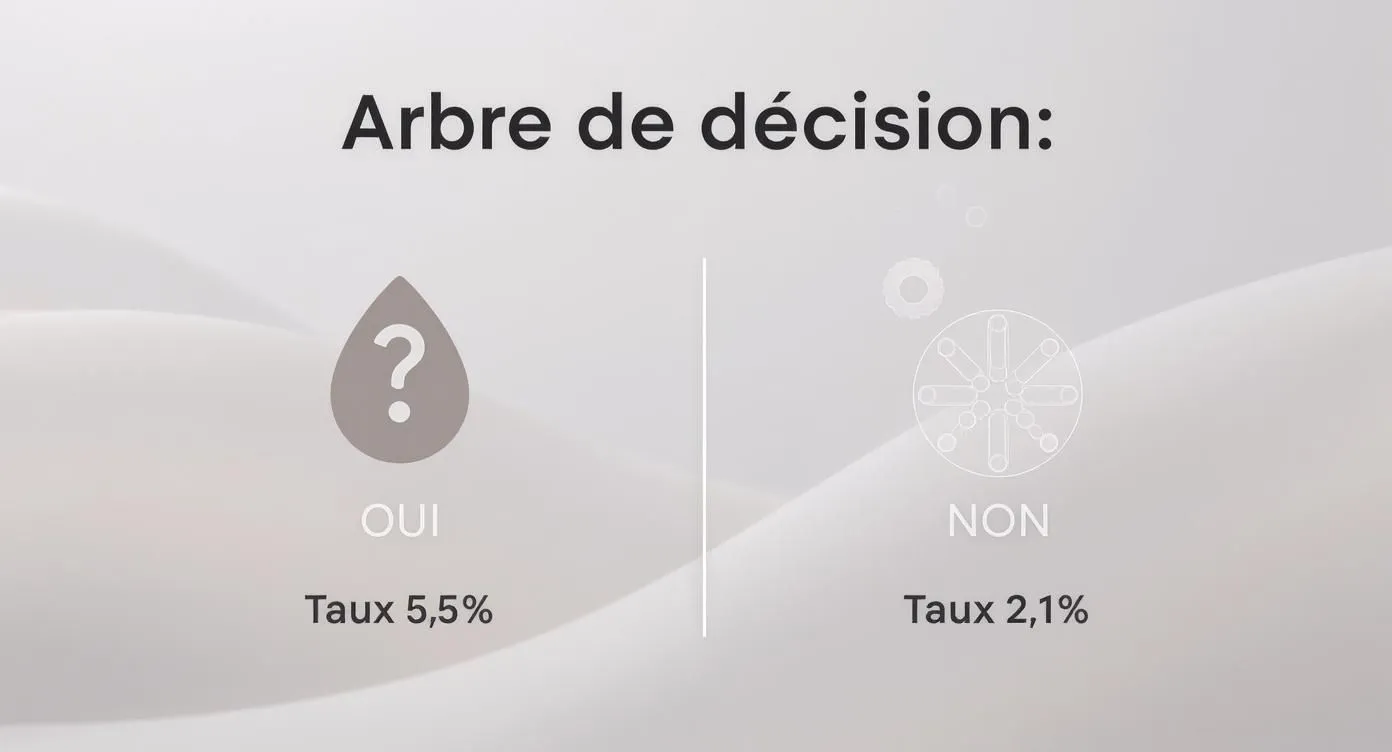
As this diagram shows, classifying a product (for example, “essential” or “medical”) points you directly to a rate of 5.5% or 2.1%.
What about mixed invoices?
Things get a little trickier when a single invoice combines items with different VAT rates. This is a very common scenario: a restaurant serving a dish (10%) with a glass of wine (20%), or a bookshop selling a book (5.5%) and a DVD (20%).
For a mixed invoice, the watchword is breakdown. Each line must clearly detail the product, its price excluding tax (net), the specific VAT rate, and the corresponding tax amount.
It’s strictly forbidden to average things out or apply a single rate to simplify matters. Transparency is the rule, and each taxable base must be calculated separately. To dig deeper into the topic, feel free to read our full article on calculating the VAT rate.
The good news is that you don’t have to juggle these calculations by hand. Invoicing tools like Bizyness are designed to handle this automatically. The software applies the correct rate to each line, breaks down the amounts, and generates a flawless invoice, without you having to worry about the details. It’s a huge time saver and near-total protection against errors, letting you focus on what really matters: your business.
A bit of history to understand today’s VAT rates
To really understand why we juggle several VAT rates, a quick look back is in order. The current system didn’t appear by magic. It’s the result of more than 70 years of adjustments, reforms, and adaptations to France’s economic and social realities.
Believe it or not, Value Added Tax is a genuinely French invention, born on April 10, 1954. Back then, it was far from the well-oiled system we know today. Rates changed often, driven by the State’s needs and economic crises. Faced with this complexity, simplification quickly became necessary.
From chaotic beginnings to a clearer structure
The real turning point came in the 1970s and 1980s. Governments began putting order into the system to make it simpler for businesses to manage and fairer for everyone. The goal was clear: move from a multitude of constantly fluctuating rates to a well-defined, lasting structure.
This drive for simplification then accelerated with European integration. For businesses to trade more easily between member states, common rules were needed. This is largely what led to the four-rate structure we use today.
The history of VAT reminds us that taxation is never set in stone. Rates aren’t just numbers; they’re political levers that adapt to the challenges of each era.
Yesterday’s rates aren’t today’s rates
Looking back at the past, you realize just how much things have changed. In 1968, for example, France applied four rates that bear little resemblance to ours today: a reduced rate of 6%, an intermediate rate of 13%, a standard rate of 16.6%, and a higher rate climbing to 20%. The standard rate even peaked at 23% in 1973 to replenish state coffers! For the curious, this detailed history of VAT rates is a mine of information.
Keeping this perspective in mind is crucial. It helps us understand that today’s system, with its various rates, is the result of a long search for balance between the State’s financial needs, the desire to support certain key sectors, and the necessity of protecting our purchasing power.
The questions everyone asks about VAT
Navigating the different VAT rates is a bit of an obstacle course for many entrepreneurs. We’ve all had that moment of doubt when creating an invoice. Let’s demystify the most frequently asked questions together to see things more clearly.
Each situation has its own rules of the game, and it’s best to know them so you can invoice with peace of mind.
What VAT rate applies to a sole trader (micro-entrepreneur)?
For the vast majority of sole traders just starting out, the rule is simple: they benefit from the VAT exemption scheme (franchise en base). What does that mean in practice? Simply that they don’t charge VAT to their customers. Regardless of the rate that would normally apply to their sector, their invoices are tax-free.
Of course, this simplicity comes with a downside: it’s impossible to reclaim VAT paid on business purchases (equipment, software, etc.). To fully understand what this means on a day-to-day basis, our complete guide on the VAT not applicable mention explains everything in detail.
One thing to never forget: every invoice must include the legal mention “VAT not applicable, art. 293 B of the French Tax Code (CGI)”. This is what justifies the absence of tax to both your customers and the tax authorities.
Be careful: this favorable scheme is tied to revenue thresholds. If you exceed them, you move into VAT territory and must start charging it.
Oops, I applied the wrong VAT rate on an invoice. How do I fix it?
To err is human! If you applied the wrong VAT rate on an invoice that’s already been sent, don’t panic, but you do need to act quickly. The only clean, legal solution is to issue a corrective invoice.
This new document isn’t a simple correction. It must clearly state that it cancels and replaces the original invoice, specifying its number. You then enter the correct information: the accurate VAT rate, the recalculated tax amount, and, of course, the new total due.
Can a product’s VAT rate change over time?
Yes, absolutely. It doesn’t happen every day, but it does happen. The VAT rate on a product or service can be modified by a new law, often for economic reasons or to address a societal issue.
A classic example would be a product that, following a political decision, is now considered an essential good. Its VAT rate could then drop from 20% to 5.5% to make it more accessible. As an entrepreneur, it’s your responsibility to stay up to date on these changes so you always apply the VAT rate currently in force.
Don’t let the different VAT rates give you headaches anymore. With Bizyness, the right rate is automatically applied to every invoice. You gain peace of mind, ensure your compliance, and can finally focus on what really matters: your business. Discover how to simplify your life at https://www.bizyness.fr.
