

 Français
VAT Rates in France: The Complete Guide
Simplify running your business with our guide to VAT rates in France. Understand every rate and invoice without mistakes.
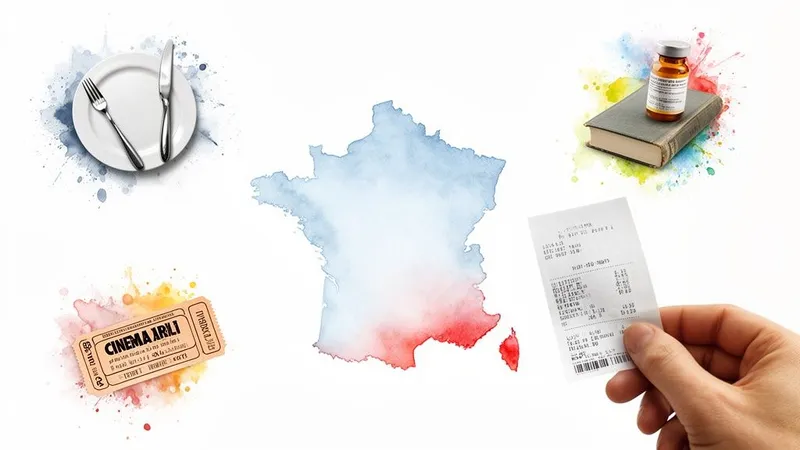
In France, businesses juggle four main VAT rates. There’s the standard rate of 20%, an intermediate rate of 10%, a reduced rate of 5.5%, and a very specific rate, known as the “super-reduced” rate, of 2.1%. Each rate targets precise categories of goods or services, making for a fairly nuanced tax system.
Understanding the logic behind the different VAT rates
Value Added Tax (VAT) can seem intimidating at first, especially when you’re launching your business and have to manage invoicing and bookkeeping. But the principle is actually quite simple: it’s an indirect tax on consumption. In practice, you, the business, collect it on behalf of the State.
Think of VAT rates as categories in a large store.
- The standard rate of 20% is the general rule, the default rate. It applies to most of the products and services you buy or sell.
- The reduced rates (10%, 5.5%, 2.1%) are exceptions. They’re reserved for goods or services considered essential or given a boost by the State: food, books, certain renovation work, and so on.
Grasping this logic is the first step toward invoicing correctly and avoiding trouble. A small rate error can quickly turn into an administrative headache, or even penalties.
The 4 pillars of VAT in France
The French tax system relies on these different rates to strike a balance. To help visualize it, here’s a table summarizing the four main rates in mainland France and their most common uses.
| Rate type | Rate | Main applications |
|---|---|---|
| Standard rate | 20% | The vast majority of goods and services (alcohol, clothing, high-tech services…). |
| Intermediate rate | 10% | Restaurant dining, passenger transport, renovation work on older housing. |
| Reduced rate | 5.5% | Basic food products, books, gas and electricity subscriptions, cinema tickets. |
| Super-reduced rate | 2.1% | Medicines reimbursed by Social Security, certain live performances, press. |
This structure was designed to ease the tax burden on essential products, while ensuring stable tax revenue for the State, which accounts for 35.4% of its gross revenue. For entrepreneurs, this means one thing: you need to stay alert and correctly identify which category your products or services fall into.
The diagram below will help you visualize this rate hierarchy.
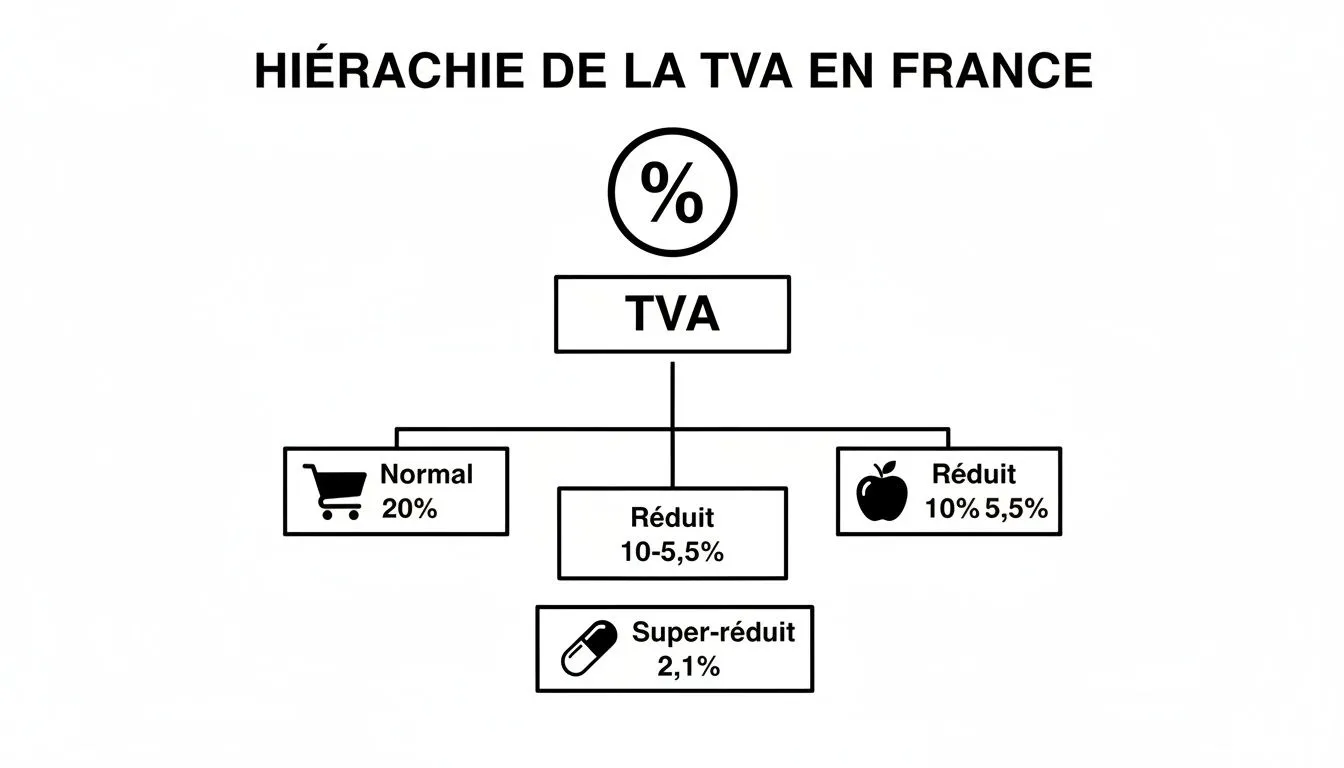
It’s clear that the 20% rate is the norm, and the other rates are narrowly targeted exceptions.
The key is to not see VAT as a cost to your business, but as a tax you collect on behalf of the Treasury. Once that clicks, managing it becomes far smoother.
Be careful: for sole traders (micro-entrepreneurs), the rules of the game can be different, particularly with the VAT exemption scheme (franchise en base). If that’s your situation, I strongly recommend reading our full guide on VAT for sole traders, which explains in detail the thresholds and obligations to follow. It’s the foundation for tackling the rest of this guide with confidence.
The standard 20% VAT rate: the pillar of the system

In the world of French VAT, the standard rate of 20% is the cornerstone, the absolute reference. If you’re unsure which rate to apply and no exception jumps out at you, there’s a good chance it’s this one.
It’s the standard rate for a simple reason: it applies to the vast majority of sales of goods and services. Think of it as the tax safety net that kicks in by default, unless a reduced rate specifically replaces it.
Understanding its scope is therefore the first step toward bulletproof invoicing and peace of mind. It’s the foundation everything else rests on.
The 20% rate in your day-to-day as an entrepreneur
To really get a feel for where this rate applies, the best approach is to look at concrete, everyday examples. Whether you’re a consultant, a craftsperson, or an e-commerce seller, you’ll definitely come across it.
Here are a few situations you know well:
- The marketing consultant: All your consulting assignments, audits, or ad campaign management are subject to the 20% rate.
- The e-commerce clothing shop: Selling ready-to-wear items, fashion accessories, or shoes systematically falls under this standard rate.
- The software developer: Whether you’re billing a SaaS subscription or custom development hours, the VAT to apply is 20%.
And the list goes on. Accountant fees, vehicle rental, buying a computer, or even subscriptions to most of your business tools are all in the same boat.
When in doubt, there’s one golden rule: if your product or service isn’t clearly listed under a reduced-rate category (such as food, culture, or certain construction work), the standard 20% rate applies.
This “default” approach greatly simplifies day-to-day decisions.
A stability that reassures
The standard VAT rate hasn’t always been set at 20%. It rose from 19.6% to its current level on January 1, 2014, a decision made at the time to help stabilize public finances. This consistency, which has now lasted a decade, is a real advantage for entrepreneurs. It makes it easier to anticipate tax charges and set prices with more confidence. You can learn more about the evolution of the VAT rate on the Mooncard website.
This stability has a very concrete impact on your management.
What impact on your cash flow and pricing?
The 20% rate directly affects two critical aspects of your business: your cash flow and how your prices are perceived. Every time you make a sale, you’re actually collecting 20% of your pre-tax price on behalf of the State.
Let’s take a simple example:
- You sell a service for €500 excl. VAT.
- You add 20% VAT: €500 x 0.20 = €100.
- The customer pays you €600 incl. VAT.
That €100 isn’t yours. It’s just passing through your account. You’ll need to set it aside to remit it to the tax authorities. Careful management of this collected VAT is therefore vital to avoid unpleasant surprises.
On the other hand, this rate influences your pricing strategy. If your customers are individuals (B2C), they only see the final price incl. VAT. A 20% rate significantly increases the amount to be paid, a key factor to factor into your positioning to stay competitive.
Finding your way around reduced VAT rates

While the standard 20% rate is the general rule, French tax law is far from monolithic. The VAT system is full of exceptions, reduced rates designed for specific economic or social reasons. For you, as an entrepreneur, these aren’t just administrative details.
These rates are real levers. Mastering them can give you an edge over your competitors or, more simply, save you from unpleasant surprises with the tax authorities. Each rate — intermediate, reduced, and super-reduced — targets specific sectors of activity.
Let’s dive into these nuances together so you always know which rate to apply, whether you run a restaurant, a shop, or a construction business.
The intermediate rate of 10%: for services and everyday life
The intermediate rate of 10% often shows up in our daily lives, particularly in the restaurant, hospitality, and renovation sectors. You can think of it as the rate for services that improve our quality of life and ease our travel.
For a business owner, understanding exactly where it applies is crucial. Mistakes happen easily, especially in a restaurant where different rates can coexist on the same bill! The idea behind this rate is to support pillars of the French economy by making their services more affordable.
Here are a few concrete examples where the 10% rate is the norm:
- Dine-in restaurant service: All dishes and beverages (non-alcoholic) served at the table are covered.
- Accommodation: If you run a hotel, a bed and breakfast, or a campsite, overnight stays are invoiced with VAT at 10%.
- Passenger transport: Train tickets, bus tickets, or taxi rides also fall under this rate.
- Improvement work: Most renovation and maintenance work on homes over two years old benefits from this advantageous rate.
The reduced rate of 5.5%: for essential goods and culture
We go down another notch with the reduced rate of 5.5%. Its purpose is very clear: to lower the price of goods and services considered essential or cultural. It’s a strong measure that has a direct impact on French households’ wallets and aims to democratize access to culture.
Applying this rate correctly isn’t just a legal obligation, it’s also a sign of professionalism for your business. It covers a wide range of products, from food to books to energy. The list is very precise, and it’s the French General Tax Code that sets the rules.
Applying a reduced rate isn’t just a matter of compliance. It means actively taking part in a tax policy that seeks to make essential products more accessible to everyone.
Among the most common applications of the 5.5% rate, we find:
- Food products: Most products bought for later consumption (such as at the supermarket) and non-alcoholic beverages.
- Books: Whether printed or digital, books benefit from this rate to encourage reading.
- Energy: Gas and electricity subscriptions, as well as heat from renewable energy sources.
- Culture and entertainment: Your cinema tickets and tickets for live performances (theater, concerts) are also covered.
- Energy renovation work: Work that improves a home’s energy performance (insulation, heat pumps…) benefits from this highly incentivized rate.
The very specific case of the super-reduced 2.1% rate
The super-reduced rate of 2.1% is the rarest and most narrowly targeted of all. It’s reserved for a handful of goods considered of vital importance, mainly in the fields of health and information.
Its scope is so limited that most businesses will never encounter it. Unless, of course, you operate in one of these very specific sectors. This is the lowest rate of all and reflects the State’s commitment to guaranteeing access to vital products at minimal cost.
This rate mainly applies to two categories:
- Reimbursable medicines: All medicines covered by Social Security are subject to this 2.1% VAT.
- The press: Sales of newspapers and periodicals, in print or digital format, benefit from this rate to support the plurality of information sources.
Understanding this rate hierarchy is fundamental. It allows you not only to invoice legally, but also to build a consistent pricing strategy to stay competitive in your market.
Making the most of the VAT exemption scheme and exemptions
For freelancers and small businesses just starting out, certain tax schemes are a real breath of fresh air. The VAT exemption scheme (franchise en base) is clearly one of them. In practice, this scheme allows you, under certain conditions, to not charge VAT to your customers. A real relief for your day-to-day management!
Imagine for a moment: you could offer more attractive prices, or, conversely, keep that margin for yourself. That’s the whole point of this mechanism, especially if your clientele is made up of individuals, since they can’t recover VAT anyway.
Be careful, though: this scheme isn’t open to everyone. Access is strictly governed by annual revenue caps. So you need to keep a close eye on your income to avoid unpleasant surprises.
The exemption thresholds: know them inside out
To benefit from the VAT exemption scheme, everything depends on your business activity and the revenue you generate. These caps are adjusted regularly, so it’s crucial to keep them in mind.
Here are the thresholds not to exceed to stay within this scheme:
- For the sale of goods and accommodation activities, your annual revenue must stay below €91,900.
- For services and liberal professions, the cap is much lower: €36,800 per year.
The tax authorities have also set “tolerance” thresholds (€101,000 and €39,100 respectively). If you exceed the first threshold but stay below the second for two years, you switch to VAT the following year. However, if you cross the tolerance threshold, it’s immediate: you must charge VAT starting from the first day of the month in which the threshold was exceeded.
Anticipating the switch to VAT is a genuine management decision. It means preparing your customers for a price increase and configuring your invoicing tool, like Bizyness, to handle VAT calculations without you having to think about it.
This anticipation will spare you the stress of a potential tax audit and help you manage your growth much more calmly.
Some activities are exempt by nature
Beyond revenue thresholds, some activities are, by definition, exempt from VAT, regardless of the income they generate. The law has provided for these exceptions for specific sectors, often considered to be in the public interest.
The sectors involved are quite varied:
- Healthcare: The vast majority of medical and paramedical care (doctor consultations, nursing care, physiotherapy sessions, etc.) is exempt.
- Education: School education, higher education, and even a good part of continuing professional training, are not subject to VAT.
- Certain banking and insurance operations.
- Renting unfurnished housing for residential use.
If your business falls into one of these categories, VAT simply isn’t an issue for you. You just need to make sure you meet all the conditions set by the tax authorities. To go further on this topic, our guide explains in detail how to know if you’re exempt from VAT.
The downside, whether for the exemption scheme or outright exemption, is that you can’t recover VAT on your own business expenses. It’s a calculation to make: if you have very few expenses, it’s often a good deal. But if you invest heavily (equipment, software, etc.), it may become more worthwhile to voluntarily switch to VAT so you can deduct it on your purchases.
Calculating and invoicing VAT without mistakes
Knowing the different VAT rates is good. Knowing how to apply them correctly on every invoice is even better. Moving from theory to practice can seem a bit complex at first, but with the right formulas in mind and a bit of method, calculating VAT will quickly become second nature.
This step is absolutely crucial. VAT isn’t just another line on a quote; it’s a genuine pillar of French public finances. To give you an idea, it’s expected to account for 35.4% of gross tax revenue in the general budget for 2025. In other words, impeccable management is essential to stay calm and avoid any risk of a tax audit.
The essential calculation formulas
As an entrepreneur, switching between prices excluding tax (HT) and prices including all taxes (TTC) is part of your daily routine. Fortunately, the formulas are very easy to remember.
To get the price incl. VAT from an amount excl. VAT:
Simply multiply your base price by the applicable VAT rate. The formula is as follows:
Price incl. VAT = Price excl. VAT x (1 + VAT rate)
Let’s take a concrete example: a consulting service billed at €500 excl. VAT at the standard rate of 20%.
€500 x (1 + 0.20) = €600 incl. VAT
To get the price excl. VAT from an amount incl. VAT:
Here, we simply do the reverse operation. We divide the final price by that same coefficient. The formula becomes:
Price excl. VAT = Price incl. VAT / (1 + VAT rate)
Using our example again, for a product sold at €600 incl. VAT:
€600 / 1.20 = €500 excl. VAT
Pro tip: To make your life easier, you can also calculate the amount excl. VAT from the amount incl. VAT using a conversion coefficient. This saves you from doing a division.
To help you quickly go from incl.-VAT to excl.-VAT prices, here’s a summary table of the coefficients to use.
Coefficients to convert incl.-VAT to excl.-VAT
Use these multiplying coefficients to quickly calculate the amount excl. VAT (HT) from a price incl. all taxes (TTC).
| VAT rate | Conversion coefficient (Price incl. VAT x Coefficient = Price excl. VAT) |
|---|---|
| 20% | 0.8333 |
| 10% | 0.9090 |
| 5.5% | 0.9478 |
| 2.1% | 0.9794 |
These coefficients are rounded, but they’re precise enough for a quick estimate or a check.
To go further, feel free to check out our full guide on VAT calculation methods, which explores every scenario.
Mandatory information on your invoices
A well-written invoice is your best ally in the event of a tax audit. Beyond the calculations, certain VAT-related information must appear on it for your documents to be valid.
Here are the points to never forget:
- Your intra-community VAT number: It must appear on all your invoices, even for customers based in France.
- The applicable VAT rate: For each product or service line, clearly indicate the rate used (20%, 10%, 5.5%, or 2.1%).
- The total VAT amount: Clearly show the total tax amount, in addition to the total excl. VAT and total incl. VAT.
Understanding how to structure your pricing and services well is key. For example, how an interior designer bills for their work clearly shows the importance of detailing each item for the correct application of rates.
Automating to avoid mistakes
We all know it: to err is human. A typo, the wrong rate selected, and your entire VAT return can be called into question, along with the penalties that come with it.
This is exactly where modern tools like Bizyness make all the difference. A good invoicing software handles all of this for you. It automatically applies the right rate to each product, performs calculations without ever making a mistake, and generates 100% compliant invoices in just a few clicks. It’s a time saver and a peace of mind that lets you focus on what really matters: your core business.
Your frequently asked questions about VAT
VAT is often the topic that raises the most questions among entrepreneurs. We all have very concrete questions when starting out, and even afterward. That’s why I’ve gathered the most common ones here, with straightforward answers, no jargon, to help you see things more clearly. The goal is to give you the right reflexes to manage this tax without hassle in your daily operations.
Let’s treat this like a quick conversation to clear up any remaining doubts you might have.
How do I know which VAT rate to apply to my business?
This is THE big question. To find the right VAT rate in France, the starting point is always the same: what exactly is the nature of what you’re selling? By default, we go with the standard rate of 20%. That’s the general rule for the vast majority of goods and services.
But be careful, your business could be among the exceptions. To be sure, you need to check whether it’s eligible for a reduced rate (10%, 5.5%, or 2.1%). The best approach is to check the official list on the tax authority’s website or, for the more determined, the Official Bulletin of Public Finances (BOFIP). A simple example: are you a consultant? It’s 20%. Do you sell e-books? That drops to 5.5%. And if doubt remains, a quick call to your accountant will clear up any ambiguity. It’s an investment that can save you a lot of trouble.
What happens if I exceed the VAT exemption threshold?
The day your revenue crosses the threshold (reminder: €91,900 for goods sales, €36,800 for services), everything changes. From the first day of that month in which the threshold is exceeded, you become liable for VAT. In plain terms, you must start charging it to your customers.
Anticipating is the key word. Remember to request your intra-community VAT number even before reaching the threshold, update your rates to include the tax, and make sure your invoicing software is ready. Keeping an eye on your monthly revenue will keep you from being caught off guard.
Can I recover VAT on my purchases while under the exemption scheme?
No, and that’s the downside of this ultra-simplified scheme. Under the exemption scheme, you don’t charge VAT, and logically, you therefore can’t deduct it from your business expenses. In practice, all your purchases (equipment, supplies, services) are made at the price incl. all taxes (TTC), and that VAT isn’t recoverable.
This scheme is therefore mainly worthwhile if you have very few business expenses or if your customers are individuals. For them, your price without VAT is naturally more attractive.
How do I report the VAT I’ve collected?
Everything happens online, in your professional account on the impots.gouv.fr website. The return is a simple subtraction: you take all the VAT you’ve invoiced (VAT collected) and subtract all the VAT you’ve paid on your business expenses (deductible VAT). The result is what you owe the State.
How often you file this return (monthly, quarterly, or once a year) depends on your tax regime, which is tied to your revenue.
Managing VAT can seem intimidating, but with the right tools, this obligation becomes a simple routine. Solutions like Bizyness let you automate calculations, produce perfect invoices in two clicks, and prepare your returns stress-free. Take a look at https://www.bizyness.fr to see how to simplify all of this.
