

 Français
VAT refund delays: a quick guide to getting paid faster
VAT refund delays: discover the timelines and strategies to speed up your VAT refunds and optimize your cash flow.

VAT refunds are far more than a simple accounting line. For an online seller, it’s a matter of cash flow — a lever that can either slow down or accelerate your growth. A refund that drags on means thousands of euros tied up, money that could be funding your stock or your next advertising campaigns.
Why mastering VAT refund timelines is vital for your business

Look at it simply: every euro of VAT you pay on your business purchases (goods, ads, shipping…) is an advance you make to the state. The VAT refund is simply the moment when the state gives you that money back.
Mastering the timelines means shortening the length of this interest-free loan you’re granting, somewhat against your will. The faster these funds come back into your account, the more breathing room your cash flow has, and the more agile your business becomes.
How does a VAT credit arise?
A VAT credit appears when, over a given period, the amount of VAT you’ve paid on your expenses (deductible VAT) exceeds the amount of VAT you’ve charged your customers (collected VAT).
For an online store, this is a very common scenario, particularly in these situations:
- Large investments: You buy a significant amount of stock ahead of sales, invest in new equipment, or launch a large-scale advertising campaign.
- International sales: If most of your customers are outside France or benefit from an exemption, you collect little to no VAT. However, you keep paying it on your expenses in France.
- Launch phase: At the start, it’s entirely normal to have more expenses than sales. A VAT credit is then almost systematic.
This situation, while logical, puts direct pressure on your cash flow if you don’t manage it closely.
A VAT credit isn’t a loss — it’s a claim against the state. Your job is to turn that claim into cash as quickly as possible to fund your day-to-day operations and your projects.
The direct impact on your e-commerce growth
For an online seller, a VAT refund delay that drags on has very concrete consequences. It can force you to postpone a key restocking order right before Black Friday, or to cut your advertising budget, which slows down customer acquisition.
More and more businesses have understood this and use the mechanism as a genuine financial tool. In France, VAT refunds reached 67.2 billion euros in 2023, up 41.2% since 2014. This dramatic rise, detailed in the French Senate’s information report, shows just how crucial recovering VAT has become for managing cash flow — whether to get through a slow period or to fund strong growth.
Ultimately, understanding and optimizing this process is far from an administrative chore. It’s an essential financial skill that determines your ability to seize market opportunities and overcome the challenges of online selling.
VAT refund timelines in France: theory versus reality on the ground

On paper, the tax administration’s promises regarding VAT refund timelines are fairly appealing. We’re often told a few weeks, which seems quite manageable for cash flow. But as every entrepreneur knows, reality on the ground is rarely that simple.
You need to draw a clear line between the “official” timeline, which is an administrative target, and the practical timeline — the one you’ll actually see hit your bank account. It’s a bit like your GPS’s estimated arrival time: it’s calculated for perfect conditions, without traffic jams or roadworks. For your VAT refund, these “roadworks” can take many forms.
In practice, expect an average delay ranging from one to two months. Of course, this duration isn’t set in stone. It depends on a whole range of factors that can either speed up or abruptly slow down the process.
The factors that really tip the balance
The speed at which you’ll see your money again depends on a few key variables. Knowing them means you can already anticipate and better manage your cash flow.
- Your VAT scheme: This is the starting point. If you’re on the standard real regime with monthly filings, you’re on the fast track. Refunds can be more frequent and therefore faster. Conversely, the simplified real regime, with its annual filing, often forces you to wait until the end of the fiscal year. That’s cash sitting idle for months.
- How often you file a claim: It’s simple math. Monthly or quarterly claims ensure a regular flow of money back into your accounts. Waiting until year-end for a single claim might mean less paperwork, but it’s a real drag on your cash flow.
- The amount you’re claiming: Be careful here. An unusually high VAT credit, or one that departs from your usual pattern, will almost certainly raise a red flag at the Business Tax Office (Service des Impôts des Entreprises, SIE). An alert means extra checks, and therefore longer delays.
The tax administration is first and foremost looking for consistency. A clean, logical file that’s in line with your business will sail through without a hitch. The slightest anomaly is an invitation for closer scrutiny.
Thresholds and frequency: know the rules of the game
Having a VAT credit isn’t enough to get a refund. You also need to meet certain thresholds, designed to prevent the tax office from being swamped with a multitude of small claims. For an entrepreneur, especially in the launch phase, mastering these rules is essential for planning cash flow accurately.
Here’s a table summarizing the conditions you need to meet to request a refund, depending on your filing frequency.
Thresholds and frequency for a VAT refund claim
| Type of claim | Frequency | Minimum VAT credit threshold | Timing of the claim |
|---|---|---|---|
| Periodic claim | Monthly or quarterly | €760 | With the filing for the relevant month/quarter |
| Annual claim | Annual | €150 | With the annual filing (CA12) |
This table highlights something important: the conditions are more lenient for the annual claim, which might seem like a windfall for very small businesses. But watch the math. Waiting a year to recover €150 is often a poor strategy if your cash needs are constant. Even if you’re under the VAT exemption threshold, it’s crucial to understand how these mechanisms could affect you one day. To dig deeper into the topic, feel free to read our guide on VAT returns for sole traders.
One last insider tip: factor in administrative “seasonality.” The periods when financial statements are wrapped up in spring, or the major year-end tax deadlines, are times of intense rush for tax offices. Submitting your file just before or after these peaks can sometimes save you precious weeks. Worth keeping in mind.
Anticipating situations that slow down a VAT refund
Most VAT refund claims are fairly straightforward and follow a well-marked path. But sometimes, certain files take an unexpected turn. Imagine the tax administration as a train station controller: a clear, standard file speeds along the express track, while a more complex situation gets rerouted to a siding for more thorough inspection.
For an online seller, spotting these “detours” ahead of time is crucial. It helps avoid having your cash flow blocked for weeks, or even months. Certain contexts almost always trigger heightened scrutiny from the tax authorities, which mechanically lengthens VAT refund timelines.
Knowing these scenarios lets you bulletproof your file and better manage your finances.
The headache of international sales and one-stop shops
Opening up to Europe is a great opportunity, but let’s be honest, it seriously complicates VAT management. And it has a direct impact on your refunds. The OSS (One-Stop Shop) and IOSS (Import One-Stop Shop) schemes may have simplified cross-border filings, but they can also slow the machine down.
When you file through these schemes, France collects VAT on behalf of other EU countries. If you have a VAT credit in France, the administration will want to make sure all these international flows are perfectly consistent before giving you your money back.
- Cross-checks: The tax office may want to make sure the VAT you’ve declared and paid via the OSS matches the sales you’ve actually made in each country.
- Complex flows: When you’re juggling marketplaces like Amazon, payment processors like Stripe, and your own bank account, financial flows become much harder to track. This can justify additional checks.
For those selling via Amazon FBA or D2C brands with a strong international presence, the lesson is clear: traceability and transparency in your transactions are no longer optional.
The “first year” effect: new businesses under watch
A young company, especially during its first 12 to 24 months, is systematically put under the microscope. The administration has no history with you. It will therefore try to verify that your refund claim is genuinely legitimate, and not the result of fraud or an overly aggressive optimization attempt.
A very first VAT refund claim is almost always synonymous with an in-depth review. The administration will take the time to understand your business model, the nature of your expenses, and the reality of your activity before making the transfer.
Don’t be caught off guard if your SIE (Business Tax Office) asks for additional documents. This is entirely normal. Expect to have to provide:
- Your company’s articles of association
- A recent Kbis extract
- Your first sales invoices to prove the business has genuinely started
- Supporting documents for large investments (supplier purchase orders, advertising contracts, etc.)
This is a mandatory step, so you might as well plan for it. Preparing a proactive file, clearly explaining your project from the outset, can really reassure your contact and speed things up.
Exceptional transactions that catch the tax office’s eye
Your business is running along quietly, and then suddenly, a transaction that’s completely out of the ordinary. It’s a bit like a warning light going on in the administration’s offices. The reviewer will immediately wonder why your deductible VAT suddenly spiked.
A few very concrete examples for an online seller:
- Buying a warehouse or offices: A real estate investment means a huge amount of deductible VAT all at once.
- Acquiring expensive equipment: Buying new packaging machines or overhauling your entire IT fleet.
- A complete stock overhaul: A massive order from a new supplier to launch a brand-new product line.
In these situations, the VAT credit you’re claiming will be much higher than usual. The administration will want to make sure these expenses are genuine and directly tied to your business. Mastering certain rules, such as the VAT reverse charge on imports, then becomes essential. If the topic interests you, our article explaining the VAT reverse charge mechanism is there to help.
A good habit: proactively attach notarized deeds or large pro forma invoices to your claim. This can considerably ease the verification work and, ultimately, shorten the timelines.
Building a bulletproof refund claim
A poorly prepared file is the number one cause of VAT refund delays. Think of your claim as a passport to get your money back: the slightest error, and you’re stuck at the administrative border. To avoid this pitfall, methodical preparation is absolutely essential.
This roadmap will guide you step by step to build an airtight file. The goal is simple: get approval on the first try, without the time-consuming back-and-forth with the tax administration that can put serious strain on your cash flow.
The checklist of essential documents
Before even thinking about filling out the form, the first step is to gather all the pieces of the puzzle. A complete, well-organized file sends a strong signal of seriousness and professionalism to the Business Tax Office (SIE). The clarity of your claim directly influences VAT refund timelines.
Here are the documents at the heart of your claim:
- The claim form (no. 3519): This is the official key. Make sure to use the most recent version, available on the tax website, and sign it electronically.
- The detailed statement of purchase invoices: For each expense, you need to list the supplier’s name, the date, the invoice number, the amount excluding VAT, the VAT amount, and the amount including VAT. A simple spreadsheet will do the job perfectly and bring plenty of clarity.
- Copies of the invoices themselves: Provide a digital copy of all the invoices concerned. This is especially crucial if the amount is significant or if it’s your very first claim.
- Proof of payment: This is an excellent habit. Attaching bank statements showing the invoices were paid proves the transactions actually took place and considerably strengthens the credibility of your file.
This process can quickly become complex, especially if you’re juggling international sales or significant investments.
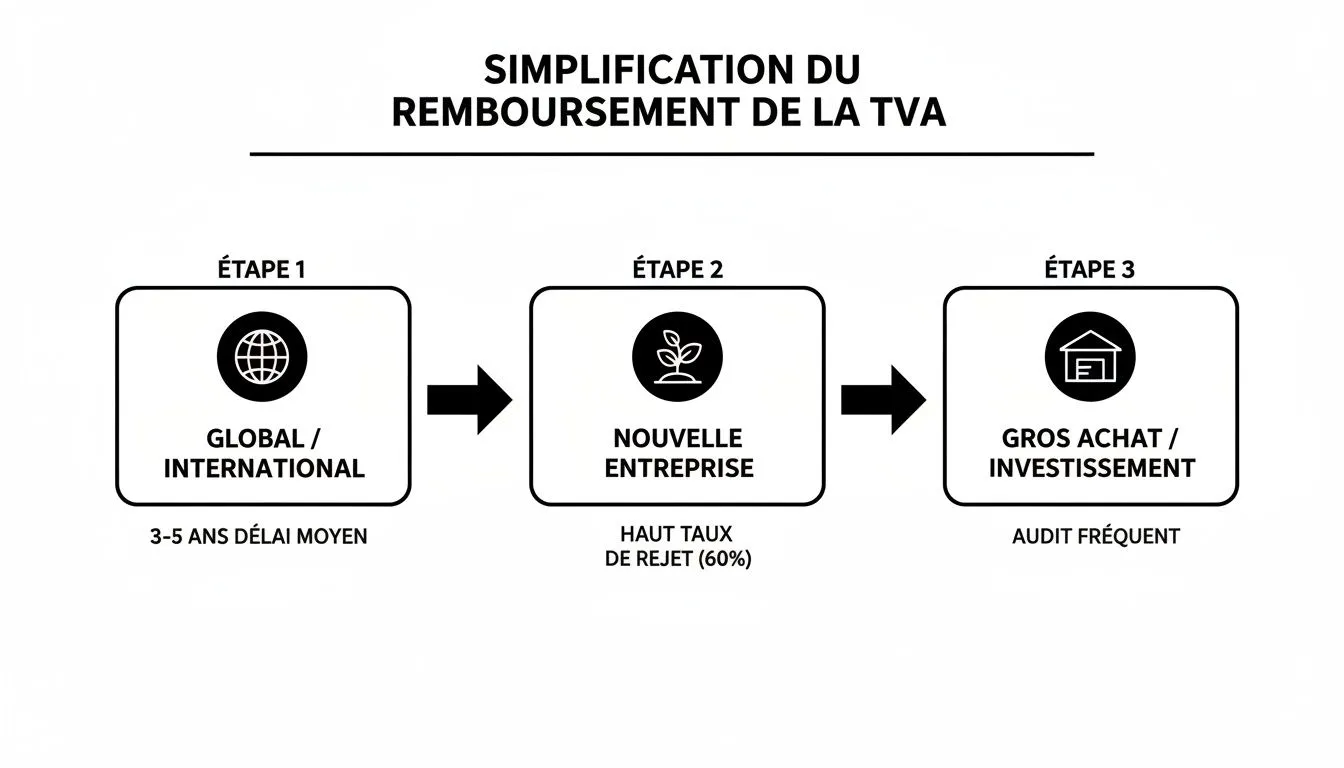
Every step of the diagram makes it clear: the more complex your business, the more documentary rigor becomes the key to fast processing.
To make sure you don’t forget anything, here’s a summary checklist.
Checklist of documents for a VAT refund claim
Check that you have everything you need before submitting your claim to avoid any delay.
| Required document | Key points to watch | Practical tip |
|---|---|---|
| Form no. 3519 | Use the most recent version of the form. Fill in every field, even the ones that seem obvious. | Download it directly from impots.gouv.fr right before you start, to make sure you have the correct version. |
| Invoice statement | The sum of the VAT amounts must exactly match the amount requested on the form. | Use a “SUM” formula in your spreadsheet to avoid any manual calculation errors. |
| Invoice copies | Check that each invoice is legible and includes all mandatory legal information. | Name your files logically (e.g., Invoice_SUPPLIERNAME_DATE.pdf) to make verification easier. |
| Proof of payment | The bank statement must clearly show the payment of the relevant invoice. | Highlight the corresponding line on the bank statement to guide the tax agent and save them time. |
| Company bank details | Make sure the bank details provided are up to date and in the company’s name. An error here will block the transfer. | Check the bank details registered on your online business account. It’s often the simplest way. |
By following this list, you give yourself the best chance of a smooth, hassle-free process.
Common mistakes that block your refund
Knowing the most common pitfalls is the best way to avoid them. Many delays are caused by mistakes that could have been fixed with a simple double-check before submission.
A VAT refund file isn’t just a compilation of documents. It’s a demonstration of your accounting rigor. Every piece needs to be flawless to inspire confidence and speed up approval.
Here are the points that demand absolute vigilance:
-
Non-compliant invoices: This is mistake number one. An invoice must include all mandatory legal information: full identity of the seller and buyer, VAT numbers, precise description of the goods or services, and of course, the VAT rate and amount clearly stated. An incomplete invoice will systematically be set aside.
-
Missing key supporting documents: For a large investment (a machine, a vehicle…), the invoice alone isn’t always enough. Remember to add the purchase order, the contract, or any other document proving the reality and necessity of that expense for your business.
-
Inconsistencies between documents: The total VAT amount claimed on form 3519 must match to the cent the sum of the VAT amounts on your invoice statement. The slightest discrepancy, even a minor one, will raise doubt and trigger a request for additional information.
Properly retaining your records is therefore a strategic issue. To help you with this, feel free to consult our full guide on accounting documents to keep and how long you’re required to keep them.
Ultimately, anticipating the administration’s expectations and providing a “ready-to-approve” file is the best strategy for securing your cash flow and keeping the wait to a strict minimum.
How to take back control and speed up your refunds
Sit back and wait for what you’re owed? Not for an entrepreneur. For an online seller, every day your cash flow is tied up is one less day to invest, buy stock, or pay suppliers. Fortunately, being at the mercy of VAT refund timelines isn’t inevitable. You have concrete levers to take back control.
Rather than seeing your VAT return as a simple constraint, think of it as an opportunity to optimize your cash flow. There are strategies, often simple to put in place, that can really change the game. Let’s look together at how to turn that waiting into action.
Switching schemes: move to the monthly standard real regime
This is arguably THE decision that will have the biggest impact on your cash flow. Many online sellers start out on the simplified regime, without realizing they’re tying up their money. If you regularly generate VAT credits, this regime forces you to wait months, or even more than a year, to get your money back.
Switching to the monthly standard real regime is a real breath of fresh air. In practice, you can file your VAT and request your refund every month. The only condition: the credit must exceed the €760 threshold.
It’s a bit like going from an annual salary to a monthly one. Instead of one large sum you have to wait for, you receive smaller but much more regular cash flows. Your financial management immediately becomes simpler and healthier.
The best part? The process is very simple. Just send a registered letter to your Business Tax Office (SIE) before February 1st for the change to apply for the current year. A small effort for a huge gain.
Automation: your best ally for a bulletproof file
Spreadsheet-based bookkeeping is an open door to data-entry errors, omissions, and inconsistencies. And for the tax administration, every small error is an excuse to put your file on hold and ask for justifications. That’s where automation changes everything.
Specialized tools like Bizyness, designed for online sellers, connect directly to your Shopify stores, your Amazon account, or your Stripe. They pull in and process every transaction for you. The benefits are immediate:
- Rock-solid data: No more risky copy-pasting. Every sale is recorded with the correct VAT rate, every expense is properly categorized.
- A one-click return: Your VAT return and the list of supporting invoices are ready in seconds, without the hassle.
- Peace of mind: The software ensures everything complies with French standards. No more stress on that front.
By automating, you’re not just saving time. You’re building an impeccable file that inspires confidence in the administration and, logically, gets processed much faster.
The follow-up email: the right approach in case of delay
Even with the most perfect file in the world, a delay can happen. If the two-month timeframe has passed and you haven’t heard anything from your SIE, it’s time to act. But with method and professionalism. A well-crafted follow-up is often enough to unblock the situation.
No need to bring out the heavy artillery. A courteous, factual message will always be more effective. Here’s a template you can easily adapt and send from the secure messaging system on your impots.gouv.fr account, or by registered mail.
Subject: Follow-up regarding our VAT credit refund claim
Dear Sir or Madam,
Unless we are mistaken, we are still awaiting the transfer for our VAT credit refund claim concerning the period of [Month/Quarter] [Year], which we submitted on [Date of claim].
The amount of this claim is [Amount] €.
Could you please let us know the status of this file, which bears the reference [Return number, e.g., CA3]?
We remain at your full disposal should you need any further information.
Kind regards,
[Your first and last name] [Your company name] [SIRET number]
This message goes straight to the point and gives the agent everything they need to find your file in the blink of an eye.
The partial refund strategy
Did you know? You’re not required to claim 100% of your VAT credit. This is a particularly useful trick if your credit is exceptionally high, for example after a large investment. A large claim can trigger longer checks from the administration.
A smart tactic is to request a partial refund. In practice, you ask to recover the “usual” amount of your VAT credit — the one the tax office is used to refunding you. You carry the surplus forward to the following month’s return.
This lets you quickly secure a good portion of your cash flow, without waiting for the full amount to be approved. It’s an excellent way to play it safe.
Frequently asked questions about VAT refund timelines
Even when very well prepared, the VAT refund process can raise quite a few questions. Between the rules, the delays that stretch out, and the special cases, it’s easy to feel lost. To help you see things more clearly, we’ve compiled here the most frequently asked questions from entrepreneurs and online sellers.
Think of this section as your cheat sheet. The answers are direct, without unnecessary jargon, and designed to help you act. The idea is to dispel your doubts and give you the keys to making the right decisions for your cash flow, without drowning in administrative complexity.
What should I do if my VAT refund is taking a long time to arrive?
It’s a situation that tests your nerves, but rest assured, it’s fairly common. If the theoretical two-month timeframe has long passed and your bank account remains stubbornly empty, it’s time to take action. No need to panic — a methodical approach will pay off much better.
Here’s the step-by-step process:
-
First move: your online business account. Log in to impots.gouv.fr and check the status of your file. Sometimes all it takes is a simple notification or a message indicating a missing document to unblock everything.
-
Contact your SIE. Nothing to report online? Use the secure messaging system in your account to send a message to your Business Tax Office (SIE). Be courteous and factual: remind them of the period, the expected amount, and the date of your claim.
-
Step it up: registered mail. If the messaging system gets no response after a week or two, it’s time to formalize your approach. A registered letter with acknowledgment of receipt leaves an official record and shows you’re actively following up on the file.
-
Last resort: the tax mediator. If the silence continues and the delay is jeopardizing your cash flow, you can refer the matter to the departmental tax mediator (conciliateur fiscal). This is a mediator whose role is precisely to resolve this kind of situation between you and the administration.
Keep in mind that a complete, well-put-together file from the start, with all supporting documents at hand, is the best insurance against ever reaching that point.
Can you request a VAT refund under the simplified regime?
Yes, technically it’s possible. But be careful, the conditions are much stricter than under the standard real regime, and it can quickly become a real headache for your cash flow. For an online seller with regular expenses, this regime is often a trap.
In practice, under the simplified real regime (RSI), here are your options:
- The annual claim: This is the basic rule. You request a refund of your VAT credit at the time of your annual filing (CA12 form). Non-negotiable condition: the credit must be at least €150.
- The semi-annual exception: There’s a way out during the year. You can request a refund with your installment payment, but only if two conditions are met: the VAT credit must exceed €760 AND it must come from the purchase of fixed assets (equipment, a company vehicle, etc.).
For an online seller whose biggest expenses are often advertising or stock (which aren’t fixed assets), the simplified regime unnecessarily ties up money. Switching to the standard real regime, with monthly filing, is almost always the best strategy for healthy cash flow.
Can the tax administration refuse my VAT refund?
Absolutely. A refusal, whether total or partial, is always possible if your file isn’t airtight. The administration’s role is to make sure every euro of VAT you deduct is justified. A refusal is never random; there’s always a specific reason behind it.
Here are the most common grounds for refusal:
- Non-compliant invoices: A mandatory piece of legal information is missing, such as your VAT number or your supplier’s. Rigor is essential.
- Non-deductible expenses: You tried to recover VAT on expenses for which it isn’t allowed (for example, a passenger vehicle or certain hotel bills).
- Missing supporting documents: You weren’t able to provide a copy of an important invoice or proof of payment that the administration requested.
- Inconsistencies in your file: The amount claimed seems disconnected from your declared revenue or the nature of your business.
If the anomalies are considered serious, the administration may even decide to launch a tax audit. This is why rigorous bookkeeping, ideally managed with a tool that centralizes and automates everything, is your best ally. It’s the guarantee of securing every claim and avoiding unpleasant surprises.
Are the timelines the same for VAT paid abroad?
No, and this is an essential point to watch if you have international business activity. Recovering VAT paid in another EU country is a separate process, and the timelines are generally much longer.
Here’s how it works: you submit your claim through the French tax portal, which forwards it to the relevant country’s administration. And that’s where things change:
- The foreign country has 4 months to review your claim and give you a response.
- This timeframe can be extended up to 8 months if the local administration needs additional information from you.
- Once your claim is approved, payment should in theory be made within 10 business days.
The process is therefore more complex, and it’s not uncommon for the timelines to stretch beyond six months. Impeccable document organization and a good dose of anticipation are essential for managing these cash flows without stress.
For an online seller, managing VAT well is a skill as crucial as marketing or logistics. From invoice to return, every detail matters to protect your cash flow. Bizyness was built to automate this entire process for you. Connected to your sales platforms, it generates reliable VAT returns in one click, ensures your compliance, and frees up precious time.
Discover how Bizyness can simplify your financial management at bizyness.fr
