

 Français
 The complete guide to VAT reverse charge under article 283-2
Master the VAT reverse charge under article 283-2. Our practical guide for online sellers explains the mechanism, the declaration and the mistakes to avoid.
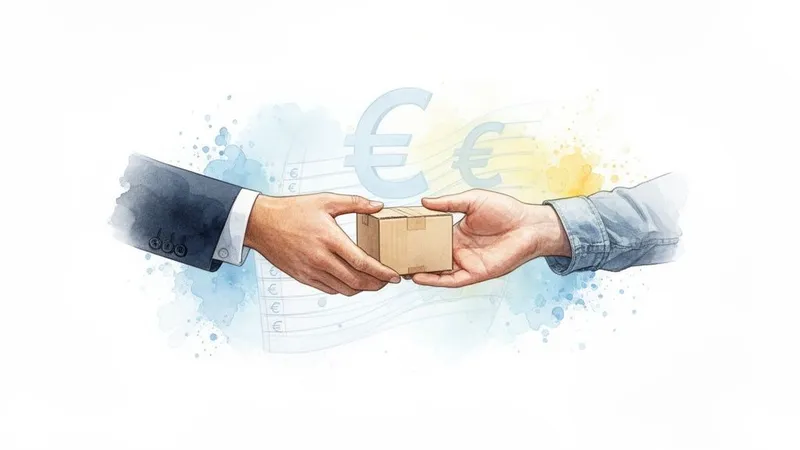
The VAT reverse charge is one of those tax concepts that can seem intimidating at first glance. Yet once you grasp the logic, it’s a very powerful tool for businesses. In concrete terms, this mechanism, governed by article 283-2 of the French General Tax Code, flips the usual roles: it’s no longer the seller who collects VAT for the state, but the professional buyer who takes care of it.
For the purchasing business, the operation is neutral for cash flow. It declares the VAT it owes, then immediately deducts it. It’s a matter of bookkeeping entries, but an essential one to stay compliant.
Decoding the principle of VAT reverse charge
To put it simply, imagine VAT as a parcel. In a standard sale, the seller receives this “parcel” from the customer and delivers it themselves to the tax authorities. With the reverse charge, the seller passes this tax parcel directly to their professional customer. It’s then up to the customer to hand it over to the state via their own VAT return.
This mechanism is at the heart of everyday life for online sellers, especially those juggling stock held abroad or buying online services from foreign providers.

A mechanism designed to simplify and secure
So why was this system put in place? The goal is twofold: to streamline exchanges and strengthen tax security. For a French business, it considerably simplifies international transactions.
Think, for example, of these very common situations for an online seller:
- Importing goods from a non-EU country to stock an Amazon FBA warehouse.
- Buying online services, such as a software subscription (SaaS), advertising campaigns on Meta or Google, or the services of a freelancer based abroad.
- Sourcing goods from a supplier based in another European Union country. To properly manage these cases, it’s also useful to master the calculation of intra-community VAT.
Historically, the reverse charge has also been a weapon of mass deterrence against fraud, notably the infamous “VAT carousel” schemes. These sophisticated setups caused colossal losses. A 2008 European Commission report already estimated the damage at over 10 billion euros per year for the EU.
In practice, the VAT reverse charge turns a tax obligation into a simple accounting entry. The buyer declares the VAT they would have had to pay (VAT collected) and deducts it simultaneously (deductible VAT), making the operation neutral for their cash flow.
For an online seller, understanding this mechanism isn’t just an option, it’s a necessity. It avoids advancing cash on imports and ensures compliance when purchasing services abroad. In short, it’s the key to turning a tax complexity into a real advantage for your business management.
Identifying the situations where reverse charge applies to your e-commerce business
For an online seller, knowing exactly when to trigger the VAT reverse charge mechanism (provided for in article 283-2 of the CGI) is absolutely crucial. Think of this mechanism as a tax GPS: it guides you step by step through certain specific situations so you always stay on the right track. Without it, the risk of going astray in your return and making costly mistakes is very real.
In concrete terms, for online sellers, three scenarios come up constantly and almost always trigger this obligation. Whether you sell via Shopify, Amazon or your own site, you’re very likely to encounter them. Let’s go through them so you can spot them immediately in your day-to-day.
Case 1: You import goods from a country outside the EU
This is the daily bread of many web entrepreneurs. Are you dropshipping with a supplier based in Asia? Bringing in stock from China to ship to Amazon FBA warehouses in France? As soon as a physical good crosses the European Union border to reach French soil, you’re affected.
Since January 1, 2022, the VAT reverse charge on imports has become both automatic and mandatory for any French business registered for VAT. Gone are the days when it was a simple option that forced you to advance cash! The process is now much simpler.
Concrete exampleA Shopify seller orders a batch of 500 phone cases from a Chinese manufacturer for €5,000. Upon arrival in France, instead of paying €1,000 in VAT (20%) to the carrier, they simply apply the reverse charge. They declare it and, at the same time, deduct it on their CA3 return. The operation is therefore entirely neutral for their cash flow.
Case 2: You buy goods in another EU country
This scenario, known as an intra-community acquisition, occurs when you buy goods from a professional supplier located in another European Union country, whether in Germany, Spain or Italy.
For the reverse charge to apply, two simple conditions must be met:
- You are a professional subject to VAT in France.
- Your supplier is also a professional subject to VAT in their own country.
The seller will then send you a tax-free invoice. It’s absolutely essential to give them your French intra-community VAT number to make sure everything is in order. If you’re unsure, our guide on how to find your intra-community VAT number is here to help.
Exchanging intra-community VAT numbers is the cornerstone of all B2B transactions within the EU. If you forget to provide yours, your seller may be forced to charge you VAT at their own country’s rate, which would needlessly complicate your accounting.
Case 3: You buy services from a foreign business
This is probably the most frequent case, and yet the least visible, for digital businesses. Every software subscription, every euro spent on online ads, every task assigned to a freelancer abroad… all of this can fall under the reverse charge.
The general rule is easy to remember: for a service provided between businesses (B2B), VAT is due in the buyer’s country. The foreign provider therefore invoices you tax-free, and it’s up to you, the French customer, to apply the reverse charge for French VAT.
Think about your most common expenses:
- Online advertising: Your campaigns on Meta (billed from Ireland) or Google (also Ireland).
- Software and SaaS: Your subscription to tools like Notion, Slack, or even certain e-commerce platforms.
- Freelance services: The web developer based in Eastern Europe or the graphic designer in Asia working for your store.
Concrete exampleA French marketing agency subscribes to an American project management tool for a €200 monthly subscription. The invoice arrives without VAT. The agency must then calculate French VAT (20% of €200 = €40) and apply the reverse charge on its return. The operation remains financially neutral, but it is mandatory. Ignoring it is a classic mistake that can prove very costly in the event of a tax audit.
Managing invoicing and VAT declaration step by step
Understanding the mechanism is one thing. Applying it smoothly across your documents and returns is another. This is where theory gives way to practice, and the smallest mistake can cost dearly in the event of a tax audit.
Taking action is fairly simple once you break it down: everything starts with a compliant invoice and ends up in the right boxes of your VAT return.
To make things clearer, this infographic summarizes the three main cases where an online seller will need to apply the reverse charge.
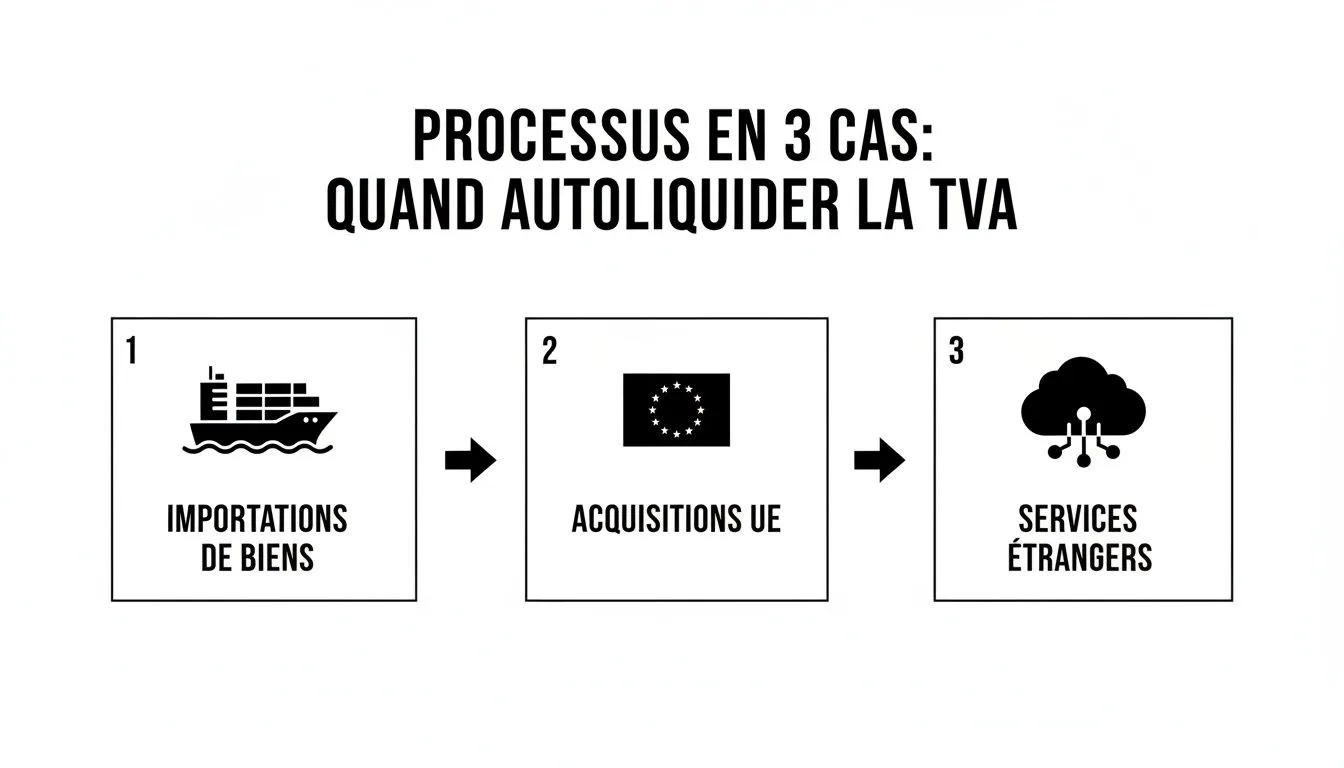
What matters is that regardless of the origin of the purchase — import, EU acquisition or foreign service — responsibility for calculating and declaring the VAT always falls on you, the French buyer.
Mandatory wording on your invoices
The invoice is the cornerstone of the operation, the official proof that you’ve applied the rules correctly. When you buy a good or service subject to the reverse charge, the invoice you receive must always be issued tax-free (excl. VAT).
More importantly, it must carry a very clear statement justifying this absence of VAT. This is the signal to the tax authorities that both parties are well aware of the special regime being applied.
In concrete terms, here are the points to check on your supplier’s invoice:
- No VAT charged: The total amount due must be the tax-free amount. This is non-negotiable.
- Explicit legal wording: The invoice must state clearly “Reverse charge”.
- Reference to the law: To reinforce the point, it’s strongly recommended to add the legal reference, such as “Reverse charge under article 283-2 of the CGI”.
- VAT numbers: For transactions within the EU, the intra-community VAT numbers of both the seller and yourself must appear on the invoice.
In the world of B2B e-commerce, this rigor is crucial. Take the example of a SaaS subscription sold by a platform like Paddle. Article 283-2 of the CGI requires the French buyer to apply the reverse charge. It’s therefore up to you to calculate VAT at the French rate (generally 20%) and declare it. If you want to dig deeper into the subject, you can consult this comprehensive guide to the VAT reverse charge.
Correctly filling out your VAT return (CA3)
It’s on the VAT return — the well-known CA3 form for businesses under the standard real regime — that the magic of the reverse charge happens. The idea is simple: you declare the VAT you would have had to pay to the supplier (the “collected” VAT) and, in the same move, you deduct it (the deductible VAT). The operation is therefore neutral for cash flow, provided you fill in the boxes correctly.
Let’s take a textbook case: you buy €1,000 excl. VAT worth of advertising on Meta, billed from Ireland.
- Calculate French VAT: With the standard rate at 20%, the VAT to reverse-charge is €1,000 × 20% = €200.
- Declare the “due” VAT: On your CA3, you’ll enter the tax-free amount of €1,000 on the line dedicated to intra-community service purchases. The system will then automatically calculate the €200 of VAT to be collected.
- Declare the “recoverable” VAT: At the same time, you carry these same €200 over to the deductible VAT section.
The result? You declare €200 owed to the Treasury, but also a €200 credit against that same Treasury. One cancels out the other. The impact on your cash is nil.
Here’s how these amounts translate visually into the key lines of the CA3 return.
| Example VAT return (CA3) for a reverse-charged operation | |||
|---|---|---|---|
| CA3 return line | Tax-free amount | VAT amount | Impact on payment |
| 03 - Intra-community acquisitions | €1,000 | ||
| 08 - Of which VAT on intra-community acquisitions | €200 | +€200 (VAT to pay) | |
| 17 - Of which on intra-community acquisitions | €200 | -€200 (VAT to recover) | |
| Total for the operation | €1,000 | €0 | Neutral operation |
This table clearly shows that the operation is a simple accounting exercise, but one that must be carried out with surgical precision.
Automating to avoid mistakes
Managing this process by hand, especially as transactions multiply, means taking the risk of making mistakes. A figure swapped, a declaration forgotten, and the door is open to complications with the tax authorities.
This is where automation changes the game. Platforms like Bizyness are specifically designed to absorb this complexity. By connecting directly to your advertising accounts (Meta, Google), your marketplaces or your SaaS subscriptions, Bizyness identifies on its own the operations that need to be reverse-charged.
The software takes care of generating the correct accounting entries and pre-filling your VAT return. The result: you save a tremendous amount of time and, above all, you gain invaluable peace of mind. Tax compliance becomes one less thing to worry about.
Mastering the accounting entries for the reverse charge
Now let’s step into the engine room: your bookkeeping. How does a reverse-charge operation translate concretely into figures? Rest assured, it’s not that complicated. The principle relies on an almost elegant symmetry, a kind of “mirror” entry that ensures total neutrality for your cash flow.
The trick is simple. For each operation concerned, you’ll record at the same time a VAT liability to the state (as if you’d collected it) and a VAT credit of the same amount (as if you’d already paid it). This double entry cancels out perfectly. That’s why, even though you must declare the operation, not a single euro will actually leave your bank account for it.
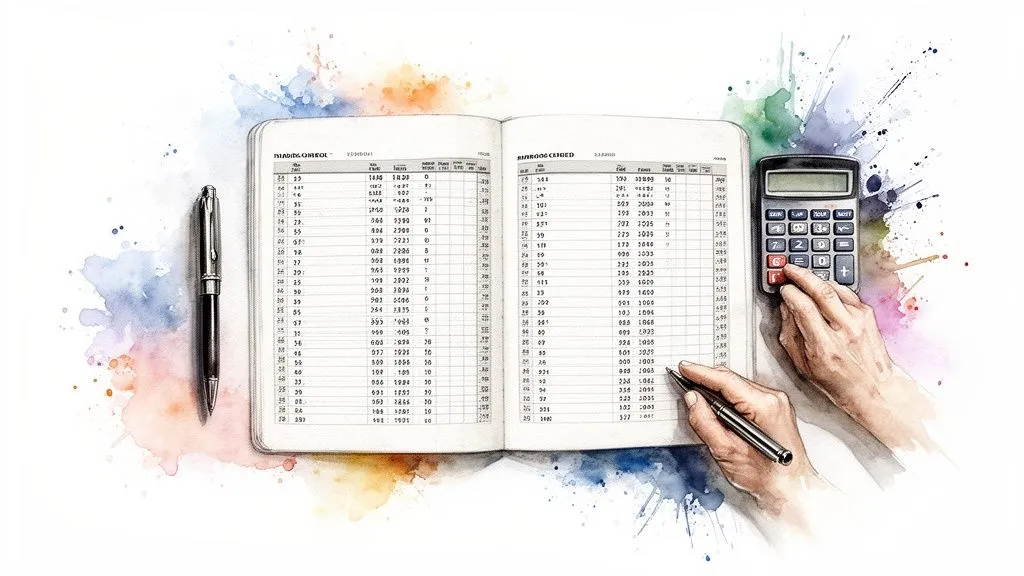
The journey of a reverse-charge accounting entry
To make this clearer, let’s take a scenario well known to online sellers. Imagine you buy a service from an Irish supplier — let’s say, advertising costs on Meta — for an amount of €1,000 excl. VAT.
Here’s how the mechanism plays out in your books, step by step.
- Receiving the invoice: You receive an invoice for €1,000, with no VAT. This is the signal that you need to apply article 283-2 of the CGI.
- Calculating French VAT: It’s your turn to act. You apply the current French VAT rate, 20%. The VAT to reverse-charge is therefore €1,000 × 20% = €200.
- Recording the mirror entry: This is where the accounting magic happens.
Your entry in the purchase journal will look like this, using the accounts from the French general chart of accounts:
| Account | Description | Debit | Credit |
|---|---|---|---|
| 623400 | Advertising, publications, public relations | €1,000 | |
| 445662 | Deductible VAT on intra-community acquisitions | €200 | |
| 401000 | Meta supplier | €1,000 | |
| 445200 | Intra-community VAT due | €200 |
You can clearly see the perfect balance: the deductible VAT account (an asset for you) is debited €200, while the VAT-due account (a liability) is credited the same amount. One cancels out the other. The only real cash outflow will be the €1,000 payment to your supplier. To better understand the structure of these entries, feel free to check out this example of a general ledger.
The key thing to remember is that the reverse charge is above all a declarative operation. Its purpose is to ensure that VAT is properly collected in France on services consumed there, without weighing down the cash flow of businesses that buy them abroad.
Automation, the key to peace of mind
Manually managing these entries for every invoice from Google, Shopify or a foreign supplier quickly becomes a headache. It’s a gateway to mistakes and a considerable waste of time. A simple typo or an oversight can lead to a painful tax reassessment and cancel your right to deduction.
This is exactly where a solution like Bizyness becomes your best ally. By connecting directly to your sales channels (like Stripe or Amazon) and your expense tools, the platform automatically identifies transactions subject to the reverse charge.
It then generates the complex accounting entries for you, with no manual intervention required. The benefit is twofold:
- A phenomenal time saving: No more manual calculation and entry for every operation.
- Maximum tax security: You have the certainty that every transaction is processed correctly, in line with the legislation.
This automation frees you from the administrative mental load. It gives you total peace of mind to focus on what really matters: growing your online business.
Mistakes you absolutely must not make
The VAT reverse charge sounds simple on paper. But in practice, it’s a minefield for many online sellers. The smallest mistake, even made in good faith, can prove very costly: tax reassessment, loss of the right to deduct VAT, penalties… Better to be forewarned.
Knowing the most common pitfalls is already a way to protect yourself and build solid foundations for your business’s tax management.
Mistake #1: The famous “reverse charge” wording forgotten on an invoice
This is the silliest mistake, but also the most frequent. You buy a service from a European supplier, everything goes smoothly, but on their invoice there’s no trace of the “reverse charge” (or “autoliquidation”) mention. To you, it’s a detail. To the tax authorities, it’s a red flag.
The consequences can be painful. In the event of an audit, if the invoice doesn’t meet the standards, the tax authorities can simply challenge your right to deduct VAT. You’d then find yourself having to pay this VAT without ever being able to recover it. The cash-flow advantage of the reverse charge? Gone entirely.
Mistake #2: Getting the VAT rate wrong
When you apply the reverse charge, the ball is in your court. It’s up to you to determine and apply the correct French VAT rate, the one that would apply if you had bought this product or service in France. The reflex is often to apply the standard rate of 20% across the board.
Except that some goods or services benefit from reduced rates of 10% or 5.5%. Applying too high a rate has no real consequence (you’ll pay too much, but the state won’t complain), but applying too low a rate exposes you to a VAT reassessment on the difference, plus penalties.
Remember this: it’s your job to correctly classify each purchase and assign it the right VAT rate. A mistake here isn’t a minor slip, it’s an underpayment in the eyes of the tax authorities.
Mistake #3: Filling out your VAT return (the famous CA3) incorrectly
Here, precision is surgical. The bookkeeping game on the CA3 return must be flawless. The classic mistake? Entering the VAT you must collect, but forgetting to carry the same amount over to the deductible VAT box. In an instant, an operation that was supposed to be neutral for your cash flow turns into a very real cash outflow.
The reverse is even worse: deducting VAT without having declared it as due. This is no longer a simple mistake, but a fault that can be treated as fraud. The key is symmetry: the amount of VAT collected must be the perfect mirror of the amount of deductible VAT.
To navigate this smoothly, here are a few good practices:
- Get into the VIES habit: systematically check the intra-community VAT number of your European partners before doing business.
- Fine-tune your invoicing software so it handles these specific cases without a hitch.
- Do a rigorous bank reconciliation to track down every transaction with a foreign supplier.
Ultimately, the safest solution is often to use a tool that does the heavy lifting for you. A platform like Bizyness, for example, connects to your various flows, automatically identifies the operations concerned, applies the right rules and pre-fills your returns. It’s the best way to sleep soundly and focus on what really matters: growing your business.
Automating your VAT management with Bizyness
Manual VAT management, as we’ve seen, has its limits. It’s often a source of mistakes and stress. The VAT reverse charge provided for by article 283-2 of the CGI is a precise mechanism that, if poorly mastered, can quickly become a headache. Fortunately, this is no longer inevitable. Automation can turn this constraint into a simple formality.
A tool like Bizyness is designed specifically for this. It’s not just a standard accounting software, but a genuine financial co-pilot for online sellers. It’s built to understand the reality of your flows, not just to line up numbers.
Smart, automatic detection
Imagine no longer having to ask yourself: “Is this invoice subject to the reverse charge?” That’s the whole point of connecting your tools. Bizyness integrates directly with your sales channels and spending platforms: Shopify, Amazon, Stripe, but also your advertising accounts like Meta or Google.
In concrete terms, the platform analyzes every transaction in real time.
- An ad invoice from Meta out of Ireland? Detected.
- A purchase of goods from a supplier in China? Identified.
- A software subscription from the US? Recognized.
In each situation, Bizyness automatically applies the correct accounting rule and the corresponding French VAT rate. No more manual intervention needed.
Automation isn’t just a time saver. It’s insurance against human error. By removing manual entries and rule interpretation, you reinforce your tax compliance and protect yourself against a potential reassessment.
The software then generates the famous “mirror” accounting entries without you having to think about it, prepares your VAT returns, and builds a perfectly clean Accounting Entries File (FEC).
The image below illustrates this idea well: Bizyness centralizes all your financial flows to give you a clear, unified view of your business.

Thanks to this integration, every operation is processed correctly from the moment it’s created. Your books stay up to date and accurate, at all times.
The benefit for the modern entrepreneur
For you, the gain is direct and tangible. You get back dozens of hours every month that used to be lost to repetitive administrative tasks. The mental load that comes with managing VAT disappears.
This relief lets you refocus on what really grows your business: finding new customers, improving your products, refining your strategy. Tax compliance is no longer a source of worry, but a simple process running quietly in the background. For an online seller looking to grow, automation is no longer optional, it’s an essential growth lever.
Your questions about article 283-2, our clear answers
The VAT reverse charge can quickly become a headache, especially when you sell online and navigate between different statuses and marketplaces. Let’s clear up the points that most often cause trouble.
Here are direct answers, designed to be applied to your business right away.
I’m under the VAT exemption scheme (franchise en base), am I affected by the reverse charge?
This is one of the most common traps. And the answer is yes, without a doubt. Your VAT exemption scheme does exempt you from charging VAT to your customers in France, but it doesn’t take you out of the game for your purchases abroad.
When you buy services (like Meta ads, a SaaS subscription) or goods from a supplier outside of France, it’s up to you to calculate and declare French VAT on these amounts. To do this, you must have an intra-community VAT number, even if you don’t collect anything on your sales.
The VAT exemption scheme doesn’t make you invisible in the eyes of VAT. For anything coming from abroad, article 283-2 catches up with you and makes you the tax collector, at least for these operations.
My supplier charged me VAT at their own country’s rate by mistake, what should I do?
This happens more often than you’d think, especially with new business partners. If you’ve properly provided your valid intra-community VAT number and the supplier still includes VAT at their own country’s rate, you must not pay it.
Here’s the simple, effective procedure to follow:
- Contact them right away to flag the error.
- Demand a corrected invoice, tax-free, that clearly states “Reverse charge” (or “Autoliquidation” in French).
- Refuse to pay the foreign VAT. This is crucial, because you will never be able to recover it on your French return.
Paying this VAT by mistake is simply a straight loss for your cash flow.
And what about my purchases on Amazon or Alibaba, how does that work?
On the big marketplaces, it’s all in the details. The key question is: who is the actual seller? Because it isn’t always the platform.
- On Amazon, you might buy a product sold by Amazon directly, or by a third-party seller on their platform. If that seller is in China, you’ll apply the VAT reverse charge on import. If they’re in Germany, it will be an intra-community acquisition.
- On Alibaba, you’re almost always dealing with a manufacturer or wholesaler outside the European Union. The VAT reverse charge on import is therefore the norm.
The habit to build: always check who the seller is on the invoice and where they’re located, to avoid getting the wrong regime.
Juggling these rules by hand is a gateway to stress and mistakes. With Bizyness, every transaction is analyzed so the correct VAT rule is applied automatically, whether you’re under the exemption scheme or the standard regime. Discover how Bizyness secures your tax compliance.
