

 Français
What Are the Mandatory Details on an Invoice in France
Discover which mandatory details must appear on an invoice to guarantee your compliance. The complete guide for businesses and e-commerce sellers.
An invoice isn’t just a receipt. It’s the legal and tax document that officially seals a commercial transaction. If you run an online store, every sale validated through Shopify or Stripe must be followed by issuing a flawless invoice that respects the rules to the letter.
Why flawless invoicing is non-negotiable
Let’s get straight to it: a compliant invoice is the foundation of your business’s credibility and longevity. It’s much more than a simple payment request. It’s legal proof that protects you and your client in case of a dispute, while guaranteeing clear, transparent traceability for the tax authorities.
Think of it as the contract that finalizes the sale. Each mandatory detail is, in a way, an essential clause of that contract, validating its authenticity. Forgetting even one is like leaving a blank page in a legal agreement: it opens the door to problems.

The risks of taking invoicing lightly
A simple mistake, a small oversight, and the consequences can quickly snowball. The slightest anomaly can lead to painful financial penalties, with fines adding up for each missing detail. But beyond the penalties, “roughly right” invoicing chips away at your clients’ trust and turns your bookkeeping into a real headache.
This documentary rigor is also true for all of a company’s expenses. In the same vein, it’s just as important to know how to manage travel expense reports.
Turning a constraint into a strategic advantage
This guide was designed to help you see things clearly and demystify invoicing. We’re going to break down every mandatory detail together, starting from the basics through to trickier cases, such as international sales handled via the OSS/IOSS one-stop shops.
The goal is twofold:
- Protect you from any tax risk by ensuring your compliance.
- Turn this obligation into a simple process, smooth and even automated.
Tools like Bizyness were designed precisely for this: they handle this critical process by automatically generating flawless invoices for every order. That frees your mind to focus on what really matters: growing your business.
The foundations of every compliant invoice
Think of your invoice as the ID card of a commercial transaction. For it to be valid in the eyes of the law and recognized by the tax authorities, it must contain a set of key pieces of information, much like a real ID card with its name, photo, and date of birth. This is the non-negotiable basis of all invoicing.
These elements answer three fundamental questions: who is selling? who is buying? and when did all this happen? Every detail matters for ensuring transparency and traceability. Let’s go through them to build your perfect invoice together.
1. Clear identification of the parties
The first step is knowing who’s who. It’s not enough to throw a name on paper; you need to provide complete contact details that leave no room for doubt.
The table below summarizes the essential information needed to identify the seller (you) and the buyer. It’s your official signature and proof that you’re dealing with the right entity.
Checklist of identification details on an invoice This table summarizes the essential data needed to identify the seller and the buyer, ensuring baseline compliance for every invoice.
| Mandatory detail | Description | Practical example |
|---|---|---|
| Name or Company name | The legal name of your company, or your full name if you’re a sole trader. | For you: “SAS DUPONT ET FILS” or “Jean Martin EI”. For the client: “Société ABC SARL”. |
| Registered office address | The official administrative address, not necessarily your office or shop address. | ”15 rue de la République, 75011 Paris” |
| SIREN number | Your unique 9-digit identifier, your company’s true fingerprint. | ”123 456 789” |
| Legal structure and share capital | Your company’s structure (SAS, SARL, EI…) and, where applicable, the amount of share capital. | ”SARL au capital de 10 000 €“ |
| RCS / RM number | Your registration with the Trade and Companies Register or the Trades Register. | ”RCS Paris 123 456 789” |
| Buyer’s details | At minimum, the name and business or registered office address of your client. | ”Société ABC SARL, 22 avenue des Lilas, 69002 Lyon” |
Making sure this information is correct on every invoice is the first step toward avoiding misunderstandings, whether with your client or with the tax authorities.
2. Time and identification markers
Once the parties are identified, the transaction must be dated and numbered. These are two elements scrutinized very closely during an audit.
The issue date of the invoice is simply the day you create it. It triggers payment deadlines and serves as a reference point for your VAT filings.
Right alongside it is the invoice number. Watch out — this detail is more strategic than it looks.
The invoice number must be unique and follow a continuous chronological sequence, without the slightest “gap”. Jumping from invoice F2024-105 to F2024-107 is a red flag for the tax authorities, who may see it as a possible attempt at concealment.
Also remember to mention the date of sale or of the service if it differs from the issue date. This is often the case if you invoice at the end of the month for services rendered earlier.
To avoid any mistakes, the ideal solution is to use invoicing software. Forget Excel, which offers no protection against edits. A dedicated tool automatically assigns a tamper-proof number to each invoice and secures your bookkeeping.
This rigor also applies beyond invoices. It’s crucial for any business to master its full set of legal notices to stay fully compliant.
3. The intra-community VAT number
This number is another indispensable detail, but whether it must be displayed depends on the context of the sale.
Here’s when it absolutely must appear on your invoices:
- If you’re liable for VAT: your own VAT number must always appear. This is non-negotiable.
- For a sale to a business in the EU: you must indicate both your VAT number and your client’s. This is the only condition allowing you to invoice tax-free under the reverse-charge mechanism.
Omitting this number on a European B2B invoice can cost you dearly: the VAT exemption could be denied, with a risk of a tax reassessment. It’s a common mistake, but an easy one to avoid.
By mastering these three pillars — identification, dating, and VAT — you ensure every transaction is solidly documented and ready to withstand any audit.
Clearly describing products and amounts
Now that everyone’s identity is established and the invoice is dated, we get to the heart of the matter: the detail of what you sold. This is the core of the engine, the part your client will scrutinize closely and that the tax authorities expect to see done right.
A vague description like “Web service” or “Store product” is the best way to create misunderstandings, expose yourself to disputes, or worse, trigger questions during an audit. Clarity is your best ally.
Precise naming of products and services
Picture this part of the invoice as a meticulous inventory. Each product, each service, must have its own line so it can be identified at a glance, without the slightest ambiguity.
For each line, the law requires you to be precise. Here’s what must absolutely appear:
- The exact description: Ban generic terms. Instead of “Clothing”, write “Organic cotton T-shirt - ‘Alpha’ model - Size L”. For a service, prefer “Creation of 5 visuals for Instagram campaign” over a vague “Graphic design work”.
- The quantity: Simple but essential. Indicate the number of units sold, whether physical items, hours of work, or software licenses. For example: “Quantity: 2”.
- The unit price excluding tax (net): The base price of a single item or a single unit of service, before adding any tax.
This line-by-line approach isn’t just good practice, it’s fundamental. It’s what justifies the total amount and allows VAT to be applied correctly.
The detailed financial breakdown of the total
Once your list of products is established, it’s time to move to the figures and detail the calculation of the final amount. This is a step where rigor matters, because it proves you have a handle on your tax obligations.
Your invoice must clearly show several key amounts:
- The total excluding tax (net total): The sum of all unit net prices multiplied by the corresponding quantities.
- The applicable VAT rate: Each product or service can have a different VAT rate (20%, 10%, 5.5%…). You must indicate the rate that applies to each category of product invoiced.
- The total VAT amount: The sum of all the VAT you collected on this sale. If you have several rates, it’s even recommended to break down the amount by rate.
- The total including tax (gross total): The final amount your client owes you. It’s simply the net total plus the total VAT amount.
Concrete example for an e-commerce seller Imagine a seller on Shopify whose customer buys a book and an electronic product.
- Line 1: Book “The SEO Guide” | Quantity: 1 | Unit price excl. tax: €18.95 | VAT rate: 5.5%
- Line 2: Wireless headphones | Quantity: 1 | Unit price excl. tax: €83.33 | VAT rate: 20%
On the invoice, the totals should therefore appear as follows:
- Net total: €102.28
- VAT amount 5.5%: €1.04
- VAT amount 20%: €16.67
- Total VAT: €17.71
- Total due, tax included: €120.00
This breakdown is absolutely crucial, particularly for your VAT filings. It lets you clearly justify the amounts you’ve collected and must remit to the State.
Fortunately, tools like Bizyness are here to automate this entire process. Connected to your Shopify store or your Stripe account, it analyzes every order, identifies the products, applies the correct VAT rates (even in complex cases like international sales), and generates a perfectly itemized invoice. That’s peace of mind: you eliminate calculation errors and ensure effortless tax compliance. To see what that looks like, take a look at our invoice template, which brings all these elements together.
These new details are changing the game on your invoices
The world of taxation is anything but static. It moves, it adapts, and you need to keep pace to stay compliant. The major shift toward electronic invoicing, planned for 2026, has already started sowing its seeds, with new requirements appearing on your invoices.
Far from being minor details, these additions pave the way for e-invoicing and strengthen the fight against VAT fraud. Burying your head in the sand today means risking penalties tomorrow. So let’s take a closer look at these four details that have become essential.
The business client’s SIREN number: the end of anonymity
The first of these new rules is adding your business client’s SIREN number. Until recently, a name and address were enough. Now, for any business-to-business (B2B) sale, your client’s 9-digit SIREN number must appear.
The goal is simple: identify the buyer without the slightest room for doubt. For the tax authorities, this is a formidably efficient way to cross-reference information and ensure transactions are genuine and properly declared on both sides. We’re clearly moving toward total traceability of commercial flows.
The delivery address, if different
Second new requirement: the delivery address. If it doesn’t match the billing address (often the registered office), you must now state it clearly.
This is a detail that speaks particularly to e-commerce sellers or businesses delivering equipment to job sites, warehouses, or different stores. In practice, it allows the physical journey of goods to be traced — vital information for VAT audits and for logistics.
Why does this matter so much? Distinguishing the billing address from the delivery address makes it possible to verify that a transaction is genuine. It’s also crucial for ensuring VAT is applied correctly, especially in international sales where the delivery location dictates the tax rules.
Goods or services? You have to pick a side
The third mandatory detail requires you to specify the nature of what you’re selling. You must now clearly indicate whether it’s a “supply of goods”, a “supply of services”, or, why not, a “mixed transaction”.
This small phrase has a big impact, as it helps determine the applicable VAT regime. The rules for selling a product (VAT due on invoicing) aren’t the same as for a service (often due on collection). This clarification removes all ambiguity and simplifies life for everyone, including the tax authorities. To learn more about VAT wording, take a look at our guide on the “VAT not applicable” mention.
These additions are the launchpad for electronic invoicing. Since decree no. 2022-1299 of October 7, 2022, this information has become the backbone of future data exchanges. A 2024 study even showed that 17% of tax reassessments in e-commerce were due to a missing client SIREN number. A figure that speaks for itself.
The option to pay VAT on collection
Finally, the last new requirement is aimed at service providers. If you’ve chosen to opt for “payment of VAT on collections”, it’s now mandatory to state this on your invoices.
In short, this option allows you to declare and pay VAT as soon as you issue the invoice, without waiting to be paid. Writing it down informs your client of the regime you’ve adopted and makes things clear.
Including these four details isn’t optional. Fortunately, tools like Bizyness have already gotten ahead of the curve by building these requirements into their processes. By automatically retrieving the SIREN number via payment APIs like Stripe and classifying transactions, they ensure effortless compliance and spare you a lot of hassle.
Adapt your invoices to your status and your activity
An invoice isn’t just a standard document you print on autopilot. Think of it instead as an ID card for each transaction: it must precisely reflect who you are (your legal status) and what you do (the nature of your business). The mandatory details on an invoice change depending on these factors, and missing them can quickly become costly.
In certain cases, it’s essential to add specific mentions to clarify your tax regime or to protect your clients. These aren’t options, but genuine legal requirements that spare you a lot of trouble with the tax authorities and ensure the validity of your accounting documents.
To help you see things clearly, this decision tree guides you through the key questions to ask yourself. It will help you identify which details to include based on your situation: professional status, type of product sold, and delivery terms.
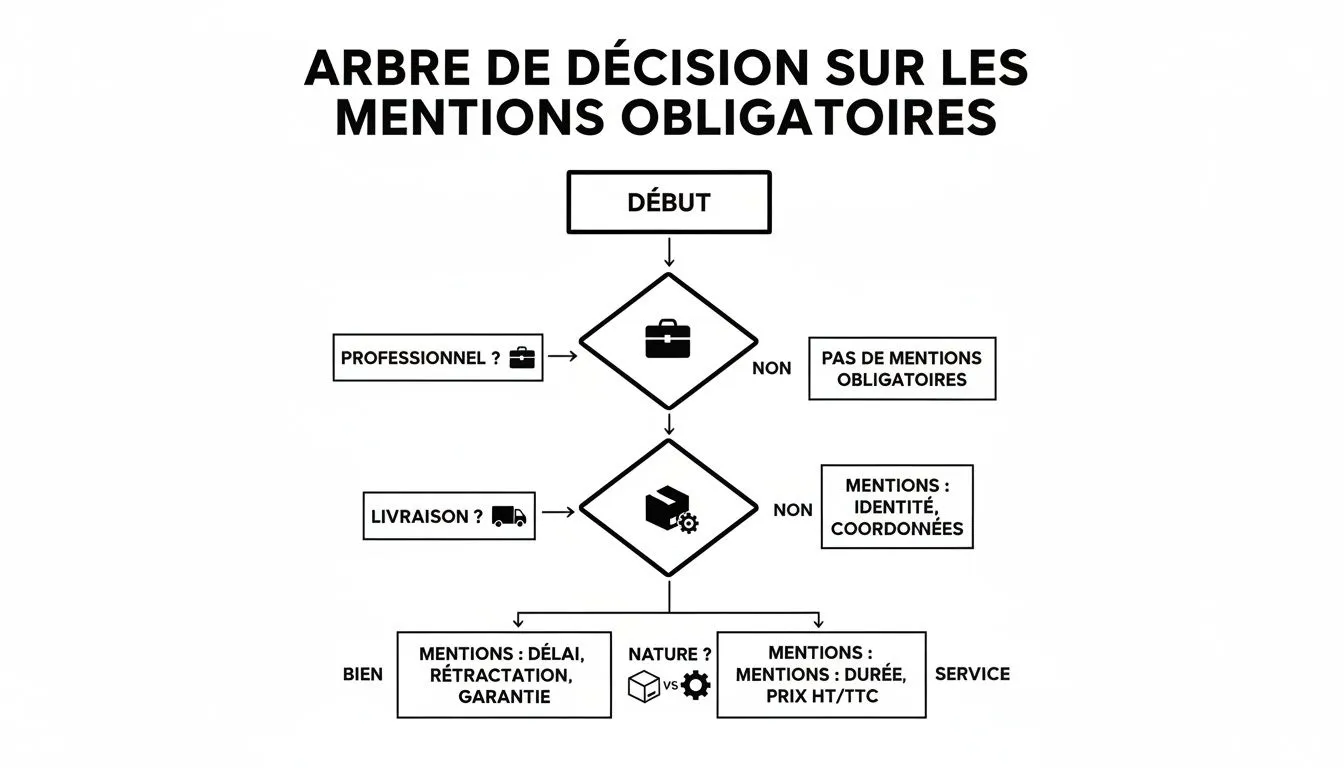
This diagram makes it clear: every sale, whether B2B, B2C, for a good or a service, follows its own compliance path. Trying to handle it all manually quickly becomes a headache.
The table below summarizes the additional details to add to your invoices depending on your status or the type of transaction.
Special mentions depending on your situation
| Situation / Status | Mandatory detail to add | Context of application |
|---|---|---|
| Micro-entrepreneur | ”VAT not applicable, art. 293 B of the French Tax Code” | When you’re under the VAT exemption scheme and haven’t exceeded the revenue thresholds. |
| Craftsperson (with mandatory insurance) | Insurer’s contact details and the geographic coverage of the policy. | Essential for regulated activities such as construction (ten-year warranty insurance, for example). |
| Member of an approved management association (CGA) | “Member of an approved association, payment by check and card is accepted” | To inform clients and the tax authorities of your membership in an approved management association (Centre de Gestion Agréé). |
| Intra-community B2B sale | ”Reverse charge by the customer” or “VAT exemption, article 262 ter I of the French Tax Code” | When invoicing a business client in another EU country. |
Each of these mentions has a very specific purpose and must never be forgotten.
The crucial case of micro-entrepreneurs
If you’re a micro-entrepreneur (the status previously called auto-entrepreneur), you’re very likely under the VAT exemption scheme. That means you don’t collect VAT, and therefore invoice tax-free. This is an advantage, provided you respect the revenue thresholds.
But be careful: it’s not enough to simply not mention VAT. You’re required to justify this absence with a specific phrase on each of your invoices.
The mention you must never forget: “VAT not applicable, art. 293 B of the French Tax Code”. This simple phrase signals to your client and the tax authorities that you’re within your rights.
This is one of the most common mistakes. Forget it, and your invoice is considered incomplete. To dig deeper, feel free to read our complete guide to invoicing for sole traders.
Invoicing a business client abroad
Are you selling to a company based in Germany, Spain, or elsewhere in the European Union? In that case, the VAT reverse-charge mechanism comes into play. In practice, you invoice tax-free, but you must state this explicitly.
The mention to include is “Reverse charge by the customer” or, more formally, “VAT exemption, article 262 ter I of the French Tax Code”. This is the phrase that shifts VAT responsibility to your client, who will have to declare and pay it in their own country. Without it, the French tax authorities could well turn to you to claim the VAT.
Stay vigilant, because the tax authorities don’t take invoice compliance lightly, especially as part of their fight against fraud. It’s no accident that since October 1, 2019, the billing address (if different from the delivery address) and the purchase order number have become mandatory. In 2024, out of more than 50,000 invoices audited, 12% were penalized for missing details, with a fine of €15 per omission.
Managing this complexity manually is a risk. A tool like Bizyness has your back, dynamically adapting the invoice mentions based on your profile and your client’s, whether in France or abroad. This way, you’re always assured of being compliant, effortlessly.
The questions everyone asks about invoicing
Theory is one thing. But day to day, on the ground, you quickly run into practical cases that sow doubt. Even with the best intentions, questions remain and can end up paralyzing your management. This section is here for that: to answer directly, without jargon, the most common questions entrepreneurs like you ask.
Each answer is designed to be clear, concrete, and immediately applicable. The idea is simple: clear the fog and give you the keys to secure your practices. That way, every invoice you issue becomes a mark of professionalism and compliance.
Am I really required to issue an invoice to an individual client?
The answer is a resounding yes, especially if you sell online. Invoicing is by no means reserved for business-to-business (B2B) exchanges. For sales to individuals (B2C), it’s a fundamental pillar and, in many cases, an unavoidable legal obligation.
The law is actually very clear on this. You must always provide an invoice in these situations:
- For any distance sale: This covers 100% of your e-commerce sales. Whether a customer orders from your Shopify store or via a marketplace, an invoice must be generated.
- For any service as soon as its amount exceeds €25 including tax.
But beyond the obligation, think of it as essential proof that protects everyone. For you, it proves the transaction took place. For your client, it justifies their purchase and lets them assert their rights (warranty, return, etc.). It’s the document that seals trust.
What should I do if I make a mistake on an invoice already sent?
To err is human, and even the most well-oiled process isn’t foolproof. A wrong price, an incorrect quantity, a bad reference number… What should you do when the invoice has already reached the client? The golden rule is simple: it’s strictly forbidden to delete or modify an invoice that has already been issued.
Once validated, an invoice becomes part of an accounting sequence that must remain inviolable. Picture it as a sealed page in your company’s ledger. Crossing it out or tearing it out would create a “gap” that would immediately alert the tax authorities.
The right method is therefore to correct the mistake with full transparency. You have two options:
- The corrective invoice: It cancels and replaces the erroneous invoice. To keep everything clear, it must always reference the original invoice number to guarantee traceability.
- The credit note: This is a document that cancels, fully or partially, the original invoice. It’s the most common solution, especially when a client returns a product.
This new accounting document corrects the record entirely legally, without ever breaking the numbering sequence.
Can I create my invoices in Excel?
This question keeps coming up, and the temptation is real. A spreadsheet seems simple, free, and easy to use. Yet using Excel or Google Sheets for your invoicing is a very, very bad idea. It’s even dangerous for your business.
Why? Simply because a spreadsheet doesn’t meet the requirements of the anti-VAT-fraud law at all. That law imposes very strict conditions that only genuine invoicing software can guarantee.
The law requires invoicing data to be tamper-proof, secure, and archived. An Excel file, on the other hand, can be edited endlessly, leaves no trace of changes, and offers no guarantee of long-term preservation. In the event of an audit, spreadsheet-based invoicing is a huge red flag for the inspector.
Equipping yourself with certified invoicing software is therefore not a luxury, but the only way to guarantee your compliance. These tools are designed for exactly that: creating tamper-proof documents, with automatic numbering and proper archiving.
What’s the fine if a mandatory detail is missing from my invoice?
Forgetting a mandatory detail is never trivial. The tax authorities take the matter very seriously, because the clarity of an invoice is the cornerstone of VAT collection and the fight against fraud. Penalties exist to be a deterrent.
In concrete terms, omitting or getting a mandatory detail wrong is punishable by a tax fine of €15 per violation. That might not sound like much, but be careful: this fine applies to every missing detail, on every invoice. If you’ve issued 100 invoices with 2 omissions on each, the total adds up fast.
Additionally, the total amount of fines for any single invoice is capped at a quarter of its total amount. If a €1,000 invoice contains numerous errors, the fine could therefore climb up to €250.
Keep in mind that far heavier criminal penalties can apply in cases of proven fraud or accommodation invoices. In short, rigor isn’t optional. It’s your best insurance for the peace of mind and longevity of your business.
Managing invoicing, with its precise rules and special cases, can quickly become a full-time job. For businesses that sell online, Bizyness automates this entire critical process. Connected to your sales platforms like Shopify or Amazon, it generates compliant invoices for every order, applies the correct VAT rates, and prepares your bookkeeping effortlessly. Discover how to secure your financial management at bizyness.fr.
