

 Français
Accounting Software for Sole Traders: The Complete Guide
Discover the best accounting software for sole traders. Compare features and choose the ideal solution for managing your business.

When you’re a sole trader (micro-entrepreneur), good accounting software isn’t a gadget. It’s what turns an administrative chore into a smooth, almost automatic process. It lets you keep an eye on your revenue in real time, create spotless invoices in a few clicks, and prepare your URSSAF filings without breaking a sweat. Think of it as a strategic investment to save time and, above all, to sleep easy.
Why accounting software is a real game-changer for sole traders

Far from being a dull formality, accounting is the beating heart of your business. Even though the micro-entrepreneur regime is simplified, juggling invoices, payment tracking and various deadlines by hand can quickly turn into a headache — one that can cost you dearly in mistakes.
Imagine driving your car without a single dial on the dashboard. No speedometer, no fuel gauge… A bit unsettling, right? Managing your books on an Excel spreadsheet or a notebook is exactly the same. You’re driving blind, without really knowing the financial health of your business.
Say goodbye to spreadsheets and hello to a tool that thinks for you
Accounting software dedicated to sole traders is a bit like your personal co-pilot. It brings all your financial information together in one place and puts repetitive tasks into overdrive. No more checking line by line whether all the legal mentions are on your invoices, or pulling out a calculator to estimate your social contributions.
The tool does the work for you. The time you get back can be reinvested where it really counts: your craft, your clients, your growth. Moving from manual tracking to an automated system is a real turning point.
The benefits are felt right away:
- Top-notch security and compliance: The software is always up to date with the latest laws. Your quotes, invoices and filings are therefore always compliant, which is crucial given the gradual rollout of mandatory e-invoicing.
- A clear, real-time view: A well-designed dashboard shows you at a glance where you stand against revenue and VAT thresholds. No more nasty surprises at the end of the quarter.
- A phenomenal time saver: By automating invoice creation, bookkeeping of the revenue ledger and filing preparation, you save precious hours every month.
- A more professional image: Sending clear, error-free quotes and invoices that match your brand immediately boosts your credibility.
Good accounting software doesn’t just line up numbers. It makes them speak, giving you key indicators. A simple administrative obligation becomes a powerful tool for steering your growth.
It’s not an expense, it’s an investment
Seeing accounting software as just another cost is a mistake in judgment. In reality, it’s one of the most profitable investments you can make. The time saved, the penalties avoided, and the peace of mind it brings are worth far more than its monthly cost.
By alerting you before you cross the thresholds, for example, it helps you anticipate a change in tax regime and prepare for it, without facing costly retroactive adjustments. It becomes a true ally in growing your business with peace of mind.
The essential features to demand from your software
Choosing accounting software as a sole trader is a bit like walking into a huge supermarket. The shelves overflow with options, each more tempting than the last. Yet not all are equal. Some are simply indispensable for running your business with peace of mind. You need to look past the marketing to find the tools that will genuinely save you time and, above all, help you avoid mistakes.
The best software isn’t the one with the longest feature list. It’s the one that masters the basics perfectly. Think of it as a custom toolbox: every instrument has its place and helps you, day after day, build a solid management system.
Creating compliant quotes and invoices
This is the crux of the matter. Your software must let you generate flawless quotes and invoices in a few clicks, personalized with your logo and details. But the most critical part is legal compliance. The tool must automatically include all mandatory mentions, kept up to date — including VAT mentions if you cross the threshold.
Picture this very concrete scenario: you’ve just crossed the VAT exemption threshold. Good software doesn’t just warn you. It updates your invoice templates to add the VAT mentions and the correct rates. This is a huge time saver that spares you the risk of sending non-compliant invoices, which could be rejected by your clients or land you in trouble with the tax authorities.
Revenue tracking and threshold alerts
Running your business without tracking your revenue is a bit like sailing the open sea without a compass. A key feature is a clear, visual dashboard that shows you in real time where you stand relative to the caps of your status.
The real bonus is automatic alerts. Your software should notify you when you’re approaching critical thresholds, whether that’s the overall revenue cap or the one that pushes you into VAT territory. Anticipating is the key to making the right decisions, like planning a change of legal status without being caught off guard.
Good accounting software doesn’t just record the numbers — it helps you anticipate. It’s a genuine strategic co-pilot that gives you the visibility you need to stay in control of your entrepreneurial journey.
Automating the revenue and expense ledger
Keeping a revenue ledger is a legal obligation for every sole trader. Doing it by hand in a notebook or spreadsheet isn’t just a chore — it’s also an open door to errors and oversights. Good software automates all of this.
How does it work? It’s simple. Every time one of your invoices is marked as paid, the software automatically adds it, in chronological order, to your revenue ledger. Even better, thanks to bank synchronization, your business expenses are imported and categorized directly. Keeping your purchase register becomes child’s play.
This diagram shows just how much good software can streamline the entire process, from document entry through to the final report.
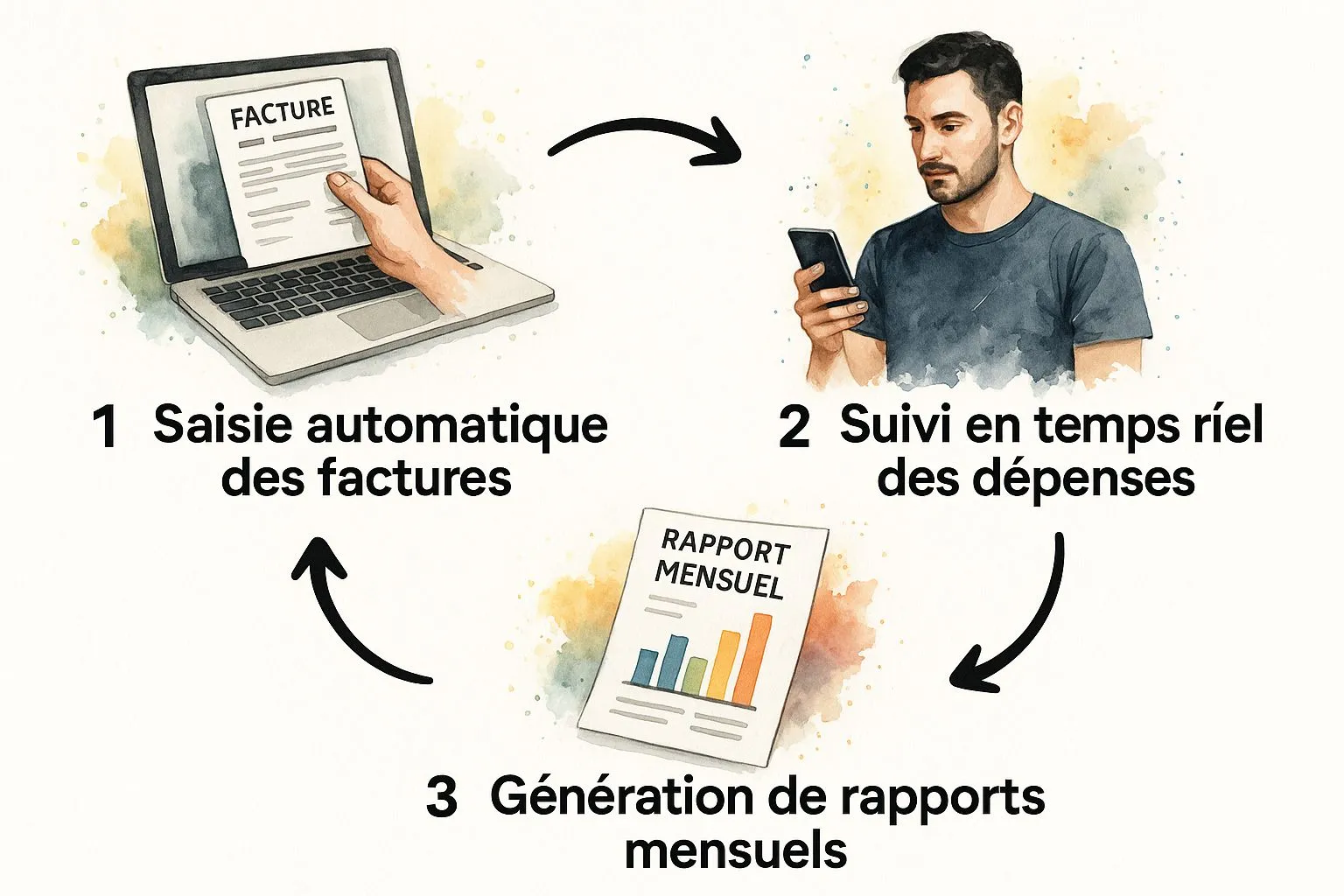
The infographic clearly highlights how automation turns repetitive manual tasks into an integrated workflow, freeing up precious time.
Preparing your URSSAF filing
Reporting your revenue to URSSAF, whether monthly or quarterly, is an appointment you can’t afford to miss. A calculation error or an oversight, and a penalty is guaranteed. The feature that changes everything here is automated pre-filing.
Based on the revenue you’ve actually collected over the period, the software calculates the exact amount to declare for you and gives you an estimate of your contributions. All you have to do is transfer these figures to the URSSAF website, without stress and without risk of error. Some tools even go further and allow direct electronic submission, simplifying the process even more.
This digitalization has given rise to a whole ecosystem of tools designed for independent workers. In 2025, many solutions like Abby offer very comprehensive features, from invoicing to bank sync, at very accessible rates — sometimes even starting at €0. It’s a real opportunity, though you should keep an eye on the limits imposed by the regime’s caps, which may force you to switch tools if your business takes off. To dig deeper, feel free to check out this comparison of software for sole traders.
How to choose the right accounting software for your business
Faced with the sheer number of accounting software options, it’s easy to feel overwhelmed. The goal isn’t to find the most powerful tool on the market, but the one that fits seamlessly into your day-to-day as a freelancer. The right choice will save you precious time; the wrong one, on the other hand, will quickly become a source of headaches.
To avoid getting it wrong, the secret is to rely on concrete criteria that match your needs. You need accounting software for sole traders that works for you, not the other way around.
Prioritize simplicity and ease of use
Software, even one packed with features, is useless if it’s too complicated. The interface must be clear, intuitive, and give you access to what matters in just a few clicks. If you’re wasting hours figuring out how to generate an invoice or check your revenue, the tool is completely missing its purpose.
Think about your own learning curve. The best software is the one you master in no time and actually enjoy using. Most offer a free trial period, so seize the opportunity to test the ergonomics and see if it suits you.
The number one criterion isn’t the number of features, but how easily you can carry out your essential tasks. A simple, effective tool will always beat a bloated “gas factory” that you’ll end up abandoning.
Make sure it’s built with micro-businesses in mind
Many accounting software packages are designed for SMEs, with complex modules that are completely useless for a sole trader. They’re not only more expensive, but they also drown you in options that only serve to confuse you.
Actively look for solutions specifically designed for the micro-entrepreneur regime. These focus on your actual obligations:
- Revenue tracking with alerts for the caps (revenue and VAT).
- Simplified bookkeeping of your revenue ledger (and purchase ledger, if you need one).
- Compliant quote and invoice generation, with the legal mentions specific to sole traders.
- Help filling out your URSSAF filing, whether monthly or quarterly.
Choosing a specialized tool guarantees you pay for what you actually need, without any bloat.
Analyze pricing and growth potential
Free plans can look appealing, but you should always ask what’s hiding behind them. Are they limited in number of clients? In number of invoices? Are certain key features locked behind a paid subscription? Read the fine print carefully to avoid unpleasant surprises.
A good pricing model is clear and able to grow with you. Your software should be able to support you if your business takes off. Do you plan to start charging VAT? Will you need bank synchronization? Make sure the tool can keep pace with your growth without forcing you to start over elsewhere.
For example, if you’re launching into online selling, features for managing transactions and inventory become essential. This is a key point in choosing the right software for the success of your project, as explained in this guide to succeeding in e-commerce in Switzerland.
Finally, never underestimate the quality of customer support. Responsive, competent support that’s easy to reach by chat, email or phone can save you when you’re stuck. It’s true peace of mind insurance.
Bizyness: what if we looked at a solution built for independent workers?
Faced with the jungle of available tools, it’s easy to feel overwhelmed. But let’s be clear: good accounting software for sole traders shouldn’t be a bloated machine full of useless features. Its real role is to be an ally, a simple and direct answer to the administrative hassles we all know, without requiring a degree in accounting.
That’s exactly the spirit in which Bizyness was designed. The tool isn’t aimed at chartered accountants, but rather at graphic designers, consultants, craftspeople and e-commerce sellers — in short, anyone who needs efficiency above all. The goal is clear: to give you back control of your management so you can finally focus on what really matters, your craft.
An interface designed for efficiency, not headaches
The first obstacle with any new tool is often its complexity. We’ve all used software with a cluttered interface that we end up abandoning after a week. Bizyness took the opposite path with a clean design, where everything important is accessible in just a few clicks.
A concrete example? A freelance graphic designer can create a flawless quote and send it to their client in under two minutes, stopwatch in hand, from their workspace. Once the client approves it, a single click is enough to turn that quote into an invoice. No double entry, no wasted time. This kind of fluidity is what changes everything day to day.
This approach is all the more relevant as entrepreneurship is going digital at breakneck speed. INSEE recorded more than 1,111,200 business creations in 2025, a record figure driven by this digital wave. Today, 85% of new entrepreneurs go digital from day one (compared to barely 51% in 2020), and more than 60% manage their business, including accounting, directly from their smartphone.
A dashboard to steer your business, not just endure it
Managing your micro-business well is above all about making the right decisions. And for that, you need the right information at the right time. Bizyness’s dashboard is there for exactly this: it centralizes all the vital data to give you a clear, immediate overview of your business’s health.
Here’s what this overview looks like, highlighting the numbers that really matter.
At a glance, you can see revenue, upcoming expenses and net profit — everything you need to steer your business with real precision.
Imagine a consultant: they can track the profitability of each assignment, which helps them better adjust their rates for future projects. An e-commerce seller, meanwhile, will visualize their sales peaks to better anticipate their cash flow needs. It’s no longer just a record of numbers — it’s a genuine management tool.
With Bizyness, accounting stops being an administrative chore and becomes a growth lever. By giving you a clear view of your performance, the tool helps you make better strategic decisions for your business.
Automations that save you precious time
For an independent worker, time is money. Every hour spent juggling paperwork is an hour that isn’t billed. That’s where Bizyness’s smart automations come in, freeing you from these repetitive tasks.
- Bank synchronization: No more hours spent reconciling statements. Transactions from your business account are imported and categorized automatically. Simple, effective.
- Simplified URSSAF filing: The software calculates your reportable revenue in real time and estimates your contributions. No more stress, no more risk of error.
- Automated VAT management: Approaching the exemption thresholds? Bizyness alerts you and prepares all the documents needed for a smooth transition.
To help make things clearer, this table sums up how Bizyness concretely addresses the everyday challenges of micro-entrepreneurs.
How Bizyness addresses sole traders’ challenges
| Sole trader’s challenge | Bizyness’s solution | Concrete benefit |
|---|---|---|
| Time lost on administrative tasks | Automated invoicing and quoting | More time to focus on your core business and clients. |
| Fear of making mistakes in URSSAF filings | Automatic revenue calculation and contribution estimates | Peace of mind and guaranteed compliance, an end to quarterly stress. |
| Lack of visibility into financial health | Visual dashboard with key indicators (revenue, expenses, profit) | Informed decision-making to grow your business. |
| Complexity of tracking and bank reconciliation | Automatic bank synchronization | Bookkeeping that’s always up to date, with no manual effort. |
| Anxiety-inducing transition to VAT | Threshold alerts and document preparation | Smooth transition, anticipated with no nasty surprises. |
These features are more than gadgets; they’re essential to managing your business with peace of mind and full legal compliance.
If you want to dig deeper into the topic, our complete guide to accounting software for sole traders will give you everything you need to make the best choice. In the end, Bizyness is much more than just a tool: it’s a genuine partner working behind the scenes for the success of your project.
Management mistakes that don’t forgive: what to absolutely avoid
Having good accounting software for sole traders is a major asset, but it’s not a magic wand. To make sure your business is really on the right track, you need to adopt the right habits from the start and dodge the classic pitfalls that can prove costly.
We often make these mistakes for lack of time or simply because we don’t know better. The problem is that they can quickly turn into penalties, tax reassessments and a good dose of stress. Fortunately, a well-designed tool acts as a safety net, making these missteps nearly impossible.
Mistake #1: Mixing business and personal finances
This is the classic, most widespread mistake. Using your personal current account to receive payments from clients and pay your suppliers? A very bad idea. You create total financial fog that makes tracking your cash flow impossible and justifying your income a nightmare in the event of an audit.
Software like Bizyness clears all of this up at once thanks to bank synchronization. Once your dedicated account is connected to the tool, every transaction is imported and categorized automatically. Your bookkeeping becomes clear and professional, without even having to think about it.
Mistake #2: Filling in your revenue ledger haphazardly
The revenue ledger, which lists all your incoming payments in order, is a legal obligation. Updating it “whenever you have five minutes,” at the end of the month or, worse, the quarter, is an open door to oversights and errors. A single omission, and your entire revenue declaration is thrown off.
Automation is your best friend. When you mark an invoice as paid in Bizyness, the line is instantly added to your revenue ledger. The result: your register is always up to date, accurate and compliant, with no effort on your part.
Good management software doesn’t just store numbers. It helps you build good habits and turns administrative chores into simple automatic routines.
Mistake #3: Estimating URSSAF filings roughly
Reporting your revenue to URSSAF can quickly become a source of anxiety. Estimating “roughly” or rounding amounts is a high-risk practice that can result in penalties for incorrect filing. The administration expects figures accurate to the cent, based on what you actually collected.
Good software completely eliminates this uncertainty. It calculates the exact amount to declare for you based on your recorded revenue. All you have to do is copy and paste it onto the URSSAF website, with total peace of mind.
Mistake #4: Getting caught off guard by the transition to VAT
Crossing the VAT exemption thresholds without realizing it is the worst-case scenario. Overnight, you find yourself having to pay VAT on sales already completed, with hefty retroactive adjustments and the obligation to redo all your invoices.
To make sure this never happens, Bizyness acts as a co-pilot. Its dashboard shows you in real time where you stand relative to the thresholds. You receive alerts well before reaching the limit, giving you all the time you need to anticipate the steps involved and prepare for a smooth transition.
By choosing the right tools and adopting the right practices, you protect your business and save a tremendous amount of time. To dig deeper into the topic, feel free to check out our complete guide on invoicing for sole traders, which explains all the rules you need to follow to stay fully compliant.
Frequently asked questions about sole trader accounting
Getting started with accounting as a sole trader inevitably raises quite a few questions. That’s completely normal. To help you see things more clearly, I’ve gathered here the most common questions, with direct, practical answers.
The idea is to give you a solid foundation for making the right decisions from the start. Understanding these points well is the key to running your business with peace of mind and in full compliance.
Is accounting software mandatory for a sole trader?
No, the law doesn’t require the use of accounting software for sole traders. Your legal obligations boil down to keeping an up-to-date revenue ledger and, for certain activities, a purchase register. Nothing more.
However, even though it’s not mandatory, it’s a very good idea. Managing your books by hand in a notebook or spreadsheet isn’t just a considerable waste of time — it’s also an open door to errors, oversights in filings, and non-compliant invoices.
Dedicated software does all of this for you, secures your data, and reminds you of important deadlines. Think of it as a safety net that ensures you’re always compliant, while freeing up precious time to take care of your clients.
What’s the difference between a PDF invoice and an electronic invoice?
This is a very common point of confusion, but the difference is essential. An invoice you send as a PDF by email is just a digital document. It’s not an “electronic invoice” in the sense of the new law.
A true electronic invoice, or e-invoice, is a document with a very specific format and data structure (such as the Factur-X format) that must mandatorily go through a certified platform. This special format allows computers, including those of the tax authorities, to read and process the information automatically.
The upcoming reform will make e-invoicing mandatory for all sales between businesses. From September 2026, all sole traders will need to be able to receive electronic invoices, and from September 2027, they will also need to issue them.
Is it mandatory to hire a chartered accountant?
Absolutely not. In fact, it’s one of the major advantages of the micro-entrepreneur status: the accounting is so simple that it doesn’t require a chartered accountant. You can perfectly well manage everything yourself.
This is exactly where accounting software for sole traders proves its worth. It’s designed to guide you step by step and automate tasks, without you needing to be a numbers expert.
Hiring a chartered accountant can become worthwhile if your business grows more complex, if you exceed the caps and need to change status, or if you’re looking for expert advice to optimize your taxes. But for day-to-day management, good software is more than enough.
How do I manage VAT with software?
Transitioning to VAT is often a dreaded moment for sole traders. At first, you’re under the VAT exemption scheme, meaning you don’t charge VAT and don’t declare it.
Good accounting software makes this step much simpler:
- Threshold tracking: The tool keeps an eye on your revenue and warns you well before you reach the exemption caps.
- Automatic transition: As soon as the threshold is crossed, the software updates your invoice templates to add VAT and the required legal mentions.
- VAT pre-filing: It calculates for you the VAT you’ve collected and the VAT you can deduct, preparing your filing for the tax authorities.
This automation spares you the stress and the errors. To learn everything about the topic, feel free to read our complete guide on managing VAT as a sole trader.
Are free software options a good choice for starting out?
A free plan can seem tempting when you’re trying to keep costs down at launch. For issuing a few quotes and invoices, it might be enough at the very start.
But you should be cautious. These free versions are often very limited: no bank synchronization, a restricted number of clients, or a cap on the number of invoices per month. Customer support is also often nowhere to be found when something goes wrong.
The most important thing is to choose a solution that can grow with your business. Starting with a free tool only to have to migrate everything a few months later is often a real headache that will cost you a lot of time.
Ready to shift into high gear and manage your business without stress? Discover how Bizyness can simplify your everyday life. Try our accounting software for sole traders for free.
