

 Français
Billing address explained: what it is and how to master it in e-commerce
Discover what a billing address is, its crucial tax role, and how to optimize it in e-commerce to ensure compliance and secure payments.
Far from being a mere formality, the billing address is essentially your customer’s fiscal and legal identity card for every transaction. It is the official address tied to their payment method. It is essential for guaranteeing the legal validity of the invoice and securing the entire sales process.
Decoding the billing address: much more than a postal address
For an online seller, the billing address is not just a line in a form. It is a genuine pillar of your accounting and tax compliance. Think about it: it’s what lets you determine the correct VAT rate to apply — an absolutely crucial obligation, whether you sell in France or internationally.
But its role doesn’t stop there. It is also your first line of defense against fraud. Payment systems like Stripe or PayPal use it to verify that the person placing the order is indeed the cardholder. If the address provided doesn’t match the one registered with the bank, the transaction can be blocked. It’s a safeguard for you, and for the customer.
An incorrect billing address can invalidate an invoice. The French General Tax Code is very clear: each erroneous mention can cost you a fine of €15 per invoice. This underscores the importance of collecting accurate information!
Here, we’ll break down the role of this address to turn it into a genuine lever for your store. To dig deeper into the information that must appear on your documents, feel free to read our full guide on mandatory invoice details.
The key roles of the billing address at a glance
To make things clearer, this table summarizes the essential functions of the billing address.
| Role | Description | Impact for the online seller |
|---|---|---|
| Tax validation | Identifies the location of the transaction to determine the applicable VAT (France, EU, international). | Ensures the correct VAT rate is applied and avoids the risk of a tax reassessment. |
| Payment security | Used by AVS (Address Verification System) systems to confirm the payer’s identity. | Significantly reduces the risk of fraudulent transactions and payment rejections. |
| Legal compliance | Constitutes a mandatory mention on every invoice to ensure its legal validity. | Secures the legal value of the document in the event of a dispute or administrative audit. |
Each of these points shows just how non-negotiable rigorous billing address management is for the long-term health of your business.
Billing and shipping: two addresses you should never mix up
In the world of e-commerce, there’s a mistake we see all the time, but whose consequences can be very real: confusing the billing address with the shipping address.
Picture a very classic situation: a customer buys a gift for a friend on your store. Naturally, they want the package delivered to their friend’s place (that’s the shipping address), but the invoice sent to their own home (the billing address). Simple enough, right? Yet this nuance is fundamental.
These two pieces of information serve completely different purposes. One tells the carrier where to drop off the package. The other, far more important, identifies who is paying, from a legal and tax standpoint.
Each address has its own precise role
Let’s take another example. A tradesperson orders equipment on your site and has it delivered directly to their job site. The shipping address will therefore be that of the job site, an inherently temporary location. The billing address, on the other hand, will remain that of their company’s registered office, since that’s where all their accounting is managed.
This distinction matters for several reasons:
- Fighting fraud: It’s the billing address that payment systems check to make sure it matches the information tied to the credit card. It’s a basic security measure.
- Ensuring accurate accounting: It links the transaction to the right person or company. This is the key to avoiding a headache in your books.
- Taking care of the customer experience: Sending an invoice with the gift’s price directly to the recipient? That’s the best way to ruin the surprise and leave a very bad impression.
To keep things clear for your customers, and for you, it’s essential to explain the difference well, as we detail in our shipping and returns policy. Good communication on your site from the start avoids a lot of mistakes.
A distinction that is becoming a legal requirement
This separation between the two addresses isn’t just a best practice — it’s becoming increasingly critical with the rise of electronic invoicing. Put simply: clearly distinguishing between the two will soon be a mandatory mention on your invoices. The stakes are high, since this concerns millions upon millions of transactions every year.
The upcoming reform, which will take effect in September 2026, will require the customer’s SIRET number and shipping address to appear on the invoice if it differs from the billing address. This affects around 2 billion B2B transactions per year. This level of detail will therefore be essential to remain compliant.
In concrete terms, what does this change for you? It means your e-commerce platform, whether Shopify, WooCommerce, or another, must let you collect and manage both addresses without the slightest error. For online sellers, ignoring this distinction could soon mean rejected invoices and, consequently, payment delays. It’s really time to review your processes and get ready.
The tax and accounting impact of the billing address
Far from being a simple line in a form, the billing address is the true tax rudder of every one of your sales. It’s what decides the VAT regime to apply, a decision with very direct financial consequences for your business. Every transaction is a dialogue with the tax authorities, and the billing address is the very first word in it.
A small error on this address, and the whole structure wobbles. Imagine selling a product to a customer in Spain but applying French VAT. You would collect 20% instead of the Spanish 21%, creating a shortfall you’d have to make up out of pocket when filing your return. And the reverse is just as problematic.
VAT: a matter of geography
The basic principle is actually quite simple: for sales to individuals (B2C) within the European Union, the applicable VAT is that of the country where the customer resides. In other words, the one shown on their billing address. This rule is the backbone of the OSS (One-Stop Shop) and IOSS (Import One-Stop Shop) single-window systems, created precisely to simplify our lives by centralizing the reporting of VAT collected abroad.
Let’s take a concrete example to picture this clearly:
- Sale in France: A customer based in Lyon buys a product for €100 excl. VAT. You invoice them €120 incl. VAT, with French VAT at 20%.
- Sale in Germany: A customer in Berlin orders the same product. There, you must invoice with German VAT at 19%, for a total of €119 incl. VAT.
- Sale outside the EU: For a customer located in New York, the sale is generally VAT-exempt. You therefore invoice €100 excl. VAT.
As you can see, without a reliable billing address, there’s no way to apply the correct rate. This rigor is absolutely essential for documents such as invoices and quotes, which must be flawless in the eyes of the law.
This simple decision tree perfectly illustrates how purchase intent — for oneself or as a gift — directly influences the separation between the billing address and the shipping address.
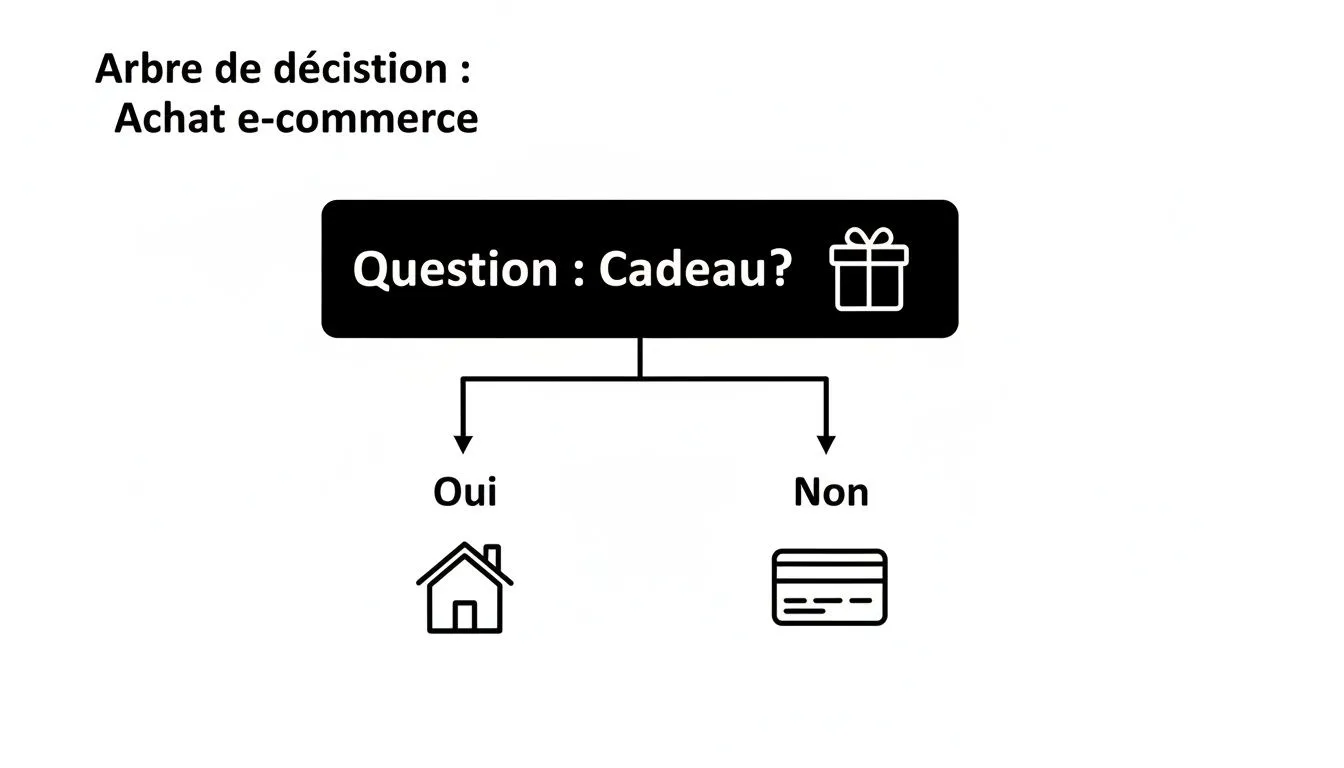
This diagram shows that if the purchase isn’t a gift, the billing address (tied to the payment method) and the shipping address are very often the same, which of course simplifies the process for everyone.
The special case of business-to-business sales (B2B)
When it comes to B2B exchanges, the billing address takes on a new dimension. It becomes a tool for validating your customer’s professional status, in particular by making it possible to verify their intra-community VAT number.
If you sell to another business in an EU country, the transaction is generally VAT-exempt thanks to the reverse charge mechanism. But be careful: for this to be valid, you must be able to prove that your customer is indeed a taxable person.
The role of the billing address here is absolutely crucial. It must match exactly the address associated with the VAT number your customer provided. In the event of a tax audit, the slightest inconsistency between these two pieces of information can lead the authorities to reclassify the sale as B2C and demand the VAT you didn’t collect.
In short, whether you sell to individuals or businesses, the billing address is the cornerstone of your tax compliance. It is not negotiable. Taking it lightly means running the risk of a reassessment that could seriously undermine your business’s financial health. Rigor is not optional — it’s a requirement.
How to optimize the collection and validation of addresses on your store
A correct billing address isn’t a minor detail — it’s a cornerstone of your e-commerce business. For you, every data-entry error can quickly turn into a headache: wasted time, tax risk, or even a lost sale. Fortunately, making this collection process more reliable is much simpler than it seems, starting with fine-tuning your checkout form.
The idea is to strike the right balance: making the experience as simple and smooth as possible for the customer, while ensuring you receive impeccable data. Let’s not forget that a frictionless checkout is one of your best assets for reducing cart abandonment.
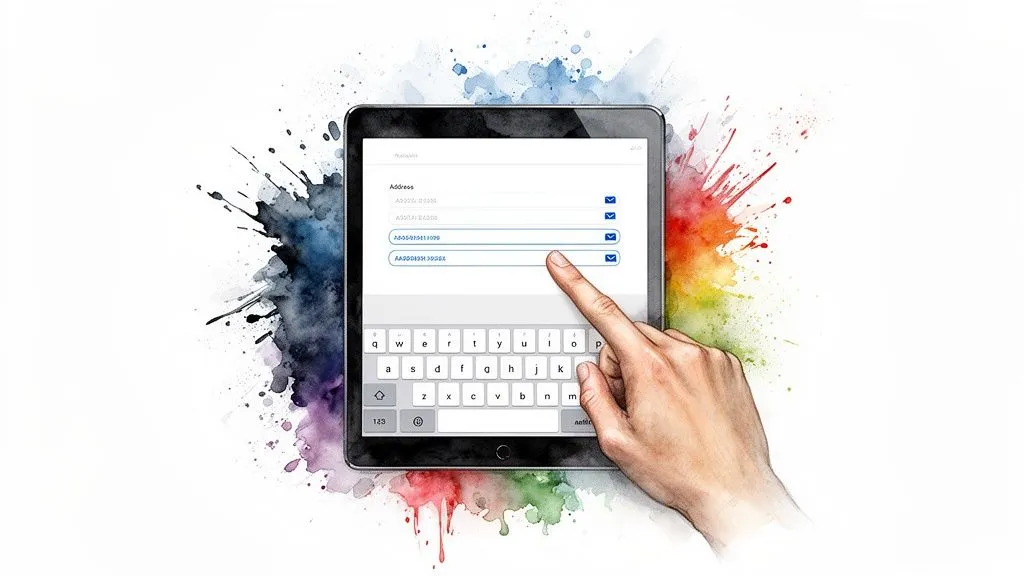
Making data entry easier to reduce errors at the source
The first step is to be proactive and help your customers. Tools like the Google Maps API, which offer autocomplete, are game-changers. The customer starts typing their address, and validated suggestions pop up. It’s a time-saver for them, and a guarantee of reliability for you.
Also consider real-time validation. A field that turns red because the postal code doesn’t match the city? A small message flagging something missing? These micro-interactions are an excellent way to gently guide the user and correct typos before the order is even confirmed.
A few best practices to implement on your form:
- Single address field: Let technology (like Google Places) do the heavy lifting by breaking the address down into street, city, and postal code. It’s simpler for the user.
- The famous checkbox: “My shipping address is the same as my billing address.” It’s a classic, but it saves precious time for the vast majority of your customers.
- Clearly visible required fields: A simple asterisk (*) and a clear legend are enough for the customer to know exactly which information is essential.
Anticipating special cases and standardizing data
Even with the smartest form in the world, you’re not immune to edge cases. A customer who urgently contacts you to correct an address after their purchase? Your customer service team needs a clear procedure for updating the information before the invoice is set in stone.
Postal standardization isn’t just about fixing a typo. It’s about reformatting an address so it matches exactly the standards used by La Poste or other postal services. This ensures proper mail delivery, of course, but above all the consistency of your data across all your IT systems.
This standardization step is becoming crucial, especially with the major electronic invoicing reform on the horizon. The billing address plays a central role in it. A non-standardized address, with odd abbreviations or an approximate postal code, could lead to your invoices being outright rejected by the authorities.
For an online seller, every rejection means payment delays and extra paperwork — not to mention fines that can climb up to €15 per non-compliant invoice.
By adopting these best practices, you turn what looks like a mere administrative constraint into a real performance lever: your accounting is healthier, you get paid faster, and your customers thank you for a smooth shopping experience.
Bizyness, or how to automate your invoicing compliance
Manually managing the compliance of every invoice is a real headache. Between different VAT rates, customer addresses to verify, and rules that keep changing, mistakes are never far away. This kind of administrative burden can quickly become a growth bottleneck. That’s exactly where a smart tool makes all the difference, securing and automating the entire process.
Bizyness was designed to simplify your life, turning this administrative complexity into a smooth, reliable system. The platform connects directly to your sales channels like Shopify, Stripe, or Amazon. The goal? To pull in all order data instantly, without you having to lift a finger.
Smart synchronization for error-free VAT
Once connected, the platform doesn’t just vacuum up raw data — it analyzes it intelligently. The customer’s billing address becomes the key to automatically applying the correct VAT rate.
Let’s take a concrete example. Imagine you’re a French online seller selling a product to an individual in Spain. Bizyness will immediately recognize the destination country and apply the current Spanish VAT rate. For you, that’s the guarantee of being perfectly compliant with the OSS single window, without having to juggle rate tables or do manual calculations.
Automation is no longer a luxury — it’s a necessity. It eliminates costly human errors, saves you precious time, and lets you focus on what really matters: growing your business.
This logic is just as vital for your B2B sales. Bizyness helps you validate your business customers’ intra-community VAT numbers and generate reverse-charge invoices seamlessly. If you’d like to dig deeper, feel free to take a look at our full invoicing software solution.
Anticipating new legal requirements
Automation doesn’t stop at VAT. With major reforms on the horizon, such as mandatory electronic invoicing, having impeccable customer data will become even more crucial.
The billing address, for instance, plays a central role in the national electronic directory set up by the government. This directory is what makes it possible to know where each French company wants to receive its electronic invoices. A tool like Bizyness ensures that the information you collect is already well structured and ready for these future obligations. To learn more, you can discover how the national directory for electronic invoicing works.
In short, Bizyness does far more than create invoices. It builds you a solid, automated financial compliance system that grows with your business. Every sale is handled properly, every invoice is legally flawless, and your accounting stays healthy. That means you can sleep easy.
Frequently asked questions about the billing address
Even after covering the whole topic, some practical questions often remain unanswered. That’s normal. Here are clear, direct answers to the most frequent questions we hear from online sellers. The goal: to help you manage your day-to-day operations securely, without the hassle.
Can a billing address be changed once the invoice has been issued?
The answer is no, categorically no. An issued invoice is a fixed accounting and legal document. Trying to modify it is like trying to rewrite a contract that’s already been signed: it’s forbidden and exposes you to serious trouble in the event of an audit.
So what should you do if a mistake slips in? The only clean, legal method is to cancel the erroneous invoice by issuing a credit note for the same amount. Then, and only then, do you create a new invoice, this time with the correct address. It’s the only way to guarantee that your accounting stays impeccable and compliant.
What should you do if an individual customer asks for an invoice in a company’s name?
This is a classic situation, and it should immediately raise a red flag. If a customer presenting themselves as an individual asks you to invoice a company, your first instinct should be caution. The best practice is simple: ask for their intra-community VAT number.
If the number is valid, everything’s fine. The sale shifts from B2C (to an individual) to B2B (to a professional), which changes the rules of the game, particularly for VAT. But without that number, politely decline and keep the invoice in the individual’s name. This is your best protection against the very real risk of unwittingly becoming complicit in VAT fraud.
How should billing addresses be managed for sales on marketplaces?
When you sell on Amazon, Cdiscount, or other platforms, the marketplace is on the front line: it collects all the customer’s information, including their precious billing address. For you, the challenge is bringing that data back into your own accounting system, reliably and without errors.
Of course, these platforms’ APIs exist for this purpose, but integrating them can quickly turn into a complex technical project.
The simplest solution is often to use a tool that bridges the gap for you. A good solution connects directly to marketplaces, automatically imports orders, applies the correct tax rules (especially for international sales), and generates compliant invoices — all without you having to lift a finger.
This automation saves you an enormous amount of time and eliminates almost all risk of data-entry errors.
Does the billing address need to be the same as the one linked to the payment method?
Yes, absolutely. It’s actually one of the basic rules for securing your online transactions. The billing address your customer enters on your site must match exactly the one registered with their bank for their credit card, or with their PayPal account.
Why? Because payment processors like Stripe rely on a system called AVS (Address Verification System). This tool checks in a fraction of a second whether the two addresses match, to make sure it’s really the legitimate cardholder making the payment. It’s actually one of the leading causes of payment rejection, and an excellent safeguard for you against fraud and unpaid invoices.
Ready to put your compliance on autopilot and say goodbye to invoicing errors? Bizyness syncs with all your sales tools to generate flawless invoices, apply the correct VAT every time, and bulletproof your accounting. Discover how to simplify your financial management at bizyness.fr.
