

 Français
 Billing address: what is it and why it matters for your e-commerce business
Discover what a billing address is and why it's essential for your payments and orders. A quick, clear guide.
In short, the billing address is your customer’s financial ID card for a specific purchase. It is inseparable from the payment method being used, and it serves to verify who is behind the transaction, to issue a proper invoice, and to calculate the correct taxes.
Why the billing address is much more than just an address
For an online seller, the billing address is far from a minor detail. It is crucial information, a keystone that supports three essential pillars of your business. Neglecting it exposes you to accounting errors, tax disputes, and payment problems.
Think of it as the legal anchor point of the transaction. It’s not necessarily where the parcel arrives, but it’s the address that ties the sale to a clear legal entity, whether an individual or a business. It’s what validates the buyer’s identity with their bank and the tax authorities.
The 3 key roles of the billing address
Every billing address you collect fulfills three vital functions for the health of your e-commerce business. Understanding them makes it clear why accuracy simply isn’t negotiable.
To help you see this more clearly, here’s a summary of these three essential functions.
The key roles of the billing address at a glance
| Key role | Simplified description | Direct impact for you |
|---|---|---|
| Legal compliance | This is the payer’s official address, which must appear on the invoice for it to be valid. | An invalid invoice can be rejected by the tax authorities and by your business customers (for their VAT recovery). |
| Tax accuracy | It determines the place of sale and, consequently, the correct VAT rate to apply. This is crucial for international sales or digital goods. | A VAT error can lead to a tax reassessment or cause you to lose money by applying too high a rate. |
| Payment security | Banks use it to verify that the person paying is indeed the cardholder (via the AVS - Address Verification System). | It’s your first line of defense for spotting a fraudulent transaction and avoiding unpaid bills and disputes. |
These three pillars are interconnected and ensure that every sale is not only completed, but also correctly recorded from an administrative standpoint.
-
Legal compliance: An invoice without your customer’s correct billing address has no legal value. It’s as simple as that. For a full refresher, take a look at our guide on mandatory information on an invoice.
-
Tax accuracy: This address is your compass for VAT. It’s what tells you where the sale is deemed to have taken place for tax purposes. Get this wrong, and your entire VAT return can be thrown off, especially if you sell abroad.
-
Payment security: It’s the guardian of your transactions. When the payment system compares the address provided by the customer with the one on file with their bank, it’s checking that everything matches. A mismatch is often a red flag for fraud.
In short, an accurate, verified billing address is your best insurance policy. It turns a simple order into a sound, tax-compliant, and secure accounting operation.
The crucial difference between billing and shipping addresses
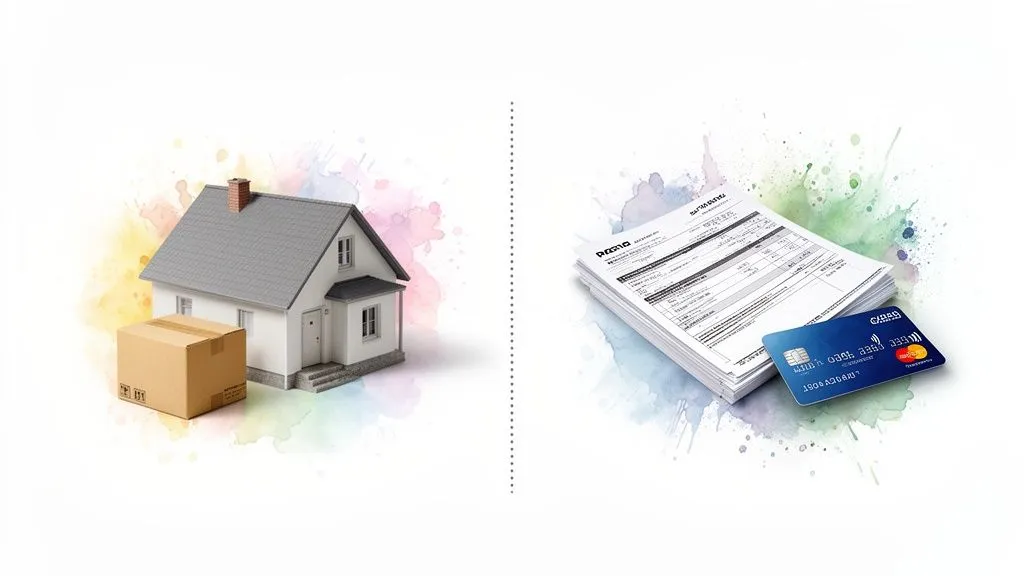
Thinking these two addresses are interchangeable is a beginner’s mistake, but it can be costly. Put simply, one concerns the parcel, the other concerns the money. It really is that simple.
The shipping address is purely logistical. It’s the physical destination of the product, the place where the carrier will ring the doorbell. It answers the question: “Where should I deliver this parcel?”
The billing address, on the other hand, is legal and financial. It identifies the person or business paying with their card. It answers the question: “Who is paying the invoice?” This is the address that banks verify during the transaction.
Mixing the two up exposes you to serious problems. Loose information at this stage can invalidate your invoices, distort your VAT returns, and turn your bookkeeping into a real headache.
Everyday scenarios to make things clearer
The best way to understand the difference is to look at how it plays out in real life, with cases you deal with every day on your online store.
Here are three very concrete examples:
- The birthday gift: Your customer buys a product to give to a friend. The shipping address will of course be the friend’s, but the billing address will remain the customer’s. They’re the one paying, it’s their name on the invoice.
- The business purchase: A company orders office supplies. Delivery happens at its premises, but the billing address is that of the head office, which is often different. This distinction is critical so the company can justify its expense and recover the VAT.
- The holiday delivery: A loyal customer orders an item for their vacation home. The shipping address is temporary, but the billing address remains their main residence, the one tied to their bank account.
In short, whenever the person receiving the parcel isn’t the one paying, the two addresses differ. Ignoring this nuance means risking issuing a non-compliant invoice that will be rejected by the tax authorities or by your customer’s accountant.
In each of these cases, the validity of the transaction, from the VAT calculation to proof of purchase, rests entirely on having the correct billing address. It’s what gives the sale its legal value.
The impact on your accounting and taxes
Far from being a simple line on a form, the billing address is actually the pivot of your accounting and tax management. It’s what sets the rules of the game, especially when it comes to applying the correct VAT rate — a real headache once your sales cross borders.
It’s simple: everything starts there. For a sale to an individual (B2C) within the European Union, the billing address determines the country of consumption, and therefore the VAT rate to apply. A customer ordering from Germany? You must invoice with German VAT, not French VAT.
This is precisely why the VAT one-stop shops OSS (One-Stop Shop) and IOSS (Import One-Stop Shop) were created. They greatly simplify VAT returns, but their effectiveness depends entirely on the accuracy of your customers’ location. A single address error, and your entire VAT return can be thrown off.
A pillar for security and compliance
But taxation is only half the story. The billing address is also your best weapon against fraud. Modern payment systems, like Stripe or PayPal, couldn’t do without it.
Their secret? A mechanism called AVS (Address Verification System). In practice, the system compares in real time the billing address entered by your customer with the one associated with their credit card in their bank’s records.
- If it matches perfectly? The transaction is validated, and you can trust it.
- If it doesn’t match? The system raises a red flag. It’s a clear signal of a possible fraud attempt.
This check, as simple as it is effective, directly protects your revenue by limiting the risk of chargebacks (payment disputes) caused by stolen cards. It’s a security filter that has become essential for any online seller.
The billing address therefore plays a dual, essential role: upstream, it secures the transaction; downstream, it ensures your tax compliance. It protects both your cash flow and your business in the eyes of the authorities.
Finally, let’s not forget its crucial role for the validity of your accounting documents. To refresh your memory on best practices, take a look at our guide on creating compliant invoices and quotes. Every invoice you issue must include the correct billing address to be considered legal. It’s also a condition for it to be included in your Fichier des Écritures Comptables (FEC) — the accounting records file that the tax authorities request in the event of an audit.
Handling all this manually is an open door to errors, which can be costly. To better understand how technology can help, know that AI accounting software can genuinely optimize financial management for small businesses. Platforms like Bizyness automate the collection, validation, and application of the correct tax rules based on the billing address. The result? Hours of work saved and a significantly reduced risk of a tax reassessment.
Anticipating the e-invoicing revolution
The way you handle billing addresses today is about to undergo a real turning point, especially if you sell to businesses. A major reform is on the horizon, and preparing for it isn’t just a good idea: it’s a necessity to keep your business compliant.
This change will bring a brand-new concept into everyday use: the electronic billing address. Forget the postal address or a simple email. We’re talking about a unique identifier, directly linked to the client company’s SIREN number. This identifier is what will allow invoices to be sent 100% securely, via specialized platforms approved by the government.
What does this actually change for you?
The idea behind all this? Streamlining exchanges, fighting VAT fraud, and giving a big push to the digitalization of businesses. For you, as an online seller, it means one simple thing: to send an invoice to a business customer, you will need to know and use their electronic billing address.
This new system is set to become the hub for all B2B invoices. Every French company subject to VAT will need one to receive its dematerialized invoices. According to FNFE-MPE, more than 200,000 active addresses have already been created, but that’s just the start: more than 7 million companies are affected! For an online seller, this is a small revolution that will streamline B2B flows and the export of the Fichier des Écritures Comptables (FEC). This is a major stake, given that nearly 2 billion B2B invoices circulate in France each year. To learn more, you can check the details of the reform on the FNFE-MPE website.
This isn’t just a technical update. The entire B2B invoicing chain is being rethought. Preparing for it now will give you a head start.
Get ahead of it. By starting today to rigorously collect and structure your B2B customers’ information (SIREN number, intra-community VAT number…), you ensure a smooth transition. Instead of being caught off guard by the regulation, you’ll be ready to embrace it, with no stress or business interruption. For more insight into the implications, our guide on e-invoicing for sole traders offers useful perspective, even for larger structures.
Optimizing address collection on your store
Well-designed information collection is the foundation of sound management. The goal isn’t to bury the customer under forms, but to make the checkout process as smooth as possible, while ensuring you gather reliable data. In short, you need to turn a somewhat administrative step into a completely seamless customer experience.
To achieve this, the first golden rule is clarity. Your order form must make a clear, simple distinction between the billing address and the shipping address. Often, a simple checkbox, already checked by default — something like “My billing address is the same as my shipping address” — is enough to simplify life for 90% of customers, while still leaving the necessary flexibility for the rest.
Also think about making things easier to reduce data-entry errors. Integrating an autocomplete tool, such as the Google Places API, changes everything. No more typos and half-correct addresses. It’s a small technical addition that makes the information you collect much more reliable.
Validating B2B information at checkout
When dealing with businesses (B2B), information collection needs to step up in rigor. That’s where the famous intra-community VAT number field comes into play.
But beware, it’s not just a box to fill in. This field needs to be connected to an automatic validation system, such as the VIES service provided by the European Commission. This lets you verify in real time whether your customer is indeed VAT-registered, a crucial step for correctly applying the VAT reverse charge on your invoices.
For this to work well, here are a few key points:
- Mandatory field: As soon as a customer registers as a “business,” the VAT number should no longer be optional but mandatory.
- Instant validation: The system should query the VIES database and confirm that the number is valid before the order is even finalized.
- Clear error message: If the number is incorrect, a simple, precise message should guide the user so they can fix their mistake without frustration.
By adopting this preventive approach, you save yourself hours of accounting headaches and ensure that every B2B invoice is fully compliant from the moment it’s created.
The infographic below highlights this shift toward an increasingly digital and automated invoicing process.
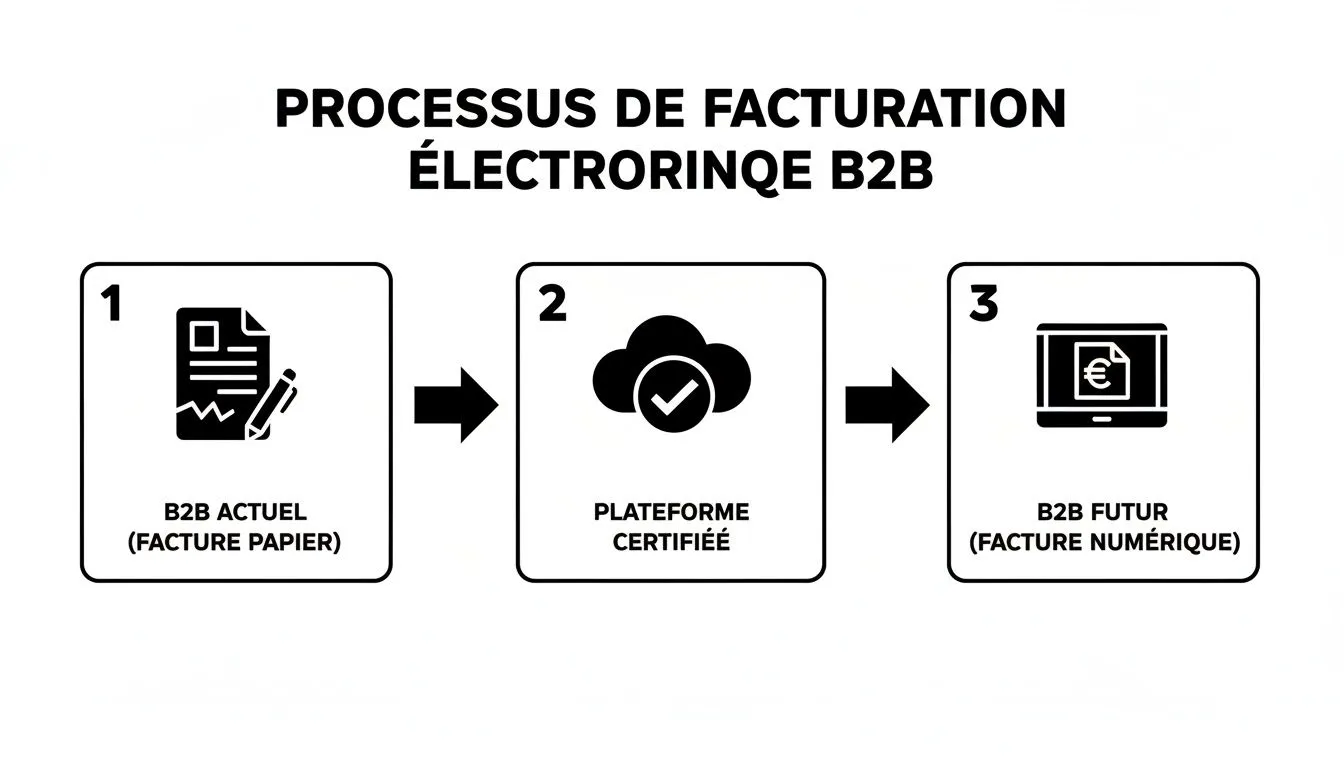
This diagram makes it clear: rigorous data collection upstream is what paves the way for efficient, hassle-free B2B e-invoicing.
Optimization isn’t about asking for more information, it’s about asking for the right information, in the right way. Every field on your form should serve a specific purpose: securing the transaction, ensuring tax compliance, or facilitating delivery.
To go even further, platforms like Bizyness fully automate these checks. By connecting your store, the system can not only validate VAT numbers but also automatically apply the correct tax rules based on the billing address, whether it’s a B2C sale within Europe or an international B2B transaction. You thereby turn a regulatory constraint into a genuine operational advantage.
Frequently asked questions about the billing address
To finish clarifying things, let’s go over the questions that come up most often among online sellers. Here are direct, practical answers to help you in your day-to-day operations.
Can a billing address be changed after the invoice has been issued?
The answer is a categorical no. Once issued, an invoice is a fixed, untouchable accounting document. If an error has crept into the address, the only legal path is to issue a credit note to cancel the first invoice.
Only after this cancellation can you create a new invoice, this time with the correct information. This rigor is essential to keep your bookkeeping clean and avoid unpleasant surprises during a tax audit.
What should I do if my customer only provides one address?
In this scenario, logic would suggest that this single address serves for both delivery and billing. But to leave no room for doubt, the best solution is to include a simple checkbox on your checkout page.
Offer a simple option such as: “My billing address is the same as my shipping address.” This formalizes the customer’s choice, secures your process, and avoids misunderstandings, especially in the case of a B2B order or a gift sent to a third party.
What is the impact of the billing address on sales of digital products?
For intangible goods — software, online courses, e-books — the billing address isn’t a minor detail, it’s the key piece of information. It’s your only geographic anchor for knowing where your customer actually is.
And this location is absolutely crucial, because it’s what determines the VAT rate to apply. For B2C sales within the European Union, for example, the law requires you to apply the VAT of your customer’s country of residence. The billing address then becomes the legal proof justifying your calculation, an essential element for staying compliant with the VAT one-stop shop (OSS). Overlooking this point exposes you to a very real risk of a tax reassessment.
Don’t let a simple billing address error throw your accounting into disarray any longer. Bizyness automates the collection, validation, and application of tax rules for every sale. You gain peace of mind with accurate financial management and effortless compliance. Discover how Bizyness secures your e-commerce business.
