

 Français
Calculating social security contributions: a practical guide for freelancers and businesses
Master the calculation of social security contributions and discover the rates, the base and the URSSAF declarations with concrete examples.

In practice, calculating your social security contributions simply means applying a rate to your income (whether that’s your revenue or your remuneration) to work out how much to pay to URSSAF. It’s a mandatory step for every entrepreneur in France, and for good reason: this money directly funds your own social protection.
Why you absolutely need to master the calculation of your contributions
Getting into the calculation of social contributions can seem like a mountain to climb. But it’s at the very heart of our protection system. We tend to talk about “charges” or “taxes”, but you should really see it as a direct investment in your future and your security. Every euro you pay builds, brick by brick, your pension rights, your health coverage, and even your access to training.
For a freelancer or the head of a small business, doing this calculation accurately is therefore not just a box to tick on an administrative to-do list. It’s a genuine management act that directly affects the financial health of your company.

Anticipate rather than endure
The number one mistake I see among new entrepreneurs? Underestimating the impact of these famous contributions. Poor anticipation opens the door to hefty URSSAF adjustments that can torpedo your cash flow. Conversely, understanding the mechanism well lets you:
- Forecast your cash flow precisely.
- Set fair selling prices that cover your costs as well as your social protection.
- Sleep easy, without the stress of deadlines and bad surprises.
A tip I always give: think of every invoice you collect as a cake with three slices. There’s your net income, VAT (if you’re subject to it), and the share for your contributions. Get into the habit, from day one, of setting aside the corresponding percentage in a dedicated account. It’s the best discipline to adopt.
With this approach, what seemed like a constraint becomes a genuine management tool for your business.
An obligation that can become an advantage
The French system has a reputation for being complex, notably because of the weight of these levies. To give you an idea, total social security contributions reached €474.9 billion in 2019, or 37% of all mandatory levies. France is also one of the OECD countries with the highest employer contributions.
But knowing the rules of the game well can give you a real advantage. Knowing how to optimize your calculation base or choose the most suitable legal status (sole trader, SARL manager, SASU president) can change the game for your final income. For example, choosing between paying yourself a salary or dividends in a SASU radically changes the contribution calculation and, as a result, your level of social coverage.
The pillars of your social protection
But where does this money actually go? In concrete terms, your payments fund several key branches of Social Security. Every declaration you make to URSSAF is a stone you lay to build your own safety net.
Here’s what you directly fund:
- Health and Maternity Insurance: This pays for your doctor’s visits, your medications, and provides you with daily allowances if you’re on sick leave or parental leave.
- Family Benefits: These funds support families through various forms of assistance (benefits, childcare support, etc.).
- Pension Insurance: The backbone of your future retirement. Every payment validates quarters and earns you points toward your pension.
- CSG-CRDS: Two contributions that fund social protection in the broader sense and help repay the social debt.
- Continuing Professional Training (CFP): A small portion of your contributions gives you the right to train and stay competitive throughout your career.
Understanding this breakdown changes everything. Calculating social security contributions is not a sunk cost, it’s an investment in your own stability. This guide is here to give you all the tools to navigate this system with confidence, whatever your status.
To calculate your social security contributions, you first need to know what base they’re calculated on and which rate to apply. The rules change completely depending on whether you’re a sole trader or running a company.
For sole traders: simplicity above all
If you’re operating as a micro-entrepreneur, the calculation is designed to be simple. Your calculation base is your collected revenue. And the word “collected” is crucial here. We’re not talking about what you’ve invoiced, but the money that has actually landed in your bank account during the declared period (the month or the quarter).
On this amount, URSSAF applies a fixed percentage. This rate depends directly on the nature of your activity. That’s the very principle of the micro-social regime.
The rates to know as a sole trader
Your social contributions cover everything: health, pension, family benefits… The overall rate applied to your revenue therefore isn’t the same whether you sell t-shirts, work as a consultant, or work as a craftsperson.
Here are the base rates to keep in mind to anticipate your charges:
- Buying and selling goods (BIC): 12.3%. This also includes selling food for on-site consumption or providing accommodation services.
- Commercial or craft services (BIC): The rate rises to 21.2%.
- Other services and unregulated professional activities (BNC): Here we’re at 23.1%. This is the case for most consultants, developers, graphic designers, etc.
- Regulated professional activities (CIPAV): For certain specific professions such as architects, the rate is 23.2%.
Let’s take a concrete example: a graphic designer running a micro-business collects €2,000 in a month. The calculation is straightforward: €2,000 x 23.1% = €462. That’s the amount she’ll pay to URSSAF for that month of activity.
Watch out, a small additional contribution is always added to this amount: the Contribution to Professional Training (CFP), which represents between 0.1% and 0.3% of your revenue.
ACRE, significant help at start-up
The Aid for Business Creators and Buyers, or ACRE, is a real breath of fresh air for cash flow in the first year. If you’re eligible, your contribution rates are simply cut in half for your first four quarters of activity.
To visualize the impact clearly, here’s a summary table of rates with and without this aid.
Contribution rates for the micro-social regime (sole trader)
This table summarizes the overall social contribution rates applicable to sole traders’ revenue depending on their type of activity.
| Type of activity | Contribution rate (without ACRE) | Rate with ACRE (first year) |
|---|---|---|
| Sale of goods (BIC) | 12.3% | 6.2% |
| Services (BIC) | 21.2% | 10.6% |
| Professional activities (BNC) | 23.1% | 11.6% |
An important detail: ACRE is no longer automatic for micro-entrepreneurs, you need to apply for it when setting up your business. It’s a simple process that can really make a difference at launch.
For company directors: a different logic
If you’re heading up an EURL or a SASU, forget about revenue. The mechanics of calculating social contributions are completely different.
Here, the calculation base is your remuneration or your professional income.
-
In a SASU, you are president “assimilated to an employee”. Contributions are calculated on your gross remuneration, much like for a standard employee with a payslip. The rates are much higher (around 65% of net pay), but the social protection is also more comprehensive.
-
In an EURL, you are majority manager “TNS” (self-employed / Travailleur Non-Salarié). Your contributions are based on your professional income. This income includes your management remuneration and, in some cases, part of your dividends. The calculation is more complex and often works with provisional advance payments during the year, followed by an adjustment the following year.
In both cases, clearly defining your remuneration is a strategic step. It’s what determines the amount of charges to pay. For company directors, good guidance is often necessary to optimize their strategy and avoid unpleasant surprises during URSSAF adjustments.
Calculating and declaring your contributions as a sole trader
Theory is all well and good, but let’s get to the heart of the matter. Whether you’ve chosen a monthly or quarterly declaration, you have a regular and unavoidable appointment with URSSAF. This involves declaring your revenue in order to then pay your contributions. It’s a fairly simple process, but one that tolerates no oversight.
The basic principle of the micro-business regime is golden: you only pay contributions on the revenue you’ve actually collected. No money coming in? No contributions to pay. Be careful, this doesn’t exempt you from making your declaration, even if it’s €0. It’s mandatory.
A concrete example to understand the calculation
Let’s take the case of Sophie, a freelance web developer. Her activity falls under Non-Commercial Profits (BNC), a category of professional services. For her, the contribution rate is 23.1% (not counting the small training contribution).
Let’s imagine that in April, business went well. Sophie collected a total of €3,500 from her various clients.
The calculation of what she owes URSSAF is very straightforward: €3,500 (collected revenue) x 23.1% (contribution rate) = €808.50.
To this amount is added the famous professional training contribution (CFP). For her activity, it’s 0.2%, or €7 more. In total, URSSAF will therefore collect €815.50.
The whole process boils down to identifying your calculation base (collected revenue) and applying the right rate to it. It’s as simple as that.
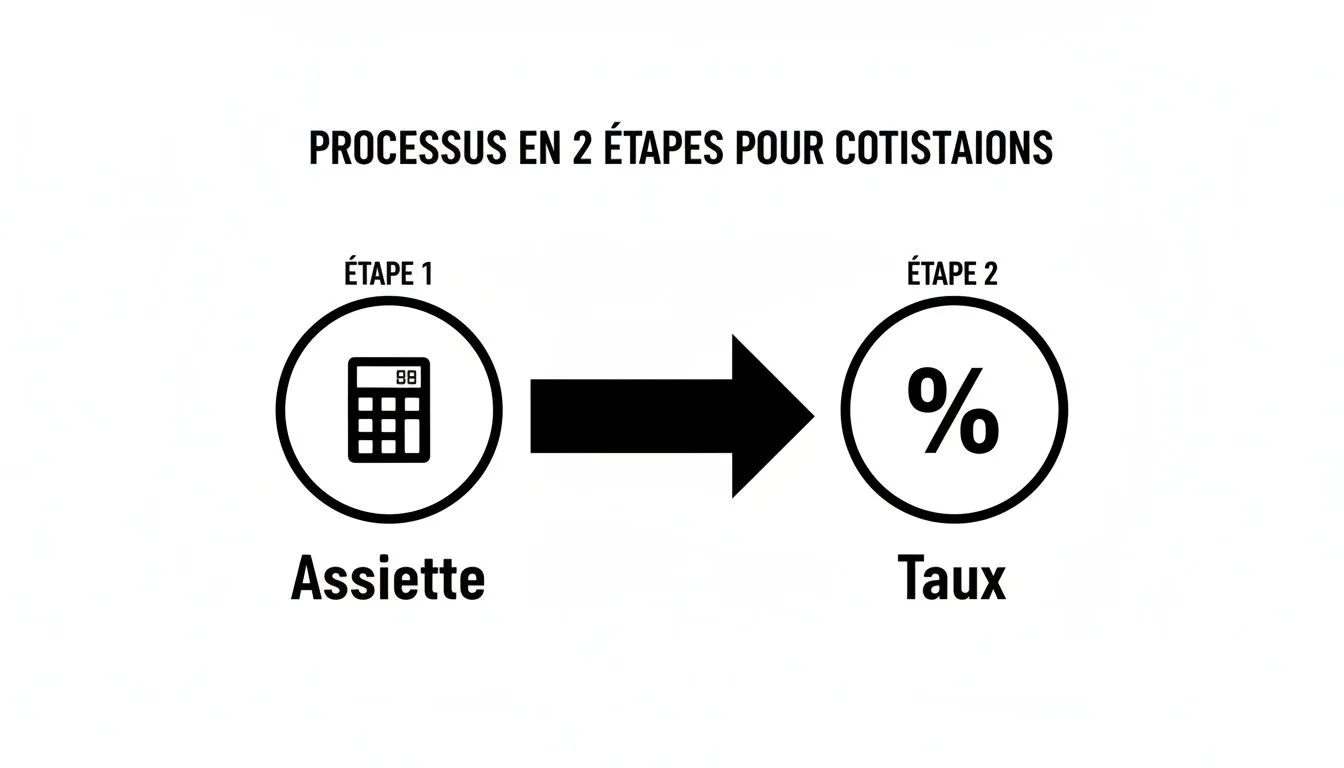
This diagram perfectly illustrates the logic: first you determine the base (the revenue amount), then you apply the percentage that corresponds to your sector.
How do you handle mixed activities?
Things get a little trickier if you juggle several types of activity. This is the case, for example, of a craftsperson who sells equipment (buy-resell) and also bills for their labor for installation (services). Here, you can’t lump everything together.
The key is to break down your revenue. In practice, when you make your declaration online, you’ll need to precisely indicate which part of your income corresponds to each activity.
Let’s take another example, that of Marc, a plumber:
- He sold €1,200 worth of equipment (fittings, water heaters, etc.).
- He billed €2,000 for his installation and repair hours.
On the URSSAF website, he’ll need to fill in two separate fields. The organization will then automatically apply the correct rate to each amount:
- On equipment sales: €1,200 x 12.3% = €147.60
- On services: €2,000 x 21.2% = €424
His total contributions will therefore amount to €571.60. To make this breakdown a breeze, clear and detailed invoicing that clearly separates these two items is your best ally. To dig deeper into the subject, take a look at our comprehensive guide on declaring revenue as a sole trader.
The final withholding tax option: a tax choice not to be overlooked
Calculating social security contributions is only part of the equation. Don’t forget income tax! Fortunately, the micro-business regime offers a very practical option to simplify your taxes: the final withholding tax (versement libératoire).
The principle is simple: every month or quarter, in addition to your contributions, you pay a small percentage of your revenue toward income tax. Once this amount is paid, you’re “discharged” of tax on your micro-business income. It’s paid, end of story.
Be careful, this option isn’t open to everyone. It’s subject to income conditions. To be eligible in 2026, for example, your 2024 reference tax income must not exceed €28,797 per unit of the family quotient.
If you’re eligible, these rates are added to your contributions:
- 1% for the sale of goods (BIC).
- 1.7% for commercial or craft services (BIC).
- 2.2% for unregulated professional activities (BNC).
Back to Sophie, our developer. If she opts for the final withholding tax, her overall levy rate will no longer be 23.3% (CFP included), but:
23.1% (contributions) + 0.2% (CFP) + 2.2% (tax) = 25.5%
On her €3,500 of revenue, she would therefore pay €892.50. This sum includes €77 that goes directly to the tax authorities.
The major advantage of this option is visibility. You smooth out your tax over the course of the year, as you collect payments, and you avoid the unpleasant surprise of a big adjustment the following year. The catch? If you weren’t taxable to begin with, you’d be paying tax you shouldn’t owe. So it’s worth doing a quick calculation to check whether this strategy is really right for your situation.
Calculating contributions for company directors
When moving from the status of micro-entrepreneur to that of company director, the rules of the game for social contributions change completely. No more calculating on revenue! Here, everything depends on your director status and how you pay yourself. Two worlds collide: that of the employee-equivalent director and that of the self-employed worker (TNS).
This distinction is really at the heart of the system. It determines not only the amount you’ll pay, but also the extent of your social protection and how you’ll need to manage your cash flow. Understanding these mechanisms well is a key step in running your business with peace of mind.
The SASU president or minority SARL manager: the world of the employee-equivalent status
If you’re president of a SASU or minority manager of a SARL, you’re considered an “employee-equivalent” (assimilé-salarié). In concrete terms, this places you under the general Social Security regime, exactly like a salaried manager in a company.
The calculation base is simple and direct: your gross remuneration. Every time you pay yourself a salary, a payslip is issued, detailing all the social charges, both employer and employee contributions. It’s clear and straightforward.
The strengths of this status are obvious:
- Rock-solid social protection: You have coverage almost identical to that of an employee. This is particularly true for pensions, with the validation of quarters, and for daily allowances in the event of sick leave, without the well-known waiting period.
- No-surprise management: No adjustment the following year. Contributions are deducted each month based on what you’ve actually received. If you don’t pay yourself a salary one month, you don’t pay contributions.
The downside, of course, is the cost. Total social charges represent around 82% of your net remuneration. That’s a significant budget, but it funds very solid social protection.
An important point for SASU presidents: remuneration isn’t the only way to receive income. Dividends are another option, but their social and tax treatment is completely different. To understand the details, take a look at our comprehensive guide on the rules for calculating dividends in a SASU.
This simplicity of management comes at a price, but it offers visibility and security that many directors are looking for.
The majority manager of an EURL or SARL: the TNS status
We change worlds completely with the majority manager, who is affiliated to the Social Security for the Self-Employed (the former RSI). You’re then a self-employed worker, or TNS.
Here, the calculation base is your professional income. Be careful, this isn’t just your management remuneration! It also includes part of your dividends (the portion that exceeds 10% of total share capital + share premiums + amounts in the shareholder’s current account).
The big difference lies in the payment method:
- The current year (N): You pay provisional advance payments. They’re first calculated based on your income from two years ago (N-2), then adjusted based on last year’s income (N-1).
- The following year (N+1): URSSAF carries out the final adjustment once it knows your actual income for year N. This can result in a refund, but more often, in a fairly heavy additional payment.
This deferred system can cause cash flow headaches. Income that spikes in year N will lead to a hefty adjustment in N+1. Anticipation is your best friend.
The overall contribution rate is more attractive, hovering around 45% of net income. In exchange, social protection is somewhat less generous, notably regarding sick pay (longer waiting period) and supplementary pension. That’s the whole trade-off at stake.
A numbers-based comparison: an example is worth a thousand words
To make this clearer, let’s put these two statuses side by side. Let’s imagine the company has a budget of €50,000 to allocate to the director’s remuneration.
| Feature | SASU President (employee-equivalent) | EURL majority manager (TNS) |
|---|---|---|
| Total cost to the company | €50,000 | €50,000 |
| Net remuneration before tax | About €27,500 | About €34,500 |
| Amount of social contributions | About €22,500 | About €15,500 |
| Social protection | Very comprehensive (close to an employee) | Comprehensive but slightly lower |
| Payment mechanism | Monthly, based on actual amounts received | Advance payments + adjustment |
The choice is far from trivial. It really depends on your priorities: seeking to maximize your available income right away, or preferring stronger social protection and smoother cash flow management.
For the record, note that contribution rates, particularly for pension insurance, have naturally evolved to maintain the balance of our system. The rate on capped salary, for example, rose from 12.9% in 1979 to 15.45% since 2016, an essential adjustment to fund pensions. For the curious, the statistics from the French pension insurance fund are a wealth of information.
Avoid mistakes and save time: automate your declarations
Meeting URSSAF deadlines isn’t optional, it’s mandatory. As an entrepreneur, you know this well. One simple oversight, one small delay, and penalties follow. For cash flow that’s often stretched thin, that’s the kind of bad surprise you’d rather do without.
The problem is that manual management is a source of constant stress and fertile ground for errors. Between hunting down paid invoices, calculations on a spreadsheet, and connecting to the URSSAF portal, you lose precious time. Time that isn’t spent growing your business. Fortunately, there are much simpler solutions to turn this chore into a mere formality.
Moving from an Excel spreadsheet to a smart solution
Automation is no longer a vague concept reserved for large companies. Today, management tools are specifically designed for freelancers and small businesses. Their mission? To give you back time and peace of mind.
Just imagine: every invoice you mark as collected is instantly taken into account. The software knows your status, your activity, and therefore the contribution rates that apply. It updates in real time the exact amount you’ll owe URSSAF. No more painstaking calculations.
In concrete terms, here’s what changes for you:
- Live calculation: No more need for rough estimates. You know at any moment how much you need to set aside for your charges.
- Pre-filled declaration: The tool prepares your URSSAF declaration. All you have to do is check it and approve it. That’s it.
- No more oversights: Smart reminders alert you when the deadline is approaching. Say goodbye to late penalties.
This approach lifts a huge mental burden. No more anxiety about having made a typo in an Excel formula.
The real benefit of automation is reducing the risk of human error to almost zero. A simple typo in a spreadsheet can throw off a declaration and lead to a painful adjustment. A dedicated piece of software, on the other hand, doesn’t make mistakes.
To dig deeper into the subject, it’s worth looking at how to automate your administrative tasks and save time more broadly and optimize your overall management.
How Bizyness transforms your URSSAF declaration
Solutions like Bizyness were designed to fit naturally into your daily life as an entrepreneur. The idea is simple: centralize all your financial data so that calculating social security contributions is no longer a separate task, but a logical consequence of your activity.
The dashboard gives you a clear, immediate overview of your revenue and the resulting charges.

This visual perfectly illustrates how the tool synthesizes information. At a glance, you know where you stand. This clarity is the foundation of good cash flow management.
And when it comes time to declare? The tool can connect directly to your URSSAF account to transmit the amounts. No more juggling between windows and copying figures. The time savings are obvious. A task that sometimes took an hour is wrapped up in a few minutes.
Adopting an accounting software for sole traders is often the first step toward healthier, much less time-consuming management. It’s not just about paying your contributions. It’s about taking back control of your finances and your time, so you can focus on what matters: your clients and growing your business.
Answering your questions about calculating contributions
Calculating social security contributions is a topic that often raises quite a few questions. Whether you’re about to start out or already knee-deep in it, some gray areas persist. Let’s get straight to the point to clear things up.
What if I don’t generate any revenue?
This is a classic, especially at the start. The rule for micro-businesses is simple: no collected revenue, no social contributions to pay. It’s logical, but keep in mind that your social protection (pension, daily allowances) is directly tied to what you contribute. Zero income therefore means zero validation of rights for the period concerned.
Be careful, this doesn’t mean there’s nothing to do! Even with €0 in revenue, the URSSAF declaration remains mandatory. Forgetting this step exposes you to a flat-rate penalty for each missing declaration. A small habit worth adopting to avoid unpleasant surprises.
Can I change how often I declare?
Absolutely. You can switch from a monthly to a quarterly declaration, or vice versa. The choice you make when setting up your business isn’t set in stone.
To change your frequency, simply submit a request to your URSSAF. The only requirement is to do it before October 31 for the change to take effect on January 1 of the following year. It’s a welcome flexibility to better match the evolution of your cash flow.
Is ACRE automatic when you’re a sole trader?
No, and this is a point to watch out for! The Aid for Business Creators and Buyers (ACRE) has no longer been automatic for a few years now. To benefit from this well-known 50% reduction on your contributions in the first year, you need to explicitly apply for it. Either when registering your business, or within a maximum of 45 days afterward.
ACRE is a real boost for your cash flow at start-up. Missing out on it is a common mistake that can be costly. Take the time to fill out this form, it’s really worth it.
What should I do if I made a mistake in my declaration?
Don’t panic, it happens to everyone. If you spot a typo in a declaration you’ve just submitted, you can correct it directly from your online account on the URSSAF website. Be careful though, this option is only available until the payment due date.
If you notice it afterward, the best approach is to contact URSSAF without delay via the secure messaging system in your account. Simply explain the situation. They’ll guide you on how to proceed to correct it, whether you’ve paid too much or not enough. In this kind of situation, responsiveness is your best friend.
Make your life easier and make sure your calculations are always flawless. With Bizyness, your declarations become automatic and you can focus on what matters: growing your business. Discover how Bizyness can transform your administrative management today.
