

 Français
Cash flow definition: the essential guide to mastering your finances
Understand the cash flow definition and its vital role for your e-commerce business. Take control of your cash and secure your company's growth.

When we talk about the health of a business, we often think of profit. Yet a far more vital indicator hides in the details: cash flow. It’s what tells you whether you have enough money to pay your bills, your salaries and your suppliers at the end of the month.
Concretely, cash flow represents the money that actually comes in and goes out of your bank account over a given period. It’s not about sales on paper — it’s about real, tangible liquidity.
Beyond the simple definition of cash flow
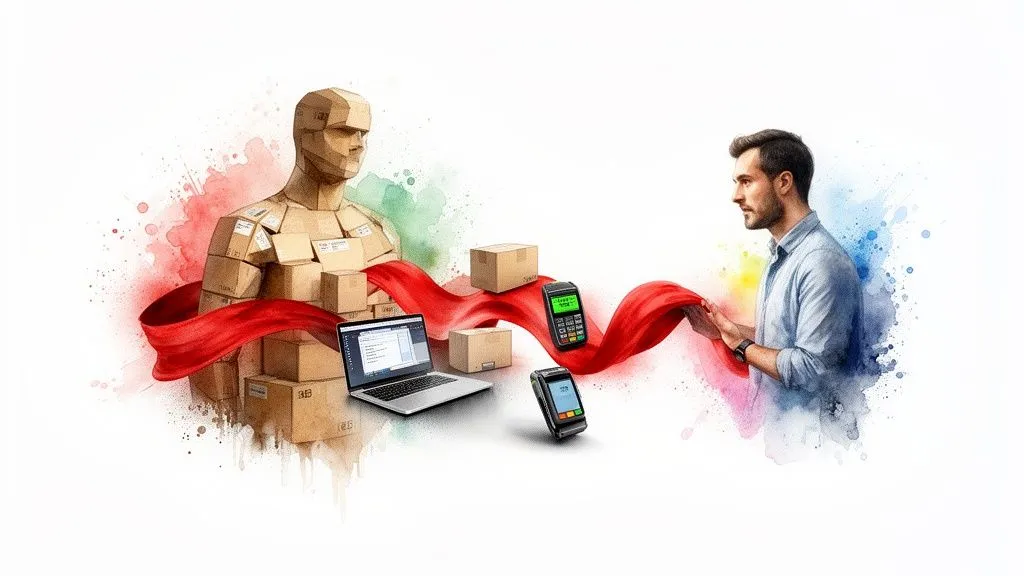
To really grasp the nuance, picture your business as a water tank. Profit is the rain that’s supposed to fill it. Cash flow is the current water level in that tank. It can pour buckets (you’re making lots of profitable sales), but if the tank is leaking or the water takes too long to arrive, you’ll run dry when you need it most to operate.
This is the paradox that has brought down so many otherwise promising companies: you can be profitable on paper and still go bankrupt for lack of cash. Understanding this dynamic is fundamental.
Timing lag, the online seller’s enemy
For an e-commerce merchant, the gap between a recorded sale and the money actually collected is a daily battle. It’s a genuine headache that directly impacts your cash position.
Think about all these situations you know well:
- Platform payout delays: Whether it’s Stripe, PayPal or a marketplace like Amazon, there’s always a delay — from a few days to several weeks — before the money from your sales lands in your account.
- Stock purchases: You pay your suppliers today for inventory you might not sell for several months. That’s an immediate cash outflow for an uncertain future inflow.
- Advertising costs: Your Google or Meta campaigns are often charged right away, while the sales they generate only turn into cash much later.
- Refunds and returns: A customer sends back a product? That’s an immediate, net cash outflow — often unplanned — that eats into your liquidity.
Tracking your cash flow is therefore not just an accounting formality. It’s a matter of survival and the engine of your growth. This indicator gives you clear visibility into your ability to operate day-to-day and to fund your development.
Mastering these flows is the first step toward building a sustainable business. To go further and discover concrete strategies, our guide on managing cash flow will give you every key to optimizing your liquidity and securing your company.
Telling cash flow and net profit apart
It’s a situation many entrepreneurs know all too well, and one of the biggest paradoxes in business management: your company shows healthy profits on paper, but your bank account is dangerously close to zero. How can a profitable business be on the verge of bankruptcy?
The key to this mystery lies in the fundamental difference between profit and cash flow.
Profit is an accounting construct. It accounts for revenue you haven’t actually collected yet, as well as expenses that haven’t yet left your account. Cash flow, on the other hand, is much more direct: it’s the money that actually enters and leaves your business’s cash position. It’s the reality on the ground.
Let’s take a concrete example. Imagine you run an e-commerce store on Shopify. You post record sales in December for the holidays. Your income statement looks excellent, showing a solid profit. The problem? Platforms like Stripe or PayPal won’t pay out the corresponding funds until January.
Meanwhile, expenses don’t wait. You have to pay your suppliers for the stock you sold, settle the ad invoices from your Meta campaigns, and pay December’s salaries. The result is brutal: even while “profitable,” your bank account is draining. You’re now facing a liquidity crisis.
Cash Flow vs. Profit: the key differences
To make things clearer, this table sums up the fundamental distinctions between these two indicators. Understanding these nuances is the first step to calmly steering your company’s financial health.
| Criterion | Cash Flow | Profit (Net Income) |
|---|---|---|
| Nature | Liquidity indicator. Measures money actually available. | Profitability indicator. Measures economic performance over a period. |
| Calculation | Cash inflows - Cash outflows | Revenue - Expenses |
| Timing | Based on when money is received or paid. | Based on when the sale is made or the expense incurred (accrual accounting principle). |
| Examples | Customer payments, salaries paid, paid-for stock purchases. | Invoices sent (even unpaid), equipment depreciation. |
| View | Short term. Reflects the ability to pay bills right now. | Long term. Reflects the viability of the business model. |
In short, profit tells you whether your business model is winning, while cash flow tells you whether you have enough fuel to keep moving forward.
The lags that create the gap
This sometimes spectacular gap between profit and cash is explained by very specific accounting mechanisms. As a business owner, you absolutely need to master them to avoid falling into the trap.
Two factors are mainly at play:
- Non-cash expenses: The best known is depreciation. Your computer or your packaging machine loses value every year. This loss of value is recorded as an expense, which reduces your taxable profit. Yet you don’t write a check for this depreciation. It’s a “fictitious” expense that doesn’t impact your cash.
- The change in Working Capital Requirement (WCR): This is the most important concept to grasp. WCR is the money your business has to advance to fund its operating cycle. It mainly includes the stock you pay for before selling it and accounts receivable (money owed to you but not yet in your account).
For an e-commerce merchant, strong growth is a classic trap for WCR. The more you sell, the more stock you need to order upfront, which ties up an ever-larger share of your cash.
Failing to understand this distinction can have dramatic consequences. To go further, we recommend reading our guide on the difference between revenue and profit.
Ultimately, focusing solely on profit while ignoring cash flow is a bit like driving while only looking in the rearview mirror. You can see where you came from, but you have no idea what obstacle lies just ahead.
To properly steer your business, knowing that money comes in and goes out isn’t enough. The real question is where it comes from and where it goes. To answer that, you don’t look at a single figure — you watch the movie of your company’s cash, told in three key scenes.
Each of these scenes, or rather these flows, tells part of your financial story. Understanding them gives you a complete, nuanced view of your business’s health, well beyond a simple cash flow definition.
To visualize this idea, imagine the difference between your bank account and your tax return. One shows the money you actually have, the other what you earned on paper. It’s the same for a business.
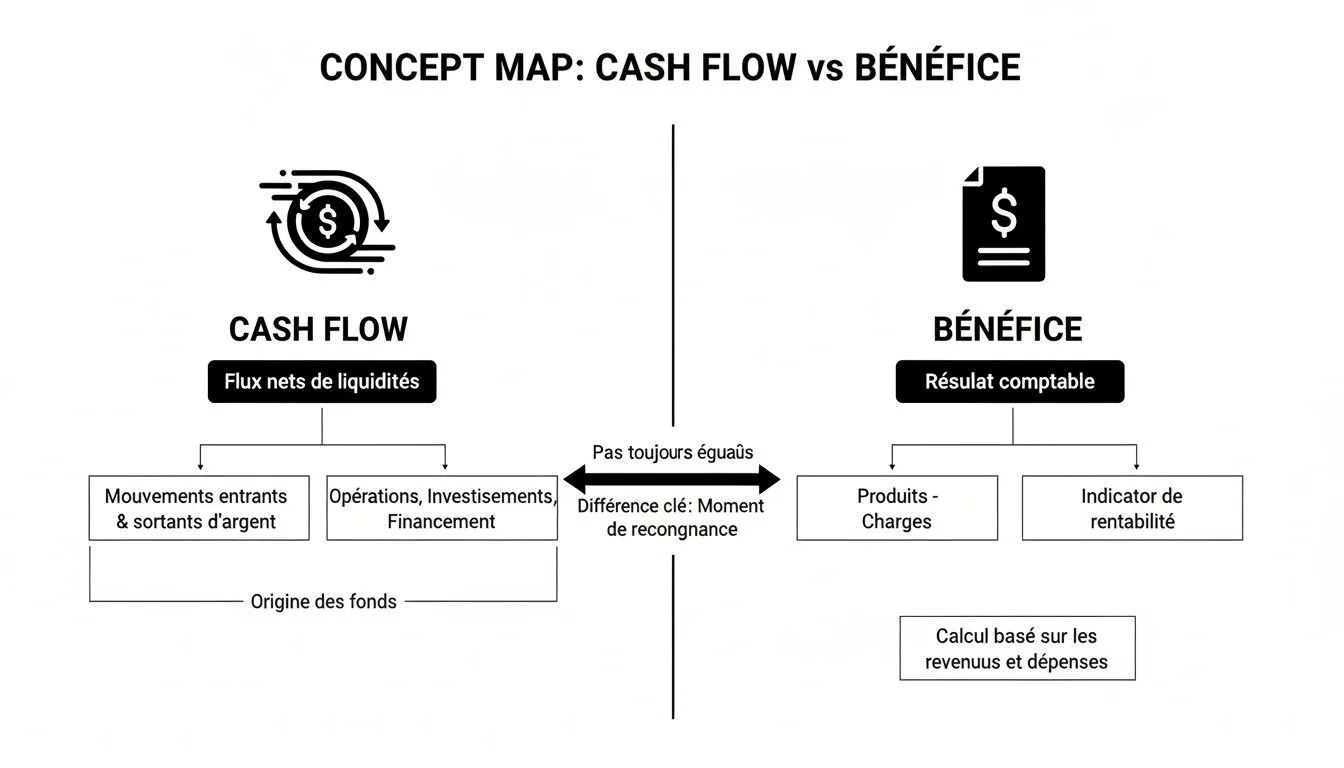
This distinction is crucial. It explains why a company can post a nice profit yet find itself short of cash to pay its bills.
1. Operating cash flow (OCF)
This is the heart of the engine. Operating cash flow measures the money generated directly by your core business: selling your products or services. No more, no less.
Concretely, it represents cash collected from your customers, minus all the cash outflows needed to run the machine day-to-day:
- Purchases of goods or raw materials.
- Payment of salaries and payroll taxes.
- Settling invoices from your suppliers and service providers (marketing, rent, etc.).
- Payment of your taxes and duties.
A positive, growing OCF is the most encouraging signal for an entrepreneur. It means your business model is viable: your core activity generates more money than it consumes, giving you the means to grow.
For an e-commerce merchant, it’s simply vital. A Bpifrance study showed that for 72% of digital micro-businesses, positive OCF is the sine qua non condition for survival. This indicator is also a close cousin of self-financing capacity, a concept we cover in detail in our guide on calculating self-financing capacity.
2. Investing cash flow (ICF)
Once your engine is running, you’ll want to improve it. That’s the role of investing cash flow. It tracks purchases and sales of long-term assets — the resources you acquire to grow your business.
For an e-commerce site, this can include:
- Buying more powerful IT equipment.
- Acquiring a new warehouse or shelving for your stock.
- Reselling an old packaging machine.
A negative ICF isn’t alarming — quite the opposite. It often means you’re reinvesting your gains into tools that support your future growth. It’s the sign of a company with ambition.
3. Financing cash flow (FCF)
Sometimes, funds generated internally aren’t enough to finance rapid growth or a big project. That’s where financing cash flow comes in. It tracks the movement of money between your business and its financial partners, whether bankers or investors.
This flow records transactions such as:
- Taking out a bank loan to buy a large stock of inventory.
- Repaying the monthly installments on that loan.
- Funds coming in following a raise (capital increase).
- Paying dividends to your shareholders.
By analyzing these three flows, you no longer see a single number — you see a complete story. You understand how your business breathes, how it feeds itself, and how it grows. This overall view is what gives you the confidence to make the right decisions.
Calculating your cash flow without being an accountant
You don’t need to be a chartered accountant to understand and track your cash. As an entrepreneur, mastering this calculation yourself is well worth it to steer your business as closely as possible.
Fortunately, there are fairly simple methods to get there. There are mainly two: the direct method and the indirect method.
The direct method is by far the most intuitive. Imagine keeping a simple logbook of your bank account: you record absolutely every inflow and outflow of money. That’s it.
- Cash inflows: The money that actually arrives in your account, whether it’s customer payments via Stripe, bank transfers, etc.
- Cash outflows: Everything that actually leaves your pocket: supplier payments, salaries, ad invoices, rent…
This approach gives you a raw, instant view of your situation. The downside is that it can quickly become a real headache if you handle a large number of transactions.
Using the indirect method
This is the method you’ll find most often in financial documents. Why? Because it bridges what your business earns on paper (profit) and what it actually has in the bank (cash).
The idea is to start from net accounting profit and “adjust” it so that it reflects the reality of cash.
The formula looks like this:
Cash Flow = Net Income + Non-cash Expenses - Change in Working Capital Requirement (WCR)
Each element of this calculation matters. Net income is your starting point. Then you add back non-cash expenses, such as equipment depreciation. These expenses did reduce your taxable profit, but the money itself never left your account.
Finally, and this is crucial, you adjust for the change in WCR (Working Capital Requirement). If your stock has grown or your customers are slow to pay you, your WCR increases. In other words, money is “tied up” somewhere in your operating cycle instead of sitting in your cash register. So it must be subtracted to arrive at your real cash flow.
At Bizyness, we know that automating this tracking is vital, especially for e-commerce merchants. Poor WCR tracking in a spreadsheet is a frequent source of errors — an estimated 42% of errors can stem from this.
To avoid drowning in numbers, solutions exist, such as AI accounting software. These modern tools automate the collection of your transactions and make these adjustments for you. The result: you get a clear, up-to-date view of your cash flow, without spending hours in Excel. You can finally focus on what really matters: making the right decisions for your growth.
Overcoming cash flow challenges in e-commerce
Managing cash in e-commerce is a real balancing act. Unlike a physical store, where the customer pays and the money is immediately in the till, the world of online selling has its own rules. And they can quickly put your cash flow under strain.
These obstacles aren’t just theoretical concepts. They’re daily realities that can bring a company to its knees, even as its sales take off. Understanding these pitfalls is the first step toward building bulletproof cash management.
Marketplace payment delays
Your liquidity’s first adversary is time. When you sell on a marketplace like Amazon or use a payment solution like Stripe, your customers’ money doesn’t land in your bank account instantly. It’s held, sometimes for a few days, often for several weeks.
Meanwhile, your bills don’t wait. Ad campaigns, suppliers, salaries… everything has to be paid. This money stuck with intermediaries creates a dangerous lag and puts constant pressure on your working capital requirement. It’s the perfect recipe for a liquidity crisis, even with excellent revenue.
The impact of stock and refunds
The other major headache is inventory management. Buying merchandise means tying up part of your cash while betting on future sales. If you overestimate and overstock, your money ends up gathering dust in a warehouse instead of funding your growth.
And as if that weren’t enough, you have to deal with the unpredictable effect of refunds. Every returned product isn’t just a lost sale; it’s an immediate cash outflow you may not have planned for. This volatility is particularly harsh, since it’s dictated by customer behavior.
The key to surviving these challenges isn’t to eliminate them — they’re an inherent part of e-commerce — but to anticipate them. An accurate cash flow forecast lets you know where you’re headed and avoid unpleasant surprises.
Overall cash flow in France is actually a good indicator of this reality. For e-commerce merchants, the average stood at +€18,200 in 2026, though this figure masks significant disparities. Indeed, 41% of sellers still underestimate outflows tied to debt, which can lead to financial difficulties that were entirely avoidable, as explained in a study on cash flow dynamics.
To give your cash flow some breathing room, the snowball method can be an excellent strategy for paying down debt step by step and strengthening your liquidity.
This is precisely where an accounting automation platform like Bizyness becomes a real ally. By automatically centralizing and categorizing all the flows from your sales and payment channels, you finally get a clear, real-time view of your cash flow. You can make decisions based on reliable data, not just gut feeling. Your cash flow stops being a source of stress and becomes a lever for growth.
Automating your cash flow tracking
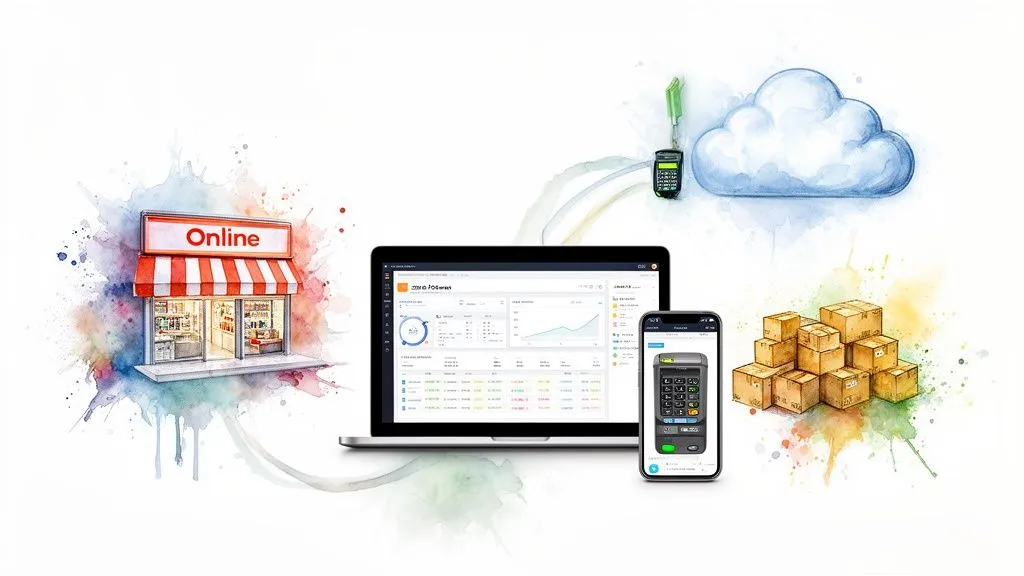
Tracking your cash by hand is a bit of every e-commerce merchant’s nightmare. You spend hours buried in spreadsheets, trying to reconcile the numbers from Shopify, Stripe and your bank account. It’s not only exhausting, it’s also a wide-open door to calculation errors that can cost you dearly.
Fortunately, this chore can now be fully automated. That’s where tools designed specifically for e-commerce merchants, like Bizyness, come in. Rather than leaving you to juggle a multitude of reports, such a platform centralizes all your financial data.
The idea is simple: free you from manual work to give you a clear, accurate, real-time view of your cash flow.
Centralize to steer better
The secret to automation is connection. The platform plugs directly into the tools you already use every day:
- Your online stores, such as Shopify, WooCommerce or Amazon.
- Your payment solutions, such as Stripe or PayPal.
Once connected, the platform pulls in and processes all the raw data. Sales, marketplace commissions, refunds, transfer (payout) delays… everything is automatically collected and turned into a finally-readable cash flow dashboard.
The gain is twofold. First, you get back precious time that you can devote to higher-value tasks. Second, and this is crucial, you eliminate almost all risk of human error, which can distort your perception of your company’s financial health.
This system transforms the definition of cash flow: it’s no longer an abstract concept reserved for your accountant, but a concrete indicator you check daily. No more flying blind while waiting for the end-of-quarter statement.
With reliable, up-to-date data, you anticipate cash dips, spot your most profitable channels at a glance, and make decisions based on facts. In short, you stop enduring your cash flow — you master it.
Your frequently asked questions about cash flow
To wrap up, let’s revisit the questions you ask most often. The goal is to give you clear, direct answers so these concepts become second nature.
What’s the difference between cash and cash flow?
Think of your cash position as a snapshot: it’s the money you have in the bank at a specific moment. It’s a still image.
Cash flow, on the other hand, is the movie. It shows all the money movements (inflows and outflows) over a given period, like a month or a quarter. It’s what explains why your cash position moved between two snapshots.
In other words, cash flow is the cause, and the change in your cash position is the direct consequence.
Is negative cash flow always a bad sign?
Not necessarily — it all depends on the context and the type of flow in question.
Negative operating cash flow should immediately grab your attention. It means your core business is burning more cash than it generates. Over the long run, that’s obviously not sustainable.
Conversely, negative investing cash flow is often very good news! It means you’re betting on the future: buying more powerful equipment, building up stock for a new collection, developing your site… In short, you’re building tomorrow’s growth.
How can I quickly improve my cash flow?
To give your cash a boost, you need to work on two fronts: speeding up inflows and slowing down outflows. It’s as simple as it sounds.
Here are a few concrete avenues to explore:
- Get paid faster: Favor payment platforms that transfer money to you quickly (short payouts). Every day gained is a breath of fresh air for your cash flow.
- Negotiate with your suppliers: Getting longer payment terms lets you align your expenses (stock purchases, for example) with your future revenue.
- Manage your stock smartly: Overstocking is a classic mistake — it’s money sitting idle on your shelves. Avoid tying up cash you need elsewhere.
Working these three levers can genuinely change the game and turn your cash management into a real strength.
With Bizyness, tracking all your financial flows becomes automatic. You finally make informed decisions, based on reliable, up-to-date data. Turn your view of accounting into a true control center. To learn more, visit https://www.bizyness.fr.
