

 Français
Mastering your e-commerce cash flow needs
Anticipate and fund your cash flow needs. Our guide secures your e-commerce growth with proven strategies.

In e-commerce, you can be profitable on paper while your bank account is desperately empty. It’s a frustrating paradox that many entrepreneurs know all too well: sales are good, margins are there, but there’s never enough money to pay the bills. This problem has a name: cash flow need.
Concretely, it’s the amount of money you need to keep the shop running (paying suppliers, salaries, ads) while waiting for your customers’ money to finally land in your account. It’s this permanent gap between money going out and money coming in that you need to learn to master.
Diving into an online seller’s cash flow needs
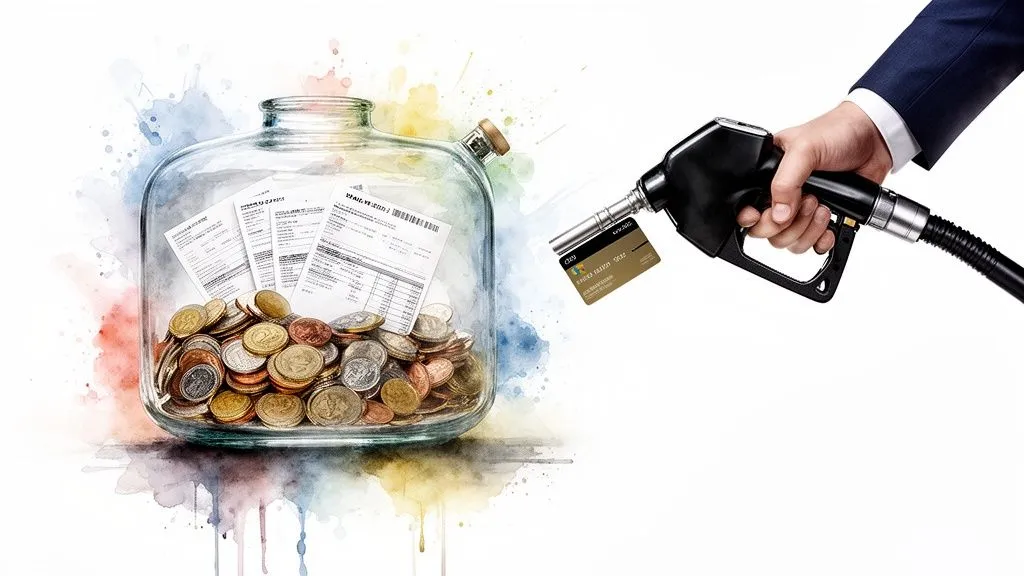
Think of your cash flow as a car’s fuel tank. You can have the most powerful engine in the world (soaring sales, great profitability), but if the tank is dry, the car stops. Abruptly. Your cash flow need is the fuel that lets you keep driving between two fill-ups.
That’s the whole challenge. An online store can show excellent profits in its reports, yet find itself unable to pay its bills at the end of the month. Understanding this phenomenon is the first step toward regaining control.
The payment gap: e-commerce’s problem number one
Unlike a physical store where the customer pays and leaves with the product, e-commerce runs in a way that creates cash flow tension almost by nature. You must systematically advance money, well before you receive any.
- Buying stock: This is the most obvious expense. You pay your suppliers today for products you’ll sell, at best, a few weeks from now.
- Marketing spend: Attracting customers requires investment. Budgets for your Google, Facebook, or TikTok campaigns are debited long before the sales they generate are collected.
- Collection delays: This is the final blow. Payment platforms like Stripe or PayPal, and especially marketplaces like Amazon, hold funds for several days, or even weeks, before transferring them to you.
This cycle creates a constant need for financial “fuel” to advance all these costs. In accounting, this is called Working Capital Requirement (WCR), a concept we’ll demystify together a bit further down.
To help you see things more clearly, here’s a summary of the typical situations that strain an online seller’s cash flow, along with initial solution ideas.
Summary of cash flow need causes and solutions
This table summarizes the common triggers of cash flow tension for an online seller and the initial solutions to consider.
| Cause of cash flow need | Concrete e-commerce example | Quick solution |
|---|---|---|
| Paying suppliers | Paying for a stock order in 30 days, while the stock takes 90 days to sell. | Negotiate longer payment terms with suppliers (60 or 90 days). |
| Customer collection delays | Amazon funds are paid out every 2 weeks, creating a 14-day gap. | Use financing solutions that advance marketplace payments. |
| Strong seasonality | Investing heavily in stock and advertising in October/November for the holidays. | Plan a short-term cash credit line or overdraft facility to get through the peak. |
| Rapid growth | Doubling sales means doubling stock purchases, which drains cash flow. | Combine better inventory management with financing suited to growth (factoring). |
Anticipating your cash flow needs is not a simple administrative task. It’s a strategic lever that lets you steer your growth, seize opportunities, and avoid the brutal stoppages that can jeopardize a company, even a profitable one.
Why this has become a critical topic
While the topic has always mattered, recent years have shown just how vulnerable companies are to cash flow shocks. The 2020 health crisis was a wake-up call. In the second quarter of 2020 alone, more than 40% of French SMEs were forced to request a cash credit line to survive the disruptions.
For online sellers, the sales rollercoaster and lengthening marketplace payment delays have only heightened these tensions. You can find more details on the evolution of business credit on the INSEE website. This has made cash flow management no longer just “important,” but absolutely vital.
This guide is here to help you move from reacting to anticipating. Together, we’ll see how to calculate, forecast, and above all master your financial flows to turn your cash flow into a genuine competitive advantage.
Identifying the real causes of your cash flow tension
Knowing you have a cash flow problem is one thing. But understanding exactly where it comes from is what makes all the difference. Let’s be clear: cash tension is not a sign of poor management, but very often simply a consequence of the e-commerce business model.
Digging a little deeper, you realize these causes are often the same ones, which means they can be anticipated. All it takes is turning what feels like a permanent source of stress into a simple parameter to manage. Generally, these causes fall into two broad categories: those tied to the very structure of your business, and those due to more one-off events.
Structural causes: the well-known Working Capital Requirement (WCR)
The most fundamental reason behind your cash flow needs hides behind a term that can sound scary but is actually very simple: Working Capital Requirement (WCR). You don’t need to be a chartered accountant to grasp the concept.
WCR is simply the money you have to advance to keep the shop running. It represents the time gap between when you pay your suppliers and when you actually collect your customers’ money.
Think of a relay race. WCR is the effort you have to make alone before you can pass the baton (and see the money arrive). For an online seller, this effort shows up in several concrete ways:
- The weight of stock: This is the most obvious cause. Every product sitting on your shelves is money asleep. You’ve already paid your supplier weeks or even months ago, but that cash won’t come back until the product is sold and delivered.
- Platform payment delays: When a customer pays you on Shopify via Stripe, PayPal, or even directly on Amazon, the money doesn’t magically land in your business account. There’s always a delay of a few days, sometimes more. This small gap, repeated over hundreds of sales, creates a permanent hole in your cash flow.
These gaps are an inherent part of the e-commerce game. They won’t disappear, but they can be measured, anticipated, and therefore managed. To go further on this topic, our guide on invoice payment terms is an excellent resource.
Cyclical or event-driven causes
On top of this underlying mechanic, certain specific events can create or worsen a cash flow need. Unlike structural causes, these are tied to the calendar and to your growth strategy.
Seasonality is the perfect example. For an online seller, preparing for peaks like Black Friday or the year-end holidays is a real baptism of fire for cash flow. You have to invest heavily in stock and advertising starting in September-October, while revenue only starts coming in from late November. It’s a sharp gap that can literally drain your accounts.
Another classic trigger is rapid growth. It’s a “good” problem, but a problem nonetheless. If your sales double overnight, your stock needs and advertising budgets double too. And that money has to go out well before the additional revenue is actually collected. Such a “growth crisis” has already brought otherwise thriving companies to their knees.
Let’s not forget the broader economic context either. A recent analysis by the Banque de France showed that, while access to credit remains possible, challenges are piling up. Cash credit lines dropped by -5.6% and the number of business failures jumped to reach 68,961 over one year, exceeding the pre-Covid average. These figures remind us how important it is to properly anticipate financial flows, as business owners’ own perception of their cash position has itself deteriorated. You can check the details of this Banque de France analysis to learn more.
How to build your cash flow forecast plan
Now that you’ve pinpointed the causes of your financial tension, it’s time to act. Setting up a cash flow forecast plan is the crucial step toward regaining control. Forget the idea of a complex document reserved for accountants; think of it instead as your personal dashboard, a practical tool for navigating with more peace of mind.
The goal is simple: list all your upcoming money in and money out. The point? Knowing where you’ll stand in one, three, or six months. That’s the whole art of cash forecasting: anticipating your bank balance so you’re never caught off guard again.
Listing your future receipts
The first thing to do is estimate all the money coming in. As an online seller, these flows can come from several places, and you need to list them meticulously.
- Your projected sales: Base yourself on past figures, seasonality, and your marketing campaigns to project your revenue. Above all, don’t forget to factor in platform payment delays like Stripe or Amazon, which can create a significant gap.
- Your VAT refunds: If you’re subject to it, VAT credits are a meaningful cash inflow. Try to anticipate the payout date so you can factor it in at the right time.
- Other inflows: Are you expecting a loan? A grant? Note everything down.
For an online seller, this exercise is absolutely fundamental. VAT refund delays for those managing OSS/IOSS, for instance, can climb up to 180 days. This mechanically creates recurring cash flow needs that absolutely must be planned for. StudySmarter offers an interesting analysis if you want to dig deeper into the topic.
Estimating your upcoming outflows
Next, you do exactly the same exercise, but for money going out. This is often simpler, since a good part of your costs are fixed or, at least, predictable.
Go through everything that leaves your business account:
- Stock purchases and supplier payments: This is often the biggest expense line for an online store.
- Operating costs: Salaries, rent, subscriptions to your tools (Shopify, for example).
- Marketing spend: Your budgets for Google Ads, Facebook Ads, influencer marketing, etc.
- Taxes and duties: VAT due, corporate tax, social security contributions.
To help you structure all this properly, building a good financial model is an excellent starting point.
The key to success: Your cash flow plan doesn’t need to be accurate to the last cent. What matters is that it’s realistic, updated regularly, and gives you a clear trend. Is your cash position going to rise or fall in the coming months? That’s the only question that matters.
This diagram perfectly illustrates the cycle behind your cash flow needs: that famous gap between the moment you buy stock, the moment you sell it, and the moment you finally collect the money.
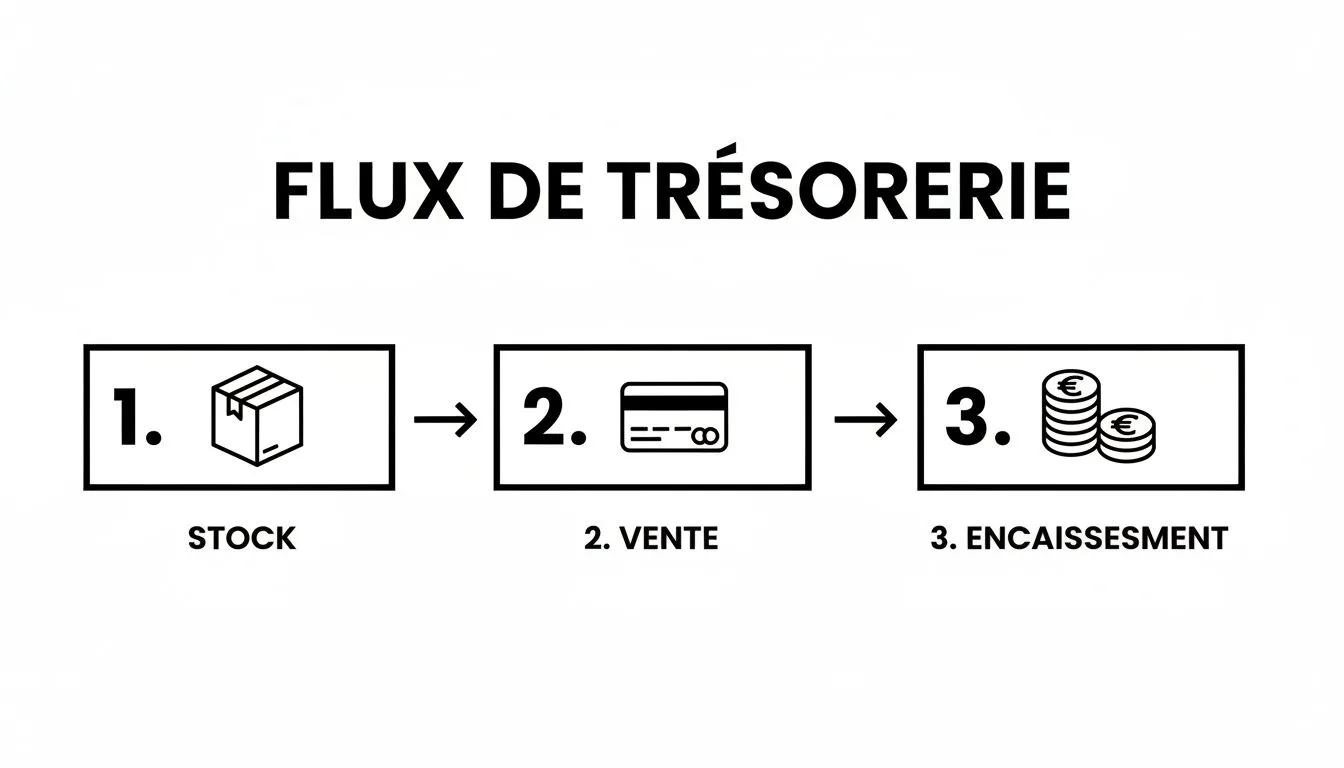
Visualizing this journey makes it immediately clear that money is “locked” in stock and only becomes available again at the very end of the process.
Automation, your best ally for a reliable forecast
Building this plan on a spreadsheet is a good start. But let’s be honest, it quickly becomes a chore. Manual entry is a source of errors, and keeping it updated eats into precious time you could invest in growing your business.
This is where connected tools like Bizyness completely change the game. By syncing directly with your sales channels (Shopify, Amazon) and your bank accounts, the platform automates the entire process for you.
The cash flow plan then builds itself, in real time. No more juggling between data exports and complex Excel formulas. The tool does the work and gives you a clear, always up-to-date view of your future cash flow needs. You’re alerted well before a problem looms, turning a stressful task into a genuine strategic steering lever.
Freeing up cash without seeking outside financing
Even before thinking about knocking on a bank’s or an investor’s door, the first reflex, and by far the most profitable one, is to look for the money already hiding within your own business. Think of your business as a water circuit: sometimes all it takes is unclogging a few pipes for everything to flow again, without having to open a new tap. That’s exactly what we’re going to do here: optimize your flows to reduce your cash flow needs.
These few adjustments, often simpler than you’d imagine, can free up thousands of euros. This “rediscovered” money gives you breathing room to invest, absorb a setback, or simply sleep a little better at night.
Extending supplier payment terms
This is probably the most powerful lever for acting on your Working Capital Requirement (WCR). Every extra day of payment delay you manage to negotiate with a supplier is one more day that money works for you, instead of sitting idle with them.
The goal isn’t to become a bad payer, quite the opposite. It’s about synchronizing your outflows with your inflows. If it takes you 60 days on average to sell a product, paying for it in 30 days mathematically puts you under pressure. That’s a structural imbalance.
Concrete D2C example: A cosmetics brand on Shopify negotiates with its lab a payment of 60 days end-of-month, instead of the usual net-30 terms. In one stroke, it gains nearly 45 days of cash flow. This money lets it fund its Mother’s Day ad campaign without needing a short-term loan.
Speeding up customer collections
If paying your suppliers later is a good thing, being paid faster by your customers is just as valuable. For an online seller, this isn’t about chasing down the end customer, who generally pays upfront, but about oiling the post-purchase gears.
When you sell on marketplaces like Amazon, you’re subject to their payment cycles. That’s the game. But for your direct sales, you’re in control. Check that your invoicing systems are solid and that transfers from your payment processors (Stripe, PayPal) are set to the highest possible frequency. Every day counts.
To better master these concepts and structure your flows, understanding the different ways to finance your WCR is an excellent starting point.
Drastically optimizing inventory management
Your stock is literally money gathering dust on shelves. Every product that doesn’t sell is a financial lock-up that digs into your cash flow needs. Finer inventory management isn’t optional, it’s a goldmine.
Here are a few concrete avenues to explore:
- Improve turnover: Dive into your data to spot “dormant” products (slow-movers). Once identified, launch targeted promotions, bundles, or flash sales to clear them and turn that stock into cash.
- Shift to just-in-time: Talk with your suppliers about setting up smaller but more frequent deliveries. This reduces the overall amount of stock you have to finance at any given moment.
- Test dropshipping: For certain product ranges, dropshipping is a radical solution. You only pay the supplier once the customer’s order has been placed. The need to finance stock is simply eliminated.
Concrete marketplace example: An electronics seller on Amazon FBA, by analyzing his sales, realizes that 20% of his SKUs represent 80% of his stock value, but only 10% of his sales. He decides to stop restocking these products. Within three months, he frees up more than €15,000 in cash, which he immediately reinvests into his star products to avoid any stockout during Prime Day.
When internal optimizations are no longer enough to sustain your momentum, it’s time to look beyond your own resources. Facing a cash flow need is not a sign of weakness, quite the opposite. It’s often proof that you’re at an inflection point, ready to move up a gear.
But be careful, not all financing solutions are equal. Choosing the wrong tool can hurt your profitability with hidden costs or lock you into rigid constraints. Let’s review the most common options for an online seller, from the most traditional to the most modern, to help you make the right choice.
Traditional financing solutions
Banks are the historic go-to for cash flow needs. Even though their doors can sometimes be hard to open for a young web-based company, their offerings are worth knowing.
-
Authorized bank overdraft: This is the go-to quick fix. Your bank allows you to go into the red up to a certain ceiling. It’s simple, fast, and flexible for a one-off need. The problem? Interest rates (overdraft fees) are often very high, making it a toxic solution if it drags on. It’s a band-aid, not a real treatment.
-
Short-term cash loan: Here we’re talking about actual credit, with an amount, a duration, and monthly payments set in advance. It’s ideal for financing a specific project, such as a massive stock purchase before Black Friday. The cost is much better controlled than an overdraft, but the lack of flexibility and the need to present a solid file (with several years of financial statements) can quickly become a hurdle.
The uncomfortable truth: Traditional banks were designed for “classic” business models. They still struggle to assess the potential of an e-commerce business, whose real value lies not in buildings or machinery, but in future sales flows and a solid acquisition strategy.
Modern alternatives built for e-commerce
Fortunately, the world of finance has evolved. New solutions have emerged, tailor-made for the dynamics of online selling. Their common trait? They care more about your sales performance than your past balance sheets.
Factoring
In practice, factoring involves “selling” your outstanding invoices to a specialized company, called the “factor.” It immediately advances you a large portion of the amount, often between 80% and 95%, then takes on the job of collecting the money from your customers itself.
This technique is remarkably effective at eliminating payment gaps, especially if you work in B2B. It turns your receivables into cash almost instantly. The downside is its cost (commission + management fees) and its scope, mainly limited to business-to-business sales with issued invoices. For a D2C online seller (direct-to-consumer sales), its usefulness is therefore more limited.
Revenue-Based Financing (RBF)
RBF, or revenue-based financing, is arguably the solution that best fits the reality of online sellers today. The principle is remarkably clear: a financial partner advances you funds, and in return, takes a small percentage of your future revenue until the amount, plus a fixed fee, is repaid.
- No equity dilution: You remain the sole master on board. You don’t sell any share of your company.
- Total flexibility: Repayments adjust to your revenue. A quiet month? You repay less. Sales take off? You repay faster. It’s as simple as that.
- 100% digital and fast process: The financing decision is often made within 24 to 48 hours, simply by connecting your sales platforms (Shopify, Stripe, Amazon, etc.).
RBF is perfect for financing expenses with a quick return on investment, such as buying stock or running an ad campaign. Its cost is transparent and known in advance. No running interest rates, no personal guarantees. It’s financing whose success is directly tied to yours.
Comparison of cash flow financing solutions
Choosing the right option depends entirely on your situation: the nature of your need (one-off or recurring), its urgency, and your e-commerce business model. This table compares the main options to help you see things more clearly.
| Financing solution | Ideal for… | Advantages | Drawbacks | Estimated cost |
|---|---|---|---|---|
| Bank overdraft | A very short-term, low-amount need (a few days). | Simple and immediate (if already negotiated). | Very high cost (overdraft fees), low ceiling, risk of overuse. | 7% to 20% (APR) |
| Short-term loan | A specific project with a quantified need (seasonal stock purchase). | Controlled cost, fixed monthly payments. | Lack of flexibility, demanding application (financial statements), approval delays. | 2% to 7% |
| Factoring | B2B online sellers with long customer payment terms. | Immediate cash flow, outsourced collections. | Cost (commissions), poorly suited to B2C, may affect customer relationships. | 1% to 4% of invoiced amount |
| Revenue-Based Financing (RBF) | Financing growth (stock, ads) for any type of e-commerce business. | Fast, flexible (repayments indexed to sales), no dilution. | Higher fixed cost than a traditional loan when things go well. | 4% to 12% of financed amount (fixed commission) |
In short, traditional solutions like overdrafts or loans can work for very specific, planned needs, provided you have a solid banking track record. To finance growth in an agile and fast way, modern solutions like RBF are often much better suited to the reality of e-commerce in 2026, since they align with your actual performance.
How Bizyness automates your cash flow management
Managing your e-commerce cash flow with spreadsheets? It’s a bit like driving a Formula 1 car while only looking in the rearview mirror. You spend your time reacting to yesterday’s problems instead of anticipating the turns ahead. Fortunately, turning this management into a real competitive advantage is now possible.
Imagine a financial co-pilot fully dedicated to your e-commerce business. A tool that, beyond simply tracking your numbers, gives you the keys to make the right decisions and steer your growth with peace of mind. That’s exactly Bizyness’s mission: to free you from the time and mental load tied to financial uncertainty.
Centralize everything, in real time
The first step to regaining control is having an overall view. No more juggling between your Shopify admin, your Amazon Seller Central account, your Stripe statements, and multiple bank accounts. Bizyness centralizes absolutely all your financial flows on a single, simple, visual dashboard.
Thanks to this automatic aggregation, you get a 360-degree view of your situation, continuously updated. You know precisely where the money comes from, where it goes, and above all, what you actually have left to run the shop. It’s the foundation of finally proactive management.

Anticipate cash flow dips before they even happen
Visualizing your current situation is good. Predicting what’s about to happen is even better. By analyzing your historical data and sales trends, Bizyness’s algorithms anticipate your future cash flow needs. Indeed, AI-driven automation of financial processes is the key to moving from a static view to dynamic management.
Concretely, the platform alerts you as soon as it detects a period of tension on the horizon.
“Alert: Based on our forecasts, your cash balance is at risk of dropping by €15,000 within 6 weeks, due to supplier payments and the collection lag on your end-of-month sales.”
Receiving such a notification changes everything. No more last-minute stress. You now have time to negotiate a delay with a supplier, launch a promotion to boost sales, or calmly prepare a financing request. You’re in the driver’s seat.
Simplify accounting and financing applications
Automation doesn’t stop there. It also revolutionizes the way you manage your accounting. By connecting directly to your sales channels (Shopify, Amazon, etc.), Bizyness prepares clean, up-to-date, effortless accounting. Every sale is automatically categorized with the correct VAT rates.
-
Bank reconciliation becomes child’s play: The tool automatically matches bank transactions with your sales and expenses. To understand it all, read our guide on automatic bank reconciliation.
-
VAT (and OSS/IOSS) returns ready to go: All data is structured so your accountant can use it instantly.
-
A financing file that inspires confidence: When you need a loan to finance your stock, you can provide reliable financial data in one click. It’s a precious time saver that considerably speeds up getting a loan.
By taking these tasks off your plate, automation gives you back your most precious resource: time. Time you can devote to strategy, marketing, customer experience… In short, to everything that truly grows your business.
Frequently asked questions about e-commerce cash flow
Got questions about managing your cash? That’s normal. Here are clear, direct answers to the most common questions among online sellers, to help you see things more clearly.
What exactly is a cash flow need?
Imagine having to pay your stock suppliers, your ad campaigns, and your salaries today, while the money from your latest sales won’t arrive in your account for several days, or even weeks. That interval is precisely the cash flow need.
It’s simply the gap between your money going out (expenses) and your money coming in (customer payments). In e-commerce, this gap is nearly systematic, because you almost always pay your bills well before funds from Stripe, Amazon, or other platforms land in your business account.
Why is my store profitable but always short on cash?
Ah, the great online seller’s paradox! Your business can show excellent profitability on paper, yet end up with a dangerously empty bank account. The culprit has a name: Working Capital Requirement (WCR).
WCR is all the money that’s “locked up” in your day-to-day operations and not working for you:
- Stock: This is literally money sleeping on your shelves.
- Customer receivables: This is your sales money still in transit, somewhere between your customer’s card and your account.
Strong growth, paradoxically, often worsens this phenomenon. The more you sell, the more stock you have to buy, which digs into your WCR and can put you in trouble, even with comfortable margins.
A high WCR is the number-one cause of cash flow tension for a growing e-commerce business. Mastering it is a priority. Think of it this way: reducing your stock by €10,000 is like injecting €10,000 of fresh, immediate cash into your business.
How do I finance an urgent cash flow need?
When time is short, several solutions are available to you. The most obvious is often an authorized bank overdraft. It’s fast, but be careful, its cost can be very high and it isn’t always suited to e-commerce’s reality.
More modern solutions, like Revenue-Based Financing (RBF), are often much more relevant for online stores. The principle is simple: you’re advanced funds based on your sales performance, and you repay flexibly, based on your revenue. It’s perfect for financing a growth push, like a large stock purchase or a seasonal ad campaign.
Don’t let financial surprises dictate your strategy anymore. With Bizyness, you can automate your tracking, anticipate your future cash needs, and make decisions based on reliable, real-time data. Discover how to regain control at Bizyness.fr.
