

 Français
How an e-commerce accountant can transform your growth
Discover how a specialized e-commerce accountant can optimize your VAT, automate your bookkeeping and become a real strategic partner.

An e-commerce accountant is far more than a plain bookkeeper. They are a genuine financial partner who has dived headfirst into the specifics of online selling. They juggle multi-country VAT, marketplace data integrations, and all the complexities that give e-commerce merchants headaches. Their role goes well beyond simple invoice entry to become a strategic pillar of your growth.
Why a generalist accountant is no longer enough for e-commerce
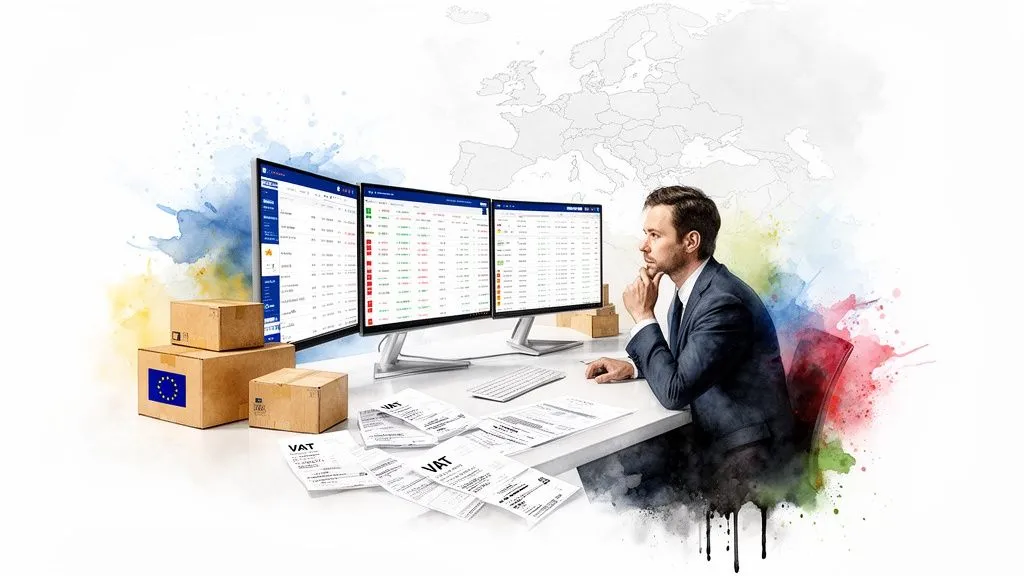
Launching an online store often looks simple at first. But behind the digital storefront lies a financial reality of unsuspected complexity. Entrusting this task to a generalist accountant, however good they are, is a bit like asking your family doctor to perform open-heart surgery. They know the broad principles, but lack the hands-on practice and sharp expertise needed to navigate this very specific ecosystem.
E-commerce has completely reshuffled the deck. The French market still reached €175.3 billion in 2024, €15 billion more than in 2023, and is expected to cross the €200 billion mark by 2026. This blistering growth, also reflected in the key e-commerce statistics on independant.io, calls for ultra-specialized financial management to avoid getting overwhelmed.
The very real challenges of online selling
A traditional accountant is used to handling a reasonable volume of customer and supplier invoices each month. On your end, you’re juggling thousands of small transactions arriving from everywhere, each with its own set of rules.
Picture the scenario: your Shopify store is booming and you sell across Europe. Payments come in via Stripe, PayPal, and even Klarna for installment payments. Meanwhile, you’re moving part of your stock through Amazon FBA, with products physically stored in Germany and Spain.
An uninitiated accountant would quickly be overwhelmed by:
- International VAT management: Gone are the days of simply applying a flat 20% rate. Today, you need to master distance-selling thresholds, juggle the OSS one-stop shop for B2C sales within the EU, and sometimes even register for VAT in other countries because of your stock held on Amazon.
- Reconciling financial flows: Each platform (Shopify, Amazon, Stripe) has its own payment schedule. They transfer you net amounts, after deducting commissions, transaction fees, exchange fees, and even disputes. Matching these transfers back to the original orders can quickly become a real headache.
- The volume and speed of data: Trying to manually process hundreds, even thousands, of transaction lines every month isn’t just inefficient. It’s an open door to costly mistakes.
An e-commerce accountant does more than key in figures. They understand your ecosystem, anticipate the tax pitfalls tied to your growth, and know how to structure your data to secure your business while optimizing your margin.
Technical integration: a non-negotiable skill
That’s where the real difference lies: the technical approach. A specialist in e-commerce won’t ask you to send them your bank statements and invoices as PDFs. They’ll talk to you about your tools, your data flows, and your integrations.
They know how to extract and decipher a Shopify report, read an Amazon payment statement, and automate the creation of the famous accounting entries file (FEC). This tech-savvy culture, which relies on platforms like Bizyness, is the key to reliable bookkeeping that can keep pace with you. To dig deeper, feel free to check out our complete guide to e-commerce accounting.
Identifying the skills of a genuine e-commerce expert
Finding the right e-commerce accountant isn’t just about checking they’re registered with the professional body. It’s above all about testing their practical knowledge on your own turf. A generic pitch about bookkeeping is no longer enough. You need a specialist who speaks the language of Shopify, Amazon, and Stripe as fluently as the chart of accounts suited to your business.
The difference between a traditional firm and a true expert shows immediately. It’s not about knowing that VAT exists, but about knowing how to actually steer it when you sell in ten European countries from a single store.
Mastery of international VAT regimes
The first, most telling test is VAT. For an online seller, it’s not just a line on a tax return. It’s a complex ecosystem that can torpedo your profitability if poorly managed.
A true specialist should be able to explain to you, simply:
- How the one-stop shop (OSS/IOSS) works: Forget the textbook definition. Ask them how, concretely, they retrieve sales data by country, how they apply the more than 15 different VAT rates across the EU, and prepare the return. A vague answer is a very bad sign.
- Managing stock held abroad: You use Amazon FBA with stock in Germany or Spain? That’s a formidable trick question. Your accountant should immediately flag it and bring up VAT registration in those countries. It’s a non-negotiable competency test.
- Distance-selling thresholds: They must know the famous €10,000 threshold for intra-EU B2C sales inside out. More importantly, they should proactively advise you to anticipate the switch to the OSS regime.
An e-commerce expert doesn’t just suffer through VAT rules — they anticipate them. They must be able to model the tax impact of your European expansion before you’ve even shipped your first parcel outside France.
In-depth knowledge of sales ecosystems
Your business isn’t just a bank statement. It lives at the heart of platforms like Shopify, WooCommerce, or marketplaces like Amazon. An accountant who doesn’t understand how these tools work is an accountant navigating blind.
Probe their expertise with very concrete questions:
- Payment reconciliation: “How do you handle reconciling a €4,520 Stripe transfer that corresponds to 150 orders, after deducting commissions, dispute fees, and refunds?” An expert will talk to you about automation tools like Bizyness to bridge the gap, not manual checking on a spreadsheet.
- Platform fee management: Ask them how they handle Amazon ad invoices or the Shopify subscription. They should know exactly where to find them and how to factor them in so your margin is calculated accurately.
- Understanding D2C models: Your contact should grasp the subtleties of the Direct-to-Consumer model. If they understand the importance of customer acquisition cost (CAC) and customer lifetime value (LTV) in financial analysis, they speak your language.
Technical skill and a culture of automation
The era of the shoebox full of invoices is over, especially for an online seller where everything moves fast. Efficiency means automation. Your accountant must absolutely share this vision.
A modern, specialized firm will know how to:
- Leverage accounting exports (FEC): They shouldn’t just know what an accounting entries file is. They should recommend tools, like Bizyness, capable of generating a clean, well-structured FEC directly from your sales flows. For them, it’s a huge time saver.
- Integrate data flows: They must be perfectly comfortable with the idea of connecting your sales and payment platforms to automate data collection. If they still talk about manual entry, run. They’re not built for the velocity of e-commerce.
This technical agility isn’t a gimmick. It’s your guarantee of reliable, up-to-date, and more cost-effective bookkeeping, since it eliminates a large share of manual work. Ultimately, choosing an e-commerce accountant comes down to their ability to prove they understand your business down to the smallest detail, whether operational or financial.
Setting up an effective collaboration with your accountant
You’ve found the rare gem, an accountant specialized in e-commerce. That’s an excellent first step, but the most important part starts now: building a genuine working relationship. A successful collaboration isn’t just about dumping invoices on them. It’s above all a matter of clear processes, shared tools, and communication that flows naturally.
The goal? For your bookkeeping to stop being a mere legal obligation and become a real dashboard to steer your growth. To get there, you need to see your accountant as a strategic partner, not just a service provider who produces a balance sheet once a year.
The accounting profession in France, incidentally, is undergoing quite a transformation. There are now over 175,000 employees and around 21,600 chartered accountants. Their number has climbed 12% between 2015 and 2023, and the number of firms has jumped a full 29%. Good news for you: this dynamic increases your chances of finding a pro who truly understands the challenges of e-commerce. To dig deeper, take a look at the full data on the accounting profession on tool-advisor.fr.
Defining the scope of the engagement: who does what?
Before diving in headfirst, get things clear. Precisely define everyone’s roles and expectations. Your accountant’s level of involvement can range from a simple annual review to a full monthly partnership.
Here are the most common arrangements seen in practice:
- Annual accounts presentation engagement. This is the minimum service. You handle your bookkeeping in-house, often with a tool like Bizyness, and the expert steps in at year-end. Their role: check your entries, prepare the balance sheet and tax return package. It’s an economical option, perfect if you already have solid processes in place.
- Partial bookkeeping engagement. Here you find a middle ground. You delegate the more technical tasks, such as VAT returns or payroll management, but keep control of day-to-day operations (purchase entry, invoicing). It’s an excellent compromise to free up time without outsourcing everything.
- Full bookkeeping engagement. The firm takes everything on, end to end. It’s the most comfortable solution, but be careful: it requires ultra-smooth data transmission to avoid turning into an administrative headache.
Whatever the arrangement, the core skills stay the same. This diagram makes that clear.
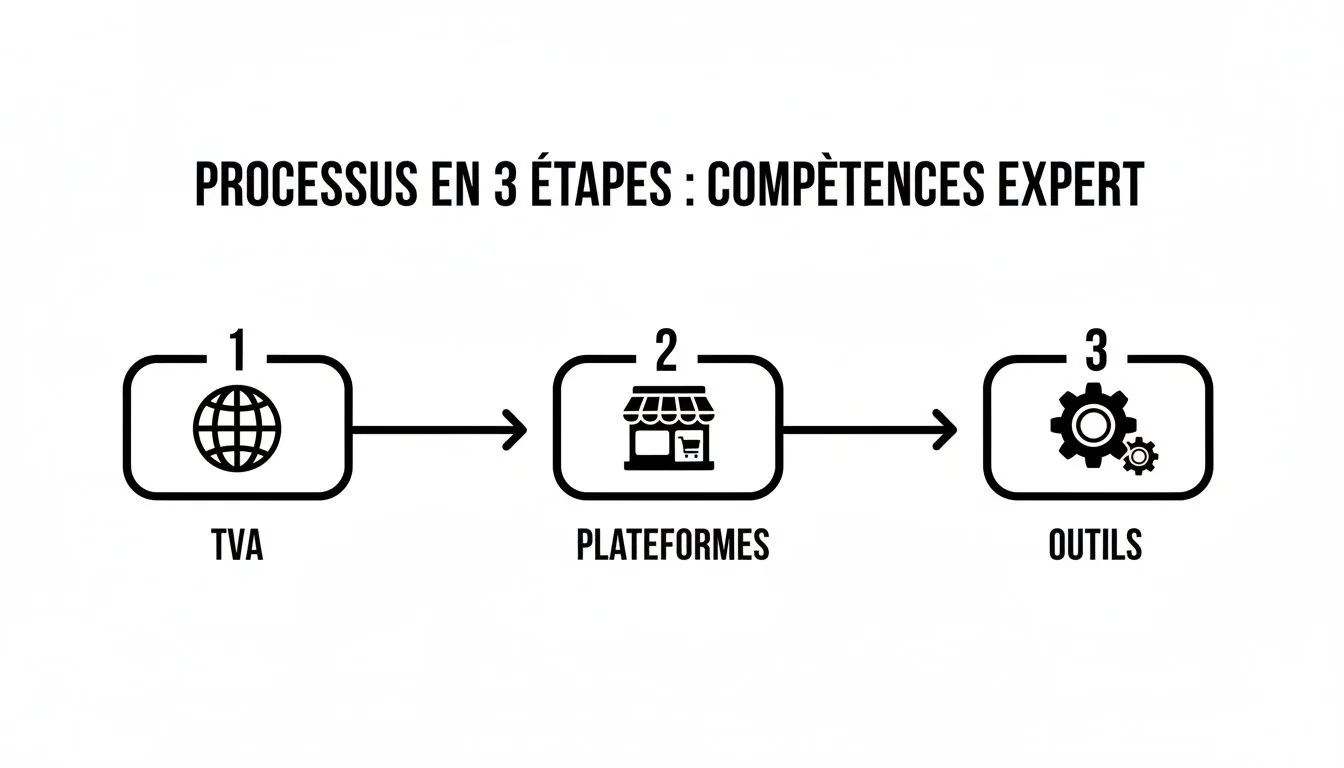
The key takeaway is that these three pillars — VAT mastery, knowledge of sales platforms, and ease with automation tools — are inseparable. One doesn’t work without the others for high-performing e-commerce management.
To help you visualize which arrangement suits you best, here’s a comparison table.
Comparing collaboration models and associated tools
This table will help you see clearly which level of support fits your needs and which tools to prioritize so everything runs smoothly.
| Engagement model | Merchant tasks (with Bizyness) | Accountant tasks | Ideal for |
|---|---|---|---|
| Accounts presentation | Syncing flows (Shopify, Stripe…). Qualifying expenses. Generating the accounting entries file (FEC). | Checking entries. Preparing the balance sheet and tax return package. Strategic advice. | Self-sufficient online sellers, with well-established internal processes. |
| Partial bookkeeping | Syncing sales flows. Entering purchase invoices. | VAT returns (OSS/IOSS). Payroll management. Accounting review. | Growing businesses that want to delegate complex tasks while keeping control. |
| Full bookkeeping | Sending receipts (e.g. via a scanning app). | Entering all documents. Bank reconciliation. All tax filings. Proactive advice. | Founders who want to fully outsource the administrative function to focus on the business. |
In short, the choice depends on your structure, your budget, and the time you want to spend on admin. The key is finding the right balance for your situation.
Automation, the cornerstone of your collaboration
The efficiency of your duo will depend directly on the tools you put in place. For an online seller, a tool like Bizyness isn’t a gadget. It’s the bridge connecting your business to your accountant’s bookkeeping.
The time your accountant doesn’t spend on manual entry is time they can devote to analysis and advice. Automation isn’t an expense, it’s an investment in the quality of your support.
Picture the classic scenario, without automation. Every month, it’s the same chore: you export CSV files from Shopify, payment reports from Stripe, fee invoices from Amazon… and send it all by email. Your accountant then spends hours sorting, consolidating, and manually re-entering. The risk of error is huge, and that entry time is what you pay for.
With a connected platform, the process is radically different.
- Automatic collection: Bizyness plugs directly into your sales channels (Shopify, Amazon…) and your payment processors (Stripe, PayPal…).
- Smart processing: The platform applies the correct VAT rates based on the customer’s country, reconciles payments with orders, and categorizes fees. No more headaches.
- Perfect accounting export: At month-end, a single click is enough. You (or your accountant) generate a ready-to-use accounting entries file (FEC), which plugs directly into your expert’s production software.
This changes everything. It lets your accountant focus on high-value analysis: how your margin evolves by product, optimizing your acquisition costs, anticipating your cash flow…
Setting up communication rituals
Finally, a good collaboration is like any relationship: it thrives on regular communication. Don’t wait for the year-end panic to check in.
Set up simple but effective rituals:
- A monthly or quarterly check-in to analyze your dashboards, discuss performance, and prepare for the months ahead.
- Proactive alerts from them if they spot an anomaly or an opportunity (for example, a VAT threshold approaching dangerously).
- A direct communication channel (a dedicated email, a Slack channel, etc.) for quick day-to-day questions.
By structuring your relationship this way, you ensure your accountant is far more than a legal obligation. They become an essential co-pilot for navigating the complexity of e-commerce growth.
Questions to ask before signing with a firm
The first meeting with a firm is a key moment. It’s not just a sales appointment, it’s a genuine reverse audit. You’re the one in the position of strength to assess their ability to handle the very real complexities of your e-commerce business.
To avoid being lulled by a smooth sales pitch, come prepared. Armed with precise, technical questions that get to the heart of things. The goal is simple: show that you master your own challenges and expect a partner up to the task, not just a provider who keys in invoices.
Questions about managing financial flows
E-commerce bookkeeping isn’t data entry, it’s above all the reconciliation of often complex financial flows. That’s where most errors and wasted time hide. So it’s worth testing the ground right away.
Question 1: “Concretely, how do you handle reconciling Stripe or PayPal payouts with each order placed on Shopify?”
Here, the answer should immediately revolve around automation. A seasoned expert will talk about tools like Bizyness or specific connectors that bridge your sales and payment platforms. They should be able to explain how they isolate commissions, exchange fees, and refunds so that every transaction is properly matched.
The big red flag? An answer that mentions “manual checking on Excel” or stays very vague. That’s a guarantee you’ll be paying for low-value-added work hours, with a huge risk of error.
Questions about international taxation
For an online seller, VAT is a real minefield. Mismanage it, and a tax reassessment is looming. It’s therefore vital to make sure your future expert masters the rules of the game, especially in Europe.
Question 2: “We plan to sell in 6 EU countries this year. Have you already set up and managed OSS one-stop-shop returns for clients in our situation?”
A good answer should go beyond a simple “yes, of course.” A genuine e-commerce accountant will share their experience, the pitfalls they’ve already encountered, and the method they use to collect sales data by country and apply the correct VAT rates. They might even mention managing thresholds or stock-abroad issues, such as with Amazon’s FBA program.
Ideally, they’ll give you a concrete (and anonymized) example of a client they’ve supported, highlighting the points requiring vigilance.
Questions about technical integration and tools
The efficiency of a modern firm is measured by its ability to plug into your technical ecosystem. An expert who doesn’t understand the language of your tools is an expert who will waste your precious time.
Question 3: “What tools do you use to connect to our sales flows and automate the generation of the accounting entries file (FEC)?”
The perfect answer should mention specialized platforms. The fact that they already know and work with solutions like Bizyness is an excellent sign. It proves they’ve understood the importance of structuring data right from the source to guarantee reliable, efficient bookkeeping, ready for a potential audit.
If their answer is evasive or focuses solely on their in-house production software, be wary. That often means they’ll expect you to provide manual exports, the very opposite of automation and efficiency.
Question 4: “How do you bill for corrections in the event of a tax audit or if errors are found in past fiscal years?”
This question is there to test transparency and risk management. A serious firm will have a clear policy, often based on a set hourly rate for exceptional work. Run from vague answers that reek of hidden fees.
The little checklist for an effective interview
For this exchange to be truly productive, don’t show up empty-handed. Besides asking your questions, give them material so they can put together an accurate quote.
Prepare a small folder with:
- Your company registration documents (Kbis) and articles of association.
- Read-only access to your Shopify, Amazon Seller Central, etc. back office (if you’re comfortable with that).
- Sample sales reports and payouts from your payment platforms (Stripe, PayPal).
- Your latest tax return package if the company already has one or more balance sheets.
- An estimate of your monthly transaction volume and projected revenue.
By showing up with these elements, you demonstrate your seriousness and let the firm put together an engagement letter that fits your needs perfectly, without wasting time on unnecessary back-and-forth.
What budget should you plan for an e-commerce accountant?

Let’s talk money. Addressing the budget question for an e-commerce accountant can seem intimidating, but it’s a crucial step in building your business on solid foundations. The idea isn’t to chase the lowest price, but to find the best balance between the value you receive and the security you gain.
Rates can vary threefold. Several factors come into play: your legal structure, your transaction volume, and above all, how specialized the firm is. Keep in mind that this investment isn’t just a line of expense — it’s real insurance against mistakes that could otherwise cost you a small fortune.
The factors that weigh in the balance
Every online store has its own DNA, and your accountant’s quote should reflect that. Truly specialized firms avoid generic packages. They prefer to build a tailored proposal, matched to the real complexity of your business.
Here’s what will mainly influence the final price:
- Legal structure: Managing the books of a sole proprietorship and those of an incorporated company are worlds apart. The obligations for a company (balance sheet, tax return package, etc.) are much heavier and demand significantly more work.
- Transaction volume: A site doing 50 sales a month doesn’t face the same challenges as a Shopify store handling several thousand. The higher the volume climbs, the more reconciling financial flows (Stripe, PayPal, etc.) becomes a real headache.
- Tax complexity: Do you only sell in France, or are you targeting all of Europe? Activating the OSS one-stop shop for European VAT, for example, is a serious matter. It requires sharp expertise, which logically shows up in the budget.
- Level of automation: The tools you use have a direct impact on fees. An online seller relying on a platform like Bizyness to generate a clean, well-structured accounting entries file (FEC) saves their accountant precious time. And that time saved is money saved on the bill.
Thinking of your accountant’s budget purely as a cost is a beginner’s mistake. See it instead as an investment in your peace of mind, your compliance, and the optimization of your finances. Good VAT management can save you thousands of euros, far more than the firm’s annual fees.
A sense of market prices
To give you a concrete idea, rates for e-commerce support vary quite a bit. In France, for an incorporated company (SARL or SAS type), you should generally budget between €200 and €500 excl. VAT per month.
Interesting fact: an online, specialized, well-equipped firm costs on average 30% to 50% less than a traditional “old-school” firm. To give an example, an e-commerce SARL with €250,000 in annual revenue might spend around €5,400 a year with a traditional firm, whereas investing in automation tools is far more affordable.
These figures clearly show the appeal of a modern approach.
The real cost of “cheap”
Giving in to the temptation of the cheapest firm, or a generalist who knows nothing about e-commerce, can seem clever in the moment. But this apparent saving often hides much steeper costs down the line.
An expert discovering the ins and outs of Shopify, Stripe, or OSS VAT is likely to spend hours trying to understand your financial flows. And you’re the one who’ll pay for that time. Worse still, a simple mistake in a VAT return can trigger a tax reassessment that’s as costly as it is stressful.
The upfront investment in a genuine e-commerce accountant shields you from these worst-case scenarios. It’s therefore far wiser to choose a partner whose added value far exceeds the amount of their fees. To get a precise idea of the budget to plan for an automation solution, take a look at our pricing at Bizyness; it’s designed to grow with you.
Your questions answered on choosing an accountant for your e-commerce business
Still have a few doubts? That’s perfectly normal. To help you see things clearly and make the right choice, here are the answers to the questions online sellers ask most often.
Can you change accountants mid-year?
Yes, no problem! Changing accountants mid-fiscal-year is a fairly common procedure, and much simpler than you might imagine.
Your new firm will simply take over. They’ll contact the previous one directly to organize the handover and retrieve all the elements of your file. If you already use a tool like Bizyness, it’s even easier: all your data is centralized, ready to be exported. The transition happens smoothly, without the slightest interruption in tracking your business.
Does my accountant have to be in my city?
Absolutely not. For a 100% online business, geographic proximity is rarely a relevant criterion. It’s far better to favor a firm specialized in e-commerce, even if it’s on the other side of the country, than a local accountant who knows nothing about the specifics of online selling.
Today, with collaborative tools, video calls, and cloud platforms, distance is no longer an obstacle. A remote collaboration is just as smooth and effective, if not more so.
The key takeaway is that a good e-commerce partner doesn’t just do data entry. They dive into your numbers, analyze your sales data, marketplace commissions, or customer acquisition costs. Their goal? To give you relevant dashboards and concrete advice to boost your product profitability and optimize your margins.
Ready to lay solid financial foundations to support your growth? With Bizyness, you automate a large part of your e-commerce bookkeeping and collaborating with your accountant becomes child’s play. Discover how Bizyness can transform your daily routine on bizyness.fr.
