

 Français
False URSSAF Declaration as a Sole Trader: Risks & Advice
Find out how to avoid a false URSSAF declaration as a sole trader and protect your business. A complete guide to avoiding penalties and audits.

Talking about a false URSSAF declaration as a sole trader can be scary, but it’s essential to understand what it actually means. In practice, it covers any error or omission in your revenue declaration, whether deliberate or not.
It ranges from a simple typo when entering your income to forgetting an invoice, or declaring the wrong business category. The result is the same: an incorrect calculation of your social security contributions.
Understanding what counts as a false URSSAF declaration
Let’s dig a bit deeper into what a false URSSAF declaration as a sole trader really covers. Forget the image of intentional fraud — the topic is much broader than that.
Think of your revenue declaration as the contribution you make to fund social protection for everyone: healthcare, pensions, family benefits. Every euro declared feeds this shared system. An error, even an unintentional one, therefore affects this collective balance — but also your own future entitlements.
A false declaration can take many forms. The administration knows how to tell the difference between forgetting a small invoice and systematically understating your income. The distinction matters a great deal.
Error, negligence and fraud: three notions worth telling apart
It’s crucial to grasp the nuance between a simple mistake, negligence and deliberate fraud. The consequences are absolutely not the same.
- A good-faith error: The classic slip-up, like a typo when entering an amount. With no intention to cheat, it can often be corrected without a heavy penalty thanks to the “right to make a mistake” (droit à l’erreur).
- Negligence: Here we’re talking about an error that stems from a lack of rigor or poor knowledge of the rules. For example, systematically forgetting to declare part of your revenue due to poor organization.
- Deliberate fraud: This is the intentional act, knowingly trying to avoid paying contributions. Think of hiding activity (undeclared work) or falsifying documents. This is the most serious case, and logically the most heavily penalized.
These errors are far more common than you’d think. A 2023 URSSAF analysis revealed a striking figure: out of 7,345 sole traders audited, 82% showed anomalies in their declarations. Total undeclared income amounted to €20.6 million. To dig further into the topic, you can consult the URSSAF report on the fight against illegal work.
The image below sums up the chain of events well, from the most common errors to potential penalties.
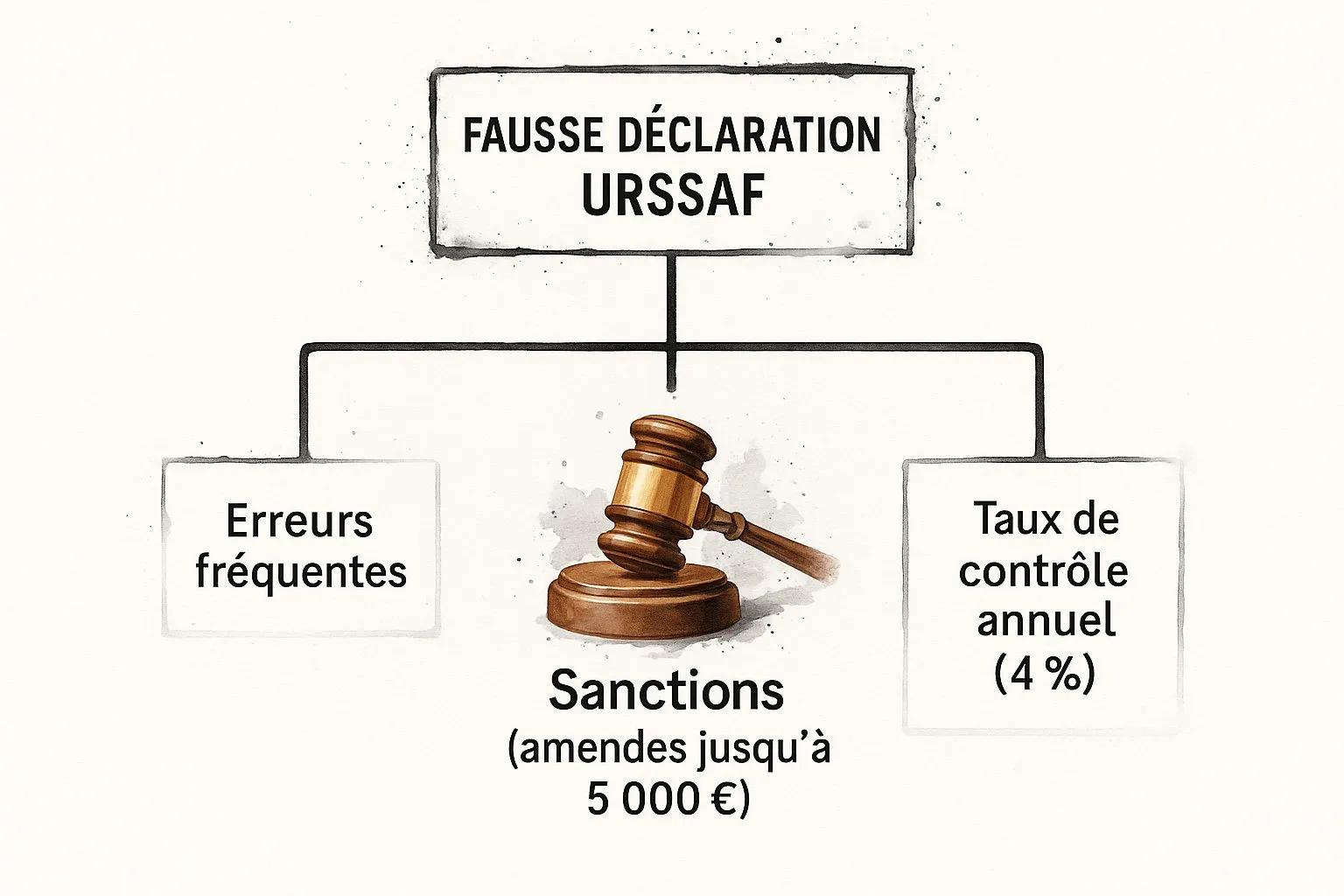
This visual makes it clear: even if the audit rate may seem low, common errors can quickly lead to serious consequences.
Types of incorrect declarations and risk levels
This table helps identify the different types of errors or omissions in URSSAF declarations and understand their potential severity.
| Type of declaration | Common cause | Risk level (Low/Medium/High) |
|---|---|---|
| One-off entry error | Typo, digits swapped. | Low |
| Omitted invoice | Poor organization, oversight. | Low to Medium |
| Declaration under the wrong category | Unfamiliarity with the rules (e.g. crafts vs. professional services). | Medium |
| Forgotten VAT | Poor understanding of the exemption thresholds. | Medium to High |
| Deliberate and repeated understatement of revenue | Intent to pay lower contributions. | High |
| Complete absence of declaration | Hidden activity (undeclared work). | Very high |
As you can see, simple unfamiliarity with the rules can quickly push the risk level up.
A typical example is VAT management. A poor understanding of the VAT exemption thresholds can quickly put you in an irregular situation. To avoid this pitfall, take a look at our complete guide on VAT for sole traders.
Identifying the financial penalties and hidden risks
A false URSSAF declaration as a sole trader is never a small matter. Far from being limited to a simple request for correction, it can trigger an escalating mechanism of financial penalties. The idea isn’t just to correct an error, but to punish the intent to defraud more severely.
Think of it as a chain reaction: a small mistake can quickly lead to heavy consequences if it isn’t dealt with. Ignoring the problem means risking turning a simple debt into a real financial burden.
Financial penalties: an escalating cost
The first penalty is the lightest, but it already stings. For any late payment or error, URSSAF systematically applies surcharges.
- The 5% late-payment surcharge: This is the starting point. If you owe €1,000 in contributions, an adjustment will automatically cost you €50 more, on top of the initial amount due. It’s automatic.
But if the administration suspects the error wasn’t a simple oversight, things get seriously complicated. Penalties shoot up as soon as intent to defraud comes into play.
In the event of fraud or an error found during a URSSAF audit, the standard surcharge is 5%, but it can reach 25% in the case of proven fraud, and climb to 40% in aggravating circumstances, such as undeclared work.
Let’s take a concrete example to make this clearer. Imagine a sole trader who “forgot” to declare €10,000 in revenue over a year. The adjustment won’t be limited to paying the contributions they should have paid (around €2,200 for a service business). URSSAF will add a penalty for deliberate non-compliance, which could easily reach €2,500 (25% of €10,000), not counting the late-payment surcharges. The final bill quickly becomes a lot steeper.
The consequences you don’t see, but that are very real
Beyond the numbers, a false declaration eats away at the very foundations of your security and credibility. These are the hidden risks that many sole traders underestimate.
Yet they can have a direct impact on your personal and professional future:
- Loss of your social rights: The contributions you pay are the pillar of your protection. Declaring incorrectly means risking not validating your pension quarters, seeing your sick pay reduced to almost nothing, or losing your maternity or paternity leave entitlements.
- Difficulty accessing credit: When you apply for a loan, the bank scrutinizes your tax notices and revenue declarations. Income declared too low or inconsistent is a red flag when trying to get a mortgage or financing for your business.
- Impact on your reputation: An adjustment for fraud leaves a mark. If your clients or partners find out, your professional image can take a lasting hit.
Staying compliant with URSSAF is therefore not just an administrative constraint. It’s insurance for your future, protecting your wallet, your health and your career all at once. Rigorous bookkeeping is your best ally. If you work in e-commerce, for example, it’s vital to adopt good practices from the start. Take a look at our guide to optimizing e-commerce accounting and securing your business.
How URSSAF spots anomalies in your declarations
You might wonder how URSSAF manages to identify a suspicious declaration. Far from being a black box, its methods are actually quite logical and increasingly refined by technology. Understanding how the agency spots a false URSSAF declaration as a sole trader is ultimately the best form of prevention.
You need to realize that the tax administration and the social security administration no longer work separately. Imagine that every piece of information you give them (taxes, URSSAF, bank…) is a piece of a large digital puzzle. URSSAF’s role is to assemble these pieces to check that the final picture is consistent.

Cross-checking data: the cornerstone of detection
URSSAF’s main weapon, and probably the most formidable one, is data cross-checking. Your declarations are systematically scrutinized and compared against a wealth of information the administration already holds elsewhere.
This largely automated process is designed to bring out even the smallest inconsistency, even one that seems minor to you. And the data sources keep growing in number.
Here are the main pieces of information cross-checked by URSSAF:
- Your income tax return: The classic one. If the revenue you declare to the tax authorities doesn’t match what you declared to URSSAF, it’s an immediate red flag.
- Bank data: Thanks to its right to access banking information, URSSAF can ask your bank for your professional account statements. Large, regular cash inflows that don’t match your revenue declarations are a very serious clue.
- Online platforms: Platforms like Uber, Deliveroo or freelance marketplaces are legally required to report the income earned by their users to the administration each year.
- Your clients’ declarations: If one of your business clients is audited, URSSAF can go through their invoices. If it comes across invoices in your name, it will make sure you declared these amounts on your side.
The signals that set off red flags
Certain behaviors or situations particularly catch the eye of URSSAF’s algorithms and agents. These are a kind of “red flag” that can justify a closer look at your file.
Declaring zero revenue for several months, for example, might seem harmless. But if, at the same time, you have an e-commerce site up and running, you’re active on your professional social networks, or your bank account shows activity, the inconsistency becomes obvious.
Repeated absence of declarations or zero declarations, while the business appears to keep running, is one of the main triggers for an audit on suspicion of undeclared work.
Other signals can raise the administration’s suspicions:
- Odd revenue swings: Revenue that drops from €5,000 to €200 a month with no obvious reason (seasonal activity, illness…) can look suspicious.
- Revenue hovering just under the thresholds: Systematically declaring an amount just below the VAT thresholds or the sole trader scheme’s ceilings can draw attention.
- Tip-offs: Less common, but a report from an unhappy client, a competitor, or even a former employee can absolutely lead to an investigation.
Keeping these mechanisms in mind lets you run your business more rigorously and transparently. The name of the game is consistency. Just make sure the figures reported to the different agencies match and reflect the reality of your business. Prevention is, and always will be, your best ally for navigating this calmly.
Navigating the stages of a URSSAF audit with confidence
Receiving a URSSAF audit notice is the kind of letter that triggers a bit of stress. You immediately imagine the worst. Yet panic is a bad advisor. The best approach? Treat this audit as a simple routine check and approach it with method and composure.
Contrary to what many think, an audit isn’t necessarily triggered because you’re suspected of fraud. It could be a random or scheduled audit, or simply due to small inconsistencies detected automatically. Your best line of defense remains impeccable preparation and a cooperative attitude.
Think of what follows as your roadmap. By following these steps, you’ll know exactly what to do and how to react, from opening the envelope to the conclusion of the audit.
Receiving the audit notice: the starting point
Everything begins with that famous official letter: the audit notice. The law is clear — it must be sent to you at least 30 days before the audit date. This isn’t a coincidence; this delay exists precisely to give you time to prepare calmly.
This document is absolutely essential, as it sets out the rules of the game. It tells you:
- The date and type of audit. For a sole trader, it’s a “desk audit” (contrôle sur pièces), meaning everything is done remotely, without a visit to your premises.
- The exact period that will be scrutinized. Generally, this covers the last three complete calendar years.
- The precise list of documents you need to gather and send.
The first thing to do: never set this letter aside. Read it carefully, and above all, note the deadline for submitting your supporting documents. This marks the start of your preparation.
Preparing your documents: rigor is your best ally
Now it’s time to collect everything. Your mission is to gather all the requested documents. This is a step where thoroughness pays off. The inspector will cross-check these documents to make sure your declared revenue matches the reality of your business.
Here are the documents you’ll systematically be asked for:
- The revenue book (livre des recettes): This is the backbone of your bookkeeping. It must list, in chronological order, every sum you received, specifying the date, the amount, the client’s identity and the payment method.
- Invoices and quotes: Pull out all the folders! You must provide all your sales invoices and signed quotes corresponding to the audited period. A crucial point: check that your invoice numbering is continuous, with no gaps.
- Statements from your dedicated business bank account: Provide all the statements for the bank account you use for your professional activity. This is what lets the inspector match the deposits into your account with the income you recorded in your revenue book.
- Your latest tax notices: These documents are used to check that the income you declared to URSSAF is consistent with what you declared to the tax authorities.
Friendly advice: Take the time to scan all your documents. Organize them neatly into folders by year on your computer. Not only will this make sending them to URSSAF easier, it will also let you find any piece of information in an instant if the inspector asks you a question.
Good bookkeeping organization is also a major asset in everyday life, for example when it comes to not letting payments slip. To dig deeper into this topic, take a look at our guide on best practices for chasing an unpaid invoice.
Exchanges with the inspector and the observation letter
Once you’ve sent everything, the inspector gets to work. For a micro-business, this review phase can take up to three months. During this time, it’s not unusual for them to contact you by email or phone to ask for clarification or a missing document. Always respond simply, directly and factually.
At the end of the review, you’ll receive an observation letter (lettre d’observations). This is the document that officially closes the audit and announces the outcome. There are four possible outcomes:
- No observation: The ideal scenario. Your declarations are spotless, and the case is closed.
- Credit in your favor: Good news — you overpaid. URSSAF will refund the overpayment or deduct it from your upcoming contributions.
- Adjustment (redressement): You didn’t pay enough. The letter then details the amount due. It includes the missing contributions plus a 5% late-payment surcharge.
- Suspected fraud: This is the most serious case. If URSSAF believes there was intent to hide part of your business activity (undeclared work), penalties rise quickly and can reach 25%, or even 40%.
If you disagree with the inspector’s conclusions, you have 30 days (the “contradictory period”) to respond in writing, make your case and provide new documents to defend your position.
Ultimately, getting through a URSSAF audit is above all a matter of method. By staying organized and transparent, you give yourself every chance for the process to go off without a hitch.
How to correct an error and regularize your situation
Finding an error in your revenue declaration happens. It’s the kind of thing that can quickly become a source of anxiety. Yet the worst reaction would be to bury your head in the sand and hope it slips under the radar. On the contrary, taking the initiative to fix it is the best thing to do. It’s a simple step, and the administration always appreciates proactivity.
The good news is that the correction process is designed to be accessible. It’s not an obstacle course, far from it. Most of the time, a few clicks from your online account is all it takes. What matters is not letting the situation fester.

The corrective declaration, step by step
Correcting a past declaration is much simpler than you’d imagine. Generally, everything happens directly online, on the autoentrepreneur.urssaf.fr website or via the mobile app.
Here’s how to go about it:
- Log in to your online account: Nothing complicated, just use your usual credentials.
- Locate the declaration to correct: In your declarations section, find the period causing the issue (the month or quarter in question).
- Look for the edit option: You should see a button or link to “Modify my declaration.” If this option doesn’t appear, the deadline has probably passed. No panic: just contact URSSAF via the secure messaging system in your account.
- Enter the correct amount: Indicate the revenue you should have declared. The system will automatically recalculate what you owe.
- Confirm and pay: Once the correction is confirmed, all that’s left is to pay the additional social security contributions.
This approach is really your best ally. It proves your good faith and puts you in a much better position than if you waited for an audit to point out the anomaly.
The right to make a mistake: a shield for your good faith
Introduced by the ESSOC law, the right to make a mistake (droit à l’erreur) is a golden principle for sole traders. In practice, it allows you to correct a first-time error in your declaration without incurring a financial penalty.
Put simply, if you make a mistake and correct the situation yourself, URSSAF will apply neither a surcharge nor a late-payment penalty. You’ll only have to pay the missing contributions.
Be careful, though — this right to make a mistake isn’t an unlimited free pass. It applies under certain conditions:
- The error must be made in good faith. It obviously must not be concealing an attempt at fraud.
- It must be the first error of its kind. Repeated omissions on the same issue could be seen as negligence.
- The correction must be voluntary. You need to act before URSSAF contacts you about it.
Voluntary correction matters all the more given that fraud on micro-entrepreneurs’ social security contributions was estimated at between €1 and €1.5 billion for 2021 alone. This figure, which represents a significant share of the amounts owed, explains why the authorities encourage proactive steps. To dig further into the topic, the IFRAP Foundation’s analysis of contribution fraud is very informative.
Concrete scenarios: what to do in practice?
To make everything perfectly clear, let’s imagine two very common situations.
Example 1: “I forgot to declare an invoice last month.” A classic. While going through your books, you realize an invoice paid last month slipped through the cracks.
- Action: Log in to your URSSAF account right away. Edit the declaration for the month in question by adding the amount of the forgotten invoice. Pay the calculated top-up. Thanks to the right to make a mistake, you won’t owe any penalty. Simple and effective.
Example 2: “I made a mistake in the amount declared two months ago.” A simple typo: you declared €1,200 instead of €2,100.
- Action: The process is exactly the same. You correct the declaration for that period with the right amount and pay the difference. Your voluntary action is proof of your good faith and shields you from surcharges.
In short, when faced with an error, your best instinct is to act quickly. The administration will always prefer a self-employed person who acknowledges their mistake and corrects it, rather than someone who passively waits for an audit. It’s the simplest and least costly way to stay on good terms with URSSAF and protect your business.
Frequently asked questions about false URSSAF declarations
The topic of a false URSSAF declaration, especially as a sole trader, can quickly stir up a lot of worry. That’s completely normal. This FAQ is here to answer them head-on, in simple terms, so you can see things more clearly and approach your obligations with more peace of mind.
The idea is to give you concrete answers you can use right away.
What’s the difference between an error and fraud for URSSAF?
This is THE big question, and the distinction is crucial. It all comes down to one thing: intent.
An error is a slip, an oversight — in short, a mistake made with no intention to cheat. It could be a simple typo when filling out your declaration or forgetting to include an invoice in the monthly total. If you notice it and correct it on your own initiative, URSSAF is fairly lenient thanks to the right to make a mistake. Most of the time, you won’t face any penalty.
Fraud, on the other hand, is a different story. Here we’re talking about a deliberate act, done with the goal of paying lower contributions. Deliberately leaving out part of your income every month, declaring nothing at all while the business keeps running… these are telling examples. In this case, it’s up to the administration to prove your intent to defraud. And if it succeeds, the penalties are much heavier: surcharges of 25% to 40%, and sometimes even legal proceedings.
Will I be audited if I declare €0 in revenue?
Yes, absolutely. Declaring zero revenue several times in a row can clearly set off a red flag at URSSAF. Picture the situation: you declare €0, but at the same time, your website is active, you’re posting on social media, you clearly seem to be working. That’s a gap that doesn’t go unnoticed.
URSSAF has the means to cross-check information. Your zero declarations can be compared against tax data, your bank activity, or information that online platforms (like marketplaces) report to them. If undeclared activity comes to light, the situation can be reclassified as undeclared work (travail dissimulé), and that falls into a particularly serious category of fraud, with very serious consequences.
How many years back can URSSAF go for an audit?
This is what’s known as the statute of limitations. Knowing it matters, if only to know how long to keep your paperwork.
Normally, the time limit is three years. In concrete terms, this means URSSAF can go through your declarations for the last three complete calendar years, in addition to the current year.
For example, for an audit starting in 2025, URSSAF could check the years 2024, 2023 and 2022, as well as the months already declared in 2025.
But watch out, there’s an important exception. If the administration finds an instance of undeclared work, the statute of limitations extends to five years. One more excellent reason to keep your declarations spotless.
What can I do if I disagree with the audit findings?
Challenging a URSSAF decision is a right. If the audit’s conclusions seem unjustified to you, don’t give up. There’s a clear process for making your case heard, but watch the deadlines!
Here are the steps to follow:
- The contradictory period: Right after receiving the “observation letter,” you have 30 days to respond in writing. This is your first chance to defend yourself: provide arguments, submit missing documents, explain why you disagree.
- The Amicable Appeals Commission (CRA): If, despite your explanations, the adjustment is confirmed, you can refer the matter to your URSSAF’s CRA. You have two months to do so after receiving the notification. This step is free and mandatory before any legal action.
- The Social Division of the Judicial Court: This is the last resort. If the CRA rejects your request, you can then take the matter to court.
If you’re confident you’re in the right, don’t give up. A well-prepared appeal file, with solid arguments and evidence, can really make all the difference.
Managing your bookkeeping and declarations can quickly become a headache. Fortunately, there are tools out there to help you. With Bizyness, you can automate your invoicing, keep an eye on your revenue in real time, and sleep soundly knowing your declarations are accurate. Free your mind to focus on what you do best: your craft. Discover how Bizyness can secure your business today.
