

 Français
 The FEC file requirement: the complete guide to staying compliant
Understanding the FEC file requirement is crucial. Our guide explains how to generate a compliant FEC, avoid penalties, and secure your accounting.

For the vast majority of businesses in France, providing a Fichier des Écritures Comptables (FEC — accounting entries file) isn’t optional, it’s a legal requirement. This digital document, to be handed over to the tax authorities on request during a tax audit, is nothing less than a complete snapshot of your accounting for a given financial year.
The FEC: decoding an unavoidable obligation

For a business owner, the Fichier des Écritures Comptables, or FEC, can quickly feel like just another administrative burden. Yet it’s worth seeing it differently: it’s essentially your company’s black box. This standardized file traces every transaction, every sale, every expense with surgical precision. It becomes the centerpiece the tax authorities will analyze when auditing your accounts.
Introduced in 2014, the FEC file aims to modernize and standardize tax audits. In practice, it lets DGFiP (the French tax administration) agents run data analysis tools to check the consistency of your accounts, without having to wade through stacks of paper documents.
At the heart of the tax audit
The purpose of the FEC is simple: to offer total transparency and an immediate view of your operations. Thanks to it, the tax authorities can check that your tax returns — VAT or corporate tax, for instance — genuinely match the reality of your business.
Here’s why it’s so central for auditors:
- A standardized format: Its very strict structure allows for automated, fast analysis, ideal for spotting anomalies.
- A comprehensive view: It must contain absolutely all accounting entries for the financial year, with no exceptions.
- A perfect chronology: Entries are presented in chronological order, giving a clear picture of how your business unfolded.
This method saves the tax authorities valuable time, letting them target their investigations far more precisely.
The FEC file is indeed a legal obligation for all French businesses required to keep accounts, as specified in Article L.123-12-1 of the French Commercial Code. If you’d like to dig deeper, you can find out more about e-commerce accounting on Bizyness.fr.
Financial stakes not to be taken lightly
The absence of this file, or its non-compliance, carries very real consequences. Simply being unable to produce it, or providing an incorrect file, can cost you a fine of €5,000 per audited financial year. But the risk doesn’t stop there. It can lead to your accounting being rejected outright, leaving the inspector to recalculate your taxes themselves — rarely in your favor.
Fortunately, this constraint can be turned into a simple formality. Modern tools like Bizyness are built exactly for this: they automate the collection of your sales flows (from Shopify, Amazon, Stripe, etc.) and generate a fully compliant FEC in one click. A way to approach this obligation with total peace of mind.
Is your business affected by the FEC requirement?
The obligation to provide a Fichier des Écritures Comptables, or FEC, doesn’t apply to everyone. This is a crucial question, since misreading it can prove costly in the event of an audit. It’s therefore essential to know exactly where you stand.
This requirement, introduced on January 1, 2014, has a simple goal for the tax authorities: standardize the presentation of accounting data for faster, more efficient audits.
In practice, if your business keeps its accounts on software and is subject to an actual taxation regime (normal or simplified), you are very likely affected. This covers the vast majority of commercial companies such as SAS, SARL, as well as sole proprietorships (EI) under the actual regime.
The FEC for e-commerce and web entrepreneurs
If you sell online, this question concerns you directly. Whether you run a Shopify store, sell via Amazon FBA, or develop SaaS software, the rule is the same: as soon as you’re under the actual taxation regime, the FEC is mandatory.
Take a concrete example: a single sale on Amazon. Behind that transaction actually lie several accounting entries that absolutely must be tracked:
- The gross amount paid by the end customer.
- The commission the platform takes along the way.
- Any advertising costs incurred to generate that sale.
- The VAT collected, which must be isolated and correctly reported.
Each of these financial movements must appear in your FEC, line by line. It’s a classic mistake to forget to detail these flows, which can make your file invalid in the eyes of the tax authorities. To better understand the fundamentals, our guide on accounting obligations for micro-entrepreneurs can shed useful light, even though the regime differs.
Who is exempt from this obligation?
Fortunately, not everyone is in the same boat. The most common exemption case is that of micro-entrepreneurs (formerly known as auto-entrepreneurs).
As long as you stay under the revenue thresholds of the micro-tax regime and benefit from the VAT exemption, you’re in the clear. Your accounting is simplified and doesn’t require producing an FEC.
Watch out, this is an important tipping point! As soon as you exceed the micro-regime thresholds, or if you choose to opt for the actual taxation regime, the obligation to generate an FEC becomes immediate. Plan ahead for this change so you’re not caught off guard.
Summary of FEC obligations by business status
To help you see things more clearly, this table summarizes the obligations relating to the Fichier des Écritures Comptables (FEC) according to different legal statuses and tax regimes. It will let you quickly identify whether your business is affected.
| Status / Tax regime | Obligation to produce an FEC | Points of attention for e-commerce |
|---|---|---|
| Company (SAS, SARL) under the actual regime | Yes, systematically | Every sales channel (Shopify, Amazon, etc.) and every payment flow (Stripe, PayPal) must be integrated. |
| Sole proprietorship under the actual regime | Yes, systematically | A clear separation between business and personal transactions is essential for the file’s validity. |
| Micro-entrepreneur (micro-tax regime) | No, unless thresholds are exceeded or the actual regime is chosen. | Closely monitor revenue to anticipate the shift to the actual regime and the resulting FEC obligation. |
| Société Civile Immobilière (SCI, real-estate holding company) | Yes, if subject to corporate tax (IS). | The obligation depends on the tax regime chosen by the SCI. |
This table highlights that the tax regime is often the determining factor. If you’re in doubt, the best approach is always to confirm your situation with an accountant.
Breaking down the FEC structure and its 18 mandatory fields
Let’s now dive into the mechanics of the FEC file. Forget the image of a classic accounting document. Think instead of a highly regulated “Lego” set: each brick (each piece of information) must be placed in the right spot, in a precise order, for the whole thing to hold up in the eyes of the tax authorities.
Technically, the FEC is a simple text file, most often with a .txt extension. It’s precisely this simplicity that makes it so rigid. For the authorities, it’s a guarantee of efficiency; for you, it’s a potential source of headaches. A comma instead of a semicolon, a date in DD-MM-YYYY format instead of the required YYYYMMDD, and the entire file becomes unreadable to their tools. Precision isn’t optional, it’s mandatory.
The diagram below summarizes clearly who is affected and who isn’t.
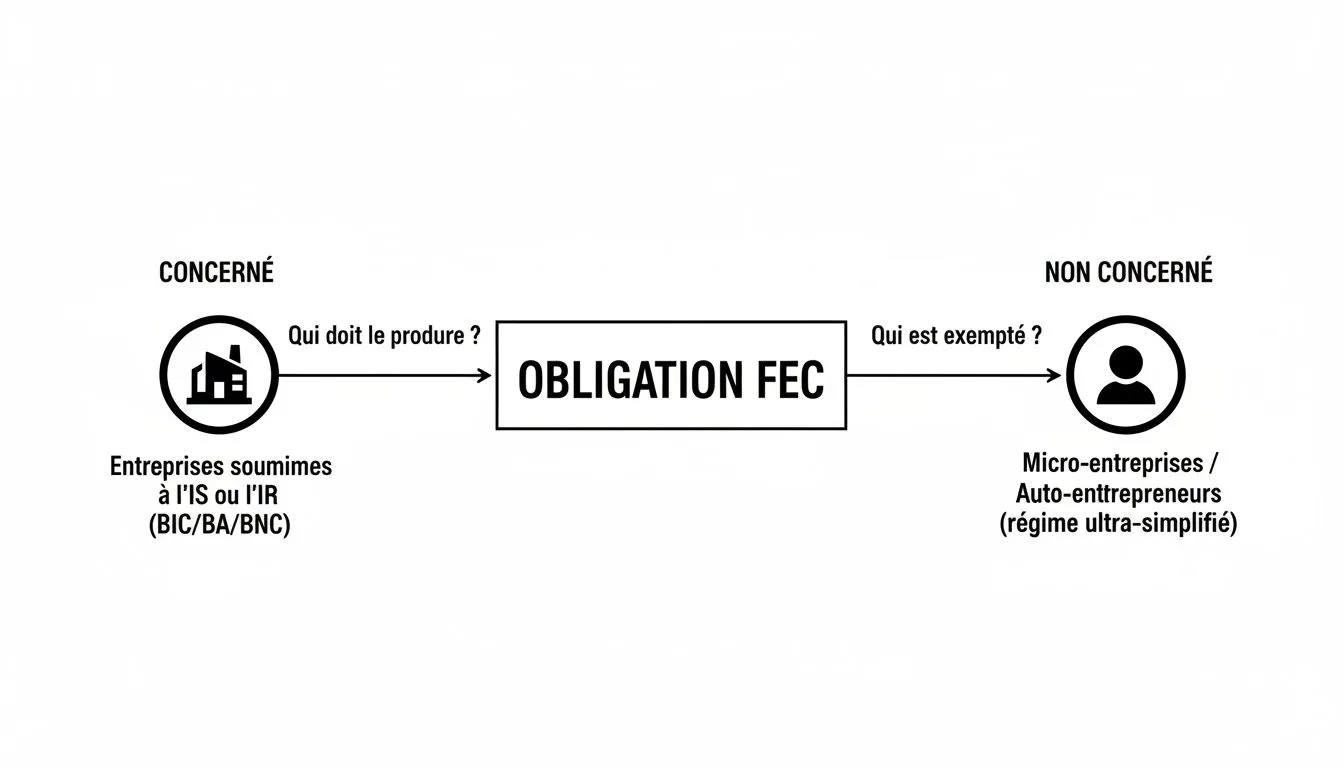
As you can clearly see, the tax regime really is the number-one criterion determining whether or not you must comply with this exercise.
The anatomy of an accounting entry in the FEC
Each line of your FEC file corresponds to a single accounting entry. And each entry is itself broken down into 18 well-defined fields. These fields must appear in the correct order, separated by a tab character. Believing you can piece all this together by hand in a spreadsheet is an illusion — it’s the surest way to produce a non-compliant file.
To make this more concrete, imagine a sale of €120 including VAT (i.e. €100 excluding VAT plus €20 of VAT) made on your Shopify store, paid by a customer via Stripe. A single, seemingly simple transaction will actually generate several lines in your FEC.
Here’s the breakdown of these famous 18 fields:
- JournalCode: The code of the journal used (e.g. “VT” for Sales).
- JournalLib: Its full name (e.g. “Sales Journal”).
- EcritureNum: The unique entry number (e.g. “VT-2023-00123”). It must follow a logical sequence.
- EcritureDate: The date of the operation, in
YYYYMMDDformat (e.g. “20231026”). Watch out, this is a classic trap! - CompteNum: The chart-of-accounts account number (e.g. “411000” for a customer account).
- CompteLib: The name of that account (e.g. “Customers”).
- CompAuxNum: The sub-ledger account number, if you use one for further detail (e.g. your customer’s internal code).
- CompAuxLib: The label for that sub-ledger account (e.g. the customer’s name).
- PieceRef: The reference of the supporting document. This is a crucial field that must make it possible to trace the origin of the entry. Think of the Shopify order ID or the Stripe transaction reference.
- PieceDate: The date of the supporting document, always in
YYYYMMDDformat. - EcritureLib: A clear description of the operation (e.g. “Shopify sale order #1050”).
- Debit: The amount posted as a debit.
- Credit: The amount posted as a credit.
- EcritureLet: The letter used for account lettering (reconciliation matching).
- DateLet: The date of that lettering, again in
YYYYMMDDformat. - ValidDate: The date the entry was validated.
- Montantdevise: The amount in the original currency, if it’s not the euro.
- Idevise: The code for that currency (e.g. “USD”).
A single poorly formatted or missing field is enough for the entire file to be rejected. The tax authorities use a dedicated tool,
Test Compta Demat, which scans the file and lets no structural anomaly through.
The major risk of manual management
Trying to compile this data by hand is a bit like trying to build a car from scratch with no plans or tools. The risk of error is enormous, and the consequences are very real. A single mistake in the FEC can turn into a tax reassessment worth thousands of euros. The DGFiP’s statistics speak for themselves: more than 15% of SMEs audited in 2022 ran into trouble at this level.
The FEC’s inflexible structure is precisely what makes automation not just convenient, but essential. A tool like Bizyness is designed to assemble this 18-piece puzzle for every transaction, automatically and reliably. That’s the guarantee of flawless compliance and, above all, real peace of mind.
To go further into accounting fundamentals, feel free to check out our article on the general ledger and examples.
Avoiding penalties linked to a non-compliant FEC
Knowing the financial risks tied to the FEC file is the best way to protect yourself against them. Let’s be clear: the tax authorities don’t take this obligation lightly. A missing, incomplete, or poorly formatted file can cost a business dearly, whether small or large.
The first penalty that hits when there’s a problem is a flat-rate fine.
If you fail to provide your FEC, or if the file provided is not compliant, the base penalty is a fine of €5,000 per audited financial year. Do the math: if the audit covers three years, the bill climbs fast.
But this fine is only the tip of the iceberg. The real danger is far more insidious.
Rejection of your accounts, the ultimate penalty
The most feared risk is what’s known as rejection of accounting records. If your FEC file is deemed unusable by the inspector, they may consider that your accounting isn’t “reliable evidence.” They are then entitled to disregard it entirely.
In practice, what does that mean? That the auditor will reconstruct your revenue and profits themselves. This procedure, known as “ex officio taxation,” is almost always to your disadvantage. Imagine facing a tax reassessment calculated on estimates, just because of a formatting error in a file…
And this isn’t a theoretical scenario. Penalties for poorly formatted FECs are becoming more and more common. In 2023, more than 25% of audits of small e-commerce businesses revealed anomalies in this file, according to DGFiP figures.
Financial penalties beyond the flat fine
If the rejection of your accounts leads to a tax reassessment, the penalties stack up. On top of the additional taxes you’ll have to pay, hefty surcharges are added.
Here’s what you’re exposed to:
- A 10% surcharge on the reassessed tax if you’re acting in good faith (for example, an FEC provided but non-compliant).
- A 40% surcharge for deliberate failure to comply.
- An 80% surcharge for fraudulent maneuvers, if the authorities prove you sought to hide income.
These figures make it clear: FEC compliance isn’t just a technical detail. It’s genuine insurance against financial risks capable of jeopardizing your business. Automating its generation is no longer a luxury but a strategic necessity for peace of mind.
For smooth management and rock-solid compliance, also remember to check that your business is in order on other regulatory fronts, such as publishing your legal notices. It’s this comprehensive approach that truly secures your business.
How to easily generate a 100% compliant FEC

Now that we’ve broken down the rigid structure of the FEC file and the heavy penalties that apply in case of error, let’s get practical. Concretely, how do you produce a flawless FEC without spending entire days on it, especially when running an online business?
Two approaches face off: the “old-school” method, often a source of headaches, and the automated approach, designed to give you total peace of mind. Let’s see why one looks like a risky bet and the other like real insurance.
The traditional method and its pitfalls
The first option, the most common one, is to rely on standard accounting software. On paper, the promise is simple: you export your data, and it’s done. But on the ground, especially for e-commerce, it’s a whole different story.
The core problem is that general-purpose accounting software isn’t designed to talk to platforms like Shopify, Amazon, or Stripe. Every sale, every transaction fee, every marketplace commission therefore has to be entered manually or imported via CSV files.
The danger is obvious: every manual step is an open door to error. An unfortunate copy-paste, a comma instead of a period, a forgotten supporting-document reference… and your entire FEC can be invalidated.
Verification then turns into a genuinely painstaking task. Everything has to be checked, line by line: the chronology, the numbering sequence, the exact match between entries and your platform statements. It’s a long, tedious, and terribly stressful process.
Automation: the solution built for e-commerce
Fortunately, faced with these challenges, a much more modern approach has emerged, specifically designed for web entrepreneurs. Tools like Bizyness turn this legal obligation into a simple formality. How? By tackling the problem at its source: collecting and organizing the data.
Rather than leaving you to juggle exports and manual entries, these platforms connect directly to your revenue and expense sources.
The process then becomes remarkably simple:
- You connect your platforms: In just a few clicks, you link your Shopify, WooCommerce, Amazon, Stripe, PayPal accounts, and more.
- The tool handles collecting and sorting everything: Every transaction is pulled in, analyzed, and converted into an accounting entry. Sales, fees, refunds, commissions — everything is handled automatically.
- Bank reconciliation is automated: The system checks that the generated entries match perfectly with your bank account movements. No transaction slips through the cracks.
- You generate the FEC in a single click: When the time comes, you just press a button to download a perfectly structured, complete, and compliant FEC file.
With this method, you eliminate nearly 100% of the human-error risk tied to manual entry. Compliance is no longer a goal to painstakingly chase, but the natural result of a fully automated process.
Saving time and ensuring rock-solid compliance
The first benefit that jumps out is, obviously, the time saved. What used to take hours of meticulous, stressful work now takes just a few minutes. You can finally refocus on what really matters: growing your business.
But the real advantage lies elsewhere. It’s the certainty of always being ready in the event of a tax audit. No more dread of having to produce that famous file within 15 days. Your FEC is there, available at any time, up to date, and guaranteed compliant. Bizyness even handles per-country VAT rates for your international stores (OSS/IOSS), ensuring a flawless FEC that will reassure your accountant or URSSAF. To dig deeper into the topic, feel free to explore the specifics of e-commerce accounting and see how automation addresses it.
Adopting an automated solution isn’t just a matter of convenience; it’s a strategic decision. It turns a complex legal constraint into a simple, secure process, protecting you from penalties and giving you a peace of mind that is priceless.
Get ready for a tax audit with a solid FEC checklist
To approach a tax audit without breaking a sweat, the best thing to do is put yourself in the inspector’s shoes. Your FEC file isn’t just a simple administrative archive; it’s the very first piece of evidence the tax authorities will scrutinize. By using a checklist, you can check the soundness of your own accounting yourself, well before anyone else does.
This proactive approach turns a potentially stressful obligation into a simple routine exercise. By focusing on the points auditors systematically check, you can spot and fix small errors before they turn into big problems.
The essential checkpoints for your FEC
An inspector doesn’t just check that the file exists. They’ll test its consistency, its logic — in short, its credibility. Your own audit should therefore focus on these same fundamentals.
Here’s a list of critical checks to carry out:
- The chronology of entries: Dates (
EcritureDate) must follow a logical sequence. A June invoice simply cannot appear before a March entry in the same accounting journal. That’s the absolute basics. - The perfect balance of entries: This is the golden rule. For every entry, the sum of debits must be strictly equal to the sum of credits. The slightest discrepancy, even a single cent, is a huge red flag for an auditor.
- Continuity of document numbers: Entry numbers (
EcritureNum) and document references (PieceRef) must follow one another without interruption. A “gap” in the numbering immediately suggests that an operation was forgotten or, worse, deleted. - Consistency with VAT returns: The VAT amounts (collected and deductible) recorded in your FEC must match exactly the figures you declared to the tax authorities. Any inconsistency will be scrutinized closely.
This rigor matters even more for businesses that sell online. A study by Insee showed that 40% of e-commerce micro-businesses exceed the VAT exemption thresholds without realizing it, due to approximate tracking of their entries. This exposes them to painful reassessments. To see how Bizyness simplifies this management, you can check out the solutions dedicated to e-commerce.
A very concrete test that inspectors love: comparing the balance of your bank account (the famous account 512) in the FEC with your actual bank statements. At the end of the financial year, the two figures must match down to the cent.
Automation, the key to effortless compliance
Reviewing all these points by hand is a huge task and an almost certain source of errors. This is precisely where automation changes the game.
A tool like Bizyness, for example, includes automated bank reconciliation. It constantly guarantees this perfect match between your accounting and the reality of your accounts. Every transaction is categorized and recorded automatically, which ensures sequence continuity and entry balance without you having to think about it.
By adopting a system that builds in these checks by default, you no longer really need to “prepare” for a tax audit: your accounting is, in effect, always ready. This frees your mind to focus on your business, knowing that your obligations — including the legal retention period for keeping your accounting records — are handled rigorously and without manual intervention.
Your questions, our answers about the accounting entries file (FEC)
Still have questions about the FEC? That’s completely normal. Here are clear answers to the most frequent questions we hear in the field.
Is the FEC mandatory for a micro-entrepreneur?
No, not as long as you’re under the micro-entrepreneur regime and benefit from the VAT exemption. The obligation to produce an FEC only applies to you if you exceed the thresholds of this regime or decide to opt for an actual taxation regime.
At what exact point do I need to provide the FEC?
The FEC isn’t a document to be sent spontaneously. You only need to produce it on request from the tax authorities, typically at the start of an audit. Watch out, time is short at that point: the deadline to provide it is often very tight, generally just 15 days after receiving the audit notice.
My accountant handles it, am I really affected?
Yes, absolutely. Even if you delegate the production of the file to your accountant, as the business owner you remain the sole legally responsible party for the proper upkeep of your accounts. In case of a problem or FEC non-compliance, it’s your responsibility that will be on the line.
What about payment flows like Stripe or PayPal?
This is a crucial point and a frequent source of error. All transactions that go through platforms like Stripe, PayPal, or any other payment gateway must be scrupulously detailed in your FEC. Every sale, but also every commission or fee taken by the platform, constitutes an accounting entry. Forgetting these flows is a direct cause of file invalidation.
Turning this complex obligation into a simple formality is possible. Bizyness was built for exactly that: the tool automates the collection of all your sales flows and generates a fully compliant FEC in a single click.
Discover how to secure your accounting today on Bizyness.fr.
