

 Français
Financing Your Working Capital Requirement: Strategies to Boost Your E-Commerce Business
Learn how to finance your e-commerce working capital requirement with concrete methods to optimize stock and receivables, without relying on banks.

Finding funds for your working capital requirement (WCR) is like fueling the engine of your e-commerce business. It’s what lets you pay your suppliers and stock up before you’ve even collected the money from your customers. Ignore this gap, and you risk running dry, even if your store is thriving.
Why WCR is a matter of survival for your e-commerce business
The working capital requirement isn’t just an accounting concept. It’s the true financial pulse of your business. To put it simply, imagine the journey of one of your products. First, you pay to buy it. Then, it sits in storage, and while it does, your money “sleeps” on a shelf. Finally, you sell it, but you still have to wait for Stripe, Amazon, or another payment service to transfer the funds to you.
This constant gap between your spending and your collections creates a cash hole that needs to be filled continuously. That’s the WCR. It’s the money you have to advance, day after day, to keep the machine running.

The danger of underestimating your WCR
Believing that strong sales are enough is a classic mistake. A spike in orders can even, paradoxically, make your problems worse. More sales means more stock to buy, so more money to advance. Your financing need explodes. It’s a trap that has cost many promising online sellers dearly.
The current context no longer forgives this kind of oversight. The numbers speak for themselves, and the trend is worrying:
- The average WCR in France jumped by +8 days in 2025, after a +5 day increase in 2024.
- According to the Banque de France, 25% of business failures are directly linked to cash flow issues, often worsened by late payments.
- With more than 68,000 business failures expected in 2026, planning ahead for WCR financing is no longer optional — it’s a necessity.
Ignoring your WCR is like flying blind through a storm. You can have the best product and a rock-solid marketing strategy, but without cash, you’re headed straight for a wall.
WCR, a barometer of your performance
Far from being a mere constraint, tracking your WCR is actually an excellent indicator of your operational health. A WCR that’s climbing fast? That’s often a sign that your stock is moving slowly or that your collection times are stretching dangerously. Conversely, if your WCR is shrinking or turning negative, congratulations: your management is excellent and you’re financing your growth with your own business.
For an online seller, rigorous cash flow management is therefore key. Tools like Bizyness can give you this real-time visibility, turning financial anxiety into a genuine strategic lever. They help you anticipate dips, optimize your cycles, and make the right decisions well before a cash shortage becomes critical.
Calculating your WCR: the numbers behind your cash flow
Enough theory, let’s get practical. To truly master your cash flow and find the right financing, the first step is to measure your Working Capital Requirement (WCR). Let’s forget complex formulas; the logic is actually quite simple and rests on three pillars you manage daily in your e-commerce business.
The basic formula is this: WCR = Inventory + Accounts Receivable – Accounts Payable
Each of these items represents money that is either tied up, expected, or owed. It’s this gap that creates a cash need (or surplus). Our goal is to turn these sometimes abstract numbers into a real management tool.

The 3 key components of your WCR, up close
To calculate your WCR, you simply need to isolate the value of these three accounts at a given point in time, for example at the end of each month. It’s an excellent habit to build.
-
Inventory: the money sleeping on your shelves. This is simply the purchase value of all the products you have in stock but haven’t sold yet. For an online seller, this is often the crux of the matter. Too much stock means blocked cash that could be used to fund your marketing or launch a new product. To go further on this point, I recommend taking a look at our guide on inventory turnover rate, a vital indicator for optimizing this item.
-
Accounts receivable: money that’s yours, but not yet in your pocket. This covers all amounts invoiced but not yet collected into your bank account. If you sell on Amazon, it’s the money Amazon holds before transferring it to you. If you run a Shopify store, it’s the amounts in transit with Stripe or PayPal, which take a few days to arrive.
-
Accounts payable: the money you owe. This item covers all the invoices you haven’t yet paid: your product suppliers, of course, but also your marketing agencies, logistics costs, or hosting fees. Paradoxically, these debts are a free source of short-term financing.
If your WCR is positive, it means you have a financing need: your uses of funds (inventory, receivables) are higher than your resources (payables). Conversely, a negative WCR is excellent news. Your business model generates a cash surplus, which means your growth is self-financing.
WCR in action: examples across e-commerce models
WCR isn’t a universal figure; it depends heavily on how you sell. To really understand how these three items interact, nothing beats comparing a few typical scenarios.
The table below highlights the differences in WCR across three common models: a D2C brand, a marketplace seller, and a software publisher.
| WCR item | Shopify Store Example (D2C) | Amazon FBA Seller Example | SaaS Publisher Example (Subscriptions) |
|---|---|---|---|
| Inventory | €50,000 (purchasing collections ahead of time) | €25,000 (stock sent to Amazon) | €0 (intangible product) |
| Accounts receivable | €5,000 (2-3 day Stripe delay) | €15,000 (Amazon pays every 2 weeks) | €2,000 (recurring payments via Stripe) |
| Accounts payable | €20,000 (manufacturers paid at 30 days) | €5,000 (near-instant supplier payments) | €3,000 (monthly costs: servers, software) |
| WCR calculation | €35,000 | €35,000 | -€1,000 |
As you can see, the D2C store and the FBA seller have the same €35,000 need, but for very different reasons. One is weighed down by high inventory, the other by Amazon’s payment delays combined with demanding suppliers.
The software seller, on the other hand, is in an ideal situation with a negative WCR of €1,000. Their customers pay in advance (via subscriptions) for a service whose costs are settled later. It’s a model that naturally generates cash.
These examples make it clear: calculating your WCR is the best diagnostic you can run. It immediately reveals your weak points and tells you where to focus your efforts. Should you reduce inventory? Speed up collections? Or renegotiate payment terms with your suppliers? The answer lies in these numbers.
Analyzing traditional banking solutions
When your WCR calculation shows a positive number, the first, almost automatic, reflex is to turn to your bank. It’s the most classic and well-known route to finance your working capital requirement. Banks do have an arsenal of short-term solutions that, on paper, seem tailor-made to fill a temporary cash gap.
These options act as financial patches. They’re designed to give you an immediate breather when the gap between your outflows and inflows becomes too uncomfortable.
Authorized overdraft and cash facility
The authorized overdraft is probably the most common solution. Concretely, it’s a line of credit your bank grants on your business account, allowing you to go into the red up to a certain ceiling. The cash facility is a cousin of the overdraft, but designed for even shorter needs, typically around two weeks per month at most.
The big advantage? Once set up, it’s simple and fast. But watch out for the downsides, because they’re significant:
- Costs that sting: Overdraft interest can climb quickly and eat into your profitability, especially if the overdraft becomes a fixture.
- Almost systematic personal guarantee: Your banker will very often ask you to act as personal guarantor. If the company fails, your personal assets are on the line.
- A false sense of security: The overdraft acts like a painkiller. It relieves the pain (lack of cash) without ever treating the cause, and can create a very costly dependency.
Short-term cash credit
Another option on the bank’s shelf: cash credit. It’s a dedicated loan, rarely exceeding one year, to finance a clearly identified need. For example, buying a large stock ahead of the year-end holiday season.
Unlike an overdraft, the amount and term are set in advance. The interest rate is often more attractive, but setting it up is more laborious. You need to put together a solid file, and your banker will scrutinize your financial statements.
Let’s be clear: these traditional solutions are often a band-aid on a wooden leg. They meet an urgent liquidity need but never tackle the root of the problem: an operating cycle that creates a structurally too-high WCR.
Banks’ caution toward the e-commerce model
The real obstacle for us online sellers is that traditional banks have a hard time understanding our business models. A 100% digital business, sometimes with dematerialized inventory or heavy dependence on giants like Amazon, is often seen as volatile and risky. Their analysis grid simply isn’t suited to it. Looking for tips to better negotiate with your account manager? Our comparison of business banks can help you prepare the ground.
This wariness isn’t just an impression — the numbers confirm it. A recent study on business financing highlights a notable tightening. While 96% of SMEs get their investment credit approved, that rate drops to 85% for cash credit — precisely the kind needed to finance WCR. And with rising interest rates, the cost of this financing weighs more and more heavily. To dig deeper into the topic, you can consult the full data on business financing.
To sum up, while bank solutions can help in an emergency, they rarely form a viable strategy for financing e-commerce growth. They’re expensive, hard to obtain, and don’t solve anything at the root. Fortunately, the world of finance has evolved, and alternatives far better suited to our businesses now exist.
Discovering alternative financing built for e-commerce
Let’s be honest: for many digital businesses, the door to traditional banks often stays closed. Fast, intangible digital business models don’t always fit neatly into classic risk-analysis boxes. Fortunately, the world of finance has evolved, and new, far more agile solutions have emerged specifically to finance the WCR of online sellers.
Unlike a bank loan, which relies on past financial statements and physical collateral, these modern financing options speak your language. They analyze what really matters for your business: your sales flows, your ad efficiency, your customer loyalty. They’re designed to understand digital growth, not slow it down.
Let’s look together at the most relevant options available to you, well off the beaten banking path.
Revenue-Based Financing (RBF): a growth partner
Revenue-Based Financing (RBF) is probably the most interesting innovation for online businesses. The principle is simple: you receive a cash advance, and you repay it by paying back a small percentage of your future revenue, until the amount is settled.
It’s the perfect solution for financing expenses that directly drive growth, such as buying stock ahead of a big season or increasing your advertising budget.
The strengths of RBF are clear:
- Speed: Your file is analyzed by connecting your tools (Shopify, Stripe, your ad accounts…). Financing can hit your account in 48 to 72 hours.
- Flexibility: Repayments follow the pace of your business. A slower sales month? Your payment drops. A spike in activity? You repay faster, with no penalty.
- No capital dilution: You don’t sell any shares of your company. You keep 100% control. A non-negotiable point for many founders.
RBF isn’t a loan, it’s a partnership. The financier bets on your future success, which fully aligns their interests with yours. It’s a real paradigm shift compared to a bank, which focuses above all on risk.
This very simple decision tree sums up the first choice you need to make: seek external financing or optimize your own processes.
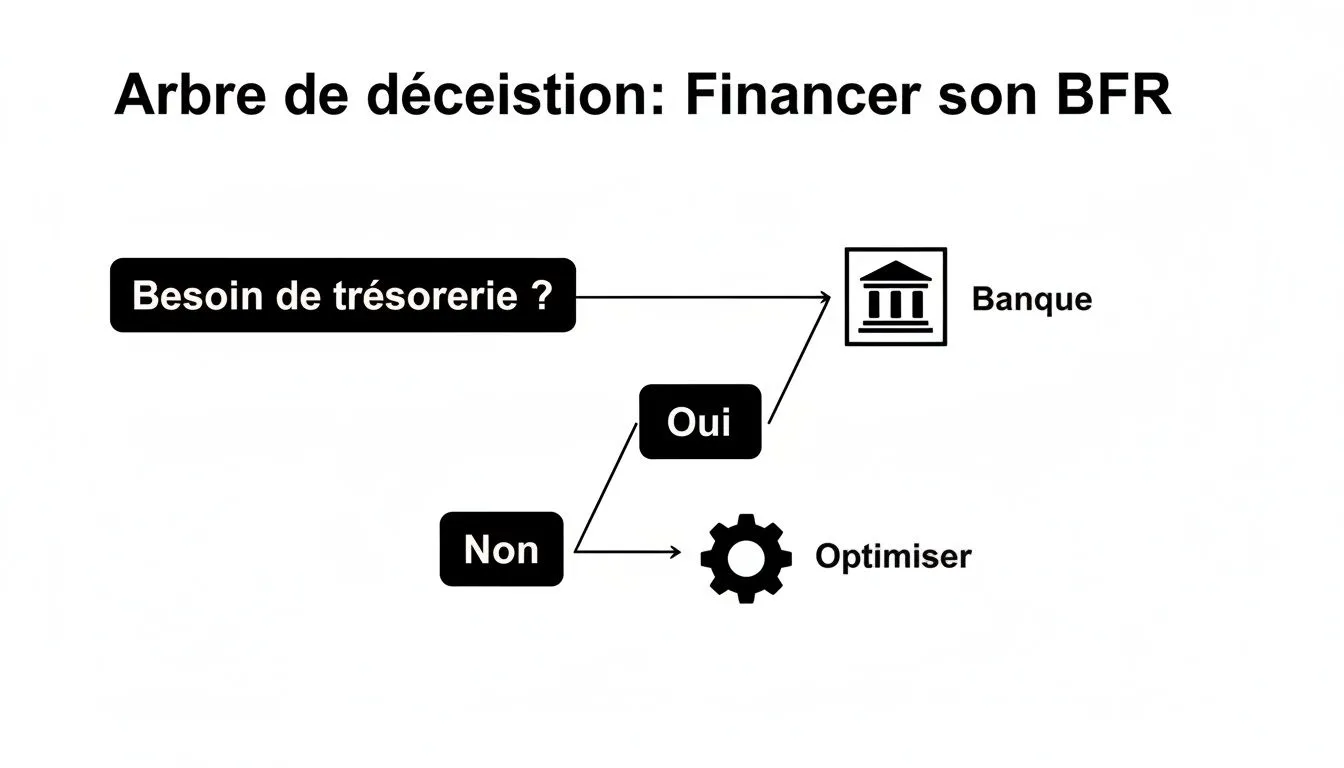
As this diagram shows, before even thinking about financing, you should ask yourself whether you can first optimize your management internally.
Invoice factoring: turn your invoices into cash
Better known, factoring has also been modernized for e-commerce. The concept: you sell your outstanding invoices to a specialized company, the “factor.” In return, it immediately pays you a large portion of their value, often between 80% and 95%.
The factor then takes care of collecting the money from your customer. Once payment is received, it returns the balance to you, minus its fee. For an online seller selling on marketplaces that impose payment terms of 14 days or more, it’s a very concrete way to speed up cash inflows.
It’s the solution to consider if your WCR is weighed down by large accounts receivable and stretching payment terms.
Crowdlending: the strength of the collective
Crowdlending, or peer-to-peer lending, is another avenue. Here, you’re not addressing a single entity, but a community of lenders (individuals and businesses) via a dedicated online platform.
This approach is particularly well suited to financing a specific, clearly identified project: buying a large stock for a new collection, for example, or launching an ambitious marketing campaign.
The process is often a bit longer than RBF, since you need to present a solid file to convince the community of lenders. The advantage is that rates can be competitive. It’s also excellent PR for your brand.
To help you see things more clearly, here’s a table summarizing the characteristics of each solution.
Comparison of WCR financing solutions
| Solution | Estimated cost | Setup speed | Ideal for… | Main drawback |
|---|---|---|---|---|
| Factoring | 2% to 10% of invoice amount | 1 to 2 weeks | B2B online sellers or those selling on marketplaces with payment delays. | Cost can become high if used continuously; not always suited to direct B2C. |
| Bank credit | 2% to 6% annual interest | 1 to 3 months | Established businesses with a solid financial track record and a predictable need. | Slow process, requires personal guarantees and isn’t very flexible for rapid growth. |
| Revenue-Based Financing (RBF) | Fixed fee of 6% to 12% on the amount advanced | 48 to 72 hours | Growing DNVBs and online sellers who want to finance their inventory and advertising. | Cost is slightly higher than a traditional bank loan, but without the constraints. |
| Crowdlending | 5% to 10% annual interest | 2 to 4 weeks | Financing a specific project (new collection, expansion) by rallying a community. | Requires a communication effort; the success of the fundraising isn’t guaranteed. |
Each solution therefore has its pros and cons. There’s no “best” choice in absolute terms — only the choice most relevant to your current situation, the urgency of your need, and your long-term vision.
Your action plan for reducing WCR without financing
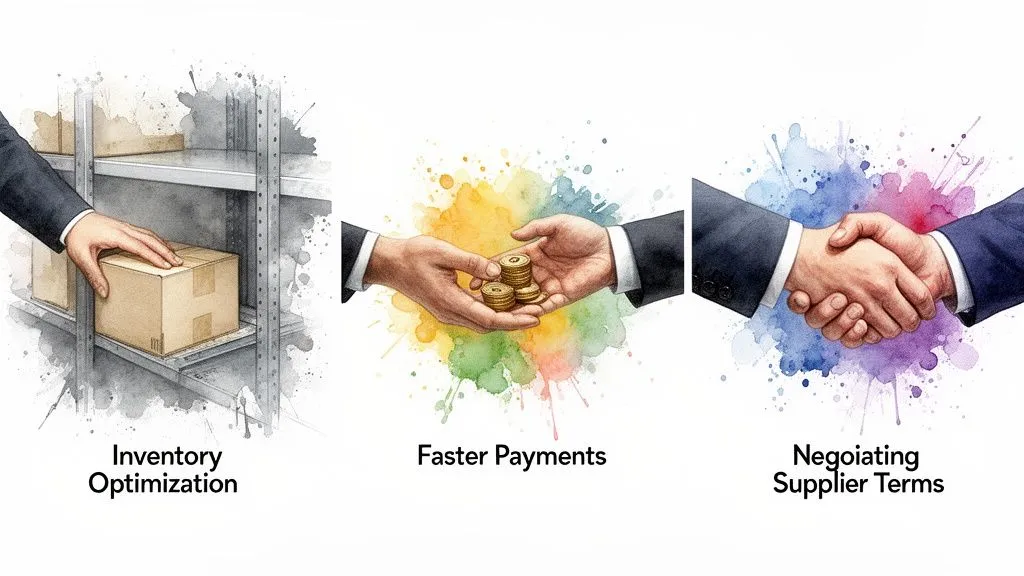
Before even thinking about seeking outside funds to finance your WCR, the first, healthiest and most profitable step is to reduce it at the source. It’s an offensive approach that will solidify the financial foundations of your e-commerce business for good. By acting directly on the components of your WCR, you truly take back control of your cash flow.
This action plan revolves around three concrete levers you can activate today. Each one aims to narrow the gap between your outflows and inflows, easing the pressure on your cash flow.
Lever 1: Speed up customer collections
The money your customers owe you is the most direct fuel for your business. Every day gained on this payment delay mechanically reduces your WCR. For an online seller, it all comes down to optimizing the checkout funnel and being rigorous with follow-ups.
Here are several tactics to deploy:
- Choose your payment processors carefully: Don’t stop at fees. What matters most is how long it takes for funds to be transferred to your account. Platforms like Stripe transfer money in 2 to 3 days, which is infinitely better than the 14 days (or more) imposed by some marketplaces.
- Offer an early payment discount: If you operate in B2B, offering a small discount, around 1% to 2%, for payment within 10 days instead of 30 can work wonders. The cost of this discount is often much lower than that of financing.
- Automate invoicing and follow-ups: A management tool like Bizyness lets you generate and send invoices as soon as an order is confirmed, with no delay. It can also automate reminders for unpaid invoices, a time-consuming but vital task for keeping your WCR under control.
The deterioration of WCR is a real weight on competitiveness. Recent sector studies show alarming customer payment delays (DSO), reaching 72 days in healthcare or 68 days in construction. For online sellers, especially those selling internationally, this trend can quickly become a headache. It’s not for nothing that 45% of CFOs see WCR optimization as a strategic priority.
Lever 2: Optimize inventory management
For an e-commerce business selling physical products, inventory is often the main culprit behind an exploding WCR. It’s money sleeping on your shelves. Every unsold product is a missed opportunity and a drag on your cash flow.
Well-managed inventory is inventory that turns quickly. The goal isn’t zero stock, but having the right product, at the right time, in the right quantity.
To get there, focus on proven methods:
- Analyze your product performance (ABC method): Sort your SKUs into three groups. “A” products (roughly 20% of your catalog) generate 80% of your sales; never let those go out of stock. Conversely, “C” products are “dormant stock” dragging down your cash. Don’t hesitate to run aggressive promotions to clear them.
- Set a minimalist safety stock: Calculate the stock strictly needed to cover sales between two supplier orders, adding a small safety margin. “Precautionary overstocking” costs a fortune.
- Think lean flow or dropshipping: For some products, dropshipping can completely eliminate the “inventory” line from your WCR. For your own stock, negotiate more frequent but smaller deliveries with your suppliers. This will drastically reduce your average stock level.
Lever 3: Extend supplier payment terms
This is the third lever, and it’s often underestimated: use your accounts payable as a free source of financing. Getting longer payment terms from your partners is a remarkably effective technique for easing your WCR.
Of course, this needs to be handled tactfully so as not to damage your business relationships.
The key is negotiation and mutual trust. Here’s how to approach the topic:
- Show your reliability: A supplier will be much more open to discussion if you have a spotless payment history.
- Negotiate in exchange for larger volumes: If you plan to increase your orders, that’s the perfect argument for requesting an extension of terms from 30 to 45, or even 60 days.
- Be transparent: Explain to your key partners that this arrangement will help you better finance your growth — growth that will, in turn, benefit them too through larger orders.
In this action plan, don’t forget that implementing customer loyalty strategies is essential. Loyal customers generate predictable revenue, which greatly simplifies cash flow management and purchase planning.
By combining these three levers — faster collections, leaner inventory and extended supplier terms — you attack WCR at its root. Every small improvement on one of these items has a direct, positive impact on your available cash. A management tool like Bizyness will give you real-time visibility to measure the effect of your actions and continuously fine-tune your approach.
Your frequently asked questions about WCR in e-commerce
Financial management of an e-commerce site, and especially the concept of WCR, can quickly become a headache. To help you see things more clearly and run your business with confidence, here are concrete answers to the questions that come up most often on the topic.
What’s a “good” WCR for my e-commerce business?
We’d all like a simple answer, but the truth is it depends on your model. For an online seller managing their own inventory, a WCR representing between 15 and 30 days of revenue is generally a good health indicator. But more than the raw figure, it’s its stability that matters. Your goal? Keep it as low and as constant as possible.
If you’re in dropshipping or selling dematerialized products, the situation is different. A negative WCR is even an excellent sign. Concretely, it means your business generates cash before you even have to pay your suppliers. You’re financing your growth with your customers’ money.
What’s the real impact of marketplace payment delays on my WCR?
This is a crucial point. Transfer delays of 14 days or more, common among giants like Amazon or Cdiscount, can put you in a tight spot. Even if the customer has paid, the money isn’t in your account yet. It’s in transit.
This gap creates what’s called an account receivable and mechanically pushes up your WCR. You absolutely need to factor this delay into your cash flow forecast. It’s the only way to make sure you can pay your suppliers, your expenses and your salaries on time, without putting your cash flow in the red.
Money “sleeping” on a marketplace is an account receivable that weighs directly on your cash flow. For any seller on these platforms, it’s one of the items to watch like a hawk.
Is RBF a good idea for financing my inventory?
Yes, absolutely. Revenue-Based Financing (RBF) is a very relevant solution for financing a large inventory purchase or a big acquisition campaign. The major advantage is speed: you get the funds within a few days, without diluting your capital. Even better, repayments adjust to your actual revenue.
The downside is that the cost is often higher than a traditional bank loan. RBF is therefore particularly well suited if you have a stable sales history and need cash quickly to seize a growth opportunity.
Concretely, how can a tool like Bizyness help me reduce my WCR?
A financial automation tool like Bizyness works on several levels to help you take back control. First, it speeds up your collections. Thanks to automated invoicing and tracking, you reduce the time your money spends “out there” and thus the weight of your accounts receivable.
Next, it gives you a clear, real-time view of what your customers owe you and what you owe your suppliers. This visibility is key to negotiating better payment terms and making the right decisions. Finally, clean, up-to-date financial data is a huge credibility boost when you go talk to financiers.
Take back control of your WCR and secure the financial management of your e-commerce business. Bizyness automates your accounting to give you a clear view of your cash flow and save you precious time. Discover how Bizyness can transform your financial management today.
