

 Français
Flat-rate income tax payment (versement libératoire): pros and cons for e-commerce in 2026
Discover the complete guide to the pros and cons of the flat-rate income tax payment in 2026. Simplify your taxes and optimize your tax bill as an online seller.

The flat-rate income tax payment (versement libératoire) is essentially the “all-in-one” tax option for micro-entrepreneurs. Its purpose? To simplify your life by merging your income tax and social contributions into a single payment, made every month or every quarter.
The benefit in terms of visibility is huge: you know exactly what you owe and when. But be careful, there’s a flip side. This payment is calculated on your revenue, not your profit. In other words, you pay tax even if your business isn’t profitable.
Understanding the flat-rate income tax payment for your e-commerce business

To really grasp it, imagine no longer having to worry about the big annual tax return and the potential unpleasant adjustment that comes with it. With the flat-rate payment, everything is bundled together. Every time you declare your revenue to URSSAF, a fixed percentage is applied, and that’s it. The tax is paid, the matter is settled.
You pay your taxes as you go, as you collect sales from your store. This approach is very popular with sellers on Shopify, Amazon, and other platforms, because it offers peace of mind and a clear view of available cash flow. No more nasty tax surprises a year later.
How does it actually work?
The principle is simple: a rate specific to your type of activity is added on top of your usual social contributions.
- Sale of goods (relevant to most e-commerce sellers doing buy-resell): you add 1% to your contributions.
- Commercial services (BIC): the rate is 1.7%.
- Non-commercial/professional services (BNC): it rises to 2.2%.
This percentage is applied to the gross revenue collected, meaning the money paid by your customers before even deducting Stripe or PayPal fees. To dig deeper into this topic, our guide on micro-entrepreneur taxation breaks down all these mechanisms.
But be careful, this option isn’t available to everyone. To qualify, you must meet an income condition: your reference tax income from two years ago (N-2) must not exceed a certain threshold.
The key point to remember: The flat-rate income tax payment is not a magic recipe for paying less tax. It’s above all a simplification tool. Its real value depends on your personal situation, particularly on whether you’d be taxable or not under the standard tax regime.
To make things clearer, the table below summarizes the rates and thresholds to know for 2026.
Rates and thresholds of the e-commerce flat-rate income tax payment in 2026
This table summarizes the key information to quickly understand your eligibility and the financial impact of this option.
| E-commerce activity type | Flat-rate payment rate | Revenue cap (Micro-BIC) | Reference tax income condition (N-2) |
|---|---|---|---|
| Sale of goods | 1.0% | €188,700 | Below €29,315 per family quotient share |
| Services | 1.7% | €77,700 | Below €29,315 per family quotient share |
These figures are the basis for assessing whether this option is relevant for you. It’s crucial to carefully check your reference tax income (RFR) from year N-2 to confirm you’re within the limits.
The real benefits for your online store

If you had to remember just one thing, it would be this: opting for the flat-rate income tax payment means choosing simplicity and predictability. And for an online seller, that benefit is anything but a minor detail. It can literally transform your day-to-day management, especially in the early years when every minute and every euro counts.
The number one advantage is, without question, perfect visibility over your cash flow. No more dreading the tax adjustment that lands the following year, often at the worst possible moment. Here, a fixed rate is applied to the revenue you’ve actually collected. So you know exactly what you owe, down to the cent, every month or every quarter.
This visibility changes everything. It lets you manage your ad budget, handle your inventory, or plan investments with a peace of mind you wouldn’t otherwise have. Instead of setting money aside “just in case,” you pay your taxes as you go. Your tax outflows are perfectly aligned with your cash inflows.
A radical administrative simplification
The second direct benefit is real relief for your mental load. Micro-entrepreneur taxation is already designed to be simple, but the flat-rate payment takes it even further.
- A single declaration, a single payment: You settle your social contributions and income tax in one go. A huge time saver!
- Automatic calculations: URSSAF calculates the exact amount due when you file your revenue declaration. No need to run complex simulations to anticipate your annual tax bill.
- Less risk of error: By simplifying the whole process, you drastically reduce the risk of making a mistake, missing a deadline, or facing penalties.
When you’re handling hundreds of transactions through Shopify or Stripe, this simplicity becomes essential. It frees up valuable time you can put toward marketing, customer service, or product development.
A potential tax optimization
But simplicity isn’t everything. The flat-rate income tax payment can also become a genuine strategy for optimizing your taxes, provided you run the numbers carefully. It’s particularly interesting if your household is already in a 30% or higher tax bracket under the standard scale.
Why? Because the flat rate applied to your e-commerce activity (1% for the sale of goods) can turn out to be much lower than the rate you’d be taxed at after the standard allowance under the micro-tax regime. In plain terms, you could end up paying less tax.
The calculation is key: The appeal of the flat-rate income tax payment isn’t universal. It all depends on comparing what you’d pay with this option versus what you’d pay under the progressive tax scale. Running a simulation is essential to make the right choice.
That said, even if you’re only lightly taxed, the peace of mind that comes from regular, predictable payments can be worth it. Better to pay a little each month than a lump sum all at once. To get a clearer picture, our guide on calculating charges as a sole trader details this mechanism in full.
Automation for your peace of mind
One often-underestimated advantage is how well this system lends itself to automation. And that’s where tools like Bizyness come into play. Imagine syncing all your sales channels (Shopify, Amazon…) and payment methods (Stripe, PayPal) with a single management platform.
The flat-rate income tax payment (VFL) is a major asset for micro-entrepreneur online sellers in France, as it unifies income tax and social contributions into a single payment. Introduced in 2019, it eliminates the unpleasant surprises of the annual tax return. To qualify in 2024, the household’s reference tax income (RFR) must not exceed a certain threshold, such as €27,478 for a single person, a condition detailed on business-creation support platforms. Read the complete guide on the topic by Bpifrance Création to check your eligibility.
Bizyness turns every sale into data ready to be declared. The software calculates the amount due for the flat-rate payment on your behalf, generates the corresponding accounting entries, and prepares your URSSAF declaration without you having to lift a finger. This automated compliance ensures stress-free, error-free tax management, so you can focus on what really matters: growing your store.
The drawbacks and pitfalls to avoid
While the flat-rate income tax payment is appealing for its apparent simplicity, you need to stay alert. It hides some significant drawbacks that can turn into real financial traps for an online seller. Ignoring them means risking paying more tax than necessary, or even paying tax when you shouldn’t owe any at all.
It’s therefore crucial to understand the flip side before taking the plunge.
The main flaw, and the most dangerous one, is its calculation basis. With this option, your tax is deducted from your collected revenue, not your actual profit. In other words, all your expenses — customer acquisition costs, logistics fees, stock purchases — are completely ignored by the tax authorities.
You could therefore end up paying tax even if your online store is running at a loss. This is unfortunately a common situation in e-commerce, where margins can be thin and where you need to invest heavily in advertising to drive sales.
The risk of paying tax when you wouldn’t otherwise be taxable
This is one of the most common pitfalls. It affects micro-entrepreneurs who, under normal circumstances, aren’t taxable. Under the standard regime, after the flat-rate allowance, if your income falls within the 0% bracket of the tax scale, you logically pay no income tax at all.
But by opting for the flat-rate payment, you voluntarily start being taxed from the very first euro collected. So you end up paying tax you should never have owed.
This is the whole paradox of this option: in seeking simplicity, a non-taxable entrepreneur can end up increasing their tax burden. The golden rule is therefore to always simulate your tax bill under the standard regime before opting for the flat-rate payment.
When your expenses make the option less attractive
The standard micro-tax regime grants you a flat-rate allowance for your expenses. For the sale of goods, this allowance is 71%. In practice, the tax authorities assume your expenses represent 71% of your revenue.
If your actual expenses (product purchases, Facebook Ads, platform commissions, etc.) exceed this percentage, the micro-tax regime is already less attractive than the standard (“réel”) regime. But with the flat-rate payment, it’s even worse: the tax applies to 100% of your revenue, with no allowance at all.
Let’s take an example to make this clearer:
- Activity: Online sale of products.
- Annual revenue: €50,000.
- Actual expenses (purchases, ads, etc.): €40,000, or 80% of revenue.
Your actual profit is only €10,000. Yet with the flat-rate payment, you’ll pay tax of €500 (€50,000 x 1%). This amount directly eats into a margin that’s already thin.
The impact on your tax credits and reductions
Another point to watch concerns your personal tax benefits. Income from your micro-entreprise that’s subject to the flat-rate payment is, in a sense, “taken out” of your household’s standard income tax calculation.
The consequence? You can’t offset your tax credits or reductions (for childcare, donations, rental investments…) against the portion of tax already paid through the flat-rate payment. If you rely on these mechanisms to reduce your overall tax bill, the option may cancel out some of their benefit.
Note that even though you don’t pay tax on it a second time, your revenue is still factored in when calculating your household’s average tax rate. This can push up the tax paid on the rest of the household’s income, such as your spouse’s salary.
Finally, VAT can add complexity. If you cross the relevant thresholds, you’ll need to manage it in parallel. You’ll continue paying the flat-rate payment on your revenue excluding VAT. To fully understand this mechanism, feel free to read our guide on exceeding the VAT threshold as a sole trader.
Making the right choice for your situation
Deciding whether or not to opt for the flat-rate income tax payment is one of the most decisive tax decisions for your e-commerce business. It’s not about finding the “right” or “wrong” option, but about selecting the smartest strategy for your personal and financial situation. The answer isn’t found in a manual, but in a concrete analysis of your business and your household’s tax profile.
To see things clearly, you need to put on your financial detective hat. What clues should you follow? Your revenue projections, your actual margins, and above all, your situation regarding income tax. A wrong turn can cost you dearly, either by paying tax you didn’t owe, or by missing out on a real optimization.
The goal is simple: identify your “tax break-even point.” That’s the tipping point where the flat-rate payment becomes more advantageous than standard taxation.
Checking your eligibility: an essential step
Before pulling out the calculator, the very first thing to do is confirm your eligibility. Without this validation, any simulation would be a waste of time. The main condition, and often the most misunderstood, concerns your reference tax income (RFR).
You need to refer to your household’s RFR from two years ago (year N-2). For example, for a request in 2025, you’d need to look at your 2024 tax notice, which covers your 2023 income. And to opt for the flat-rate payment in 2026, it’s the 2024 RFR that will be taken into account.
For 2026, the threshold is set at €29,315 per family quotient share. In concrete terms, this gives:
- For a single person (1 share): your N-2 RFR must be below €29,315.
- For a couple with no children (2 shares): the household RFR must be below €58,630.
- For a couple with two children (3 shares): the threshold rises to €87,945.
If you exceed this threshold, even by one euro, the option is closed to you. It’s a binary criterion, with no wiggle room.
Calculating your tax break-even point
This is where it all comes down to. Analyzing the “pros and cons of the flat-rate income tax payment” often boils down to this calculation. You simply need to compare what you’d pay under each of the two scenarios.
Scenario 1: Standard micro-tax regime
- Take your projected annual revenue.
- Apply the flat-rate allowance of 71% (for the sale of goods) to get your taxable income.
- Add this amount to your household’s other income (salaries, property income…).
- Apply the progressive income tax scale to this total to find the amount of your tax.
Scenario 2: Opting for the flat-rate income tax payment
- Take the same projected revenue.
- Apply the flat-rate payment rate: 1% for the sale of goods.
- The result directly gives you the amount of tax due for your e-commerce activity.
Comparing these two results is what will give you the answer. If the amount from Scenario 2 is lower than that of Scenario 1, then the flat-rate income tax payment is financially more advantageous for you.
The infographic below offers a simple decision tree to quickly visualize whether the option is relevant, based on your tax situation and your margins.
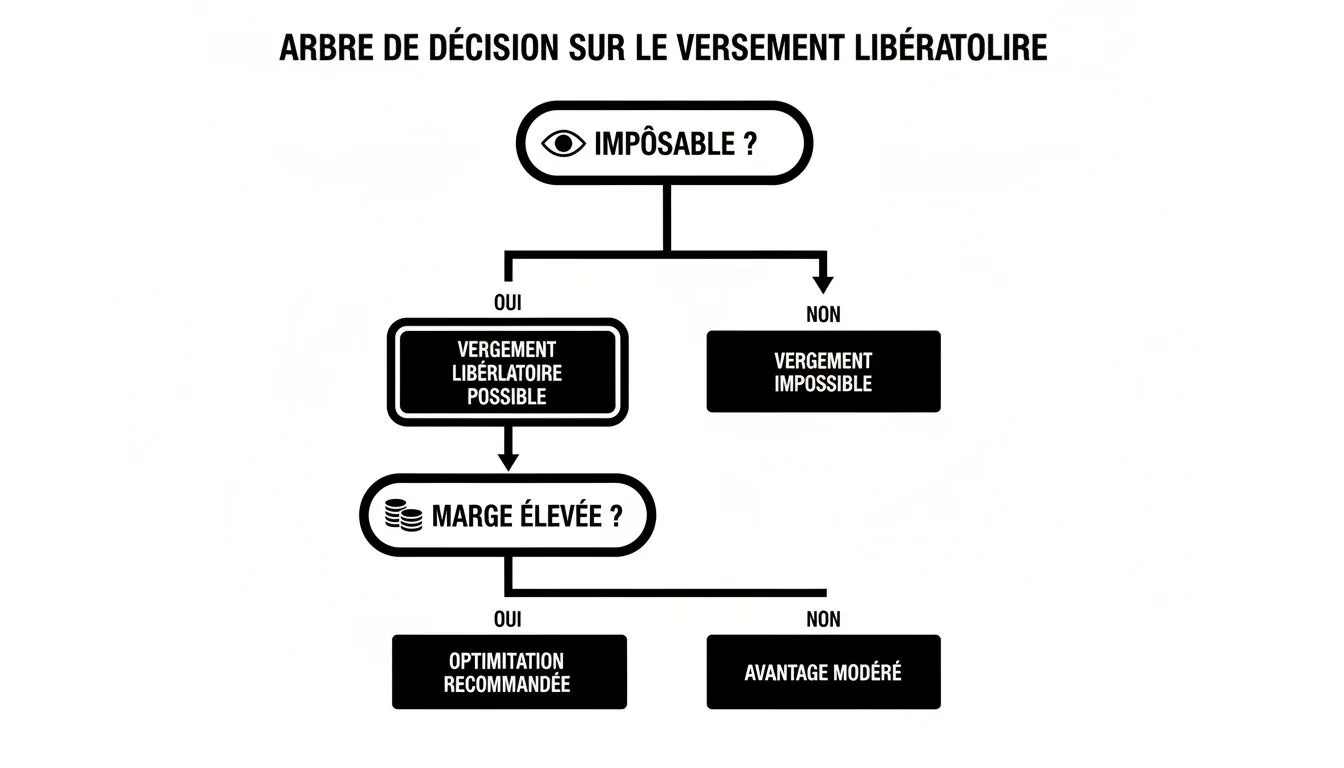
This decision tree highlights an essential point: the flat-rate income tax payment is above all an opportunity for online sellers already taxed in the higher brackets who maintain comfortable margins.
Activating or leaving the flat-rate income tax payment: how and when to do it
Choosing the flat-rate income tax payment, or on the contrary opting out of it, is a decision that carries real weight in your e-commerce strategy. Fortunately, the process is simple, but be careful: it’s subject to very strict deadlines. Once the deadline passes, you’ll have to wait until the following year.
Whether you’re just about to launch or already booming, let’s look at how to manage this tax option without making mistakes.
Opting for the flat-rate income tax payment: the steps to follow
The timing of your request is crucial, as it determines when the flat-rate payment starts to apply. The process isn’t quite the same depending on whether you’re setting up your business or it’s already running.
1. When creating your micro-entreprise
This is by far the simplest time. On the business start-up declaration form, a checkbox invites you to opt for the flat-rate income tax payment. A simple click, and you’re off to a good start from day one.
Forgot to check the box in the excitement of launching? No worries. You have until the last day of the third month following your business creation to correct it with URSSAF.
2. For a micro-entreprise already up and running
If your online store is already launched, you can of course still choose this option, but you need to plan ahead.
- Your request must be sent to your URSSAF (or CGSS) before September 30 of the current year.
- The change will only take effect from January 1 of the following year.
Watch out for the deadline! September 30 is a date to carve in stone. If your request arrives on October 1, it’s too late. You’ll have to wait another year for your choice to take effect.
How to go back and opt out?
Has your situation changed? Is the flat-rate income tax payment no longer as advantageous as before? No problem. You can go back to the standard micro-entreprise regime at any time. The process is the same as for opting in.
Simply send a message to URSSAF through the secure messaging in your online account to cancel the option.
- Deadline to do so: by September 30 at the latest.
- Effective date of the change: January 1 of the following year.
This reversal simply means you’ll go back to paying your income tax the following year (N+1), based on your annual tax return.
What does this actually change day to day?
Switching to the flat-rate income tax payment or moving away from it has a direct impact on your cash flow and how you handle your declarations. For an online seller already juggling Shopify, Amazon, or Stripe, automation isn’t a luxury — it’s a necessity to keep everything running smoothly.
This is where a tool like Bizyness comes into play. It connects to your platforms and instantly adapts to your tax regime. If you opt for the flat-rate payment, it automatically calculates the exact amount to pay to URSSAF, applying the right percentage to your social contributions. It prepares your declarations and gives you a clear view of the tax impact of every sale. No more calculation errors or oversights that can cost you dearly.
Bizyness: what if you automated your e-commerce taxes?

Weighing the pros and cons of the flat-rate income tax payment is one thing. Actually managing this option day to day is another, and it can quickly become a real headache. How can you be sure every declaration is accurate, that the right rates are applied, and that nothing has been overlooked? This is precisely where tax theory meets on-the-ground reality.
Rather than fighting with spreadsheets and manual calculations, a platform like Bizyness can turn this chore into a simple, reliable process. The goal is clear: to free you from administrative constraints so you can focus on what matters — growing your online store.
Centralization and error-free calculations
Bizyness’s principle is simple: it connects directly to your sales channels. Whether you sell on Shopify, Amazon, WooCommerce, or use Stripe for payments, the platform centralizes all your data in real time. No more manual entry and the errors that come with it.
Once everything is synced, the software takes over. It identifies the nature of each transaction (sale of goods or provision of services) and automatically applies the correct social contribution rate and the correct flat-rate payment percentage.
You no longer have to wonder whether it’s 1% or 1.7% that applies. The system does it for you, guaranteeing that every declaration is fully compliant.
This automation shields you from calculation errors that can lead to costly penalties. It secures your tax management and gives you peace of mind that’s simply priceless.
Complete visibility for better decision-making
Beyond the simple calculation, Bizyness gives you an instant view of what you owe. On your dashboard, you clearly see the exact amount to declare and pay to URSSAF.
This interface lets you view your key indicators at a glance. This way you can anticipate your social and tax charges for cash flow management with no nasty surprises.
With this level of clarity, you manage your business much more calmly, knowing your taxes are under control. No more waiting until the deadline to discover how much you owe. You anticipate, you plan, and you manage your cash flow with surgical precision. An administrative obligation then becomes a genuine strategic advantage for your e-commerce business.
Your questions, our answers on the flat-rate income tax payment
The flat-rate income tax payment, even when well explained, often raises very concrete questions. That’s normal! Let’s dive together into the questions that come up most often among online sellers, to give clear, practical answers.
The idea here is to give you the keys to making the right choices, without falling into the usual traps.
What revenue should I declare?
This is THE question every seller on platforms like Shopify or Amazon asks. The rule is simple: the revenue to declare is always the full amount your customer paid, before any deduction.
Fees charged by Stripe, PayPal, or Amazon’s service fees are business expenses. You should never deduct them from the revenue you declare to URSSAF. Think “gross collected.”
My spouse earns a good living — can I still opt for it?
That’s an excellent question that goes to the heart of the matter. To know whether you can opt in, only one figure matters: your household’s reference tax income (RFR) for year N-2. That’s the entry criterion, and nothing else.
Your spouse’s current salary therefore has no impact on your eligibility. However, it’s absolutely essential for calculating whether the option is worthwhile for you today. A high RFR two years ago can close the door to you, even if your household’s situation has changed since.
Remember: eligibility looks in the rearview mirror (RFR N-2), while profitability is calculated looking at the road ahead.
How does it work with VAT?
It’s essential to clearly separate the two. The VAT regime and the flat-rate income tax payment are two completely different things that don’t mix. It’s entirely possible to be on the flat-rate payment while also being liable for VAT.
If your activity leads you to exceed the VAT exemption thresholds, you’ll simply continue paying your flat-rate payment on your revenue excluding VAT. This requires solid bookkeeping so you don’t mix everything up.
What if I exceed the micro-entreprise thresholds?
Be careful, exceeding the thresholds during the year has immediate and significant consequences. If this happens, you fall out of the micro-tax regime from January 1 of the year the threshold was exceeded.
In practice, your flat-rate income tax payment option is canceled retroactively. All income for the year in question will be recalculated and taxed under the standard (“réel”) regime. Expect a substantial tax adjustment the following year.
Navigating between these different rules, especially once VAT gets involved, can quickly become a headache. Bizyness is precisely here for that. The platform automates all these calculations for you: it applies the right rates, prepares your URSSAF and VAT declarations, and guarantees you stay compliant without spending your nights on it. Discover how Bizyness can secure the management of your e-commerce business.
