

 Français
GoCardless: what is it and how it simplifies your payments
Discover what GoCardless is and how this solution automates your recurring payments and subscriptions, saving you time.
So, what exactly is GoCardless? Picture a payment solution built specifically for businesses that rely on recurring revenue, such as subscriptions or monthly billing.
Its role is to simplify and automate direct bank debits. Forget expired cards, unexpected payment failures, and hours spent chasing customers. GoCardless takes care of it all.
A different way to think about collections
Most online payment systems, like credit cards, work on a “push” model. That is, the customer has to actively “push” money to your business at each due date.
GoCardless flips this logic. Through a “pull” debit system, you “pull” the payment directly from the customer’s account on an agreed date. Everything relies on a single authorization known as the direct debit mandate. Once your customer has approved this electronic mandate, that’s it. You’re free to collect future payments on your own.
Why is this a real game-changer?
Historically, setting up direct debit was an administrative obstacle course, often reserved for large companies. GoCardless has made this system accessible to everyone, with striking ease.
For businesses, the benefits are immediate:
- Far fewer payment failures. An IBAN is stable, unlike a bank card that can expire, be lost, or stolen.
- More predictable cash flow. No more waiting for a transfer or hoping the card goes through. Funds are collected on the date you set.
- A huge time saving. Automation puts an end to manual invoice tracking and chasing unpaid bills.
For a SaaS business, a gym, or a subscription box service, this approach isn’t just a nice-to-have. It’s a strategic asset that directly reduces involuntary churn and stabilizes revenue.
To better visualize the differences, here’s a quick comparison highlighting why direct debit via GoCardless is so well suited to recurring revenue.
Quick comparison of payment methods
| Criteria | GoCardless (Direct Debit) | Credit Card | Manual Transfer |
|---|---|---|---|
| Payment initiative | Merchant (“Pull”) | Customer (“Push”) | Customer (“Push”) |
| Automation | High (automatic collection) | Medium (recurring payments possible but fragile) | None (manual action every time) |
| Payment failures | Very low | Frequent (expired card, limit reached, dispute) | Frequent (forgetfulness, entry errors) |
| Administrative burden | Minimal (once set up) | Moderate (managing failures) | High (tracking, reminders, reconciliation) |
| Ideal for… | Subscriptions, recurring invoices | One-off purchases, first payments | Occasional large payments |
This table makes it clear: GoCardless transforms payment management. It’s no longer a repetitive administrative task, but a reliable, automated engine driving your growth.
How GoCardless works under the hood
To really understand how GoCardless works, you need to go back to the basics: the direct debit mandate. Forget complex paper processes. Here, everything happens through a secure online form that you integrate directly into your checkout flow.
Your customer fills out this form once to give you authorization to collect money from their account. It’s a bit like handing you a permanent digital key to collect your future payments. Once this authorization is given, the customer has nothing more to do. It’s the “set it and forget it” principle, applied to payments.
Orchestrating bank networks
GoCardless didn’t reinvent the wheel by building a payment system from scratch. Its genius move was to act as a conductor connecting and simplifying access to local bank networks, which are often complex and siloed.
Specifically, the platform relies on well-established direct debit infrastructures:
- SEPA direct debit (Single Euro Payments Area), covering 36 countries in the euro zone and facilitating cross-border transactions in Europe.
- The BACS system in the United Kingdom, the backbone of British interbank payments.
- The ACH network (Automated Clearing House) in the United States, its equivalent for electronic transfers.
For an online merchant, that’s a huge difference. You can collect payment from a customer in Berlin, London, or New York just as easily as one in Lyon, without getting lost in the administrative and technical maze of each national banking system.
The process is straightforward: your customer authorizes the mandate, you trigger a payment (one-off or recurring), and GoCardless handles everything until the funds land in your account.
This visual perfectly summarizes this three-step flow: authorization, collection, and disbursement of funds.
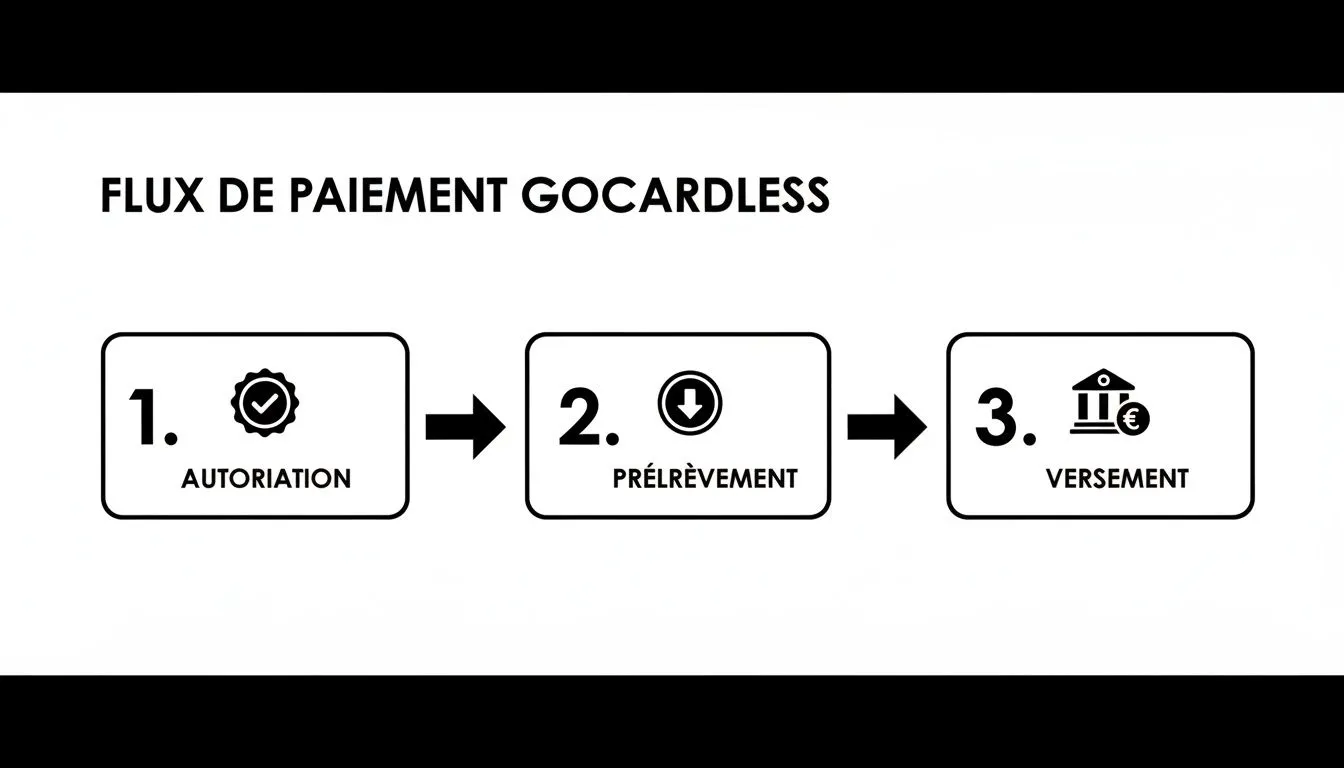
It’s this simple model — “authorize once, collect at will” — that gives the solution its power.
A solution that has won over the French market
GoCardless quickly understood the French market’s appetite for this type of solution. Present in France since 2014, the company opened offices there in 2018 and has established itself as a benchmark in B2B payments.
Today, nearly 100,000 businesses worldwide trust it to manage their direct debits, totaling more than $130 billion in transactions per year. France is no exception, with impressive growth of 42% in local revenue in 2023, as detailed in GoCardless’s latest financial results. This clearly proves the platform meets a real need.
Real-world example: French insurtech Wemind, which insures more than 12,000 freelancers and small businesses, relies on GoCardless to collect its members’ monthly contributions. The SEPA direct debit mandate is integrated white-label into the sign-up flow. The result: payment becomes an invisible, entirely seamless formality for the end user.
Now that we’ve seen how GoCardless works under the hood, let’s talk practicalities. What are the real benefits for an e-commerce merchant like you? Adopting automatic direct debit with GoCardless isn’t just another payment option. It’s a decision that directly affects the health of your business: the stability of your revenue, your costs, and the time you spend on administrative tasks.
The first gain, and probably the most striking, is the drastic reduction in payment failures. Think about it: card payments are surprisingly fragile. An expired card, a loss, a theft, a limit reached… and a sale fails while a customer needs chasing. This is what’s known as “involuntary churn”: a customer who didn’t want to leave, but whom you lose because of a simple technical hiccup.
GoCardless bypasses this problem by relying on the customer’s IBAN, a bank identifier that almost never changes. Fewer payment failures means a revenue stream that immediately becomes more predictable. And above all, customers who stay subscribed longer, with zero friction.
This image sums up the idea well: turning your payments into a genuine growth engine. Reliable collections are the foundation on which you can finally build your growth with peace of mind.
Controlling costs and cash flow
The second advantage is purely financial: optimizing your transaction costs. GoCardless’s fees are often more attractive than those of credit cards, especially if you have average or high basket sizes. Why? Thanks to a fee structure that’s capped. Across thousands of transactions, the difference isn’t trivial — it can add up to very substantial savings.
Finally, and this is a critical issue for many, let’s talk about the impact on your cash flow. Late payments are a slow poison for businesses. An OpinionWay study for GoCardless revealed an alarming figure: 94% of French businesses lose money every month because of these delays. This is a direct threat to the survival of an online business. To dig deeper into the topic, you can find the full details of this survey here.
GoCardless tackles this problem at its root. By automating payment collection on a fixed date, the solution eliminates delays and the hours spent chasing your money.
To sum up, here’s what GoCardless brings to the table:
- Secured revenue: The payment success rate often exceeds 97.5%, a much higher score than credit cards.
- Cash flow under control: Collections become predictable and arrive in your account on a date known in advance. Your working capital will thank you.
- Significant time savings: No more manual reminders for overdue invoices. The entire collection process is handled automatically.
Whether you sell subscription boxes on Shopify or run a SaaS agency, the change is radical. Knowing your monthly revenue is secured turns an administrative chore into a real competitive advantage. The result? You finally have more time to focus on what really matters: growing your business.
How do you connect GoCardless to your sales tools?
A payment tool, however powerful, loses all its value if it operates in a silo. Its true worth is revealed when it integrates with your sales ecosystem to automate flows, from order to collection. And GoCardless clearly understood that.
For e-commerce merchants, setup is often child’s play. The platform has developed native integrations with the biggest names in the industry. In practical terms, this means you can add direct debit to your store in a few clicks, without needing a developer.
Integrations for e-commerce and invoicing
The most common connections let you sync GoCardless with the software you use every day.
- E-commerce platforms: Ready-to-use modules exist for Shopify, WooCommerce, PrestaShop, and Magento. Your customers then see direct debit appear as a standard payment option in their purchase journey.
- Invoicing and subscription software: By connecting GoCardless to tools like Zuora or Chargebee, the entire subscription lifecycle is automated. The invoice is created, sent, and the payment is collected without any manual intervention.
- CRM: Linking GoCardless to your CRM (such as Salesforce) lets you trigger payments following specific actions, for example as soon as a sales rep marks a contract as “signed.”
This flexibility makes GoCardless far more than a simple payment gateway; it’s a building block that fits perfectly into your software architecture. If you want to dig deeper into how these tools can work together, take a look at our guide on integrations that automate your management.
A complementary solution, not an exclusive one
One key point to remember: adopting GoCardless doesn’t mean giving up on credit cards. Far from it. The two payment methods aren’t in competition — they complement each other to deliver a frictionless customer experience.
GoCardless can work perfectly alongside other payment gateways like Stripe or PayPal. This hybrid strategy is often the most effective.
This approach lets you offer your customers the best of both worlds:
- The spontaneity of credit cards for one-off or impulse purchases, where speed is the priority.
- The reliability of GoCardless direct debit for subscriptions, recurring invoices, or high-value baskets where stability matters most.
By intelligently combining these options, you optimize your conversion rates at every touchpoint. You offer the most relevant payment method depending on the context of the purchase, without adding to your own internal workload.
Connecting GoCardless to Bizyness to automate your accounting
Congratulations, you’re collecting hundreds of recurring payments with GoCardless. Your cash flow is healthy, but a new challenge arises: accounting. Every transaction, every subscription, every paid invoice needs to be processed.
The problem? Each GoCardless payment must be reconciled with the right invoice, fees must be calculated, VAT broken down… Done manually, it’s a monumental, repetitive task prone to errors.
That’s where the alliance between GoCardless and Bizyness becomes obvious. Think of Bizyness as an automatic translator plugged into your payment flow. It doesn’t just list transactions; it reads them, understands them, and instantly converts them into clean, accurate accounting entries.
From transaction to accounting entry, without a second thought
Once you’ve connected GoCardless to your Bizyness account, everything happens behind the scenes. Automation takes over tasks that would otherwise steal hours from you every month.
Here’s specifically how it works:
- Automatic retrieval: Bizyness fetches all your GoCardless transactions in real time. This includes both your customers’ payments and the fees charged by the platform.
- Smart reconciliation: No more headaches trying to figure out which payment matches which invoice. Every collection is automatically matched to the corresponding invoice in Bizyness.
- Precise accounting breakdown: The software sorts it all out for you. It separates the sale amount, the VAT to declare, and the GoCardless fees to generate distinct accounting entries, as required by tax authorities.
This automation isn’t a luxury — it’s a necessity. GoCardless adoption in France is booming, with revenue jumping 69% in fiscal year 2024. For businesses securing their revenue with this solution, automating accounting is the logical next step. You can also check out the full GoCardless analysis to learn more about this growth.
Rock-solid tax compliance
One of the biggest challenges for online merchants remains VAT management, especially when selling internationally. Bizyness was designed specifically for this. The platform analyzes every GoCardless transaction to apply the relevant tax rules, without you having to think about it.
By connecting GoCardless to Bizyness, you’re not just automating a task. You’re setting up a reliable system that guarantees compliance for every sale, from payment through to tax filing.
Ultimately, Bizyness prepares an impeccable FEC (Fichier des Écritures Comptables) file, ready to be sent to your accountant. This file contains all the information, formatted to standard, for direct integration into their software. To understand how Bizyness simplifies your entire management, take a look at our guide to accounting automation for e-commerce merchants.
This synergy frees you from time-consuming work and gives you invaluable peace of mind on the tax front, even for complex regimes like the VAT one-stop shops (OSS/IOSS).
GoCardless: how much does it cost, what are its limits, and what alternatives exist?
To choose a tool wisely, it’s not enough to list its strengths. You also need to look closely at what it will cost you, and above all, understand in which cases it’s not the right solution. Weighing the pros and cons is how you make a truly informed decision.
GoCardless’s pricing model is fairly simple to understand: a percentage is charged on each transaction, plus a small fixed amount. But its real strength is the cap on these fees. In practical terms, beyond a certain payment amount, fees no longer increase. This makes the solution extremely competitive for average or high-value baskets.
Choosing the right GoCardless plan
GoCardless has structured its offers to match the maturity of your business. Your choice will mainly depend on your transaction volume and your need for customization.
- Standard Plan: Perfect for getting started with no commitment. You get access to the essentials of automatic direct debit with no monthly subscription, ideal for testing the solution or for small businesses.
- Plus Plan: Designed for businesses that want to strengthen their brand image. It lets you add your colors and logo to payment pages and notification emails sent to your customers.
- Pro Plan: The most complete offer, aimed at businesses handling large volumes. It grants access to priority customer support and more advanced integration options for tailored management.
So where’s the catch? GoCardless’s main limitation is also its greatest strength: its specialization. The platform is a champion of “pull” payments, meaning merchant-initiated collections. On the other hand, it’s not designed for instant “push” payments, like a one-off purchase where the customer pulls out their credit card to pay on the spot.
What alternatives should you consider?
If GoCardless’s model doesn’t tick all your boxes, don’t worry — the market is full of options. Having a clear view of the payment institutions ecosystem is key to building a financial architecture that truly fits your business model.
If you’re looking for an all-in-one solution that handles both direct debits and card payments, Stripe Billing is a serious direct competitor. It offers a complete infrastructure for managing subscriptions and invoices, accepting a wider range of payment methods.
For more specific needs, other players deserve your attention. SlimPay, for example, is also a SEPA direct debit specialist. Platforms like Adyen or Mollie take a more comprehensive approach, covering a multitude of payment methods and sales channels. Ultimately, it all comes down to the balance you’re looking for between the performance of a specialist and the flexibility of a generalist.
Your questions about GoCardless
Switching to automatic direct debit always raises a few questions. That’s completely normal. Let’s demystify together the points that concern you most so you can make an informed choice.
Is GoCardless secure enough for my customers?
This is THE most common question, and the most legitimate one: “Can my customers really trust this?” The answer is a resounding yes, for very good reasons.
GoCardless is a licensed payment institution, meaning it’s regulated by financial authorities such as the ACPR in France. It’s not just software — it’s a financial institution that must comply with very strict rules, particularly regarding the security of funds and data.
In practical terms, all information is encrypted to the highest standards. More importantly, transactions pass through the bank networks themselves (such as the SEPA network), which have been the pillar of trust in the financial system for decades. The direct debit mandate isn’t just a checkbox; it’s a legal framework that protects your customer and gives them clear recourse, such as the ability to dispute a payment very easily.
How long does it take for the money to reach my account?
Once the payment is initiated, the burning question is: “When does the money actually arrive?” For a SEPA direct debit in Europe, the cycle is fairly quick: generally allow 2 to 3 business days between the moment you trigger the payment and the moment the funds are credited to your account.
One of GoCardless’s strengths is transparency. Your dashboard shows you in real time where each transaction stands: payment submitted, processing, confirmed, or, more rarely, failed. This is a real plus for managing your cash flow and anticipating incoming funds.
Can I use it for one-off payments?
Technically, the answer is yes. But in practice, it’s not its preferred playground. GoCardless was designed and optimized from the ground up for recurring payments.
Using the platform for a one-time payment would require your customer to sign a direct debit mandate… for a single transaction. This is a much less direct and instant process than a simple card payment. For a “one-shot” sale, where the customer decides to buy on impulse, solutions like Stripe or PayPal remain far more suitable.
The right instinct: Think of GoCardless as your specialist for subscriptions and invoices with regular due dates. For one-off purchases, favor credit card payments.
What happens if a direct debit fails?
Payment failures are exactly one of the headaches GoCardless aims to solve. When a direct debit doesn’t go through (the most common reason being insufficient funds in the customer’s account), the platform takes over.
You can set up smart rules so the system automatically retries the payment a few days later, without you having to think about it. You’re of course notified of the failure and can track the entire follow-up chain from your interface. This is a huge time saver and spares you many awkward conversations.
Automating your collections is an excellent first step. But the real change happens when your accounting follows the same path. Bizyness plugs directly into GoCardless so that every direct debit instantly becomes a clean, accurate accounting entry, ready for your accountant. Discover how Bizyness simplifies your financial management.
