

 Français
How to Successfully Segment Your Customer Base in France
Discover how to segment your customer base effectively using methods proven by French experts. Practical tips and real-world examples.

Why ignoring segmentation is costing you money
I’ve come across far too many French businesses that treat their customer base as a uniform block, as if all their customers were identical. And the result? Marketing budgets going up in smoke, poured into ineffective campaigns. Because the reality is that your customers have very different needs, budgets, and motivations.
Picture a baker. He won’t sell the merits of his traditional baguette the same way to a student and to a family with children. The student, likely more price-sensitive, might be won over by an offer like “buy 4 baguettes, get the 4th free.” The family, on the other hand, will probably care more about quality and ingredient origin, willing to pay a bit more for an organic sourdough baguette.
Well, it’s the same for your business! With a one-size-fits-all approach, you’re missing golden opportunities. I’ve personally helped SMEs that tripled their conversion rate simply by tailoring their messaging to different customer profiles. For example, an online clothing shop that segments its customers by style (classic, bohemian, urban…) can offer personalized selections and targeted recommendations, boosting its chances of selling.
 This chart illustrates the importance of customer retention.
The image above clearly shows that the bulk of a company’s revenue comes from its existing customers. It’s further proof of how important it is to truly know and segment your customer base to unlock its full potential. On that note, a HubSpot statistic reveals that 72% of a company’s revenue comes from existing customers. A figure that highlights the crucial importance of retention and tailored communication.
Ignoring segmentation is a bit like watering an entire field instead of targeting the plants that actually need it: wasted water and a disappointing yield. In the sections that follow, we’ll see how to avoid these costly mistakes and how to set up effective, profitable customer segmentation for you.
Making sense of your current customer base without losing your mind

Before talking about segmentation, let’s take a moment to truly understand who your current customers are. It’s the foundation of everything! A bit like cooking: you can’t nail a dish without knowing the ingredients. I’ve personally used a customer audit method for years, and I can tell you it has often revealed surprising things.
Analyzing sales data: a goldmine of information
First step: dive into your sales data. Set aside your preconceptions and let the numbers speak. Look closely at purchase frequency, average basket size, and star products. Even this basic data can teach you a lot about your customers’ buying behavior. For instance, if a group of customers regularly buys a particular product, that’s a strong signal to build a segment around that product and offer complementary deals.
I remember an online cosmetics shop I worked with. Data analysis revealed that customers who bought high-end mascara came back more often and spent more. Based on this simple observation, they created a “Premium Beauty” segment with dedicated offers. An instant success!
Your CRM: a valuable ally
Your CRM, even a simple one, is a valuable source of information. It lets you identify your loyal customers, those who haven’t purchased in a while, or those who abandoned their cart. Key information for effective segmentation. Don’t hesitate to cross-reference data: age, location, purchase history… That’s how you’ll find the most relevant combinations.
Analyzing interactions with your customer service is also a goldmine. Reasons for contact, complaints, specific requests… all of this helps you identify unmet needs and adapt your offering. If many customers contact customer service with shipping questions, for example, that may be a sign you need to improve communication on that point.
Segmentation: watch out for the pitfalls!
Segmenting on purely theoretical criteria is a common mistake. Your segments must reflect the reality of your customers, not your assumptions. Segmenting by age may seem logical, but if your 25-year-old and 50-year-old customers have similar buying behavior, that criterion isn’t relevant.
That said, you shouldn’t neglect demographic and geographic data either. Combined with behavioral data, it helps create precise, actionable personas. The goal is to turn cold data into real marketing levers. Imagine being able to anticipate your customers’ needs before they even express them! That’s the power of well-designed segmentation.
To help you choose the most relevant criteria, here’s a comparison table:
Segmentation criteria: demographic vs. behavioral
Comparison of different segmentation criteria by their effectiveness and ease of implementation.
| Criterion | Ease of obtaining | Impact on sales | Application example |
|---|---|---|---|
| Age | Easy | Low to medium | Special offers for birthdays |
| Location | Easy | Medium | Geographic ad targeting |
| Purchase history | Medium | Strong | Personalized product recommendations |
| Average basket | Medium | Strong | Loyalty programs based on spending |
| Purchase frequency | Medium | Strong | Special offers for regular customers |
| Customer service interactions | Difficult | Strong | Content creation answering frequent questions |
This table highlights the importance of cross-referencing demographic data (age, location) with behavioral data (purchase history, average basket) for truly effective segmentation. By analyzing these different criteria, you’ll be able to identify the most promising segments and adapt your strategy accordingly.
Three segmentation methods that actually work
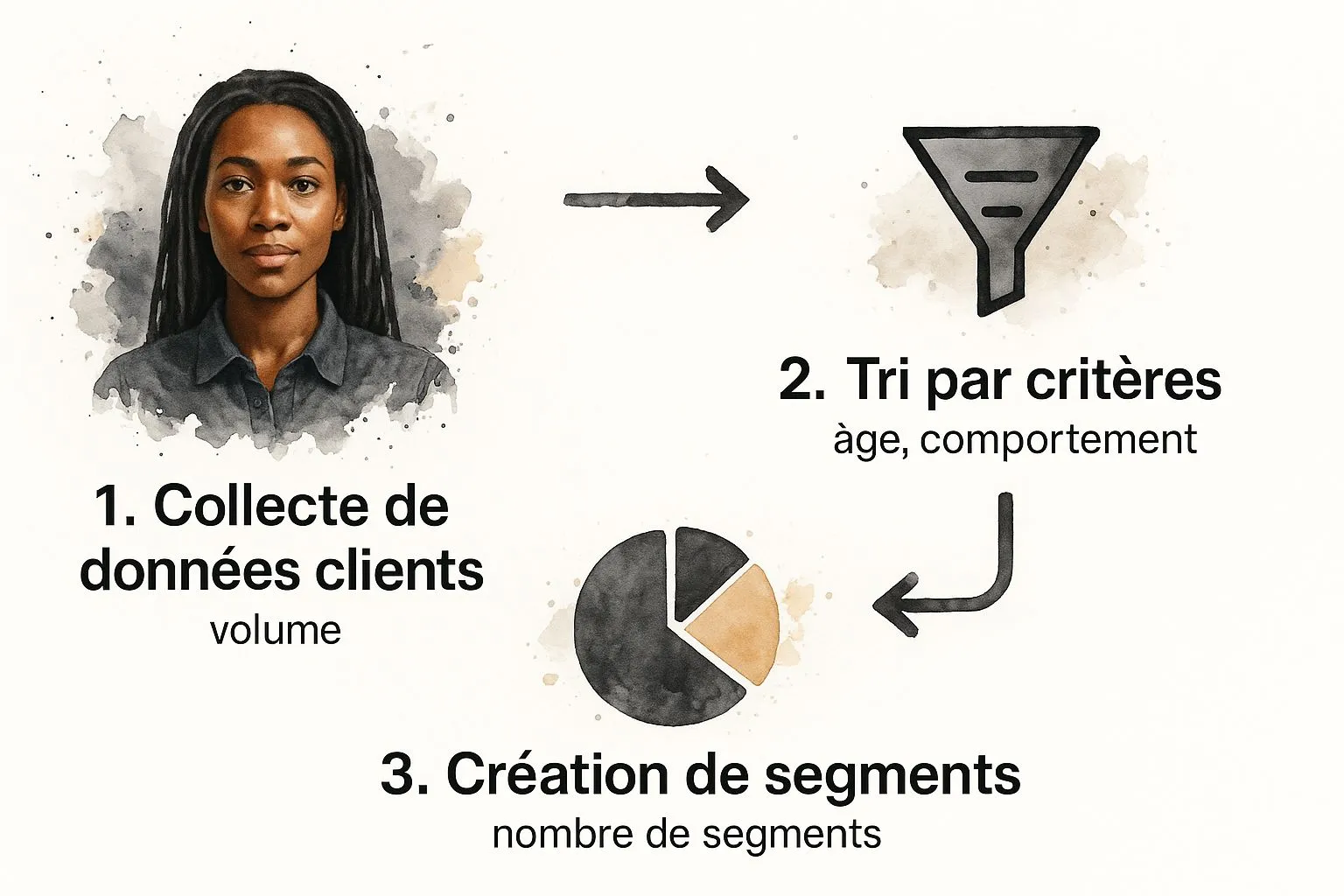
The infographic above illustrates the customer segmentation process in three key steps: data collection, sorting by criteria, and segment creation.
Segmenting your customer base is essential, but it can quickly become a real headache. Forget complicated methods and vague theories. Let’s focus on the practical, with three approaches I use daily and that have proven their worth. A bit like a funnel: you start with a mass of data, filter it, and end up with clearly distinct groups of customers.
Value-based segmentation: pampering your best customers
For me, the first thing to look at is purchasing behavior. Specifically, we’re talking about customer value: how much each customer spends on average over a given period. You can also analyze purchase frequency and average basket size. A simple spreadsheet is enough to get started! The goal? Identify your most profitable customers. Take an e-commerce example: those who order often and for large amounts are your VIPs! You need to pamper them. Create a dedicated segment, offer them exclusive deals, personalized customer service… in short, make them feel special.
Digital engagement: decoding online clues
Digital is a goldmine of information. Who opens your emails? Who clicks on your ads? Who interacts with your social media posts? All valuable signals for segmenting your audience. This lets you spot your most engaged customers, those interested in specific products, and adapt your communication accordingly. Imagine: a customer regularly clicks on your blog posts about new products… odds are they’ll be receptive to your next product launches! Need a hand finding new customers? Take a look at our guide: finding customers.
Life moments: anticipating needs at the right time
This one is a bit of a secret weapon. You segment customers based on important life events: a wedding, a birth, a move… By knowing these key moments, you can anticipate their needs and offer relevant deals. For example, a furniture store could target young couples who are moving in together. The automotive industry, for one, has clearly understood this. In France, segmentation is essential. According to NGC-DATA figures from May 2025, the market share of new vehicles varies considerably depending on the customer segment. More information here.
These three methods, used together, let you build solid, scalable customer segmentation that adapts as your business changes. The most important thing? Choosing the approaches that truly fit your business and your goals.
Creating personas that feel like real people

The image above represents personas, detailed and personalized customer profiles.
Once you’ve segmented your customer base, it’s time for the crucial step: bringing these segments to life. Forget stock photos and generic descriptions! We’re aiming to create personas — customer profiles so detailed they feel like real people. Imagine finally meeting them face to face.
Bringing your data to life: a 5-phase method
My personal method? Turning raw data into living portraits that your whole team can use. Take “Sophie,” 35, an entrepreneur in Lyon. She uses Bizyness to manage her online jewelry shop. “Sophie” has needs, frustrations, dreams. By understanding her, you adapt your communication and offers. That’s the key to winning her over and keeping her loyal.
Here are my 5 key phases:
- Identify the key segments. Focus on the segments with the greatest potential.
- Interview your customers. The heart of the matter! Open-ended questions, exploring deep motivations… more on this below with concrete examples.
- Synthesize the information. Gather the common points, build a composite portrait for each segment. Precision and conciseness are key.
- Humanize your personas. A name, a photo, a story… the more real they feel, the more useful they’ll be.
- Share and use your personas. Accessible to everyone, this document becomes the reference for your marketing decisions.
The customer interview: getting to the heart of motivations
Creating relevant personas means going beyond simple demographic data. You need to understand deep motivations. Why do they buy? What frustrates them? Where do they want to go? The customer interview is the ideal tool.
Here are a few questions to get started:
- “What is your biggest professional challenge?”
- “How do you use Bizyness day to day?”
- “Why did you choose Bizyness?”
- “What could we improve at Bizyness?”
Adapt these questions to your own context. What matters is creating a genuine dialogue and listening carefully. Personalization is essential. In fact, in 2025, 64% of consumers expect a personalized experience, and 73% appreciate being treated as individuals according to Apizee.
Avoiding the “shelved persona” trap
Beware of personas that are too generic and end up forgotten in a folder. Your personas need to be specific and actionable. They should help you concretely: what content to create? Which channel to use? What argument to highlight?
To help you build effective personas, I’ve created a B2B vs. B2C comparison table:
Customer persona template: B2B vs. B2C
Comparison of the essential elements to include in your personas depending on your market
| Element | B2B | B2C | Key questions to ask |
|---|---|---|---|
| Demographics | Company size, industry, role | Age, gender, location, family situation | What is your company’s profile? / What is your age, occupation, etc.? |
| Goals | Business goals, challenges, KPIs | Personal needs, purchase motivations | What are your company’s goals? / What matters to you in life? |
| Decision process | Buying cycle, influencers, decision-makers | Purchase criteria, sources of information | How do you make professional purchasing decisions? / How do you choose your products? |
| Frustrations | Weaknesses of current solutions, obstacles | Problems encountered, dissatisfactions | What frustrates you about current solutions? / What problems do you have with similar products? |
| Aspirations | Future vision, ambitions | Dreams, desires | Where do you want to take your business? / What are you looking for in an ideal product? |
This table helps you clearly understand the differences between B2B and B2C personas and adapt your questions accordingly. Remember, an effective persona is a living persona!
In the next section, we’ll see how to turn these personas into concrete results.
Turning your segments into concrete results
Creating customer segments is great. But a spreadsheet gathering dust on a server is useless! What matters is embedding this segmentation at the heart of your business to reap real benefits. I’ll explain how I go about it with my clients, how we move from theory to practice, and how we turn these segments into hard cash.
Personalizing email campaigns: concrete examples
Email marketing still works, as long as you’re not sending generic messages that end up in the trash. The key is personalization, and segmentation is your best ally for that. Imagine you have an “e-commerce entrepreneurs” segment, another “freelancers” segment, and a third “small businesses” segment. Each gets its own email, with content tailored to its needs and challenges.
Concretely, what does that look like? I’ve seen clients achieve impressive results. An online organic shop, for example, segmented its customers by product type (food, cosmetics, etc.). Result: the open rate went from 15% to 25%. Another example: a communications agency segmented its prospects by industry and saw its click-through rate skyrocket, going from 5% to 12%. Not bad, right?
Adapting your website: a tailored experience
Your website is your storefront. It needs to speak to all your customers, and therefore to each of your segments. Imagine: a visitor lands on your site. Based on their browsing behavior, you know they belong to the “e-commerce entrepreneurs” segment. Bam! You show them testimonials from other online sellers using Bizyness, highlight the features they care about, and offer resources dedicated to their industry, like this article on optimizing e-commerce accounting: Optimizing e-commerce accounting. That’s what a tailored experience looks like.
Training your teams: a common language
Customer segmentation isn’t just for marketing. It’s a mindset that should be shared across the whole team. Sales, customer service, marketing… everyone needs to know how to identify and interact with each segment. A “key account” doesn’t have the same expectations as a sole trader. Adapting your messaging and approach is essential to building a solid, lasting relationship.
Automating without dehumanizing: finding the right balance
Automation is a powerful tool. With a good marketing automation tool, you can personalize your communications at scale without sacrificing the human touch. For example, automatically send a personalized welcome email based on the new customer’s segment. Or schedule targeted follow-up messages after a purchase. Time saved and maximum efficiency!
Keeping your segments up to date: an ongoing process
Careful: segmentation isn’t a one-and-done exercise. Your customers evolve, their needs change. You need to set up a system for regularly updating your segments. Use simple, accessible tools, French ones if possible. The goal: to make segmentation a reflex, a tool built into your daily routine, serving your company’s growth.
Measuring what really matters in your segmentation
You’ve segmented your customers, refined your personas… Well done! Now, how do you know if your efforts are paying off? Forget the pretty charts that look good in meetings and focus on the KPIs, the key performance indicators that prove your customer segmentation is working.
Beyond vanity metrics: identifying the relevant KPIs
The number of Instagram followers or unique visitors to your site is all well and good, but it says nothing about the real impact of your segmentation. These are called vanity metrics. What matters to us are concrete figures: conversion rate, average basket, purchase frequency, retention, and customer acquisition cost. That’s where you see whether each segment is profitable.
For example, if you segment based on newsletter engagement, the active subscriber segment should have a better conversion rate. If it doesn’t, you need to ask questions. Your segmentation or your content may not be optimized.
Tracking how your segments evolve: anticipating change
Your segments aren’t static. Needs and buying behaviors evolve. It’s therefore essential to monitor these changes and spot when a customer moves from one segment to another.
Why? To adapt your strategy in real time! If a customer moves from “occasional” to “loyal,” that’s the moment to offer them a loyalty program or exclusive deals. Conversely, if a loyal customer starts buying much less, you need to understand why and take action.
Tools and analysis frequency: adapting to your context
You don’t need complex tools to analyze your segments. Google Analytics, your CRM (if you have one), or an email platform like Mailchimp will give you valuable insights. How often you analyze depends on your business. Fast-moving industry? Monthly analysis. More stable industry? Quarterly may be enough. On a related practical note, VAT is an important topic, especially for sole traders. Need a quick refresher? Here you go: VAT for sole traders.
Presenting your results: convincing your leadership
To justify your efforts and investments in segmentation, present your results clearly. Use simple charts, comparison tables, and concrete examples to show the impact on your KPIs. French industry benchmarks can also help put your performance in context.
To help you, here’s a summary table:
Essential KPIs by segmentation type
Key metrics to track depending on your segmentation approach, with realistic targets
| Segmentation type | Primary KPI | Secondary KPI | Measurement frequency |
|---|---|---|---|
| Value-based segmentation | Average basket | Retention rate | Quarterly |
| Engagement-based segmentation | Conversion rate | Customer acquisition cost | Monthly |
| Geographic segmentation | Penetration rate by area | Revenue by region | Quarterly |
This table is a starting point. Adapt these KPIs to your own goals and your business. What matters is measuring what truly makes sense for your business.
Your action plan for the next 90 days
Enough theory, time for practice! How do you actually get started, as early as next week? I’m offering you a game plan for your customer segmentation, with a realistic timeline I’ve tested myself.
The essential tools (and free ones!)
No need to break the bank to get started. In the beginning, simple, free tools do the job perfectly:
- Your CRM (if you have one): a real goldmine for digging into purchase history, frequency, and customer value.
- Google Analytics: essential for understanding how your visitors behave online, which pages they prefer, and where they come from.
- Excel (or Google Sheets): perfect for organizing your data, calculating your KPIs, and creating visual dashboards.
Later on, you can consider more advanced solutions, but for now, let’s focus on the essentials.
Resources and pitfalls to avoid
The size of your business affects the resources you’ll need. If you have a small team, get everyone involved! The idea is to speak the same language when discussing your customer segments.
As it turns out, 70% of segmentation projects fail within the first 6 months. The main reason? Poor follow-through and weak internal communication. To avoid this pitfall, here’s my personal checklist:
- Phase 1 (30 days): Dive into your existing data. Isolate 3 to 5 key segments. Start building your personas.
- Phase 2 (30 days): Put your segmentation to the test with targeted marketing campaigns (email, social media…). Analyze the first results. Adjust course if needed.
- Phase 3 (30 days): Integrate segmentation into your daily operations (customer service, sales…). Train your teams. Share your wins!
Communicating and keeping the momentum going
One crucial point: communicate regularly about your progress, both internally and externally. Sharing your early positive results (higher conversion rate, happier customers…) keeps the team motivated and justifies the invested effort.
In France, there are many resources and communities to support you in your customer segmentation journey. Don’t hesitate to connect with other entrepreneurs facing the same challenges. Other people’s experience is an invaluable source of inspiration.
Want to simplify your management and boost your business? Bizyness is the ideal tool for French entrepreneurs. Find out how Bizyness can help you run your business more efficiently.
