

 Français
The practical guide to intra-EU VAT calculation
Simplify intra-EU VAT calculation with our guide. Master reverse charge, rates and returns for error-free trade within the EU.

Calculating intra-EU VAT can seem complex at first glance. Yet it all rests on a fairly simple logic: between European professionals, invoices are issued excluding tax (net of VAT). It’s then up to the buyer to play their part and handle VAT in their own country.
This system is known as the reverse charge mechanism. Its purpose is to streamline trade within the European Union. For everything to run smoothly, one thing is absolutely essential: a valid intra-EU VAT number for each business involved in the transaction.
The basics you need to calculate intra-EU VAT correctly
Before even reaching for a calculator, you need to understand the key concepts that govern these transactions. Solid fundamentals are the best way to avoid classic mistakes and secure your commercial operations.
To help you find your way, here’s a quick glossary of the essential terms to know.
Quick glossary of intra-EU VAT
| Key Term | Practical Definition | Impact on the Calculation |
|---|---|---|
| Intra-EU VAT number | Your European tax “passport.” It proves that you and your partner are both liable for VAT. | Essential for invoicing net of VAT. Without it, the sale is treated as VAT-inclusive. |
| Reverse charge | The buyer declares and deducts the VAT at the same time. Responsibility for collection is shifted. | The seller invoices €0 of VAT. The buyer calculates the VAT of their country on the net amount. |
| Intra-EU supply | You sell goods from France to a business in another EU country. | You invoice net of VAT. This is a VAT-exempt transaction in France. |
| Intra-EU acquisition | You buy goods from a supplier located in another EU country. | You receive a net invoice and must reverse-charge French VAT on that amount. |
This table is a good compass for navigating the administrative maze. Now let’s explore these concepts in more detail.
The VAT number: much more than a simple identifier
This famous intra-EU VAT number isn’t just another line on your invoices. It’s the key that activates the entire tax mechanism for European trade. If your client doesn’t provide you with a valid number, you simply don’t have the right to issue them a net-of-VAT invoice.
In France, its structure is designed to be secure and traceable:
- The country code: FR for France, of course.
- The check digits: two digits that act as a control code to validate the number.
- The SIREN number: the well-known nine digits that identify your business.
Thanks to this structure, you can verify almost instantly that your business partner is indeed a taxable professional in their own country.
The reverse charge: the mirror-tax principle
The pillar of the system is the reverse charge mechanism. Think of it as a transfer of responsibility. Instead of you, the seller, collecting VAT on behalf of the French state, it’s your client who will declare it (and deduct it at the same time) with their own tax authority.
For a French buyer importing goods, the operation is entirely neutral for their cash flow, but it absolutely must appear on their VAT return. It’s a simple accounting entry, but a mandatory one.
This mechanism was put in place for a very practical reason: to spare businesses from having to register for VAT in every EU country where they have customers. It’s a huge administrative simplification, provided you master the rules of the game.
Supply or acquisition: watch your vocabulary
In tax jargon, words carry very precise meaning. Mixing them up can quickly lead to mistakes on your returns.
When you sell goods from France to a business in another EU country, this is called an intra-EU supply. Your invoice must be issued net of VAT, and you’ll need to keep proof that the goods actually left French territory to justify this exemption.
Conversely, if you buy goods from a German, Italian or Spanish supplier, you’re making an intra-EU acquisition. You’ll receive a net invoice from them, and it will be up to you to calculate and reverse-charge the corresponding French VAT.
These principles also apply to services, even if the rules can sometimes differ slightly. For sole traders (micro-entrepreneurs), the situation can be even more specific because of VAT exemption thresholds. If that’s your case, feel free to check out our complete guide on VAT for sole traders for more clarity.
Correctly defining the taxable base and the VAT rate
For your intra-EU VAT calculation to be accurate, you need to start from solid foundations. This is non-negotiable. Before even thinking about a formula, two elements must be validated with the utmost rigor: the taxable base and the applicable VAT rate. One small error on either of these pillars and your entire return could fall apart.
The first step is therefore to correctly build this taxable base. Be careful: it isn’t simply the sale price of your product or service. Many businesses get caught out by forgetting to include incidental costs, which are nonetheless subject to VAT.
Precisely defining the taxable base
In concrete terms, the VAT base is the total amount your client pays you for the goods or service you provide. It’s crucial to systematically include all the ancillary costs you rebill to them.
Make sure to include:
- Transport and delivery costs.
- Packaging costs that aren’t refundable.
- Insurance you may have taken out on your client’s behalf.
- Any commissions or brokerage fees related to the transaction.
In short, if a cost is directly linked to the sale and appears on the invoice, it must be part of your net taxable base. This is a classic source of error that can lead to tax reassessments.
The golden rule for a smooth intra-EU VAT calculation is simple: if a cost is billed to the client and is inseparable from the main sale, it’s part of the taxable base. It’s never treated separately for VAT purposes.
Choosing the appropriate VAT rate
Once your taxable base is properly established, you need to apply the correct VAT rate. In France, these rates have evolved, which has had a direct impact on the accounting of businesses managing international flows. Take, for example, the standard rate moving from 19.6% to 20% in 2014, which required an update to configuration settings.
Today, the main rates in use are 20% (standard), 10% (intermediate), and 5.5% (reduced). For a refresher, you can check the history of VAT in France on Wikipedia.
For B2B trade within the European Union, the reverse-charge mechanism is the norm. This means the transaction is exempt from VAT in the seller’s country, since it’s the buyer who will declare and pay it in their own country. It’s a clever system for avoiding double taxation and simplifying trade flows.
The infographic below sums up this logic nicely so you don’t get it wrong.
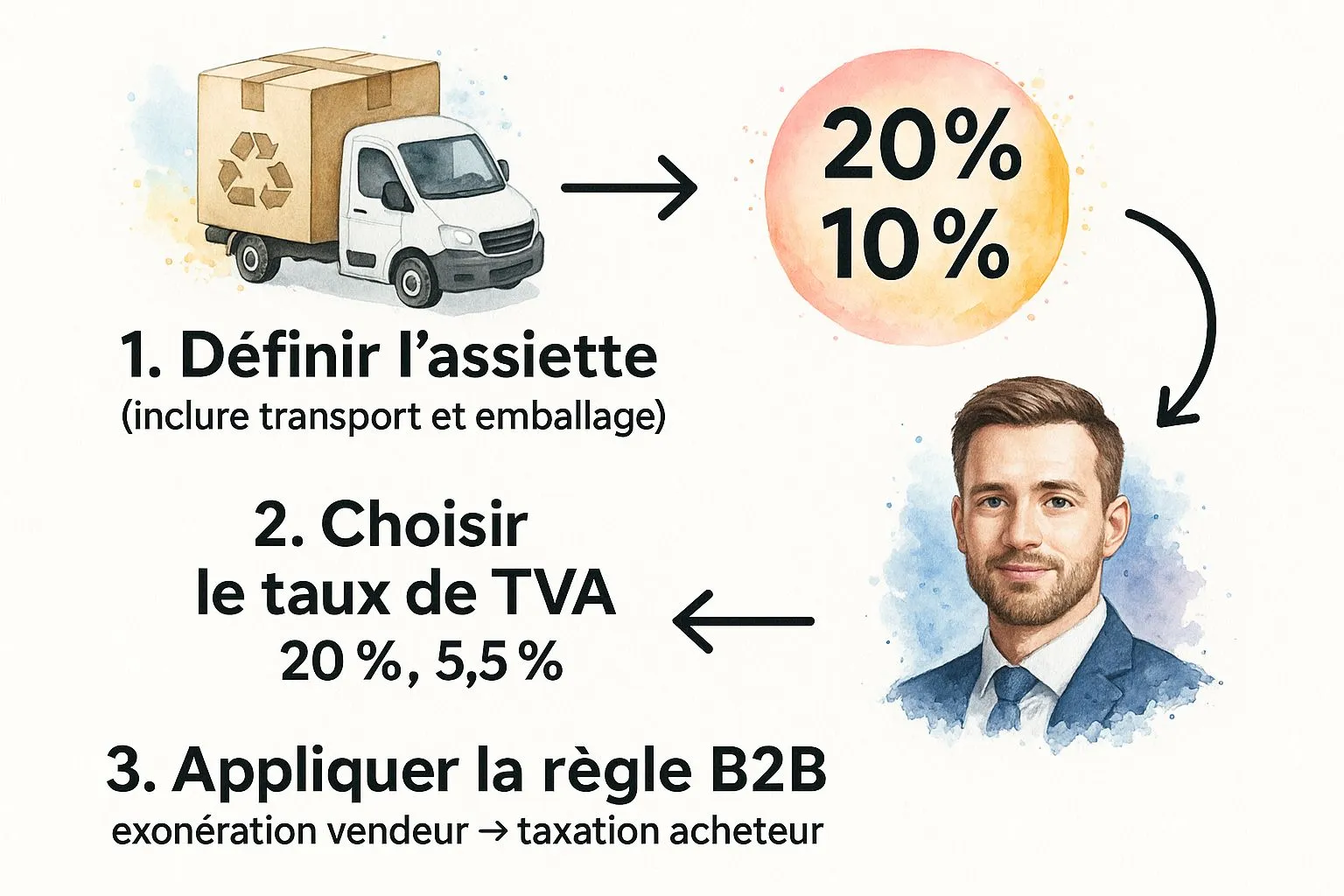
This visual makes it clear: you need to proceed step by step. First, secure the taxable base. Then, identify the correct rate. Finally, apply the specific B2B rule. Keeping this sequence in mind is the key to making every transaction reliable.
Sales and purchases in the EU: how do you navigate the calculations?
Now let’s get to the heart of the matter: how do you calculate this famous intra-EU VAT for your invoices and returns? The logic changes completely depending on whether you’re the seller or the buyer. Understanding these two scenarios clearly is key to keeping your European trade compliant.
When you sell, it’s called an intra-EU supply, and the golden rule is VAT exemption. Conversely, when you buy, it’s an intra-EU acquisition, and that’s when the reverse-charge mechanism comes into play. Let’s look at this more closely with clear examples.
The case of the intra-EU supply (a B2B sale)
Good news: when you sell a product or service to a business client in another EU country, it’s very simple. Your invoice must be issued net of VAT.
The formula couldn’t be more straightforward:
Amount invoiced = Net sale price
The VAT amount is therefore €0. This is a crucial point: your invoice must include the mention “VAT exemption - Article 262 ter I of the French Tax Code” and, of course, the intra-EU VAT numbers of both businesses.
Let’s take a concrete example:
Your French company sells a software license to a business in Spain for €2,500 net.
- Net sale price: €2,500
- VAT invoiced: €0
- Total amount payable by the client: €2,500
Don’t forget to report this transaction on your VAT return (in the “Intra-EU supplies” box) and on your EU Trade Declaration for Goods (DEB) or Services (DES).
The case of the intra-EU acquisition (a B2B purchase)
Here, the scenario is different. When you’re the buyer, you receive a net invoice from your European supplier. It’s up to you to apply the reverse charge principle for French VAT.
What does that mean? In short, you must calculate the French VAT yourself, declare it as if you had collected it, then immediately deduct it on the same return. The operation is entirely neutral for your cash flow, but it absolutely must appear in your accounts.
Here’s how it works:
- First, calculate the French VAT: Simply apply the VAT rate in force in France (most often 20%) to the net amount of your purchase. The formula is
VAT amount = Net purchase amount x French VAT rate. - Then, declare and deduct: On your VAT return (the CA3 form), you’ll enter this amount in two places: in the “VAT collected” section and in the “Deductible VAT” section.
Another example to illustrate:
Your business buys electronic components from a German supplier for €10,000 net.
- Net invoice amount: €10,000
- VAT to reverse-charge (rate of 20%): €10,000 x 0.20 = €2,000
- On your return: You declare €2,000 of VAT collected AND €2,000 of deductible VAT. The final impact is €0.
This accounting exercise can seem a bit confusing at first, but it quickly becomes second nature. To make life easier, know that there are effective tools available. You can find out more about the benefits of automatic VAT calculation to say goodbye to entry errors and save precious time.
The reverse charge is a wash entry, a net-zero operation. Yet forgetting it is one of the most frequent errors flagged by the tax authorities during audits. So be particularly rigorous with every intra-EU acquisition.
Filing correctly to avoid unpleasant surprises
https://www.youtube.com/embed/K1r8Y3fwLpc
Having the right calculation formulas is great. But that’s only half the journey. The other half, just as crucial, is making sure every transaction is impeccably documented and reported. Administrative rigor is your best ally for avoiding reassessments in the event of a tax audit.
Here, we’re no longer just talking about numbers. It’s about validating your partners, scrupulously meeting deadlines, and submitting the right information to the authorities. This is the safety net that justifies every transaction.
VIES validation: a habit to build
Before even thinking about issuing a net-of-VAT invoice to a European client, there’s a mandatory step: checking the validity of their intra-EU VAT number. This isn’t a simple administrative formality — it’s the sine qua non condition for having the right to apply the VAT exemption.
For this, the official tool is the VIES service (VAT Information Exchange System), made available by the European Commission. The right reflex? Take a screenshot of the positive result at the time of the transaction and archive it carefully. It’s your proof.
Without this proof of validation, the tax authorities may very well consider that the exemption wasn’t justified. Then the axe falls: they’ll claim payment of French VAT on the sale from you. This is a simple precaution that protects your cash flow.
Mastering periodic returns
Once the transaction is secured and validated, you must inform the tax authorities via specific returns. These documents track flows of goods and services within the European Union. Neglecting them, or filling them in incorrectly, exposes you to penalties.
There are mainly two returns to know:
- The EU Trade Declaration for Goods (DEB): This is mandatory for all shipments of physical goods you send to another member state.
- The European Services Declaration (DES): This covers services you provide to a business client based in another EU country.
Incidentally, the very structure of the French intra-EU VAT number, which incorporates a check digit calculated from the SIREN number, shows how much importance the authorities place on traceability. This rigor underlines just how essential it is to correctly report these transactions every month. To dig deeper into the subject, feel free to check out further information on the structure and obligations related to intra-EU VAT.
Each of these returns has its own thresholds and deadlines, generally set on the 10th business day of the month following the transaction. Stay vigilant, as an oversight happens easily and can be treated as an infringement. Ultimately, these documents are just as important as your regular VAT return.
Pitfalls to avoid with intra-EU VAT
On paper, intra-EU VAT is a fairly logical mechanism. But in practice, experience shows that small oversights can quickly turn into big problems. It’s better to know the classic mistakes in order to anticipate them and secure your trade with your European partners.
One of the most frequent risks, and one that can be costly, is not being able to justify the VAT exemption on your sales. It’s not enough to issue a net-of-VAT invoice; you absolutely must prove that the goods actually crossed the border. Without this proof, the tax authorities may well reclassify the transaction as a local sale and claim the corresponding VAT from you.
Proof of transport: your shield in the event of an audit
To prove that delivery actually took place in another EU country, the key document remains proof of transport. For road transport, this is the famous consignment note (CMR), which must be signed by the carrier and your client. It’s this document that clearly certifies that the goods were picked up in France and delivered to their destination.
My advice: never treat the CMR as a simple piece of administrative paper. Carefully archive a copy of every transport document. It’s your only guarantee in the event of a tax audit to justify the VAT exemption.
Deposits and credit notes: watch for consistency
Deposits and credit notes require particular vigilance. If you request a deposit for a future intra-EU supply, the rule is the same: it must be invoiced net of VAT. Be sure to include the VAT numbers of both businesses on your deposit invoice.
For a credit note, the mirror effect applies. If it cancels part or all of an intra-EU sales invoice (which was therefore net of VAT), the credit note must also be issued net of VAT. Consistency between the invoice and the credit note is crucial for your accounts to stay accurate.
The mistakes we see time and again
With enough practice, certain mistakes keep coming back. Keep this short list in mind — it could spare you a lot of complications.
- Charging VAT to a European professional. This is the classic one. If your B2B client has a valid VAT number, your invoice must be net of VAT. Full stop.
- Forgetting to reverse-charge VAT on a service. Do you pay for a subscription to Irish software? Even though the operation is financially neutral, you must reverse-charge French VAT on your return.
- Getting the wrong box on the CA3 return. Intra-EU transactions have their own specific lines. A data-entry error can easily trigger alerts and requests for explanation from the tax authorities.
- Omitting incidental costs from the taxable base. Don’t forget that shipping or packaging costs are an integral part of the taxable base. To learn everything about this subject, I recommend our complete guide on managing VAT on shipping costs.
By adopting these few habits, managing intra-EU VAT will quickly become a well-oiled routine rather than a source of anxiety. It’s all a matter of rigor and anticipation.
Frequently asked questions about intra-EU VAT
Let’s now move on to the common questions that everyone asks themselves when managing VAT on European transactions. Here are clear, direct answers, drawn from practice, to help you navigate these situations without making mistakes.
What should I do if my client’s VAT number is invalid?
This is a classic situation, and one that calls for an immediate response. If, after checking with the VIES service, your European client’s VAT number turns out to be invalid, there’s one golden rule: do not invoice with a VAT exemption.
If you ignore this, the French tax authorities won’t see an intra-EU sale, but a simple local sale. The consequence? You’ll be liable for French VAT on the invoiced amount. The best approach is therefore to contact your client without delay so they can provide you with a valid number or take the necessary steps to reactivate it. This is a basic safeguard for your cash flow.
A VAT number received by email should never be taken at face value. The right habit to adopt is systematic verification in the VIES database before any first invoice. This is non-negotiable and will save you major headaches. No valid number, no exemption. Full stop.
How do I invoice an online service to an EU business?
For digital services — think software sales, online training, remote consulting, etc. — the mechanism stays the same. It’s the reverse charge principle applied by your business client that takes precedence.
You must therefore issue your invoice net of VAT. But for everything to be compliant, it’s essential to add a specific mention justifying this absence of VAT.
Here’s the standard wording to include on your invoice:
- “Reverse charge by the recipient - Article 196 of Directive 2006/112/EC”
This small sentence, unassuming as it looks, officially transfers responsibility for the VAT to your client. It’s a crucial detail for the validity of your accounts and those of your business partner.
Should I file a DEB or a DES?
This is a fundamental point. Not confusing the EU Trade Declaration for Goods (DEB) with the European Services Declaration (DES) is essential. This mistake can quickly distort your returns and draw the attention of the authorities.
To keep it simple and never hesitate again:
- The DEB is for physical goods. Think products, equipment, raw materials… anything that physically crosses a border within the EU.
- The DES, as its name suggests, is reserved for services you provide to businesses located in other EU countries.
Why is this distinction so critical? Simply because the thresholds, the information required and the filing frequencies are absolutely not the same. Filing the wrong return is a bit like trying to send a parcel with a letter stamp: it won’t go through and it will create anomalies that the tax authorities will have no trouble spotting.
To automate your VAT management and effortlessly guarantee the compliance of your invoices, Bizyness is the tool designed for you. Simplify your accounting and focus on what really matters: your business. Discover Bizyness today.
