

 Français
Mastering invoice settlement for e-commerce to keep your cash flow healthy
Optimize invoice settlement for your online store. Discover concrete strategies for managing payments, deadlines and legal compliance.
As an online seller, invoice settlement is far more than a single line in an accounting spreadsheet. It’s the fuel of your cash flow. If you neglect this process — whether you sell on Shopify, Amazon, or through a subscription system — you risk jeopardizing your company’s financial health.
Why flawless invoice settlement management is critical for your e-commerce business
In the world of e-commerce, every sale triggers a series of financial flows. Invoice settlement isn’t just an administrative formality; it’s the culmination of your sales cycle and the beating heart of your cash flow.
Poorly managing these flows has immediate repercussions on your growth. Payment delays, even of just a few days, can quickly create “cash flow gaps.” These mismatches complicate everything: restocking inventory, paying suppliers, or funding your marketing campaigns.
The challenges specific to e-commerce
Online selling has its own set of complexities. Unlike a physical store, you have to juggle a multitude of sales channels and payment solutions. Each one has its own rules, fees, and payout schedules.
Here are a few challenges you’re surely familiar with:
- Multi-platform reconciliation: Trying to match a payment received via Stripe, PayPal, or an Amazon payout with the exact order in Shopify can quickly turn into a nightmare.
- International VAT management: If you sell across Europe, you have to juggle different VAT rates and comply with the One-Stop Shop rules (OSS/IOSS). That’s a complexity that directly impacts your invoicing.
- Fees and delays that vary: Every payment provider charges different commissions and transfers funds on its own schedule. Forecasting your cash flow then becomes a real balancing act.
Managing your invoice settlement well means turning an accounting obligation into a genuine strategic asset. When the process is smooth and automated, you save time, secure your revenue, and gain a clear view to steer your growth.
That’s where tools like Bizyness come in. They don’t just create invoices. Their role is to connect all your financial flows to make this essential process reliable and give you real peace of mind.
Decoding payment methods and their accounting impact
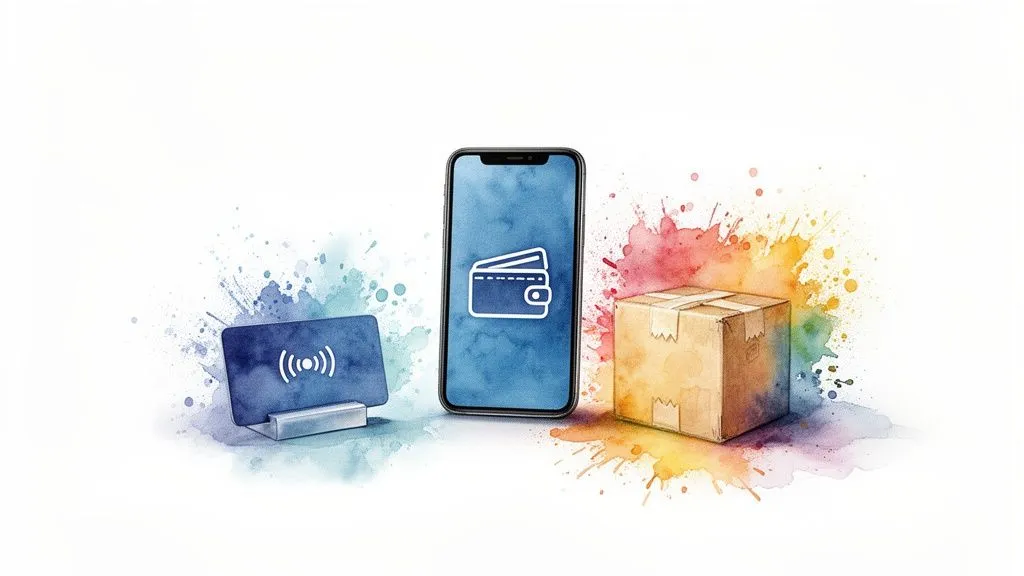
On your online store, the payment methods you offer aren’t just a matter of convenience for your customers. They have a direct and very real impact on the complexity of your accounting management. Every option — from credit cards to bank transfers to marketplaces — has its own rules for your cash flow and for the time you’ll spend on invoice settlement.
The secret is to understand these nuances well enough to anticipate the challenges of bank reconciliation. A payment isn’t just money coming in. It’s a data flow that needs to be tracked, justified, and recorded flawlessly in your books.
Credit cards via Stripe or other providers
Card payments? A must-have. Platforms like Stripe or Adyen make the experience ultra-smooth for your customers. But behind the scenes, for your accounting, it’s a different story.
Let’s walk through the typical path of a transaction:
- Your customer pays, and the amount is immediately charged to their card.
- The payment service provider (PSP), such as Stripe, deducts its transaction fees along the way (a percentage plus a fixed commission).
- A few days later, you receive a transfer to your account. But be careful — it’s a batched transfer that mixes several sales together, net of commissions.
This gap is the main headache. The amount that lands on your bank statement never matches the exact amount of a single invoice. Your mission, should you choose to accept it, is to “break down” this transfer to reconcile it with each sale, while also making sure to properly record the commissions as expenses.
Digital wallets like PayPal
PayPal works on a similar principle, but with one major nuance: the money first passes through a virtual PayPal account before reaching you. The funds aren’t transferred directly to your business bank account.
This intermediary account must be treated as a genuine bank account in your bookkeeping. Every transaction — sale, refund, supplier payment — must be scrupulously recorded there. Reconciliation is therefore twofold: you have to track everything happening in the PayPal account, and then match PayPal’s transfers to your bank.
Marketplace payouts like Amazon or Etsy
Selling on a marketplace like Amazon adds another layer of complexity. The platform is a true hub: it centralizes sales, manages payments, and ultimately pays you a lump sum. But that sum has been reduced by a myriad of fees:
- The well-known sales commission
- Processing fees if you use FBA (Fulfillment by Amazon)
- The cost of storing your products
- Your advertising spend on the platform
Amazon’s payment report is often a dense document, not to say indigestible. Without the right tool, trying to link a single payout to hundreds of individual orders, while correctly breaking down each type of fee, becomes painstaking work. It’s time-consuming and opens the door to errors.
Choosing the right payment tools is therefore crucial not just for the customer experience, but also for your administrative health. To help you see things more clearly, here’s a quick comparison of the most common options.
Comparison of e-commerce payment methods
| Payment method | Average fees | Settlement time | Reconciliation complexity | Best for |
|---|---|---|---|---|
| Credit card (Stripe, Adyen) | 1.5% to 3% + fixed fee | D+2 to D+7 | Medium (batched transfers) | All stores |
| PayPal | 2.9% + fixed fee | Immediate (to PayPal account) | High (intermediary account) | International sales, reassuring customers |
| Marketplaces (Amazon, Etsy) | 10% to 20% | D+14 to D+30 | Very high (multiple fees) | Reaching a wide audience |
| SEPA bank transfer | Low or none | D+1 to D+3 | Simple (single transaction) | B2B, high-value orders |
| SEPA direct debit | Low (often fixed) | D+2 to D+5 | Simple (after setup) | Subscriptions, recurring payments |
Each solution has its pros and cons. Bank transfer is simple to reconcile but less instant, while marketplaces offer immense visibility at the cost of greater accounting complexity.
This is where automation changes the game. A solution like Bizyness, for example, connects directly to your sales channels (Shopify, Amazon…) and your payment processors. It automatically retrieves the details of each transaction, separates revenue, fees and VAT, then reconciles as if by magic the payouts received in your account. What used to take hours becomes a near-instant, error-free operation.
By the way, to dig deeper into money transfers, it’s worth looking into the risks associated with instant bank transfers and understanding the importance of well-secured processes.
Payment terms and legal obligations: the duo to master
Managing invoice settlement isn’t just about checking that the money comes in. Above all, it’s a matter of compliance. A simple oversight, a lack of knowledge of the rules, and it’s your cash flow that suffers, not to mention the risk of disputes. For an online seller, striking the right balance between customer expectations and the regulatory framework is a daily challenge.
Meeting payment deadlines is simply vital for your company’s financial health. It’s easy to forget, but late payments are one of the leading causes of bankruptcy among small businesses. Even though in B2C, payment is often settled on the spot, the rise of “Buy Now, Pay Later” (BNPL) is changing the game and calls for constant vigilance.
The legal framework for payment terms, decoded
In France, the Law on the Modernization of the Economy (LME) sets out clear rules for transactions between professionals. It’s essential to know these rules inside out so that your terms and conditions of sale and your invoices are bulletproof.
To help you see things clearly, here are the deadlines to know:
- The default term: 30 days. If you don’t state anything specific on your invoice or in your terms and conditions, your customer has 30 days to pay you after delivery or the end of the service.
- The negotiated term: 60 days. This is the maximum. You can agree with your customer on a term that doesn’t exceed 60 calendar days after the invoice issue date.
- The alternative: 45 days end of month. A bit more technical, this calculation involves adding 45 days to the invoice date, with the due date set at the end of that same month.
These are legal caps for B2B transactions. Failing to comply exposes you to heavy penalties. My advice: always clearly display your terms so there’s no room for doubt.
Compliant invoices for secure payments
Think of your invoice as your best insurance policy. To be valid, it must include certain mandatory statements about payment terms. Without them, you risk not only seeing payment drag on, but also finding yourself unprotected in the event of a dispute.
Your invoice must therefore imperatively display:
- The payment due date.
- Applicable late payment penalties. Even if you’re lenient, this mention is mandatory and has a real deterrent effect.
- The flat-rate €40 collection fee. It’s owed by any business customer who pays you late.
This is where automation becomes your best ally. A tool like Bizyness lets you set up these rules once and for all. Every invoice generated will then automatically include the correct legal statements, due dates, and penalties. You can sleep soundly, knowing your documents are flawless. To dig deeper into the topic, feel free to check out our complete guide on invoice payment terms.
This rigor becomes all the more crucial with the spread of electronic invoicing. In France, the movement is underway: in 2023, 67% of small and medium businesses were already equipped with invoicing software, preparing for the major Factur-X reform. Automated, compliant management is no longer just a best practice — it’s a necessity for the future.
From payment to bookkeeping: how do you find your way?
When a customer pays you, that’s excellent news. But for your business, the work is just beginning. Behind the scenes, your bookkeeping must take over so that your financial picture stays accurate and up to date. This is a fundamental step for the good health of your e-commerce business.
Concretely, everything revolves around three actions: recording payments, the well-known matching of customer accounts, and finally, bank reconciliation. Each step ensures that every euro coming into your accounts is properly linked to the right sale.
What exactly is accounting matching?
The term accounting matching (or “lettrage”) might sound a bit intimidating, but the idea is quite simple. Imagine two lists: on one side, all the invoices you’ve issued that are awaiting payment; on the other, all the payments you receive into your account. Matching is the act of pairing each payment received with the correct invoice.
It’s a bit like a matching game. Once an invoice and its payment are linked, the account is cleared.
This operation is much more than a simple administrative formality. It’s what lets you know, at a glance, which invoices have been paid and, more importantly, which ones are still outstanding. Without precise matching, it’s impossible to properly track your receivables and know who still owes you money.
Tracking deadlines is key to triggering this process at the right time.
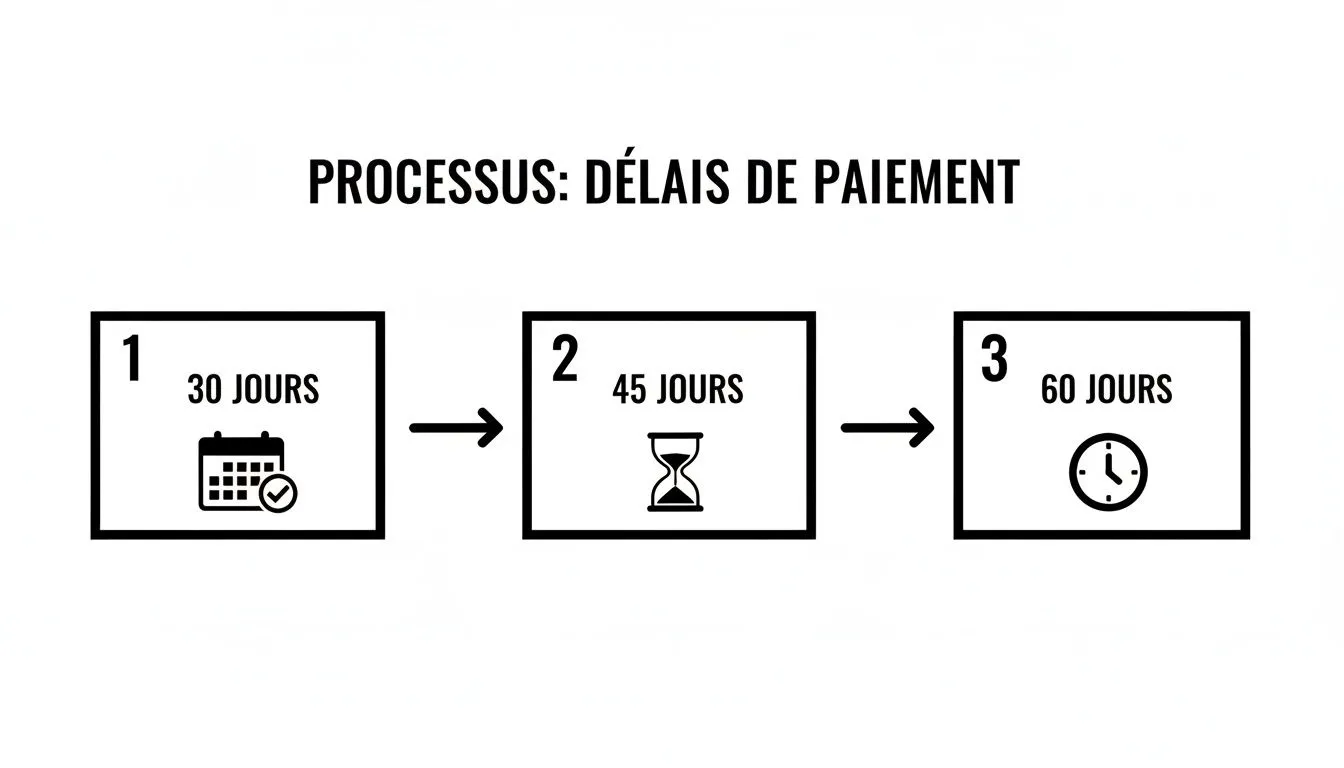
Keep these 30, 45, or 60-day deadlines in mind. They’re the starting point for your accounting actions to maintain healthy cash flow.
The challenge of matching in e-commerce
For an online seller, doing this work by hand quickly turns into a nightmare. We’re not talking about ten invoices a month, but potentially hundreds, even thousands of transactions coming in from everywhere: Shopify, Stripe, Amazon, PayPal…
The real challenge? The payments landing in your bank account are rarely individual payouts. They’re batched transfers, already net of platform commissions. A single Stripe transfer can correspond to 50 different sales, minus their fees. Trying to reconcile that single amount with 50 invoices in a spreadsheet exposes you to hours of work and near-inevitable errors.
In 2024, the tight economic climate is putting pressure on payment terms. According to a Banque de France study, nearly 25% of business failures are linked to cash flow problems. Given that SMEs suffer 30% in unpaid invoices, it’s easy to see that automation is no longer a luxury but a genuine necessity for securing your finances.
This is where specialized tools completely change the game.
A solution like Bizyness was designed specifically for this. By connecting directly to your sales platforms (Shopify, Amazon…) and your bank accounts, it automates the entire process. The tool identifies batched transfers, “breaks them down” to find the individual sales, matches each payment to its invoice, and records the commissions along the way. What used to take you hours is done in a few seconds, without you having to lift a finger. The result? Reliable accounting data for your FEC export (French statutory accounting records file) and real peace of mind.
Setting up an effective payment reminder strategy
Unpaid invoices aren’t just a B2B issue, far from it. In e-commerce, a simple failed subscription payment or an order dispute can quickly put a strain on your cash flow. That’s why it’s crucial to set up a proactive reminder strategy, designed to secure invoice settlement without damaging the relationship with your customers.
A good strategy isn’t about harassing people. It’s above all about communicating clearly, progressively, and, most importantly, at the right time. The idea is simple: prevention is better than cure.
Building a progressive reminder sequence
A reminder sequence that actually works starts before the due date even arrives. The goal is to create a process that adapts to the situation, moving from a simple friendly reminder to firmer communication if things drag on.
Here’s what a well-oiled reminder process looks like:
- The preventive notification (D-3): A few days before the due date, a courteous email that simply reminds the customer the invoice is coming due. It’s seen as good customer service and helps avoid quite a few oversights.
- The first friendly reminder (D+2): The date has passed. A second email, still in a neutral tone, assumes it’s simply an oversight. It’s the chance to attach the invoice again and include a direct payment link to make things easier.
- The firm reminder (D+15): Still nothing. The tone shifts slightly and becomes more direct. The message recalls the terms of sale and mentions the late payment penalties provided for by law.
- The final notice before formal demand (D+30): If the invoice remains unpaid, this is your last attempt at friendly communication before considering more formal procedures.
The challenge is finding the right balance between firmness and empathy. A customer with a simple expired-card issue shouldn’t be treated like a bad payer. A smart, automated system lets you personalize these communications so you don’t get it wrong. To go further, feel free to check out our detailed guide on following up on an unpaid invoice, which offers concrete templates.
Automation, the key to acting quickly and effectively
Let’s be honest, manually tracking every due date is an impossible mission for an online seller. The key to healthy management of late payments is automation. A system that alerts you as soon as a due date has passed is a real asset for your cash flow.
The current economic climate makes this vigilance all the more crucial. A recent study revealed that in 2025, 86% of French companies faced payment delays, with an impact rated “critical” on cash flow for more than half of small businesses. These delays are not without consequences: they contribute to a record number of business failures, of which 25% are directly linked to a cash flow shortfall. To learn more, you can check out the full results of the study on payment behavior.
This is precisely where platforms like Bizyness add tremendous value. By centralizing the payment status of all your invoices, the tool gives you a clear, real-time view of due dates. You can configure reminder scenarios that trigger automatically, freeing up valuable time while ensuring rigorous, professional follow-up. In short, you act fast, protect your cash flow, and maintain a healthy customer relationship.
Automation: a necessity to secure your growth
Let’s be clear: invoice settlement in e-commerce isn’t just an administrative formality. It’s the engine of your cash flow. It’s what determines your ability to buy stock, invest in marketing, and simply grow without stumbling.
The era of the Excel spreadsheet where everything was tracked by hand is well and truly over. Between sales across multiple channels, international payments, and the complexity of VAT (with OSS/IOSS), manual management quickly becomes a nightmare. It’s not only a monumental waste of time, but also a real danger to your cash flow. One data-entry mistake, one missed follow-up, and it’s your profitability that takes the hit.
Automation is no longer a luxury, it’s a foundation
Faced with this reality, automating is no longer an option reserved for big companies. It has become the baseline for any e-commerce business worth its salt. By automating, you turn a legal and accounting constraint into a genuine growth lever, giving you a real-time, effortless view of where you stand financially.
The idea isn’t to work more, but to build a financial system that works for you. A system that locks in every transaction, from the order all the way to its accounting entry, without you having to lift a finger.
When every sale is automatically linked to its counterpart in your books, you finally free yourself from repetitive, low-value tasks. That time, you can reinvest where it truly counts: improving your products, refining your marketing, or taking care of your customers.
Turning a constraint into a competitive advantage
This is exactly the spirit in which a platform like Bizyness was designed. It doesn’t just issue invoices. It drives the entire financial cycle of your e-commerce business:
- It connects directly to your sales platforms (Shopify, Amazon, etc.) and your payment processors (Stripe, PayPal).
- It automatically reconciles batched transfers with the corresponding individual orders. This is often where a huge amount of time gets lost!
- It intelligently applies the correct VAT rules, even for your international sales.
- It prepares all the data for a clean, reliable accounting export (the well-known FEC).
This integrated approach gives you peace of mind that’s priceless. To go further and see how to implement this kind of system, you can check out a guide on process automation for SMEs which offers very concrete pointers.
Ultimately, automating your invoice settlement means choosing to steer your growth on sound financial foundations, rather than flying blind.
Don’t let administrative complexity hold your growth back any longer. With Bizyness, turn your e-commerce accounting into a strategic asset. Discover how to secure your growth starting today.
