

 Français
Invoicing without VAT between businesses: a practical guide
Invoicing without VAT between businesses - a clear guide on the conditions, exemptions and best practices for issuing your invoices correctly.
Issuing an invoice without VAT between businesses is not an option — it is a legal obligation in very specific situations. This applies when the usual tax mechanism doesn’t apply, notably if you’re under the VAT exemption scheme (franchise en base), if you make intra-EU sales, or if you export goods.
Understanding when to invoice without VAT
At first glance, invoicing without tax can seem like a headache. Yet the basic principle is quite simple: VAT is a tax on final consumption. In certain business-to-business (B2B) transactions, the seller simply doesn’t have to collect it, because the tax liability is either shifted or cancelled.
This isn’t a simple omission on your invoice. Each exemption case follows a well-defined logic and requires specific legal wording. The three most common situations are:
- The VAT exemption scheme (franchise en base): a scheme designed for micro-entrepreneurs and small businesses that stay under certain revenue thresholds.
- Intra-EU deliveries: this applies if you sell goods or services to a business client based in another European Union country.
- Exports: this case applies when you sell goods to clients located outside the European Union.
To help you see things clearly, the decision tree below lets you quickly identify which situation you’re in.
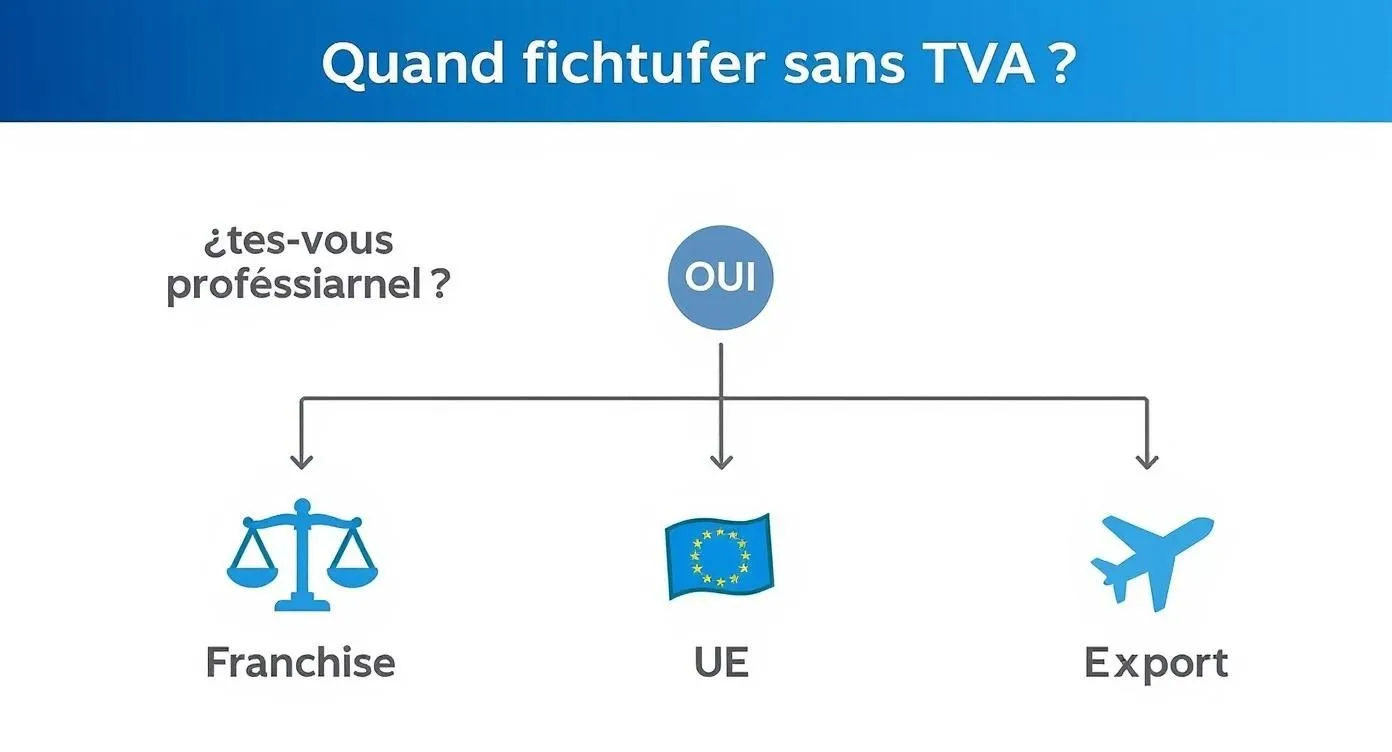
As you can see, the regime that applies depends mainly on your own business status and your client’s location.
The VAT exemption scheme case
The most common situation for invoicing without VAT is undoubtedly the VAT exemption scheme (franchise en base). In France, this option is strictly regulated. It applies to businesses whose annual revenue does not exceed €91,900 for commercial activities and €36,800 for services.
The benefit? A business that stays within these caps doesn’t have to charge VAT, which considerably lightens its accounting obligations. The trade-off is that it also can’t reclaim the VAT it pays on its own business purchases.
Be careful: for an invoice issued under this scheme to be compliant, it must include the mandatory legal wording: “VAT not applicable, art. 293 B of the French Tax Code (CGI)”. If you’d like to dig deeper into the thresholds and obligations, you can consult the official information. You’ll find more details on the VAT exemption scheme on economie.gouv.fr.
Decoding the VAT exemption scheme

If you come across an invoice without VAT between businesses, chances are it’s thanks to the VAT exemption scheme. This is the most frequent case, and for good reason: it was designed to simplify life for the smallest structures, such as the many freelancers and micro-businesses in France.
The principle is as simple as can be. As long as your annual revenue stays below a certain ceiling, you’re exempt from collecting VAT on your sales. No more periodic VAT returns, just lighter bookkeeping!
Of course, to enjoy this benefit, you have to play by the rules and not exceed the thresholds set by the tax authorities. These caps depend directly on the nature of your activity.
Keeping an eye on revenue thresholds
To stay within the rules, there’s one golden rule: vigilance. You need to watch two thresholds closely.
- €91,900 if you sell goods, merchandise, or supplies, or if you run on-site/takeaway catering and accommodation services.
- €36,800 for all other services, which includes liberal professions.
These figures are the base thresholds. The tax authorities have also allowed some leeway with increased thresholds (€101,000 and €39,100 respectively). This acts as a kind of tolerance zone. If you’re between the base threshold and the increased threshold for two consecutive years, you move to the standard VAT regime the following year.
Be careful: if you exceed the increased threshold during the year, the change is immediate. You must then charge VAT starting from the first day of the month in which the threshold was exceeded.
The consequence is far from trivial. Exceeding the increased threshold requires you to reissue your invoices for the current month to add VAT. It’s therefore best to plan ahead to avoid dealing with complex and potentially costly corrections.
The showdown: pros versus cons
The VAT exemption scheme is a great opportunity, but it isn’t always the miracle solution. It’s crucial to weigh the pros and cons against your own situation.
The obvious advantage is administrative simplicity. No VAT returns to file — that’s a huge time saving you can reinvest in your business. It’s also a commercial edge, especially if your clients are individuals: without VAT, your prices are mechanically more attractive.
But there’s a flip side, and it’s a significant one: you cannot deduct VAT on your own business purchases. If you invest heavily in equipment, software (a web developer, for example) or raw materials (an artisan creator), you pay VAT in full, without ever recovering it.
This non-deductible VAT turns into a pure cost that eats into your margin. Before you get started, grab your calculator and estimate the real impact of this non-recoverable VAT on your profitability.
How do you write an invoice under the VAT exemption scheme?
Under this scheme, your invoices need to be flawless. To justify the absence of VAT, a legal mention is absolutely mandatory. It’s non-negotiable and it’s what guarantees the validity of your document.
Here’s the magic formula to write on every one of your invoices: “VAT not applicable, art. 293 B of the CGI”.
Forgetting this simple phrase can cost you dearly in the event of a tax audit. Fortunately, invoicing tools like Bizyness are there to spare you this kind of cold sweat. They automatically add the correct legal mentions so your invoices are always compliant, without you having to think about it.
Reverse charge VAT for trade within Europe
When you sell a product or service to a business based in another European Union country, the rules of the game change completely. In this context, we’re no longer talking about the VAT exemption scheme. The key mechanism to master is reverse charge (autoliquidation in French).
It’s a rather clever system, designed to smooth trade between European businesses. In practice, instead of charging French VAT, you’ll issue an invoice without VAT. It’s your client who will take care of declaring and paying VAT in their own country.
For you, the seller, the benefit is huge: no need to register for VAT in every country where you have clients. For the buyer, the operation is transparent. They declare the VAT they owe, then deduct it on the same return. The operation is therefore neutral for them, but it is recorded.
What are the conditions for applying reverse charge?
Be careful, this mechanism isn’t automatic. For your tax-free invoice to be valid, you and your client must meet two absolutely essential conditions.
- You, the seller, must have an intra-EU VAT number. If you’re already under the standard VAT regime, you have one. However, if you’re under the VAT exemption scheme, you’ll need to apply for one from your local Business Tax Office (SIE) to trade in Europe.
- Your client must also provide you with their valid intra-EU VAT number, issued by their country.
This is a point to never overlook. If your client’s VAT number is invalid, the exemption falls through. In the event of an audit, the French tax authorities can claim from you the amount of VAT you should have charged.
Fortunately, there’s an official and free tool to check all this: the European Commission’s VIES (VAT Information Exchange System) service. Expert tip: always take a screenshot of the validation. It will serve as proof if any issue arises.
What legal mentions should be added to the invoice?
Once you’ve properly verified your client’s VAT number, your invoice must include specific information to justify the absence of tax. These mentions are of course different from those for the VAT exemption scheme.
Here are the two elements that must absolutely appear:
- Your intra-EU VAT number as well as your client’s.
- The legal mention justifying the exemption.
For a delivery of goods, the standard phrase is: “VAT exemption, article 262 ter I of the CGI”. For a service, you’d instead use: “Reverse charge by the recipient, article 283-2 of the CGI” or an equivalent wording in your client’s language.
To help you visualize the differences, this table compares the requirements for a sale within France and a B2B sale in another EU country.
Comparison of VAT invoicing: domestic sale vs. intra-EU sale
| Element | Domestic sale (France to France) | Intra-EU sale (France to Germany) |
|---|---|---|
| Invoicing | Invoice with French VAT (e.g. 20%) | Invoice without VAT (net of tax) |
| VAT number required | Your SIREN/SIRET and VAT number | Your intra-EU VAT number AND your client’s |
| Legal mention | No specific VAT mention required (except special cases) | Mandatory mention: “Reverse charge by the recipient” or “VAT exemption” |
| VAT return (CA3) | VAT collected to be declared and paid | Revenue to be declared under “Non-taxable transactions” |
| Additional declaration | None | Intra-EU Trade in Goods Declaration (DEB) or Services (DES) to be filed |
This table clearly shows that while invoicing may seem simpler (no VAT to calculate), the resulting reporting obligations are quite specific and should not be overlooked.
Managing these various cases can quickly become a headache. To get a clearer picture, feel free to read our guide on calculating intra-EU VAT, which covers several scenarios in detail. Tools like Bizyness make life easier by automatically generating the correct mentions based on your client’s country, ensuring you’re always compliant.
Invoicing without VAT: other cases to know
The VAT exemption scheme and intra-European trade aren’t the only situations where you can invoice without VAT. Other scenarios, perhaps less common for some, exist and deserve your full attention, especially if you work internationally or in very specific sectors such as construction.
These scenarios rely on precise tax rules, but the result is the same: a tax-free invoice that must be perfectly justified. The goal is to bulletproof your transactions so you can sleep soundly in the event of a tax audit.
Exports of goods outside the European Union
Selling a product to a business client based outside the European Union? This is what’s called an export. Good news: these sales are, by nature, exempt from French VAT. The logic is simple: goods that will be consumed outside our tax territory aren’t taxed.
- Concrete example: Imagine a French SME selling machinery to a factory in Japan. The invoice sent to the Japanese client will be issued without VAT.
Be careful: for this exemption to be valid, you absolutely must keep proof that the goods actually left EU territory.
This is where everything is decided. You must be able to provide customs documents, such as the Single Administrative Document (DAU) stamped by customs, or proof of transport (waybill, bill of lading, etc.). Without these supporting documents, the tax authorities could challenge the exemption.
Domestic reverse charge in certain sectors
Reverse charge VAT doesn’t stop at borders. It also applies within France, in specific sectors, often to combat fraud. The best-known example is the construction industry.
The principle is as follows: a construction company (the main contractor) hires a subcontractor for a job. The latter will then send them an invoice without VAT. It’s the main contractor who takes care of collecting and paying the corresponding VAT to the State.
This mechanism applies to a large number of building projects. For the subcontractor, it’s a simplification, but there’s one condition: adding a mandatory legal mention on the invoice to stay compliant.
- Mention to add: The invoice must include the mention “Reverse charge - VAT due by the recipient”.
Whether you’re a large company or a self-employed subcontractor, this rule applies. It ensures that VAT is properly paid on the full amount billed to the end client. Ignoring this procedure can expose both businesses to penalties. Vigilance is therefore essential when managing subcontracting.
Writing a fully compliant invoice without VAT
Issuing an invoice without VAT doesn’t mean you can afford to be less rigorous. Quite the opposite. For your invoice to be watertight in the eyes of the tax authorities, it must be absolutely flawless and clearly justify why no tax is being collected.
First, every invoice without VAT between businesses must contain the basic information. This means the full identity of your business and your client’s, the date, the invoice number, a clear description of the services or products, and of course the amounts excluding tax. To make sure you don’t forget anything, our guide on mandatory invoice mentions is here to help.
But the most important point, the one that makes all the difference between a valid invoice and one that puts you at risk, is the legal mention justifying the absence of VAT. Without this small phrase, your document loses all legal value and exposes you to a tax reassessment in the event of an audit.
Legal mentions to know by heart
Each exemption case has its own wording, citing the applicable article of law. This isn’t a mere recommendation — it’s an obligation. It’s your proof that you know and follow the tax rules.
Here are the exact mentions to use depending on your situation:
-
If you’re under the VAT exemption scheme
This is the most common case for micro-entrepreneurs or businesses whose revenue stays below certain thresholds.The phrase to write: “VAT not applicable, art. 293 B of the CGI”
-
If you’re making an intra-EU delivery of goods
You’re selling goods to a business client based in another European Union country? This mention is non-negotiable.The phrase to write: “VAT exemption, article 262 ter I of the CGI”
-
If you’re providing an intra-EU service
Here, it’s the reverse charge mechanism that comes into play for your European business client.The phrase to write: “Reverse charge by the recipient, article 283-2 of the CGI”
-
If you’re a subcontractor in the construction industry
This specific domestic reverse-charge case for the French construction sector also requires its own mention.The phrase to write: “Reverse charge - VAT due by the recipient”
Getting into the habit of systematically including the correct mention is your best insurance against unpleasant surprises. It’s this detail that legitimizes your approach and secures your transactions. By following this simple checklist, you turn what could seem like an administrative headache into a simple formality.
Anticipating the impact of e-invoicing
E-invoicing is coming, and faster than you might think. If you think your VAT exemption scheme protects you from this reform, it’s time to take a serious look at the issue. In reality, this major shift concerns all businesses, including those issuing an invoice without VAT between businesses.
The purpose of this transition is twofold: on one hand, simplify life for businesses with their tax returns, and on the other, crack down on VAT fraud. In practice, even if you don’t collect this tax, your invoices to other businesses will have to go through a certified e-invoicing platform (PDP) or the public invoicing portal (PPF).
The end of PDF invoices sent by email
It’s fair to say it: this is the end of an era. Sending a simple PDF invoice by email for your B2B transactions will soon no longer be possible. The tax authorities want full visibility over business transaction flows in order to eventually pre-fill VAT returns automatically.
With the reform, all VAT-liable businesses, including those benefiting from the VAT exemption scheme, will have to transmit their invoicing data to the authorities. This measure aims to pre-fill VAT returns and fight more effectively against fraud, which represents several billion euros in lost revenue for the State each year. To learn more about this transition, you can check the details on the Ministry of Economy’s portal.
Getting ready now with the right tools
Getting ahead of the curve is probably the best strategy. Instead of enduring this new obligation as a constraint, why not see it as a chance to modernize your management? Online invoicing software like Bizyness is already designed to align with these upcoming requirements.
These tools make life easier by automating the creation of compliant invoices, with the correct legal mentions and in structured formats like Factur-X. By choosing the right solution today, you save valuable time day-to-day and ensure a smooth transition to the new rules, without stress or unpleasant surprises.
Frequently asked questions about invoicing without VAT
Let’s wrap up with the questions that come up most often. These are the kind of practical details that can quickly become a headache when you’re out in the field.
Is the VAT exemption scheme mandatory?
No, not at all! Even if your revenue qualifies you for the VAT exemption scheme, you’re entirely free to choose the standard VAT regime instead.
Why would you do that? It’s a purely strategic decision. If you’re planning major investments or have a lot of business expenses, opting for VAT will let you reclaim it on your purchases. It’s worth doing the math to see what’s most profitable for you.
What if I exceed the thresholds during the year?
This is the classic scenario that requires vigilance. If you exceed the increased thresholds, you move into the world of VAT starting from the first day of the month in which the threshold was exceeded.
In practice, this means you must immediately apply VAT on your invoices. You’ll even need to send corrected invoices to your clients for all transactions billed during that month. Good tracking of your revenue is therefore essential to avoid being caught off guard.
A crucial point: before sending a reverse-charge invoice to a European client, verifying their VAT number is not optional. It’s your responsibility to make sure it’s valid. Without that, no exemption will hold up in the eyes of the authorities.
How do I check an intra-EU VAT number?
Before every reverse-charge invoice, take a few seconds to verify your European client’s VAT number. It’s a habit worth having.
The simplest and safest way is to use the European Commission’s official tool: the VIES (VAT Information Exchange System) service. It’s free, instant, and provides the proof of compliance you’ll need in the event of an audit.
Ready to invoice with total peace of mind, without worrying about legal mentions and special cases? Bizyness takes care of everything for you, including invoicing without VAT.
Discover how Bizyness can simplify your life today at bizyness.fr
