

 Français
The complete guide to late payment penalties for B2B e-commerce
Master late payment penalties to protect your cash flow. Our guide covers the calculation, mandatory notices, and how to apply them effectively.

Late payments aren’t just a minor administrative hiccup. For a B2B e-commerce business, they’re a real threat to your financial health. Fortunately, the late payment penalty is a legal tool designed precisely to protect you. It compensates for the harm you suffer when a business customer fails to pay on time. It’s a right, and it’s crucial for the security of your cash flow.
Why late payments are poison for your e-commerce business

For an online store, every day of late payment translates into a cash shortfall. That money, stuck in a customer’s account, is money you can’t reinvest in your inventory, your marketing, or the development of new products.
Imagine an important client paying several weeks late. The impact is immediate. You could find yourself struggling to pay your own suppliers, cover payroll, or even fund the advertising campaigns that drive your next sales.
The domino effect of unpaid invoices on your growth
Failing to manage late payments means risking a dangerous domino effect. A first unpaid invoice weakens your cash flow. As a result, you postpone investments that were nonetheless essential. Your ability to innovate and stay competitive is directly held back.
The situation in France only makes things worse. Payment terms keep stretching out. The average delay now reaches 13.6 days, placing us above the European average. Worse still, 61% of businesses report an increase in these delays. Major delays — over 30 days — are becoming more common and mostly affect SMEs.
The late payment penalty isn’t there to create conflict. It’s a protective lever. Applying it simply reminds both parties of the professional framework of your business relationship and encourages respect for commitments made.
Rather than seeing it as a punitive measure, you should build it into your processes as a guarantee of stability. It helps maintain healthy relationships by setting clear rules from the outset.
This guide will give you all the keys to moving toward proactive management. You will learn to:
- Understand the legal framework that protects you.
- Calculate and apply late payment penalties without making mistakes.
- Automate the entire process to secure your cash inflows without spending hours on it.
By mastering these points, you’ll turn what is today a major risk into a well-oiled management process, essential to ensuring the longevity of your business. To go further, you can read our full article on effectively managing late payments.
The legal framework for late payment penalties: what you need to know
To effectively protect your cash flow, you need to fully understand the rules of the game. The late payment penalty isn’t just a commercial clause you can negotiate; it’s a very solid legal tool, designed to secure payments between professionals. Think of it as your best ally against the delays that drag down your cash flow.
It was the French Law for the Modernization of the Economy (LME) that laid the foundations of this system. Since it came into force, applying penalties is no longer a choice: it’s a legal obligation in every B2B transaction. The goal was simple: rebalance business relationships and protect smaller companies from the extended payment terms imposed by some clients.
An obligation, not a favor
In the professional world, the late payment penalty is due “as of right.” That small legal phrase changes everything. In practice, it means you don’t even need to send a reminder letter or a formal notice for your right to kick in.
From the very first day after your invoice’s due date, the penalty clock starts running automatically. Your client is legally required to pay you these amounts, whether you claim them immediately or later. This automatic nature is a huge advantage, as it gives you an indisputable legal basis to act.
The fact that the penalty is due “as of right” removes all ambiguity. It’s a right acquired as soon as a delay is observed, which immediately strengthens your position as a creditor without you having to launch complex procedures.
This approach radically simplifies the management of unpaid invoices. All it takes is for the payment deadline to be exceeded for your claim to be legitimate. To cover the topic in full, take a look at our complete guide on invoice payment terms.
The pillars of the legal framework
The system rests on a few key elements you need to master to apply penalties correctly.
- The statutory interest rate: This is the percentage used to calculate the penalty amount on the sum owed. The law provides a very precise framework for defining it.
- The €40 flat-rate compensation: A fixed amount of €40 added to the late interest to compensate for your initial collection efforts.
- The mandatory notices: For everything to be compliant, certain information must absolutely appear on your invoices and in your general terms and conditions of sale.
These three pillars form a coherent and, above all, highly deterrent system.
What interest rate should you apply?
For the late payment penalty’s interest rate, you have two options. Either you use the European Central Bank’s (ECB) refinancing rate increased by 10 points, or you set your own rate in your terms and conditions of sale.
Be careful, though — you don’t have total freedom. The legislator has set a floor: your custom rate can never be lower than three times the statutory interest rate in force. This is one of the strong measures of the 2008 LME law, designed to ensure a minimum level of pressure on late payers.
Don’t forget the €40 flat-rate compensation!
In addition to the pro-rated late interest, the law provides for an additional compensation. For each invoice paid late, your business client automatically owes you a fixed amount of €40.
This compensation was created to cover your administrative costs related to collection (the time you spend on it, the cost of sending reminders, etc.). It’s due as of right, with no need for you to provide any supporting documentation, and it’s added on top of the penalty amount.
And what if your actual costs are higher? For example, if you have to hire a collection agency, you can absolutely claim additional compensation, provided you can justify it. To fully understand all the contractual obligations governing sales, a careful read of the General Terms and Conditions of Sale is essential.
Calculating late payment penalties without making mistakes
Moving from theory to practice can seem a bit complex, but rest assured — calculating late payment penalties is actually a very logical exercise. All you need to do is apply a simple formula that lets you precisely quantify the harm caused by a lagging payment. Once you understand the mechanism, you’ll be able to apply it confidently to all your unpaid invoices.
The basic formula for determining the amount of the late payment penalty is fairly straightforward:
Penalty amount = (Invoice amount including tax x Interest rate) x (Number of days late / 365)
Every element of this formula matters and must be clearly defined for your calculation to be accurate and unchallengeable. Let’s break down each variable together.
The calculation base: always start from the total amount including tax
The first reflex is to always base your calculation on the total invoice amount, including tax. This is exactly the amount your client should have paid you by the agreed date. Using the amount excluding tax would be a mistake that would understate the penalties owed to you.
The interest rate: the heart of the engine
This is the percentage that determines the scale of the penalties. As we’ve seen, you have two options: either use the ECB’s refinancing rate increased by 10 points (currently 4.5% + 10% = 14.5%), or set your own rate in your general terms and conditions of sale.
Be careful — this custom rate can’t be set just any way. It can never be lower than three times the statutory interest rate. For the first half of 2024, this rate is 5.07% for professionals, which puts the floor for your custom rate at 15.21%.
A friendly tip: choose a clear rate and state it explicitly on your invoices. It makes the calculation transparent and cuts short any potential dispute. Clarity is the best prevention against litigation.
The number of days late: every day counts
The count is simple: it starts the day after the invoice’s due date and stops on the day you actually receive the money in your bank account. Not before.
The diagram below neatly summarizes the legal process triggered in the event of a delay, from the law that underpins it to the application of compensation.
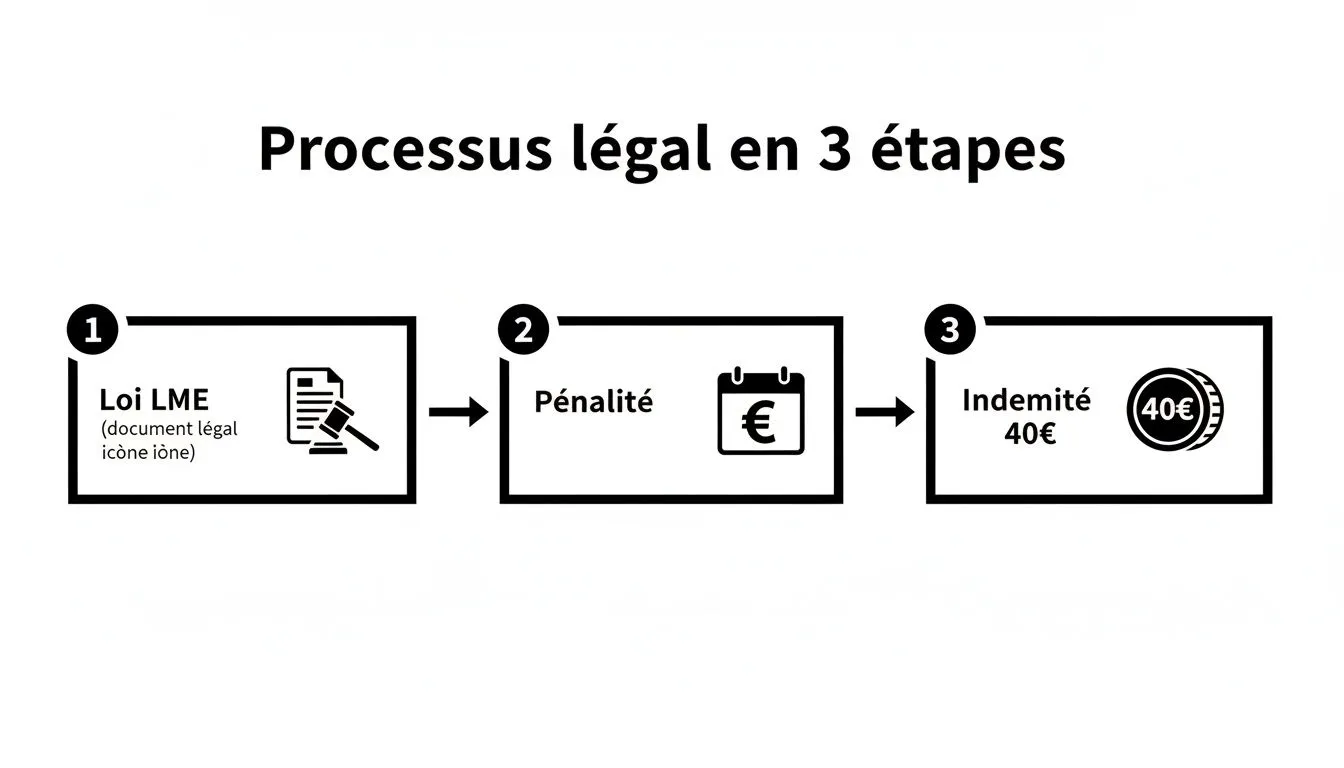
This visual clearly shows that the financial penalty and the flat-rate compensation are two complementary tools provided by law to protect you.
Don’t forget the €40 flat-rate compensation!
This is a crucial point. In addition to the calculated penalties, you must systematically add the flat-rate compensation of €40 for collection costs. It applies to each invoice paid late. It’s a fixed amount, regardless of the invoice amount or how long the delay lasted.
Practical case #1: a Shopify seller and a B2B order
Let’s put ourselves in a scenario. You run a store on Shopify and sold €5,000 including tax worth of equipment to another business. The invoice was issued on March 1st, due on March 31st. Your client only pays on April 30th.
- Invoice amount: €5,000 including tax
- Days late: 30 days (the entire month of April)
- Applicable rate (ECB rate + 10 points): 14.5%
Let’s apply the formula: (€5,000 x 0.145) x (30 / 365) = €59.59
And of course, we add the flat-rate compensation: €59.59 + €40 = €99.59
The total amount to claim on top of the original invoice is therefore €99.59.
Practical case #2: a SaaS software publisher
Another example. You’re a software publisher and you bill a marketing agency €1,200 including tax for an annual subscription. The due date was January 15th, but the transfer only arrives on March 20th.
- Invoice amount: €1,200 including tax
- Days late: 65 days (from January 16th to March 20th)
- Applicable rate (you set a rate of 15% in your terms and conditions): 15%
Let’s calculate the penalties: (€1,200 x 0.15) x (65 / 365) = €32.05
Don’t forget the €40 compensation: €32.05 + €40 = €72.05
The total penalties and compensation you can claim amount to €72.05.
Mastering this calculation is truly the first step toward asserting your rights. The next one is making sure all your commercial documents include the mandatory legal notices so everything is fully compliant.
Adding the mandatory notices to all your invoices
To be able to claim a late payment penalty without it being disputed, everything needs to be in order from the start. Your best weapon is to be beyond reproach administratively. In short, your right to demand compensation directly depends on the presence of certain notices in your documents, and especially on your invoices.
A simple omission can cost you dearly and strip you of this right, even if your client’s late payment is obvious. Rigor is therefore essential — there’s no way around it.
The crucial information you must never forget
The French Commercial Code is very clear on this: every invoice sent to a business client must explicitly state the payment terms. This transparency is the foundation for securing your receivables and, quite often, for discouraging bad payers before they even become one.
Here’s what must absolutely appear on your invoices:
- The late payment penalty rate: State clearly the rate you’ll apply. For example: “Late payment penalty rate: 15%.” If you write nothing, the statutory rate (ECB refinancing rate plus 10 points) applies by default. But spelling it out explicitly is far more professional.
- The terms of application: You must clearly state that penalties are due starting the day after the due date, with no reminder required. There’s no need to send a follow-up for the penalty to apply.
- The amount of the flat-rate compensation: Mentioning the €40 compensation for collection costs is a legal obligation. A simple sentence will do, such as: “In the event of late payment, a flat-rate compensation of €40 for collection costs will be due.”
Keep in mind that this information must also appear in your General Terms and Conditions of Sale, which form the contract binding you to your client. For a full overview, feel free to check our guide on mandatory invoice notices — it’s an excellent resource.
Be careful: forgetting these notices isn’t a minor error. In the event of a DGCCRF inspection, their absence from your invoices can lead to a hefty administrative fine — up to €75,000 for an individual and €2 million for a company.
Ready-to-use wording examples
To save you time, nothing beats concrete examples. Here are clauses you can plug directly into your terms and conditions of sale or into the footer of your invoices. Just adapt them to your situation.
This table gives you a few pointers to make sure you’re compliant.
Example wording for your commercial documents
| Document | Recommended clause | Key point |
|---|---|---|
| Invoice | ”In accordance with Article L. 441-10 of the French Commercial Code, late payment penalties are due in the absence of payment on the day following the payment date stated on the invoice. The rate of these penalties is 15% per year. A flat-rate compensation of €40 for collection costs will also be due.” | A clear, direct wording that includes every element required by law. |
| Terms and conditions | ”Any payment made after the agreed payment date will trigger late payment penalties calculated at a rate equal to three times the statutory interest rate in force, as well as flat-rate compensation for collection costs of €40, without prejudice to the possibility of claiming additional compensation upon proof.” | More detailed, it sets a solid framework for all your future transactions. |
As you can see, rigor is essential.
Using an invoicing solution like Bizyness can really change your life on this front. You configure these notices once and for all, and they’re automatically added to every new invoice. It’s total peace of mind: no more risk of forgetting anything, and the guarantee of always being compliant, without even having to think about it.
Don’t take the regulation lightly: the risks are very real
Believing that late payment penalties are just an extra line on an invoice means exposing yourself to serious setbacks. Whether it’s a deliberate omission or simple negligence in managing your payments, the consequences can be far more serious than a mere dispute with a client. Compliance isn’t a constraint — it’s genuine protection for your business.
The referee in this game is the DGCCRF (the French Directorate General for Competition Policy, Consumer Affairs and Fraud Control). Its agents have the power to scrutinize your commercial documents closely and penalize the slightest deviation.
DGCCRF administrative sanctions: what you need to know
During an inspection, the DGCCRF focuses on two essential aspects: the presence of mandatory notices on your invoices and compliance with the maximum payment terms allowed by law. A single incomplete invoice, missing the late payment penalty terms, is enough to trigger a procedure.
And make no mistake — these failures are taken very seriously. Lawmakers wanted to make an example, in order to put an end to bad practices that choke smaller businesses. The sanctions are therefore deliberately designed to deter.
Think of it this way: every invoice you issue is a business card for your professionalism. By following the rules, you’re not just complying with the law — you’re strengthening your credibility and protecting yourself from potentially devastating financial penalties.
Fines that leave no room for error
To understand just how sensitive this topic is, you only need to look at the amount of the fines. They’re designed to make you think twice, no matter the size of your business.
The numbers speak for themselves:
- For an individual, such as a sole trader, the fine can climb up to €75,000.
- For a legal entity, meaning a company, the cap reaches €375,000.
And that’s not all. In the event of a repeat offense within two years, these amounts can simply be doubled. Tolerance is close to zero. The effectiveness of this firmness has, moreover, been proven, with a 18.5% increase in fine notifications and pre-fine warnings in recent years. To dig deeper into the topic, feel free to check out this information on payment terms in France.
Faced with this reality, continuing to manage invoicing manually becomes a risky bet. The slightest oversight can be very costly. This is where an automated invoicing system really proves its worth: by ensuring every invoice is flawless, it becomes an indispensable safety net for your business.
How to automate the management of unpaid invoices and penalties

Knowing the rules around late payment penalties is one thing. Applying them day to day without wasting a huge amount of time is another. Between us, manually tracking invoices and chasing due dates is exactly the kind of repetitive, error-prone task that quickly drags down productivity.
Fortunately, there’s a much better approach. Imagine, for a moment, a system that monitors your invoices for you, calculates penalties down to the cent, and sends reminders at the right time, without you having to think about it. That’s exactly what a financial automation platform like Bizyness does.
Putting an end to the mental burden of unpaid invoices
Automation is much more than a gadget. It transforms an administrative chore into a smooth, and frankly much calmer, process. Instead of juggling spreadsheets and calendar reminders, you set the rules once and for all. From then on, the system takes over.
This proactive approach changes everything for the health of your cash flow. You no longer suffer through late payments — you anticipate and manage them in a structured way. The impact on your cash reserves — and on your peace of mind — is immediate.
The benefits are felt right away:
- Effortless compliance: The legal notices on the penalty rate and the €40 compensation are automatically added to every invoice. Say goodbye to the risk of forgetting something that could undermine your claims.
- Real-time tracking: A clear dashboard shows you at a glance which invoices have reached their due date or are approaching the deadline.
- Smart reminders: Polite but firm reminders go out automatically to your clients starting on the very first day of delay, then at intervals you choose.
- Instant calculations: No more calculator. The system computes the exact amount of penalties owed, never forgetting the flat-rate compensation.
Automation isn’t just about saving time. It’s a genuine safety net that ensures your rights are consistently enforced, strengthening the predictability of your cash flow.
Real-world scenarios with a real impact
To make this more concrete, let’s see what it looks like in the daily life of an e-commerce business.
Scenario 1: A regular client simply forgets to pay One of your good B2B clients simply forgot to settle an invoice for €2,500. With an automated system, a first courteous reminder goes out the day after the due date. Very often, this simple nudge is enough to resolve the situation without creating tension. The client relationship stays intact, and you get paid quickly.
Scenario 2: A partial payment A client pays part of their invoice, but not the full amount. Your platform detects this immediately and can send a targeted notification. Late payment penalties are then calculated only on the remaining balance due. It’s fair, precise, and it avoids a lot of disputes.
Scenario 3: Managing a delay that drags on If a payment really doesn’t come, the system keeps working for you. It sends increasingly firm reminders, following the scenario you’ve programmed. At each step, an up-to-date invoice is generated, including the precise calculation of accumulating penalties. This way, you build a solid file, ready to be submitted if a more serious collection procedure becomes necessary.
By delegating these tasks to a specialized tool, you free up mental energy and precious time. You can finally focus on what really matters: growing your catalog, refining your marketing, and scaling your business. Automation is no longer a luxury — it’s a growth lever that has become essential.
Your frequently asked questions about late payment penalties
Even once you’ve mastered the theory, practice always raises its share of questions. That’s entirely normal. Let’s untangle the most common questions together so you can manage late payments with confidence and peace of mind.
Can I let late payment penalties slide for a good client?
Legally, the answer is no. Charging late payment penalties is an obligation. In practice, many entrepreneurs hesitate to claim them so as not to upset a loyal client, especially if it was a simple oversight.
Be careful with this approach. If you never claim these penalties, the authorities (particularly the DGCCRF) could see this as a form of unfair competition during an inspection. The trick is to stay firm on the principle, while knowing how to make a commercial gesture through another means if the situation warrants it.
Think of it this way: not claiming penalties is like granting your client a free loan. It’s a practice very tightly regulated by law. The best approach, then, is to apply the rule, for your own legal protection.
The secret is to build the application of penalties into your processes, then manage the communication with tact and diplomacy.
Do I need to send a formal notice before applying them?
Absolutely not, and this is a key point to remember. Late payment penalties between professionals are what’s known as “due as of right.” In practice, this means they run automatically starting the day after the invoice’s due date.
There’s no need to send a reminder letter or a formal notice to activate your right. The simple fact that the invoice is late is enough to make them payable.
What about VAT on these penalties?
This is a question that keeps coming up, and the answer will make your life easier: there is no VAT to apply on late payment penalties, nor on the €40 flat-rate compensation.
These amounts are considered damages compensating for the harm you’ve suffered. They are not the consideration for a service or product. You therefore don’t include them in your VAT calculation base.
My client refuses to pay the penalties, what do I do?
This is a tricky situation. Your client has paid the main invoice but is deliberately ignoring the penalty line. Here’s how to respond, step by step.
- Start with a conversation: Begin with a courteous call or email. Simply explain that this is a legal obligation, not a punishment you’re personally inflicting on them.
- The formal reminder: If the conversation doesn’t resolve things, step it up with a formal notice sent by registered letter. Clearly detail the penalty calculation and reiterate that it’s mandatory.
- Legal action: If the amounts involved are significant and the client is turning a deaf ear, you can initiate a collection procedure. A payment order (injonction de payer) is often a fast and effective procedure for this type of situation.
Keep in mind that the law is on your side, provided your invoices included all the mandatory notices from the start. That’s your best weapon.
Don’t let late payments keep dragging down your cash flow any longer. With a solution like Bizyness, you can automate invoicing, payment tracking, and the calculation of late payment penalties. Free your mind to focus on what really matters: your growth. Discover how Bizyness simplifies your financial management at https://www.bizyness.fr.
