

 Français
Partner Dematerialization Platform: 2026 Guide to Choosing One
Discover how to choose the ideal partner dematerialization platform in 2026. A practical guide for e-commerce and SaaS.
The term Partner Dematerialization Platform (PDP) may sound a bit technical, but it’s a concept every online seller or SaaS publisher will need to master very soon. In concrete terms, it’s a service provider certified by the French State whose role is to manage the entire lifecycle of your electronic invoices: from issuance to receipt, including transmission. With the major 2026 reform approaching, choosing the right PDP is no longer a technical question — it’s a genuine strategic issue for your tax compliance and the health of your financial flows.
The 2026 deadline: more than just a date, a revolution for your management

The e-invoicing reform looming for 2026 is not a mere administrative formality. It’s a paradigm shift that will redefine how businesses — and especially digital players — manage their transactions and VAT compliance. Burying your head in the sand is no longer an option. It exposes you to a very real operational and financial risk, whether you sell on Shopify, Amazon, or run a SaaS software company.
This transition brings a whole new ecosystem built on two pillars:
- The Public Invoicing Portal (PPF): the State’s central platform, which will act as a large data hub.
- The Partner Dematerialization Platform (PDP): a private intermediary, validated by the DGFiP (French tax authority), offering much more advanced services to manage your invoices from A to Z.
A PDP’s role therefore goes well beyond simply transmitting documents. It becomes a critical link in your financial value chain.
For an online seller, the PDP isn’t just a compliance tool. It’s what guarantees that a sale made on WooCommerce or Stripe is correctly translated into tax information for the authorities. The slightest break in this flow can quickly turn into costly errors and critical delays.
Why this reform hits at the heart of your business
Whether you run a shop on Shopify, sell through Amazon’s FBA program, or bill subscriptions with Stripe, every B2B transaction you make will have to pass through this new circuit. The good old PDF sent by email? For exchanges between VAT-liable businesses in France, that will soon be a thing of the past.
This reform, which kicks off on September 1, 2026, is a real turning point. In fact, a recent study shows that 59% of businesses think they’ll need at least 12 months to become compliant. For online sellers, the math is quick: the fine is €15 per non-compliant invoice. A cost that can add up fast.
Turning this constraint into a genuine opportunity
Seeing this transition purely as an obligation would be a strategic mistake. Adopting a PDP is actually a golden opportunity to automate and make more reliable processes that are often still manual, slow, and error-prone.
Picture this: every sale recorded in your CMS is automatically turned into a fully compliant, validated invoice, then sent to your customer through their own platform. At the same time, the tax data is sent to the PPF. That’s the promise of finally seamless financial management.
This is where a solution like Bizyness plays a key role. By connecting natively to a PDP, it becomes the true conductor of this new setup. It centralizes all your sales data (Stripe, WooCommerce, PayPal), formats it, and prepares it for smooth transmission to the PDP. The result? You eliminate the risk of VAT errors and lock down your compliance. This is nothing less than an essential step in the digitalization of your business.
Evaluating the technical capabilities of your future PDP

Choosing your partner dematerialization platform (PDP) isn’t just a formality to stay compliant. For an online seller or SaaS publisher, it’s above all a crucial technical choice. It’s the underlying technology that will guarantee your financial operations run smoothly, are reliable, and can keep up with your growth.
Trust me, a technically ill-suited PDP can quickly become a real headache — a bottleneck that generates errors, forces manual data entry, and ultimately slows down your growth. This technical audit is therefore a step you should not take lightly. The goal is to make sure your future partner integrates perfectly with your ecosystem, beyond the DGFiP’s basic requirements.
The API: the heart of the engine
The API (Application Programming Interface) is undoubtedly the centerpiece. It’s the bridge between your sales tools and the PDP. It lets your Shopify store, your WooCommerce site, or your Stripe payment system communicate in real time with the invoicing platform. An underperforming or poorly documented API? That’s a red flag you shouldn’t ignore.
To properly assess this, don’t stop at “Do you have an API?” You need to dig a little deeper:
- Is the documentation clear? Is it complete and easy for a developer to pick up? Good documentation saves hours (and therefore money) on integration.
- Can the API handle the load? Picture the order volume during Black Friday. A platform handling 10,000 orders a day needs infrastructure that can keep up. Question the stability and performance.
- What can it actually do? Does the API cover the entire lifecycle of an invoice? We’re talking about sending, receiving, but also status updates (paid, overdue, rejected, etc.).
Scenario: Your SaaS manages 200 monthly subscriptions via Stripe. Your partner dematerialization platform must, through its API, automatically pull every invoice generated by Stripe, put it in the right format, and transmit it without you lifting a finger.
Seamless integration is key. To get a sense of this, take a look at the integrations offered by tools like Bizyness; it illustrates well how to effectively connect your sales flows to your financial management.
Format handling and automatic conversion
The reform imposes very specific invoice formats: Factur-X, UBL, CII. Your current systems probably output PDFs, and that’s normal. Your PDP’s job is precisely to take those PDFs and convert them effortlessly into the regulatory formats.
The right question isn’t “Do you support Factur-X?” but rather “How does the conversion actually work?”
- Data extraction: Can the platform reliably read a PDF and extract all the mandatory fields?
- Enrichment: Can required information missing from the original invoice easily be added?
- Handling failures: What happens if an invoice is illegible or incomplete? Does the system alert you, or does everything need to be checked manually?
Take the example of an Amazon FBA seller processing 1,000 orders a day. It’s unthinkable to check every invoice by hand. The PDP must act as an autonomous, intelligent conversion engine.
Preparing the ground for the Accounting Entries File (FEC)
At the end of the day, the goal of all this dematerialization is spotless accounting. Your PDP must therefore be able to structure invoicing data to simplify the production of the Accounting Entries File (FEC).
Concretely, the platform shouldn’t just pass invoices through. It should be able to pre-categorize the data, link it to the right accounting accounts, and prepare it for a clean export to your accounting software. A PDP offering smart pre-accounting is a huge asset: it saves you a tremendous amount of time and considerably reduces the risk of errors at month-end.
The table below summarizes the technical points you shouldn’t overlook during your evaluation.
Comparison of key PDP features for e-commerce
This table compares the technical and functional features essential to evaluate when choosing a partner dematerialization platform, tailored to the specific needs of online sellers and SaaS publishers.
| Technical Criterion | Essential For… | Points of Caution | Application Example (Bizyness) |
|---|---|---|---|
| API quality | Automating invoice creation from Shopify, Stripe, etc. | Incomplete documentation, lack of webhooks, poor error handling. | Bizyness’s REST API creates an invoice from a WooCommerce order in a single call. |
| Format handling | Automatically converting PDFs to Factur-X, UBL, CII. | OCR reliability, handling edge cases, need for manual intervention. | An Amazon invoice PDF is uploaded, the data is extracted, and a Factur-X is generated automatically. |
| Native connectors | Quickly integrating flows without custom development. | Limited number of connectors, complex configuration. | One-click connection with Stripe to retrieve all subscription invoices and transmit them. |
| FEC preparation | Facilitating the accounting close and the accountant’s work. | Missing chart of accounts, unstructured raw data export. | Export of pre-formatted sales entries with the correct product accounts (706, 707…). |
In short, don’t let yourself be blinded by sales pitches. Get your hands dirty with the technical details, or get support to do so. It’s the robustness of these technical aspects that will determine whether your PDP becomes a genuine growth partner or just an administrative burden.
Ensuring your tax compliance internationally
For an online seller selling in Germany or a SaaS publisher billing a client in Italy, the e-invoicing reform completely changes the game. Your partner dematerialization platform (PDP) cannot be limited to French B2B flows. It must be the true pillar of your international tax strategy, especially when it comes to VAT.
The difficulty is no longer just issuing an invoice in Factur-X format. The real challenge is juggling the different VAT rates across Europe, correctly allocating sales for your OSS (One-Stop Shop) or IOSS (Import One-Stop Shop) filings, and of course, transmitting all this data via e-reporting.
Beyond the invoice: tracking B2C flows
Many people mistakenly think the reform only targets business-to-business (B2B) transactions. That’s a common mistake. In reality, the e-reporting obligation also applies to sales to individuals (B2C) and international transactions. Your PDP must therefore be able to absorb and process these information flows.
Take a concrete case: a sale is made on your WooCommerce store to an individual customer in Germany. Here’s how your Bizyness + PDP ecosystem should work behind the scenes, without you lifting a finger:
- The invoice creates itself: Bizyness automatically generates a compliant invoice, applying the correct German VAT rate of 19%.
- Everything is sorted for OSS: The transaction is immediately identified and classified to feed your VAT return via the OSS one-stop shop.
- The information goes to the authorities: The PDP transmits this sale’s data to the Public Invoicing Portal (PPF) to fulfill your e-reporting obligations.
A partner that doesn’t natively handle B2C flows and the European one-stop shops will leave you with only half-baked compliance. You’ll end up doing manual exports, which dangerously multiplies the risk of errors and tax reassessments.
This integrated process is key. It turns a legal constraint into an automation that secures your growth abroad. To go further on best practices, take a look at our tips on invoices and quotes in this detailed guide.
Managing invoice statuses and the Reliable Audit Trail
Another absolutely essential point is managing the lifecycle of your invoices. The reform requires you to report the different statuses in real time: submitted, rejected, refused, collected. Your PDP must be able to gather this information from your customers and report it to the PPF.
This traceability is the foundation of what’s known as the Reliable Audit Trail (PAF). In the event of a tax audit, you must be able to reconstruct the complete history of a transaction, from the order through to payment. Your partner platform is responsible for guaranteeing a solid, tamper-proof audit trail for every invoice it processes.
This tracking requirement puts PDPs at the heart of the system. Remember, with the obligation to receive electronic invoices starting in September 2026, all businesses will need to rely on a platform to issue, receive, and transmit their data. In fact, a recent study showed that while 74% of businesses see the reform as a constraint, 65% admit it will be useful for reducing errors and speeding up payments.
When choosing, make sure your partner offers a readable dashboard to track these statuses and that it archives documents securely and accessibly for the entire legal retention period. That’s your best insurance against unpleasant surprises.
Pricing and service guarantees (SLA): what’s hiding behind the numbers
Choosing your dematerialization platform isn’t just about comparing monthly subscriptions. For an online seller or SaaS publisher, the real cost often lies in the contract details, between pricing models and the famous service level agreements (SLAs). Reading too quickly at this stage can cost you dearly — very dearly — and could even block your invoicing at the worst possible moment.
The mistake I see most often? Stopping at the cost per invoice. That’s a partial view. To truly understand what you’ll be paying, you need to think in terms of total cost of ownership (TCO) and learn to spot fees that can quietly add up.
Let’s look together at the most common pricing models and the points to watch:
- Volume-based pricing: This is the classic tiered model (for example, up to 500 invoices per month). The trap here is overage costs. They can be disproportionately high and turn a good deal into a financial pit.
- Per-transaction fees: Here, you’re charged a fixed cost or a percentage per invoice. It seems simple and transparent, but for high-volume businesses with a low average order value, the bill can add up fast.
- Hidden fees: This is where the devil hides. Think about initial integration costs, fees for services that seem obvious like legal archiving beyond a certain period, or technical support that becomes paid when you really need it.
A crucial point that’s often underestimated: archiving. The law is clear — you must keep your invoices for 10 years. A partner that charges extra for this service after 2 or 3 years can blow your long-term budget. It’s a detail that’s anything but minor.
Calculating the real cost tailored to your business
To make this more concrete, let’s walk through some scenarios. I’ve taken three typical profiles of online businesses to illustrate how the “right” pricing model depends entirely on your business.
Case study #1: A Shopify store with 500 orders/month For this volume, a flat rate is often the smartest choice. The key is making sure it covers everything: invoice conversion, the connection to Shopify, and archiving. An “all-inclusive” package at €50/month will be far more reassuring than a model at €0.10 per invoice which, in the end, would come out at the same price but without any guarantee on ancillary fees.
Case study #2: An Amazon FBA seller with 5,000 orders/month Here, we’re changing scale. Volume is key. A degressive model is absolutely essential. Your goal is to negotiate the lowest possible cost per invoice and to verify that the platform can absorb activity spikes without extra cost. API performance for processing thousands of transactions in a short time becomes just as critical as the price itself.
Case study #3: A SaaS with 200 subscribers managed via Stripe For a SaaS, each invoice’s value is generally higher. A per-transaction model can therefore make sense. But be careful — the integration with Stripe must be flawless and free of extra costs. Here, the top priority is reliability and fine-grained management of payment statuses, a vital element for tracking the health of your subscriptions.
Service level agreements (SLAs): your insurance against downtime
Price isn’t everything. Imagine for a moment: your invoicing platform goes down on the first day of Black Friday. Even a few hours of downtime means hundreds of pending invoices, impatient customers, and a loss of credibility. This is precisely why SLAs exist.
This document is far from a mere administrative formality. It’s a contract that binds your partner in black and white. Here’s what you should look for:
- Guaranteed availability: A worthy SLA must guarantee availability above 99.9%. Anything below that is a red flag.
- Response time in case of trouble (GTR): If an incident occurs, how quickly does the technical team step in? For a blocking issue, the response should be measured in minutes, not hours.
- Clear penalties: And if the partner doesn’t keep its promises? The contract must include concrete, dissuasive financial penalties.
To conclude, analyze a dematerialization platform’s pricing with the same rigor as your customer acquisition costs. This is a long-term partnership. Its cost must be predictable, and its service guarantees must match your ambitions.
Building your migration plan toward your PDP
Integrating a partner dematerialization platform (PDP) isn’t just a simple technical formality; it’s a genuine company-wide project. A poorly planned migration can quickly sow chaos in your operations, create friction with your customers, and, worse, jeopardize your tax compliance. To avoid these pitfalls, it’s crucial to draw up a clear, precise roadmap well ahead of the September 2026 deadline.
This upfront preparation is the key to a smooth transition. The goal is simple: turn what could be a source of monumental stress into a controlled, efficient evolution.
Launching the project and auditing your systems
The first thing to do — and this is often where things go wrong — is to formalize the project internally. It starts with naming a dedicated project manager. You need someone with a global view who can orchestrate all the teams. Without a pilot in the cockpit, the project risks drifting off course.
Once appointed, this person’s mission is to launch a full audit of your current systems. The idea is to meticulously map out every flow that leads to an invoice:
- Your sales channels: How do orders from Shopify, WooCommerce or Amazon currently turn into invoices? Is it manual, semi-automated?
- Your payment processors: What data comes back from Stripe or PayPal? Is it rich enough to generate a compliant invoice?
- Your management tools: Are your CRM or ERP connected to invoicing? Does information pass through them?
This inventory is fundamental. It will highlight friction points, missing data, and all those small manual processes you dream of automating. It’s the diagnosis that will guide everything that follows.
The infographic below gives you a clear picture of the three pillars to analyze in order to estimate the total cost of your future PDP.
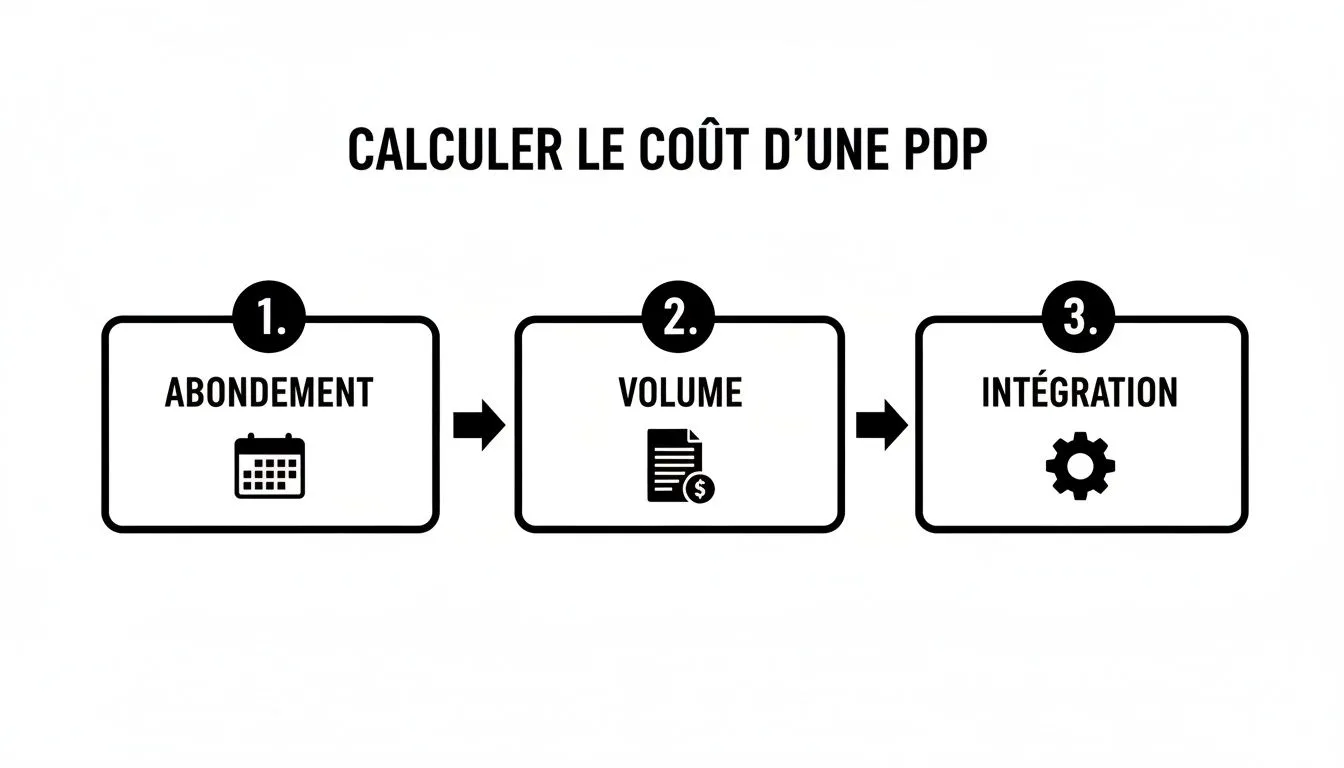
As you can see, the cost isn’t just the monthly subscription. Transaction volume and integration complexity weigh just as heavily on the final budget.
Defining the testing phases and onboarding
The audit is done, the partner is chosen, it’s time to get down to business. Switching all your flows at once, overnight? Very bad idea. The only viable approach is to proceed in stages, with rigorous testing to secure the transition.
You need a test environment, a “sandbox,” to simulate real flows without touching your production. This phase must validate every scenario: a standard order, an invoice with multiple VAT rates, a cancellation, the creation of a credit note. Every business scenario needs to go through it.
A non-negotiable point at this stage: coordination with your accountant. They must confirm that the invoice formats (such as Factur-X) and the data exports generated by the PDP are fully compatible with their own software. This upfront validation will save you sleepless nights at closing time.
To help you make sure nothing is overlooked, the checklist below details the onboarding process.
Integration checklist for your partner dematerialization platform
Here is a 5-step roadmap to plan and successfully carry out your company’s migration to a PDP, from the initial audit to going live.
| Key Step | Required Actions | Stakeholders | Recommended Timeline Before Go-Live |
|---|---|---|---|
| 1. Preparation | Appoint a project manager. Audit existing invoicing flows. Define the scope. | Management, Technical team | 6 to 9 months |
| 2. Contracting | Validate the legal aspects of the contract with the PDP. Confirm the SLA and pricing terms. | Legal department, Management | 5 months |
| 3. Configuration | Set up connectors (API, webhooks). Configure invoice templates and VAT rules. | Technical team, Project manager | 4 months |
| 4. Testing | Run flow tests in the “sandbox” environment. Validate accounting exports with the accountant. | Technical team, Accountant | 2 to 3 months |
| 5. Deployment | Train internal teams (support, admin). Plan the switchover to production. Communicate with customers. | All teams | 1 month |
This table is a compass for your project, helping you allocate the right resources at the right time.
Training teams and going live
The best technology in the world is useless if no one knows how to use it. The success of the migration also depends on your teams’ buy-in. Plan training sessions for everyone who will interact with the new platform in any way: customer service, sales administration, finance team.
Everyone must understand the new process, know where to find information, and how to handle edge cases. A well-trained team is a more autonomous, more confident team when facing customer questions.
The go-live itself must be planned surgically, preferably during a period of low activity. A good practice is to start with a limited scope — a single sales channel, for example — before rolling the solution out across all your flows.
For companies that already rely on a centralizing tool like Bizyness, this transition is much simpler. Since all sales flows are already aggregated, cleaned, and structured, connecting to the partner dematerialization platform becomes the last logical piece of an already-assembled puzzle. A complex migration turns into a simple plug-in, guaranteeing a fast and secure transition.
FAQ on partner dematerialization platforms
The e-invoicing reform can seem a bit scary. As an online seller or SaaS publisher, you inevitably have a whole bunch of questions. Choosing your partner dematerialization platform (PDP) is not a decision to take lightly, and it’s normal to want clarity.
Here, we’ve gathered the questions that come up most often on the ground. The idea is to give you honest, direct answers to clear the way and help you understand what really lies ahead.
PDP, PPF, OD… honestly, what’s the difference?
This is THE question everyone asks, and it’s the starting point for everything. These three acronyms are the new players in invoicing, but they’re not playing in the same league at all.
-
The Public Invoicing Portal (PPF): Think of it as the State’s minimum service. It’s free, based on Chorus Pro (already used for invoices to the public sector), and it does the basic job: sending and receiving invoices, then transmitting the information to the tax authorities. Nothing more.
-
The Partner Dematerialization Platform (PDP): Now we’re changing dimension. It’s a private provider, but note that it’s registered by the State after passing a very thorough audit. A PDP is a genuine service hub: it manages the complete lifecycle of your invoices (statuses, legal archiving), it can convert formats between each other, and above all, it connects to your tools like your ERP or software such as Bizyness.
-
The Dematerialization Operator (OD): This is an intermediary, a non-certified provider. It can help you put your invoices in the right format, but it cannot send them directly. It must always go through the PPF or a PDP. It’s a bit like a mail carrier who prepares the mail without having the key to the mailbox.
In short, choosing a PDP isn’t just about being compliant. It’s a strategic choice to automate and make your invoicing flows more reliable. The PPF makes you compliant, the PDP makes you more efficient.
So, am I really required to get a PDP?
Technically, the answer is no. Nobody forces you to — that’s what the PPF is for. But for an online seller juggling hundreds of orders or a SaaS publisher managing complex subscriptions, settling for the public portal is a bit like wanting to manage your inventory with a notebook and a pencil. It works, but it’s incredibly laborious.
A PDP gives you things the PPF never will:
- Native integrations with the tools you use every day: Shopify, WooCommerce, Stripe, etc.
- Advanced automation to track payment statuses in real time.
- Dashboards and reports to steer your cash flow.
- Legally binding archiving of your invoices for the statutory 10-year period.
The investment in a PDP pays for itself very quickly through time saved, errors avoided, and the clear visibility you gain into your business.
And how does it work for the security of my invoicing data?
This is the crux of the matter, and the State isn’t messing around with it. To get registered, a PDP must prove itself and meet requirements worthy of a digital fortress. Security is at the heart of the process.
Very concretely, a partner platform commits to guaranteeing:
- The integrity and authenticity of invoices so that no one can alter them after issuance.
- The full confidentiality of your business data.
- Service availability, with very strict service level agreements (SLAs).
- GDPR compliance and data hosting that follows European rules.
The certification process is so rigorous that it acts as a natural filter: only the most serious and solid players get the coveted registration. So you can rest assured — your data is well protected.
How much does a PDP typically cost?
There’s no fixed price list, since pricing models are as varied as the businesses themselves. The cost mainly depends on the volume of invoices you issue, the features you need, and the complexity of your integrations.
Generally, you’ll find monthly subscriptions based on document count, per-invoice pricing, or custom packages for larger accounts. The most important thing is to calculate the total cost, including setup, support, and long-term archiving fees. For a small business, the bill can range from a few dozen to several hundred euros per month.
Prepare for the transition to e-invoicing without the headache. With Bizyness, you can centralize all your sales flows and connect seamlessly to the partner dematerialization platform of your choice. Discover how Bizyness simplifies your compliance.
