

 Français
 The guide to payment institutions for your e-commerce business
Boost your sales and simplify your accounting in 2026. Discover the role of payment institutions and how to choose the right partner.
In concrete terms, what is a payment institution? It’s simply the player that manages the flow of money between your customers and you. It’s the conductor that ensures every transaction runs smoothly and that the money actually reaches your cash flow. It’s an essential link, especially if you sell online.
At the heart of your online sales
When a customer clicks “Pay” on your site, whether it’s a Shopify store or a marketplace, a whole mechanism kicks in behind the scenes. This is the exact moment the payment institution (PI) comes into play. Its role? Execute the payment order smoothly and securely.
The customer enters their card details, and the PI, a player like Stripe or Adyen, takes over. It doesn’t just transfer the money: it checks that the card is valid and that the funds are actually available in the customer’s account.
A payment institution isn’t just a simple pipe. It’s a genuine partner that secures exchanges, enforces the rules of the game, and turns every click into revenue.
The safeguard of PSD2
Every transaction is subject to very strict rules, in particular the Revised Payment Services Directive (PSD2). This European regulation is there to protect you against fraud, notably by imposing what’s known as Strong Customer Authentication (SCA).
It’s your payment institution that’s responsible for enforcing these rules. It ensures that every payment is legitimate before transferring the funds to your account. This control process is what allows you to build a relationship of trust with your customers and secure your revenue.
Whether you sell SaaS software, D2C products, or through a marketplace, understanding this process is essential. It helps you to:
- Set up solid, predictable financial management.
- Anticipate incoming cash to better manage your treasury.
- Avoid accounting errors that can become costly as your business grows.
This mechanism is all the more critical as payment volumes explode. In France alone, payments handled by payment institutions and other players represented 34 billion transactions in 2024, a 5.2% increase. With card payments accounting for 62.1% of value, managing these flows has become a genuine strategic challenge. To dig deeper, the latest statistics from the Banque de France are very telling.
This rapid growth means more transactions to process, verify and, of course, record in your books. For an online seller, tracking all of this manually quickly becomes an unmanageable headache. This is exactly why automation platforms like Bizyness exist. By connecting directly to your payment institution, they turn this stream of raw data into clear, compliant accounting entries, without you having to spend hours on it.
Payment institution vs bank: what really changes for you
For an online seller, confusing a bank with a payment institution (PI) is a bit like mistaking a carrier for a warehouse. Both handle your goods, but their role, constraints, and impact on your logistics are completely different. It’s exactly the same with your money: understanding this distinction is essential for managing your treasury.
A traditional bank, or more technically a credit institution, is a real financial Swiss Army knife. It’s authorized to do everything: receive your funds as deposits in a current account, grant you credit to finance your stock or marketing campaigns, and of course, manage your payments.
By contrast, a payment institution is a hyper-specialist. Its sole mission is to execute payment orders. Names like Stripe, Adyen or Mollie are probably familiar to you; they’re the perfect example. They’re experts in the secure transit of money, from your customer’s account to your business.
A clearly distinct scope of action
The major difference between these two worlds comes down to the license granted by the sector’s watchdog, the Autorité de Contrôle Prudentiel et de Résolution (ACPR, the French prudential supervisor). Banks hold a full banking license, which gives them a very broad scope of action. PIs, on the other hand, operate under a payment institution license, which is far more narrowly targeted.
For you, day to day, this different status has very concrete consequences:
- Fund management: A bank holds your deposits. The money in your current account is entrusted to it. A PI, however, doesn’t have this right. The funds it collects on your behalf are “ring-fenced,” meaning isolated in a safeguarding account held at an actual bank. Your money only passes through the PI; it never stays there.
- Access to credit: Your banker can lend you money directly from the bank’s own funds. A payment institution, by virtue of its status, cannot grant you credit. It can, however, act as an intermediary and offer you financing options through its partners, who are… credit institutions.
- Services offered: Banks offer you a whole range of financial products (savings, investments, insurance…). A PI focuses on its core business: providing you with high-performance payment services, often paired with analytics and management tools designed for digital businesses.
To put it simply, a payment institution isn’t a vault where your money sits. It’s more like a financial highway, designed so that the proceeds of your sales arrive quickly and securely, before being paid into your professional bank account.
This architecture has a direct impact on your accounting. The payouts you receive from Stripe, Adyen or Amazon Payments never correspond to a single sale. They’re a lump sum of dozens or hundreds of transactions, net of various fees. Trying to reconcile this manually is a real headache. This is precisely why tools like Bizyness exist, to automate this complex task.
Comparison of financial players for an online seller
To make things even clearer, this table summarizes the key differences between banks, payment institutions, and a third category, electronic money institutions, which you may also come across.
This table highlights the differences in services, regulation, and practical use between traditional banks, electronic money institutions (EMIs) and payment institutions (PIs).
| Criterion | Traditional bank | Electronic Money Institution (EMI) | Payment Institution (PI) |
|---|---|---|---|
| Main mission | Deposits, credit, payments | Issuance of electronic money, payments | Execution of payment services |
| Holding of funds | Yes (deposits) | Yes (storage of electronic money) | No (funds in transit and ring-fenced) |
| Granting of credit | Yes | No (except related services) | No (except via partners) |
| Guarantee of funds | Up to €100,000 (FGDR) | Full ring-fencing | Full ring-fencing |
| Typical use | Current account, financing, investments | Payment account, online wallet | Collecting sales (card, etc.) |
| Examples | BNP Paribas, Crédit Agricole | PayPal, Lydia, Revolut | Stripe, Adyen, Mollie |
In short, the choice depends entirely on your needs. For overall treasury management, financing or investment needs, a professional bank remains essential. But to collect your online sales efficiently, quickly, and with advanced technological integration, payment institutions are your natural allies.
By the way, to make the right choice on the banking side, our comparison of business banks can help you see things more clearly.
The journey of an e-commerce transaction, step by step
When a customer clicks “Checkout” on your site, they unknowingly trigger a series of financial operations that are as fast as they are complex. As an online seller, understanding this invisible mechanism isn’t just a technical curiosity. It’s the key to truly mastering your treasury and simplifying your accounting. Let’s follow the path the money takes, from the customer’s click to its arrival in your accounts.
Everything starts at the moment of checkout. Your site, whether it runs on WooCommerce, Shopify, or a custom-built solution, sends the payment order to your partner: the payment institution. It’s the one that takes charge of the entire operation.
Acquiring and securing the payment
The first task of the payment institution is what’s known as acquiring. Specifically, it collects the transaction details: amount, currency, and of course, the customer’s payment method data.
It immediately launches a security step that’s become unavoidable: Strong Customer Authentication (SCA), an obligation imposed by the PSD2 directive. It’s the well-known code received by SMS or the validation in the banking app. This barrier ensures that it really is the cardholder behind the purchase, drastically reducing the risk of fraud for everyone.
The diagram below clearly shows each player’s role. It shows the difference between a traditional bank, an electronic money institution (EMI), and a payment institution (PI), the latter illustrated with gears to highlight its role as a pure payment-processing specialist.
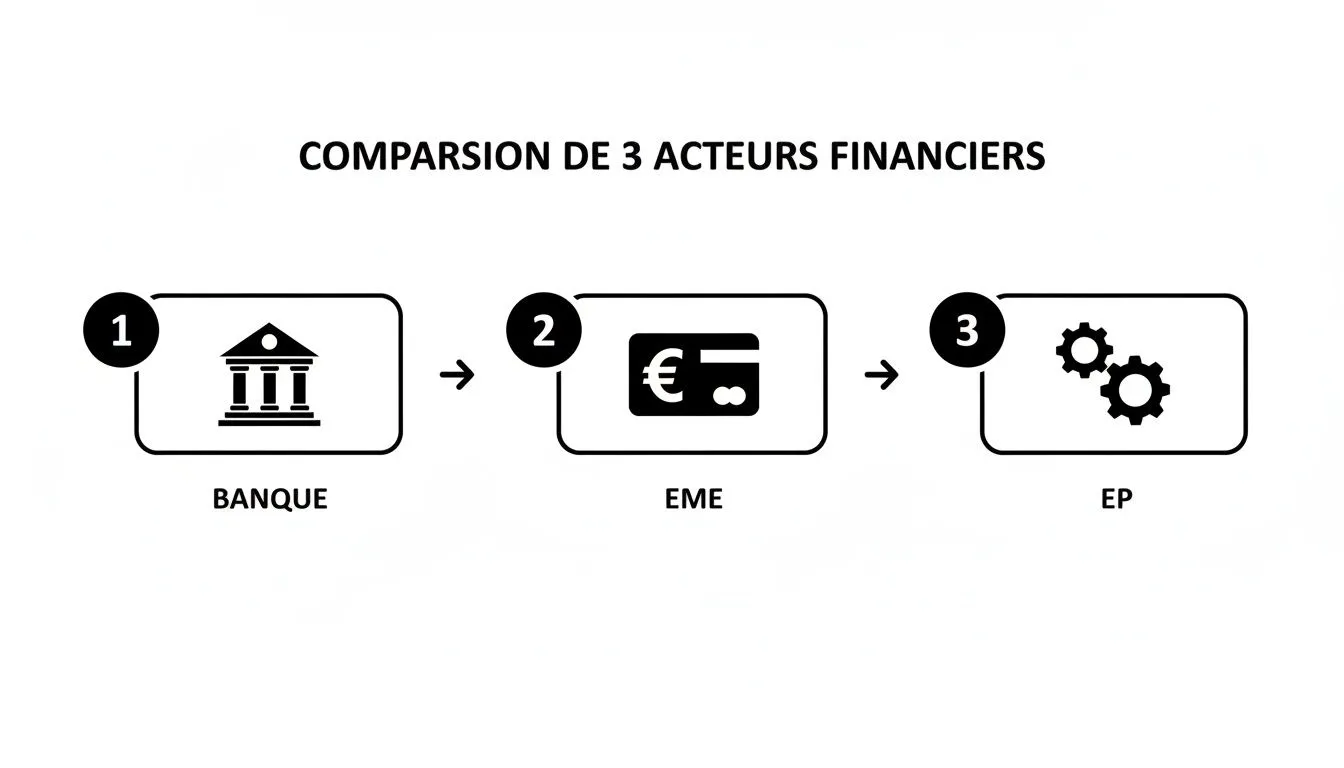
Unlike banks, which are generalists, payment institutions are dedicated experts. They’re an essential cog, the engine that drives the e-commerce machine.
The dialogue between networks and banks
Once the buyer is authenticated, a lightning-fast dialogue begins. The payment institution contacts the card network (Visa, Mastercard, etc.), which in turn queries the customer’s bank, known as the “issuing bank,” to request payment authorization.
In a fraction of a second, the customer’s bank checks several essential points:
- Is the account balance sufficient?
- Is the card active and not reported stolen?
- Has the payment limit been reached?
If everything checks out, the bank gives its approval. The payment institution receives this authorization and passes it on to you almost instantly. The order is then confirmed on your site. But be careful, at this stage, the money hasn’t actually moved yet.
A payment confirmation is not a fund transfer. It’s a promise of payment, guaranteed by the customer’s bank and orchestrated by your payment institution. The physical movement of the money happens later.
Clearing and settlement of funds
This is where things become concrete, with two technical terms to know: clearing and settlement. Every day, the payment institution gathers all authorized transactions and presents them to the various card networks. This is clearing: the accounts are settled between all the banks involved.
Then comes settlement. The customers’ banks actually transfer the funds to your payment institution. This money is then set aside in a safeguarding account, a specific account fully separate from the institution’s own funds, pending payout to you. This is a far more controlled method than instant transfer, which has certain drawbacks. To learn more, feel free to read our article on the risks of instant transfers.
The final step is the payout to your professional bank account. This transfer, which often groups together several days’ worth of sales, corresponds to the total amount of your transactions, minus your provider’s fees. It’s precisely this bundling that makes manual accounting reconciliation so tedious, and which explains why a solution like Bizyness, which automates the link between payment flows and accounting, becomes a major asset for running your business.
The regulatory obligations that protect you
You don’t become a payment institution overnight. To be allowed to handle your money, even if only in transit, a provider must meet an extremely strict set of requirements.
Far from being mere administrative constraints, these rules are actually your best insurance policy. They concretely protect you against the risks of fraud or, worse, the insolvency of your payment partner.
In France, it’s the Autorité de Contrôle Prudentiel et de Résolution (ACPR), a body attached to the Banque de France, that calls the shots. It’s the ACPR that grants the coveted license after a very thorough audit of the candidate. Obtaining it is a real obstacle course, one that attests to the operator’s seriousness and reliability.
ACPR authorization, a mark of solidity
To have a chance of obtaining this license, a provider must first prove itself financially sound. Regulations require a minimum share capital, ranging from €20,000 to €125,000 depending on the payment services offered. This isn’t just a figure on paper; it’s a very real safety cushion, which guarantees that the institution can meet its obligations, even in the event of a setback.
But money isn’t everything. The ACPR also scrutinizes the executives: their experience, their reputation, their integrity. It ensures that the people at the helm are competent and trustworthy enough to run such a sensitive business.
The licensing process acts as a highly effective filter. It weeds out unreliable players and only lets the most solid ones through. For you, this is the guarantee that the company handling your revenue flows is trustworthy.
Once licensed, the institution is entered on a public register: the REGAFI (Register of Financial Agents). This database, accessible to everyone, lets you check in just a few clicks that your partner is indeed authorized to operate.
You can check this yourself on the official website. REGAFI lists all payment institutions licensed by the ACPR.
Checking this register confirms that your provider meets French and European regulatory standards, and therefore a high level of security.
KYC and anti-money laundering (AML-CFT)
If you’ve ever opened a business account with Stripe or another platform, you’ve certainly had to provide documents: proof of identity, company registration (Kbis), proof of address… This process is what’s known as “Know Your Customer” (KYC).
This isn’t a formality specific to your provider, but a legal obligation that’s part of the fight against money laundering and terrorist financing (AML-CFT). In practical terms, a payment institution must know precisely who its customers are and monitor transactions to spot any unusual activity.
In practice, this translates into several actions:
- Verifying the identity of each merchant upon sign-up.
- Continuously monitoring transactions to detect unusual flows or patterns.
- Reporting any suspicious transaction to Tracfin, the financial intelligence unit of the French Ministry of the Economy.
By working with a licensed player, you ensure that your partner actively participates in protecting the financial ecosystem. It doesn’t just protect its own systems; it helps keep the environment in which your own business operates clean and safe.
How to choose the right payment institution in 2026
Choosing a payment institution isn’t just a matter of comparing pricing grids. It’s a deeply strategic decision that will directly impact your treasury, your compliance, and your growth potential. As 2026 approaches, selection criteria have evolved significantly, and cost per transaction is no longer the only thing that matters.
To find the right partner, you need to look beyond the basic service. You’re not looking for a simple provider, but an ally that will actively support your growth. This choice will have concrete repercussions on your day-to-day efficiency.
Beyond fees: technical and functional criteria
The first, almost universal, reflex is to compare fees. Of course, that’s a starting point, but it’s only the tip of the iceberg. The real performance of a payment institution lies in its ability to integrate smoothly into your working environment.
Does your provider offer solid modules or APIs for your e-commerce platform (Shopify, PrestaShop, WooCommerce)? A native, well-documented integration will save you weeks of development and countless headaches.
But don’t stop there. Here are a few key questions to ask yourself:
- What about technical support? If a payment gets stuck, can you quickly speak to someone competent? Responsive, effective support isn’t optional, it’s a necessity if you don’t want to lose sales.
- How are international payments handled? Does your partner easily handle different currencies? Does it offer solutions to simplify international tax matters, such as the OSS/IOSS one-stop shops for VAT?
- How often will you receive your money (payouts)? The speed at which funds are transferred to your account is absolutely vital for your treasury.
This question of payout timing is far from a minor detail. For an online seller, cash flow is what matters most. A recent study showed that in 2025, 86% of French companies faced late payments, with an average delay of 49.7 days. A good payment partner should guarantee you fast, predictable flows. The findings of the Coface study on payment behavior are, on this point, very telling.
The often-overlooked criterion that changes everything: accounting integration
Having an excellent system for collecting payments is great. But if the resulting data is a nightmare to work with for your management needs, you’re simply moving the problem elsewhere. That’s why, in my view, the most important criterion is your payment institution’s ability to natively communicate with your financial tools.
A good payment partner doesn’t just collect the money. It gives you clear, usable data so you can record it effortlessly.
A smooth connection between your payment provider and a platform like Bizyness radically changes the game. It automates tasks that take hours every month and almost completely eliminates the risk of human error.
In concrete terms, here’s what such an integration can do for you:
- Automatically reconcile payouts. The tool identifies the hundreds of sales that make up a single Stripe or Amazon transfer, and accounts for the discrepancy due to fees. No more manual reconciliation headaches.
- Break down VAT effortlessly. By connecting to your store, it analyzes each sale to apply the correct VAT rate, whether the customer is in France or abroad.
- Generate the Fichier des Écritures Comptables (FEC, the French statutory accounting-entries file). All your sales data is structured and converted into compliant accounting entries, ready to be sent to your accountant.
In 2026, choosing a payment institution means thinking about the entire financial value chain. Look for a partner that not only reliably collects your sales, but above all helps you manage them frictionlessly. That way, you can focus on what really matters: growing your business.
FAQ: payment institutions and accounting
Integrating payment flows into day-to-day management raises quite a few questions among online sellers. Let’s go over the most common ones, with a particular focus on accounting and automation.
How do I account for Stripe or PayPal fees?
The commissions you pay a provider like Stripe or PayPal are financial expenses for your business. They absolutely must appear in your accounts so that your income statement reflects reality.
The problem is that the transfer that arrives in your business account is already net of these fees. So you can’t reconcile it directly against your gross revenue. That’s the classic headache.
For accurate accounting, it’s essential to clearly distinguish the gross sale amount, the provider’s fees, and the net amount you actually receive. Get this wrong, and your entire profitability analysis is thrown off.
A platform like Bizyness is designed to automate this. It connects to your payment solution, retrieves the details of each transaction, isolates the gross sales amount from the commission amount, and then generates the accounting entries without you having to lift a finger.
Does my payment provider handle VAT on my sales?
No, and that’s a crucial distinction to make. The role of a payment institution is to ensure that money moves from the customer to you. It collects the funds and transfers them to you, that’s it. It’s in no way responsible for the taxation of your sales.
It’s up to you, and you alone, to calculate and apply the correct VAT rate for each order. The task quickly becomes complex if you sell internationally, since the rules change depending on the customer’s country and status (individual or business).
This is precisely where a management tool designed for e-commerce becomes essential:
- It analyzes each sale based on the buyer’s country.
- It applies the correct VAT rate, whether that’s the French rate or that of another EU country.
- It prepares your VAT return, notably for the OSS (One-Stop Shop).
How do I justify the lump-sum transfer from my marketplace?
Marketplaces like Amazon or Etsy send you a single lump-sum transfer that bundles together dozens, even hundreds, of sales. This single amount corresponds to the total of your orders, from which a multitude of fees have been deducted: sales commissions, advertising fees, logistics costs (FBA), etc.
Trying to manually justify this transfer in your accounts is a real nightmare. It’s one of the main sources of errors and wasted time for marketplace sellers.
A connected solution solves this problem by communicating directly with the marketplace’s API. It retrieves the details of each order included in the transfer, issues invoices for your customers, records the various commissions, and thus perfectly justifies the amount received in your account. Mastering this flow is fundamental to good e-commerce accounting management.
Simplify the financial management of your online business. With Bizyness, turn every sale into a clear, automated accounting flow.
Discover how Bizyness can structure your accounting and save you precious time.
