

 Français
Pending bank transfers demystified for your e-commerce business
The 'pending bank transfer' status affects your cash flow. Discover why it happens and how to automate its management for healthy e-commerce accounting.

You made a sale, the customer paid, but the money still hasn’t shown up in your account. Instead, you see that familiar status: pending bank transfer. Don’t panic — this is a perfectly normal, even healthy, situation for any online seller. Far from being a sign of a problem, it’s simply proof that your money is on its way.
Understanding what a pending transaction means
Imagine your customer’s money as a package you shipped. The pending bank transfer status simply means that package has left the warehouse (your customer’s account or a marketplace) but hasn’t yet been delivered to your doorstep (your business account).
This waiting period, which can sometimes feel stressful, is actually a standard and secure step in the financial system. It’s the time needed for the funds to travel through various networks and checkpoints before landing in your account.
Why this delay is a normal step
The thing is, money doesn’t teleport. Between the moment your customer clicks “Pay” and the moment you see your account balance rise, the funds pass through several intermediaries. We’re talking about payment processors like Stripe or PayPal, as well as interbank networks.
Each of these players has its own role: verifying the payment is valid, ensuring there’s no fraud, and confirming everything is in order.
We tend to believe money transfers are instant, but that’s a myth. The “pending bank transfer” status represents a series of essential checks that protect everyone, buyer and seller alike. It’s not a delay — it’s quality assurance.
Rather than seeing this delay as a bug, view it as confirmation that the process is unfolding exactly as intended. In fact, the mechanics are quite different from those of a standard bank transfer. To better understand the nuances, our guide on the risks of instant transfers sheds light on the differences in processing.
To help you get a clearer picture, let’s review the situations where you’ll encounter this status most often.
Common scenarios for pending bank transactions
The table below summarizes the most frequent cases where your funds will be in transit. It also gives you an idea of the average delays observed in practice, so you can better anticipate them.
| Transaction type | Parties involved | Average delay observed |
|---|---|---|
| Customer card payment | Customer, Shopify/WooCommerce, Stripe, your bank | 2 to 7 business days |
| Marketplace transfer | Amazon/Etsy, their partner bank, your bank | 3 to 14 days depending on the platform |
| Refund to a customer | You, your payment processor, the customer’s bank | 5 to 10 business days |
As you can see, these delays are unavoidable and are an inherent part of doing business online. Knowing them helps you manage your cash flow better and avoid unpleasant surprises.
Why your funds remain in transit
Contrary to what you might think, an online payment isn’t instant. When you make a sale, the money doesn’t jump directly from your customer’s account into yours. There’s a whole secure journey between the two. The pending bank transfer status simply corresponds to the duration of that journey. It’s not a block — it’s a series of indispensable checks to make sure everything goes smoothly.
In fact, money rarely leaves the customer’s account and lands in yours within a minute. It passes through several intermediaries that validate, secure, and route the transaction. This delay is the guarantee that the payment is legitimate and properly confirmed. A safeguard for you, as much as for your buyer.
This little infographic sums up the journey well: the money leaves the customer, transits, then finally arrives in your account.
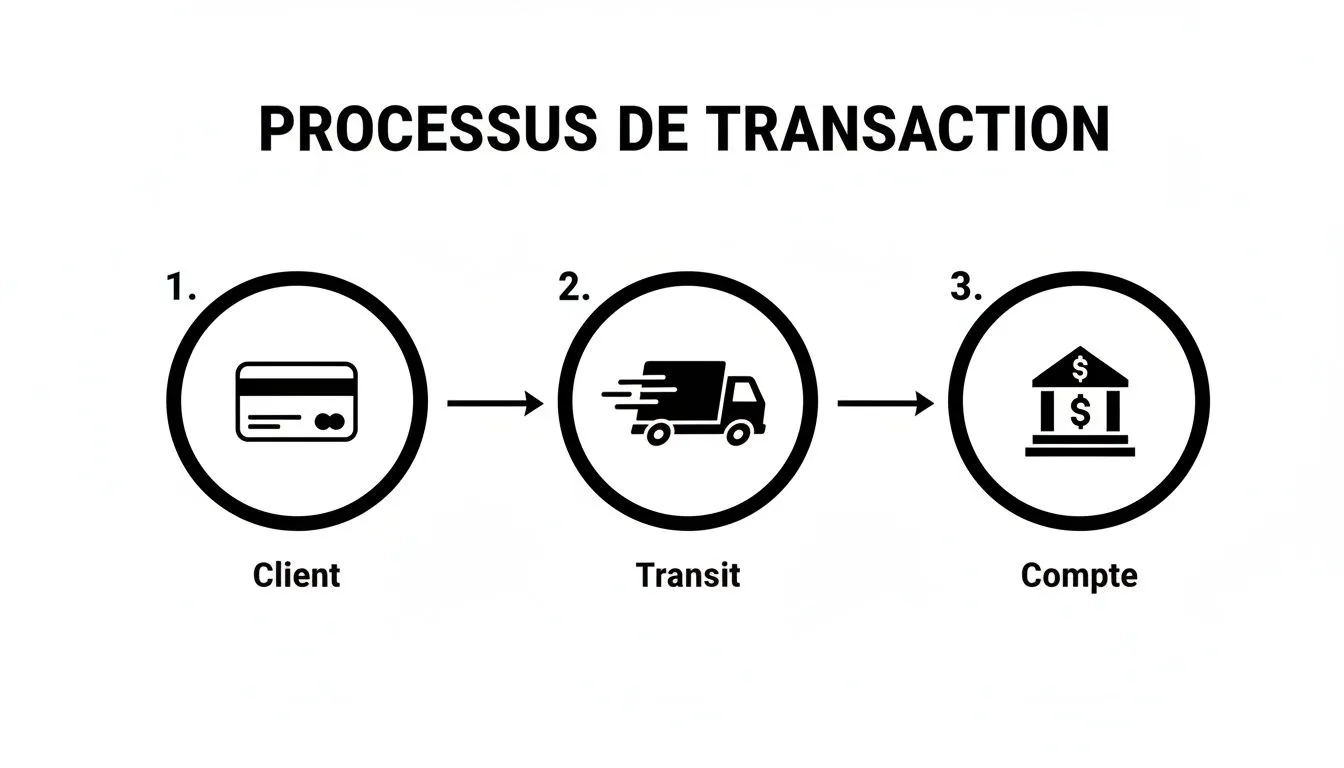
The truck image is an excellent metaphor. While the funds are “on the road,” they undergo a battery of checks before being delivered. But what exactly happens during this journey?
Standard interbank delays
The most common reason is quite simple: banks have their own schedules and only operate on business days. A payment you receive on a Friday evening, for example, will often only be processed by banking networks on Monday, or even the following Tuesday. This mechanically adds a few days of waiting.
This system might seem a bit slow, that’s true, but it’s a well-oiled machine that safely and orderly handles billions of transactions every day. Think of it like the postal service: it doesn’t deliver on Sundays or public holidays. For banks, it’s a similar principle.
Anti-fraud checks and verification
Security is the other major reason for this delay. Every transaction triggers a cascade of automatic checks to sniff out suspicious activity. This is a crucial step to protect you.
Payment processors like Stripe analyze more than 100 different signals in a matter of milliseconds to assess the risk of a payment. If a transaction stands out as unusual, it can be paused for manual review. This is what protects your business from fraudulent payments and costly disputes.
A typical example? A customer using a card issued in a country very different from their shipping address. The system will likely flag it and mark the transaction for verification. This small pause is actually an active shield for your cash flow.
Platform payout cycles
Finally, most e-commerce platforms have their own payout schedule. They group your sales over a certain period, then send you a single bulk transfer.
- Amazon: The marketplace typically operates on a 14-day cycle. Your sales from the past two weeks are added up, then transferred all at once into your account.
- Shopify Payments: This is usually faster, but you should still generally expect 2 to 4 business days in France between the moment the customer pays and the moment the money actually arrives in your account.
- Stripe: The default setup provides for daily payouts with a 2-day transit delay, but this can vary depending on your industry or how long you’ve had your account.
These cycles are designed to simplify your life, particularly your accounting, and to reduce transaction fees. This is also why the balance shown in your store never perfectly matches the balance in your bank account.
The impact on your cash flow and accounting
The pending bank transfer status is far more than just a line on a statement. For an online seller, it’s the source of a sometimes dizzying gap between the sales displayed and the money actually sitting in the business’s account. It’s precisely this ambiguity that prevents you from having a clear, accurate view of your financial health.

Let’s put ourselves in a situation you probably know well. Your Shopify dashboard proudly displays €10,000 in sales for the past week. Great news! Except when you check your business account, you only see €6,000 credited. The remaining €4,000? It’s somewhere between the sale and the bank, in that famous transitory state.
This isn’t trivial. You might think you have €10,000 to pay your suppliers, launch new ad campaigns, or cover payroll. The reality is you only have €6,000. If left unmanaged, this gap renders all your cash-flow forecasts completely useless.
Bank reconciliation, a real headache
This processing delay turns bank reconciliation into a logistical nightmare. Your mission, should you choose to accept it: link dozens, even hundreds, of individual orders in your store to bulk transfers that only arrive several days later, net of fees.
Without rigorous tracking, figuring out which sale corresponds to which transfer becomes detective work. This opens the door to oversights, data-entry errors, and, above all, a phenomenal waste of time.
This challenge is all the greater given the current economic context. To give you a sense of the scale of these financial flows, outstanding consumer credit in France reached €1,537 billion at the end of January 2026. For an online seller on Shopify or Amazon, this intense activity translates into an ever-growing volume of transactions to reconcile. You can track the evolution of these figures on the Banque de France website.
The solution: the suspense (clearing) account
So, how do you properly handle the missing €4,000 in our example? The soundest accounting practice is to use what’s called a suspense account (or clearing account).
The principle is quite simple:
- At the time of the sale: The full €10,000 is recorded as a receivable in this suspense account. The money isn’t in the bank yet, but it is indeed owed to the business.
- At the time of the bank transfer: When the €6,000 finally arrives in your account, it’s moved out of the suspense account and recorded in your regular bank account.
- Real-time tracking: The balance of the suspense account — here, €4,000 — represents at any given moment the exact amount of your money that is still a pending bank transfer.
The suspense account isn’t just an accounting trick. It’s an essential tool for maintaining an accurate view of your situation, isolating funds in transit, and, above all, avoiding decisions based on cash-flow figures that don’t reflect reality.
Burying your head in the sand about this gap is risky. You could find yourself unable to pay an important invoice, wrongly believing the funds were available. Worse still, poor tracking of your receipts can lead to incorrect VAT filings and, ultimately, costly tax complications.
Managing your pending funds on Shopify, Amazon, and Stripe
To run your business well, you need to know where your money is at all times. Tracking a pending bank transfer payment across major e-commerce platforms might seem complicated, but rest assured: each one offers very precise tracking tools. You just need to know where to look to turn this uncertainty into clear, directly usable information for your management.
Each platform, whether Shopify, Amazon, or Stripe, has its own logic and its own dashboard. Once you master these interfaces, you can track every euro, from the customer’s purchase click to its arrival in your bank account. It’s a real peace-of-mind win.
Finding your funds on Shopify
On Shopify, everything mainly happens within the Shopify Payments interface. To really make the most of it, it helps to understand how Shopify works as a whole.
Specifically, to see the status of your payouts, the steps are simple:
- From your Shopify admin interface, go to the Finance section.
- Then click on Payouts.
- And there you go! You’ll see the list of all transfers, whether already sent or upcoming. You’ll find the details of the orders included, the fees deducted, and, most importantly, the estimated date the money will land in your account.
This view is essential, as it shows you the difference between your gross revenue and the net amount you’ll actually receive.
Tracking transfers on Amazon Seller Central
Amazon, for its part, operates on a much longer payment cycle, generally 14 days. Your sales money is therefore held during this period before being paid out to you.
To track this flow, here’s the path:
- Log in to your Seller Central account.
- In the menu, go to Reports, then select Payments.
- The dashboard that appears is very comprehensive. It shows you the total balance, the date of the next transfer, and, above all, a precise breakdown of all transactions, the various Amazon fees (commissions, FBA fees, etc.), and any reserves set aside.
Forecasting your cash flow is impossible without understanding this cycle. Your funds can indeed remain “pending” for two full weeks.
Distinguishing balances on Stripe
Stripe is the payment engine behind many platforms. Its dashboard is a goldmine of information, provided you understand the crucial difference between the pending balance and the available balance.
Take a look at Stripe’s Payouts dashboard screenshot, which illustrates this perfectly.
The pending balance corresponds to money from recent transactions that isn’t yet finalized and ready to be transferred. The available balance, on the other hand, represents the amount you can receive with the next scheduled payout. You can track each transfer individually and know its expected arrival date.
This distinction is key to proactive management. Think of it this way: the pending balance is tomorrow’s revenue; the available balance is today’s cash on hand. Payment institutions like Stripe structure these flows precisely to secure every step of the process.
All this data, whether it comes from Stripe, Shopify, or Amazon, is really a micro-version of what’s observed at the national level. For instance, Banque de France’s publications on outstanding bank balances give a pulse of the entire economy. It’s this macro-economic information that allows tools like Bizyness to refine their bank reconciliation algorithms. If you’re curious, you can check out the Banque de France statistics.
Gain clarity on your cash flow with automation from Bizyness
Manually tracking every pending bank transfer transaction is a bit like trying to piece together a giant puzzle without the picture on the box. Between Shopify transfers, Amazon’s payment cycles, and Stripe balances, you spend an enormous amount of time chasing numbers, with a risk of error at every line. Fortunately, there’s a much simpler way to take back control.
This is where automation completely changes the game. By connecting your sales tools directly to a financial platform like Bizyness, you turn this daily headache into a perfectly smooth system. No more afternoons lost on spreadsheets and endless manual reconciliations.
How Bizyness reconciles your flows for you
Bizyness syncs directly with your Shopify, Amazon, Stripe accounts and your other sales channels. The platform automatically pulls in all transaction data: sales, of course, but also refunds and, above all, those pesky fees deducted at the source.
This direct connection solves a problem every online seller knows all too well. Let’s take a simple example:
- You see a €4,850 transfer arrive from Stripe into your business account.
- Without a tool, there’s no way to know exactly what this amount corresponds to. Is it yesterday’s total sales? Last week’s?
- With Bizyness, the information is instant: this amount comes from €5,000 in gross sales, from which €150 in transaction fees were deducted.
The platform does this reconciliation work for you, without you having to lift a finger. Every euro is tracked, explained, and correctly categorized.
Real-time cash flow and flawless accounts
By automating this entire process, Bizyness gives you a level of financial visibility you could never achieve manually. Amounts still shown as pending bank transfer are intelligently isolated in dedicated suspense accounts.
In practice, you always know exactly how much of your money is actually available in your account and how much is still in transit. This precise view of your cash flow helps you make better decisions and avoid unpleasant surprises like an unexpected overdraft.
The benefits are felt throughout your management:
- Always accurate VAT filings: Calculations are based on actual sales and the correct dates, protecting you from costly errors.
- A flawless French Accounting Entries File (FEC): Your accountant receives a clean, already-structured file that they simply need to import. Pure relief!
- A phenomenal time saving: You can finally focus on what really matters: growing your store and increasing your revenue.
For healthier management and smoother cash flow, AI-driven automation of financial processes is now a major ally. If you want to dig deeper into the topic, feel free to check out our complete guide to setting up your own automatic bank reconciliation.
Frequently asked questions about pending transactions
Even once you understand the principle, the pending bank transfer status often leaves people puzzled when faced with very concrete situations. We all ask the same questions: is this money really mine? When will it arrive? What happens if there’s a problem?
It’s normal to wonder. Let’s go through the most common doubts so you can handle all of this with peace of mind.
Can a pending transaction fail?
Yes, it’s a possibility. Fortunately, it’s not the most common case, but it’s worth keeping in mind. A transaction can very well go from “pending” status to “failed” or “cancelled.”
Most often, a payment fails for fairly simple reasons:
- Insufficient funds: This is the number one cause. When the bank attempts to finalize the charge, the customer’s account isn’t sufficiently funded.
- Suspected fraud: Security systems, whether Stripe’s or the customer’s bank’s, can flag unusual activity. As a precaution, they block the payment.
- Incorrect information: A small typo in the card number, expiration date, or CVC code can pass the first filter but get rejected during final verification.
- Card dispute: The customer may have reported their card lost or stolen between the time of purchase and the final capture of funds.
The takeaway? Never consider a “pending” payment as money definitively in your pocket until it’s visible on your bank statement.
How long do my funds remain in transit from a marketplace?
Here, the delays can really vary wildly. Each marketplace has its own rules for payments, designed to secure transactions on their end and optimize their own accounting.
To give you a concrete idea with the best-known platforms:
- Amazon: The default payment cycle is 14 days. Your sales money is therefore held in reserve for two weeks before being transferred.
- Etsy: Here, you’re in control. You can opt for daily, weekly, biweekly, or monthly transfers. Once the transfer is initiated, expect 3 to 5 business days of banking transit.
- Cdiscount Marketplace: The platform processes payments three times a month, roughly every 10 days.
Knowing these delays is essential for building a solid cash-flow forecast.
How should my accountant handle these operations?
For an accountant, an amount that’s pending bank transfer requires a bit of mental gymnastics: it’s revenue you’ve genuinely generated but haven’t yet collected. The correct method is to use a suspense account, often a class-5 account like 512 or 580.
Using a suspense account is the cleanest method for tracking pending funds. The sale is recorded on its actual date, while showing that the money isn’t yet in the bank account. This allows revenue to be declared in the correct period, even if collection is delayed.
And this is precisely where automation changes everything. A tool like Bizyness manages this back-and-forth behind the scenes for you. It identifies sales, classifies them in this suspense account, and automatically links them once the marketplace transfer finally arrives. For your accountant, that’s valuable time saved and the assurance of accurate accounting, without any reconciliation headaches.
With Bizyness, managing pending bank transfers is no longer a burden. The platform automates reconciliation, gives you a crystal-clear view of your cash flow, and prepares flawless accounts for your accountant. Discover how Bizyness can simplify your finances at bizyness.fr.
