

 Français
Which quoting and invoicing app should you choose for your e-commerce business
Find the best quoting and invoicing app for your e-commerce business. Our guide compares features, automation and VAT compliance.
Let’s be honest: for an online seller, insisting on handling invoicing by hand is shooting yourself in the foot. A good quoting and invoicing app doesn’t just produce nice-looking PDFs. It’s the real engine of your administrative management, capable of turning a monumental chore into a competitive advantage.
Going well beyond simple invoice creation
In e-commerce, an invoice is never a standalone document. It’s the conclusion of a customer journey that has passed through several systems, with tax rules that change from one country to another and a requirement for absolute precision. Believing that a spreadsheet or a Word document is enough is a mistake that costs you dearly, in both time and stress.
The real challenge isn’t producing a document. It’s orchestrating a flow of information vital to your business.
Centralize to steer better
Think about it for a second. You have to juggle sales reports from Shopify, Amazon order statements, Stripe transactions and payments received via PayPal. Each platform has its own format, its own fees, its own logic. Trying to reconcile all of that manually is a nightmare.
That’s where an invoicing app built for e-commerce changes everything. It acts as a genuine management hub.
It connects directly to all your sales and payment channels to:
- Bring all orders together in a single, clear interface.
- Issue invoices automatically as soon as a sale is confirmed.
- Apply the correct VAT rate based on the buyer’s country, a task that’s nearly impossible to manage at scale without a tool.
This centralization puts an end to omissions and duplicate entries. Above all, it gives you an accurate view of your revenue, in real time, without you having to compile dozens of files yourself. To review the fundamentals, our guide on quotes and invoices is an excellent starting point.
A tool like Bizyness doesn’t just retrieve information, it understands it. It knows that a sale on Amazon to a customer in Germany doesn’t carry the same tax consequences as a sale via WooCommerce to a customer in France.
Securing compliance to support your growth
The bigger an e-commerce business grows, the more complex the paperwork becomes. Selling internationally plunges you into the puzzle of the OSS and IOSS one-stop shops. Preparing figures for your accountant quickly starts to feel like an archaeological dig through your statements.
A specialized app is designed to anticipate these issues. It’s built to grow with your business, natively integrating:
- International tax management, so you can expand across Europe and beyond without fear of an audit.
- Preparation of accounting exports, such as the famous FEC (Fichier des Écritures Comptables), for smooth collaboration with your accountant.
- Adaptation to regulatory changes, such as electronic invoicing, which becomes mandatory starting in 2026.
The manual approach with Excel or Word may seem cost-effective at first, but it quickly shows its limits against the complexity of e-commerce.
Manual management vs. automated app for your quotes and invoices
This table compares a manual approach with a specialized app to concretely show the productivity and compliance gains.
| Aspect | Manual management (Excel/Word) | Automated app (Bizyness) |
|---|---|---|
| Invoice creation | Manual, one by one. Time-consuming and error-prone. | Automatic, generated from the order (Shopify, Amazon, etc.). |
| VAT management | Manual calculation, high risk of errors on rates (country, products). | Automatic calculation of correct VAT rates (France, EU, international). |
| OSS/IOSS compliance | Extremely complex task, if not impossible to manage manually. | Native, automated management of one-stop shops. |
| Data centralization | None. Requires compiling exports from each platform. | Central hub for all sales and payments. |
| Accounting export (FEC) | Manual creation by the accountant (additional cost). | One-click FEC export, ready to use for the accountant. |
| Reporting and tracking | Basic, manual reports, fragmented view of revenue. | Real-time dashboards, detailed performance analysis. |
| Data security | Low. Risk of file loss, no reliable audit trail. | Secure cloud data, VAT anti-fraud compliance. |
In short, switching to an automated solution isn’t an expense, but a direct investment in the reliability and efficiency of your business.
Ultimately, choosing the right tool is above all about buying yourself peace of mind. It’s the guarantee that your management is not only effective today, but also ready for tomorrow’s challenges.
What are the must-have features for an online seller?

When you run an e-commerce business, choosing your invoicing solution is a bit like choosing a co-pilot. Pick wrong, and an administrative crash landing is guaranteed. Let’s face it: most general-purpose invoicing software simply isn’t built for online selling. You need a tool that speaks the same language as your store, not just a PDF generator.
The starting point, the non-negotiable criterion, is native integration with your sales platforms. And I don’t mean a vague API connection. You need deep synchronization, a constant dialogue between your invoicing app and your store.
Imagine an order coming in on your Shopify site. With a good integration, the software immediately creates a fully compliant invoice, pulls in the Stripe or PayPal transaction including fees, and updates the payment status. All of that without you having to lift a finger.
This fluidity changes everything. No more data-entry errors, missed items, or the stress of manual reconciliation. Your administrative management becomes the exact mirror of your commercial activity.
Automated international VAT management
If you sell in Europe, you know that VAT can quickly become a headache. Between the different rates by country and the thresholds to watch for the one-stop shop (OSS/IOSS), manual tracking is an open door to errors and stress.
Invoicing software built for e-commerce absolutely must automate this. In practice, you sell a product to a customer in Germany? The tool should detect their location and apply the German VAT rate, with no action on your part.
The real advantage of a good tool isn’t just applying the right rate. It’s consolidating all your VAT data by country to pre-chew the work for your OSS declaration. It’s a huge time saver and real protection for your tax compliance.
Managing the entire sales cycle, from A to Z
Your business isn’t necessarily limited to direct sales through your website. Maybe you deal with professionals (B2B) for custom orders, or you build partnerships. Your quoting and invoicing app needs to keep pace.
It’s therefore essential that it can handle the entire process:
- Create quotes that are clear and professional, with an online acceptance option.
- Turn an accepted quote into an invoice in a single click.
- Manage deposits, then automatically generate the balance invoice.
This kind of scenario is very common. A company contacts you to order 100 units for a trade show. You send them a quote, which they approve online. You then issue a deposit invoice for 30%. Once the deposit is paid and the goods shipped, you generate the balance invoice, which already accounts for the amount already paid. Simple, clean and efficient.
Accounting exports your accountant will love
Your relationship with your accountant is valuable. The worst thing you can do to them is send a chaotic zip folder with a jumble of invoices and bank statements. Your app should be a solid, reliable bridge between your day-to-day management and their accounting work.
The key feature here is the generation of standardized accounting exports. The holy grail is the FEC (Fichier des Écritures Comptables), the standard format the tax authorities require in the event of an audit. A tool like Bizyness prepares this file for you. Your accountant just has to import it into their own software. No more re-entering data, the risk of errors is nearly zero and, as a bonus, you lighten their workload (and, potentially, their fees).
How to choose the right invoicing software for your e-commerce business
Finding the right software for your quotes and invoices is a bit like choosing your main carrier. It’s a strategic partner that will support you through your growth. To avoid getting it wrong, you need a methodical approach, starting with an honest assessment of your business.
The first step is asking the right questions. Do you sell only on your own site, or are you also present on marketplaces like Amazon or ManoMano? Are your customers individuals (B2C), businesses (B2B), or a mix of both? Do you ship packages beyond your home country?
The answers to these questions are the foundation of everything. An online seller who sells only in France via Shopify won’t have the same constraints as a brand juggling a WooCommerce site, B2B resellers and shipments across the European Union.
Assessing the depth of integrations
Once you have a clear picture of your sales flows, it’s time to dig into the details of integrations. Never settle for a simple “Shopify compatible” logo on a marketing page. You need to dig deeper to understand what that really means.
Specifically, does the data sync go both ways? For example, if you cancel an order in your back office, will the software automatically cancel the corresponding invoice? Is refund handling, whether partial or full, reliable and automated? A worthy integration must match every detail of your business, without you having to go back and fix things manually.
Anticipating tax and legal compliance
This is THE criterion that makes all the difference. With the major electronic invoicing reform looming for 2026, overlooking compliance would be a huge strategic mistake.
Your future tool must absolutely be ready for e-invoicing (electronic invoicing between businesses) and e-reporting (transmitting B2C sales data to the tax authorities). We’re talking about colossal volumes: in 2021, the AIFE counted nearly 2 billion B2B invoices. All of these transactions will move into the new system. Make sure the software vendor is already on top of it and actively preparing for this transition.
Never underestimate the importance of preparing ahead of regulatory change. Choosing non-compliant software today means exposing yourself to a forced, costly and stressful migration tomorrow.
Before taking the plunge and investing, you can start by roughing out the work with simpler tools. A free Excel quote template, for example, can be a good way to structure your first commercial proposals and better understand your actual needs.
Analyzing the pricing model and support quality
Beyond the technical side, look closely at the pricing model. Is pricing based on your invoice volume, your revenue, or the number of users? Are there hidden costs for certain integrations or modules that will quickly prove essential?
Customer support is just as crucial. Don’t hesitate to test it before signing. Does the team you’re dealing with understand the specifics of e-commerce, such as managing intra-EU VAT with the OSS one-stop shop? Good support isn’t the one that replies in 5 minutes, but the one that gives you the right answer, tailored to your business.
To compare the solutions you’re considering, here’s a simple checklist:
- Sales channels covered: Does the tool natively connect to all your sales platforms (website, marketplaces, etc.)?
- Integration depth: Does it correctly and automatically handle cancellations, refunds and different order statuses?
- Tax compliance: Is the tool certified and ready for the 2026 reform (e-invoicing/e-reporting)?
- Customer support: Is the team genuinely specialized in the challenges online sellers face?
Setting up your automated invoicing workflow
Alright, enough theory. Now that you know what to look for in a quoting and invoicing app, it’s time to get your hands dirty. Don’t worry, setting up an automated workflow is nothing like an insurmountable technical project. It’s simply a matter of making a series of logical decisions so the tool can work on your behalf.
The goal is clear: turn every sale into a flawless accounting entry, with zero friction.
It all starts with connecting your revenue sources. With a solution like Bizyness, it’s a matter of a few clicks. You grant access to your Shopify store or your Stripe account, and the tool gets straight to work importing your orders, past and future. Not a single line of code to write, no obscure configuration to manage.
This initial connection is the foundation of the entire system. It’s what allows all the vital information to be centralized: products sold, customer details, amount paid and sales channel.
Setting the rules of the game
Once your channels are connected, you need to define your rules. This is where you customize the tool to match your brand and your legal obligations. Most serious apps will walk you through this step.
You generally start with the visual and legal aspects:
- Template customization: Add your logo and your colors. Every invoice should reflect your brand.
- Numbering configuration: This is a crucial point. Set up a continuous, gap-free numbering sequence, as required by law.
- Defining payment terms: Specify your default payment deadlines, late-payment penalty notices, etc.
These settings are configured once and for all. They ensure every document issued is not only professional, but fully compliant. If you want to explore the benefits of this approach further, discover how to automate invoicing to save precious time.
The heart of the engine: VAT automation
For an online seller, this is arguably the most critical point. VAT management can quickly become a headache, especially if you sell internationally. Your quoting and invoicing app absolutely must take care of this for you.
The principle is simple: for each sale, the tool analyzes the customer’s delivery country and automatically applies the correct VAT rate. A sale in France? 20% (or the applicable reduced rate). A sale to an individual in Spain? The tool applies the Spanish VAT rate and allocates the amount to the OSS one-stop shop.
This diagram perfectly illustrates how a good app structures this decision flow, from sales channels through to final compliance.
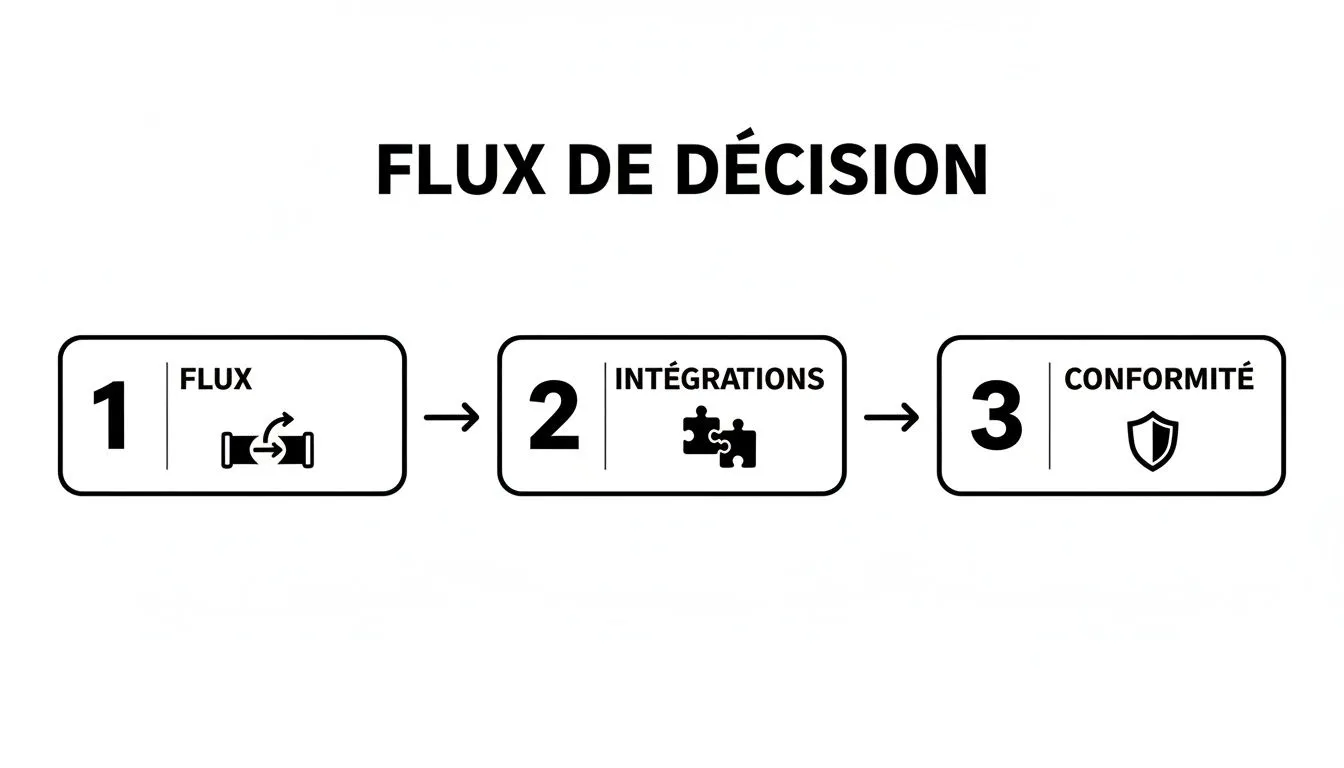
You can clearly see that everything starts with the sales flow, moves through integrations to collect the data, and results in effortless tax and accounting compliance.
Concrete example: You receive an €80 order via your Amazon store, destined for Italy. Without any action on your part, Bizyness identifies the country, applies the Italian VAT rate, generates a compliant invoice with the OSS mention, records the payment (after deducting Amazon fees) and prepares the accounting entry. You did nothing.
Steering your business and collaborating with your accountant
A well-oiled workflow doesn’t just spit out invoices. It produces gold-standard data for running your business. In just a few clicks, you can finally see:
- Your revenue by channel (Shopify, Amazon, etc.).
- The total VAT collected, broken down by country.
- Your best-performing products.
This kind of dashboard centralizes your key indicators and gives you a clear, real-time view of your e-commerce business’s financial health.
Ultimately, the whole point of this automation is to smooth out collaboration with your accountant. No more sending a jumble of Excel files and PDFs. You simply give them access or generate an accounting export (such as the famous FEC - Fichier des Écritures Comptables) in a single click.
Your accountant receives a clean, structured sales journal ready to be imported. It’s a time and peace-of-mind saver for everyone. To go even further, take a look at our guide to automating your administrative tasks and refocus on what really matters: your growth.
Preparing for mandatory electronic invoicing in 2026
The electronic invoicing reform, arriving in 2026, may seem far off, but for an online seller, ignoring it would be a mistake. This isn’t a topic reserved for accountants or large companies. It’s a reality that will directly impact your day-to-day.
Believe me, it’s better to prepare for it now than to find yourself managing a complicated, costly migration in a rush.
The timeline is now official. Starting September 1, 2026, all French companies, without exception, will need to be able to receive invoices in electronic format. The obligation to issue such invoices will apply from September 1, 2027 for small and medium businesses like yours. The goal is simple: digitize all commercial exchanges between businesses.
Choosing a quoting and invoicing app that’s already ready for this deadline, like Bizyness, today isn’t just a precaution. It’s a strategic decision that will save you precious time and spare you a lot of headaches.
E-invoicing, e-reporting: what are we really talking about?
These somewhat technical terms hide a fairly simple reality, especially if your invoicing tool is well designed. The reform is built around two components.
-
E-invoicing concerns all your sales to other businesses (B2B). In practice, your invoices to companies will need to go through a state-certified platform.
-
E-reporting, on the other hand, applies to your sales to individuals (B2C) and international sales. You won’t send every invoice to the authorities, but you’ll need to transmit a summary of these transactions.
As an online seller, you constantly juggle between these two worlds. An order from a reseller on your site? That’s e-invoicing. A product sold via Shopify to an individual customer in Germany? That’s e-reporting. Good software should handle this automatically, without you ever having to think about it.
PDP or PPF: how will it work?
To send and receive this information, you’ll have a choice between two channels. Either the Portail Public de Facturation (PPF), the free solution set up by the government. Or a Plateforme de Dématérialisation Partenaire (PDP), a private operator certified by the tax authorities.
For an online seller, turning to a PDP is often the best approach. These platforms are generally integrated with management software like Bizyness and offer much more than simple compliance: dashboards, direct connection to your online stores, and support far more attuned to your business challenges.
By choosing a tool that’s preparing to become a PDP, or that already integrates with a partner, you ensure a seamless transition. No last-minute tool switch, no emergency data migration in 2026. Your everyday invoicing software will simply become your compliance portal, with no effort on your part. To go further, our article breaks down in detail the role of a partner dematerialization platform.
Ultimately, viewing this reform as a mere constraint is a mistake. It’s an opportunity to modernize your management. A well-suited invoicing app doesn’t just tick the “compliance” box; it automates these new obligations to make them completely invisible in your workflow.
Your questions, our answers on invoicing software
Choosing the right quoting and invoicing software is a bit like choosing a co-pilot for your e-commerce business. You have a thousand questions, especially given the complexities of online selling. Let’s untangle it all together with concrete answers.
What would be the best invoicing app for Shopify?
The question isn’t so much finding an app that connects to Shopify, but one that speaks Shopify. A simple API connection isn’t enough. The “best” solution is the one designed from the ground up for the platform’s ecosystem.
What does that mean in practice? Imagine a partial refund, an extremely common case. A good tool doesn’t just log the transaction. It automatically generates a proper credit note, with no action required on your part. Also consider integration with Shopify Flow, which opens the door to custom automations well beyond simple invoice creation.
And if you’re targeting the North American market, it’s even more critical. A truly well-suited app will handle complex sales taxes, which vary from one US state or Canadian province to another. This is the kind of detail that, done manually, becomes a real headache and a source of costly errors.
Can software really handle VAT for my EU sales?
Yes, absolutely. It’s actually one of its superpowers. Worthy quoting and invoicing software is equipped to manage the VAT one-stop shop (OSS/IOSS), which changes everything for you.
The mechanism is both simple and remarkably effective:
- The customer is identified: The tool automatically detects your individual customer’s country of residence within the EU.
- The correct rate is applied: It instantly applies the local VAT rate of the buyer’s country. That would be 19% for a sale in Germany or 21% for Spain, for example.
- The data is consolidated: The software sorts and totals all the VAT you’ve collected, country by country.
The result? No more spreadsheet-compiling nightmare at the end of the quarter. You just export a clear, ready-to-use report for your OSS declaration. Managing European taxation suddenly becomes much simpler.
Will my accountant be able to use the software’s data?
That’s the whole point! Collaboration with your accountant becomes incredibly simpler. A modern tool isn’t limited to creating nice PDFs; it structures your financial data so it’s directly usable.
The goal of a tool like Bizyness is to build a solid bridge between your business and your accounting. We eliminate manual re-entry, which costs time and causes errors, while ensuring a reliable audit trail, essential in the eyes of the tax authorities.
In practice, your software will generate standardized accounting exports that your accountant will love:
- Sales journals: A complete, detailed history of every transaction, ready to be imported.
- FEC (Fichier des Écritures Comptables): This format is a standard that integrates with nearly all accounting software on the market.
Your accountant receives clean, structured, reliable data. For them, it’s a precious time saver; for you, it’s the assurance of stress-free compliance.
Ready to take your financial management to the next level? With Bizyness, automate your quotes, invoices and accounting so you can finally focus on your growth. Discover how Bizyness can simplify your daily operations.
