

 Français
 The Complete Guide to Reverse Charge Invoicing
Master reverse charge invoicing. Our practical guide covers VAT rules, mandatory mentions, and real-world B2B cases.
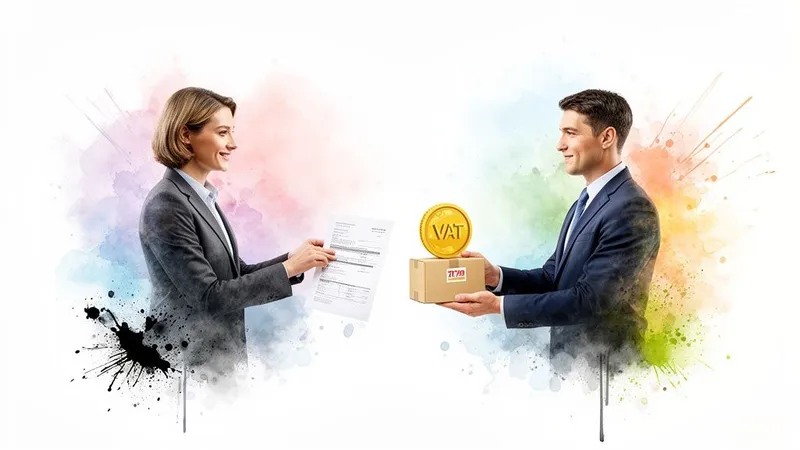
The VAT reverse charge may sound like just another piece of tax jargon, but it’s a mechanism you almost certainly encounter every day. Put simply, it’s a system where the roles are reversed: it’s no longer the seller who collects VAT, but you, the buyer, who takes care of it.
In practice, your supplier sends you an invoice with no VAT (net of tax). It’s then up to you to calculate the applicable French VAT, declare it… and immediately deduct it on the same return. The result? The operation is completely neutral for your cash flow.
Breaking it down: how does VAT reverse charge work?

To picture the concept, think of VAT as a “tax parcel” addressed to the government. In a standard sale, your supplier acts as the courier: they pick up the parcel from you (by charging VAT) and hand it over to the tax authorities. With the reverse charge, it’s as if the supplier hands you the parcel directly. It’s your responsibility to declare it to the tax office.
This system, also known internationally as the “reverse charge” mechanism, was introduced for two main reasons:
- Facilitating international B2B trade: it saves foreign companies from having to register for VAT in France just to sell you a service or product.
- Fighting fraud: in certain sensitive sectors and on imports, it secures VAT collection by handing it directly to the buyer.
What impact does it have on your cash flow and returns?
The biggest advantage of the reverse charge is that it has zero impact on your cash flow. You don’t advance VAT to your supplier only to recover it weeks later. Everything happens at the accounting level through a simple double entry: you declare the VAT as “collected” and, on the same line, as “deductible,” for the same amount. One cancels out the other.
The reverse charge turns VAT management into a simple declarative operation. Instead of a financial flow, it’s a double accounting entry that ensures the tax is correctly recorded without affecting your cash flow.
But be careful — this apparent simplicity requires rigor. For everything to go smoothly with the tax authorities, it’s crucial to know which transactions are affected and to make sure your suppliers’ invoices contain the right mentions.
An increasingly common obligation
Far from being optional, this mechanism is a legal obligation in specific, well-defined situations. This is notably the case for most of your purchases of goods and services from suppliers established in another European Union country. To dig deeper into the topic, feel free to read our guide on calculating intra-community VAT.
The reverse charge is now a pillar of French tax law, especially for e-commerce businesses. Since January 1, 2022, it has even become mandatory for all imports, now accounting for close to 15% of monthly VAT returns. This system concerns you directly if you source goods abroad or use services such as Shopify or Amazon.
When should you apply the VAT reverse charge?
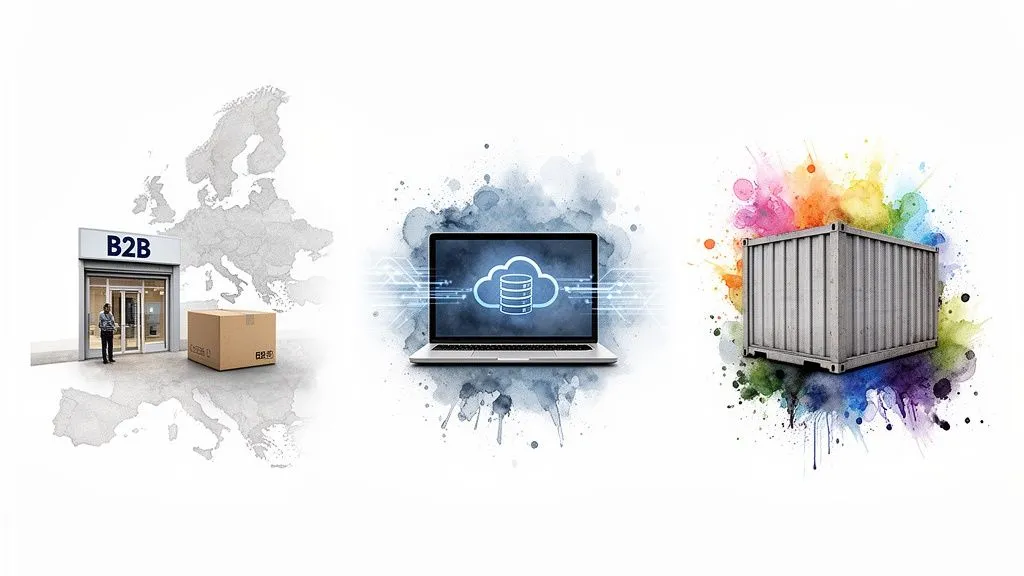
Far from being a simple accounting option, the reverse charge is a legal obligation in very specific situations. To stay compliant, it’s crucial to know how to identify these cases. The core principle never changes: it’s the buyer who declares and pays the VAT, not the seller. But the conditions for application depend on the nature of the transaction.
The main playground for this mechanism is the B2B (Business-to-Business) world. Specifically, it concerns transactions between two VAT-registered professionals. The essential condition? Both the seller and the buyer must have a valid intra-community VAT number.
This number is the cornerstone of the system. It allows each country’s tax authorities to make sure everyone is properly identified, ensuring that VAT flows correctly within the European single market. Let’s go through the three most common scenarios for an online seller.
1. Purchases of goods B2B within the European Union
This is probably the most classic case for an online seller. You buy goods from a supplier based in another EU country? You’re right in the middle of an intra-community acquisition.
Whether you’re ordering stock from a German, Spanish, or Polish company for your store, the rule is the same. Your supplier must send you an invoice net of tax.
Real-world example: Imagine a French store on Shopify selling pet accessories. It sources from a manufacturer in Portugal. The manufacturer issues a net-of-tax invoice, taking care to include both its own VAT number and that of the French store. The French seller must then calculate and declare the 20% VAT on their French return.
2. Purchases of services from an EU provider
The reverse charge also applies when you buy services from a European company. For an online business, this is an almost daily occurrence.
Think about it: your software subscriptions, platform commissions, advertising spend, or cloud services. Most of these web giants (Google, Meta, Amazon Web Services) are often based in Ireland or Luxembourg.
Any expense for a digital service supplied by an EU company falls under the reverse charge. It’s a reflex to have for all your SaaS tools, advertising platforms, and marketplace commissions.
Real-world example: A French SaaS startup pays a monthly subscription to a server management platform whose parent company is in Ireland. Every month, the invoice arrives without VAT. It’s up to the French startup to calculate the VAT on that amount, declare it to the tax office, and then deduct it on the same return. The operation is neutral, but the accounting entry is essential.
3. Imports of goods from outside the EU
Since January 1, 2022, a small revolution has taken place: import VAT reverse charge has become automatic and mandatory in France for any company with a French intra-community VAT number.
This change has genuinely simplified life for importers. What used to be optional is now the norm. Gone are the days of advancing VAT at customs only to recover it weeks later. Everything now happens directly on your VAT return (the well-known CA3 form).
This rule applies across the board, whether you’re importing raw materials from China or finished products from Vietnam for your e-commerce business.
- Cash flow relief: no need to put out cash for VAT at the time of customs clearance. A real breath of fresh air.
- Automated process: the tax authorities pre-fill the VAT amounts to be reverse-charged on your return based on customs information.
- Mandatory for everyone: all VAT-registered businesses in France are subject to it, with no steps required on their part.
Real-world example: A French brand has its products manufactured in China and imports them to sell via the Amazon FBA (Fulfilled by Amazon) program in France. When the container clears customs, no VAT is paid on the spot. The amount is simply carried over to its next VAT return to be reverse-charged there. The impact on its cash flow is zero.
To make things clearer, here’s a table summarizing these different scenarios.
Common scenarios where the reverse charge applies
This table summarizes the situations where the reverse charge applies for an online seller, along with the required conditions and a concrete example for each case.
| Transaction type | Supplier’s origin | Required conditions | Real-world example |
|---|---|---|---|
| Purchase of goods | European Union member | B2B seller and buyer with valid intra-community VAT numbers. | Ordering stock from a manufacturer in Germany for a French store. |
| Purchase of services | European Union member | The provider is based in the EU and the buyer is a VAT-registered professional in France. | Paying advertising fees to Google Ireland or commissions to a Luxembourg-based marketplace. |
| Import of goods | Outside the European Union | The importing company holds a French intra-community VAT number. | Importing products from China to sell on the French market. |
This table should help you quickly identify whether a transaction needs to be reverse-charged. The key is to always check the supplier’s origin and the nature of what you’re buying.
Writing a compliant reverse-charge invoice
An invoice subject to the reverse charge isn’t quite like any other invoice. It’s a document with its own codes. A single mistake, a simple omission, and the invoice can be invalidated by the tax authorities, with financial penalties on the line. Whether you’re the seller issuing the document or the buyer receiving it, rigor is essential.
Think of this section as your compliance checklist. Every point is crucial to secure your transactions and make sure the reverse charge mechanism is applied by the book. After all, a properly drafted invoice is the first piece of evidence of your good faith in the event of an audit.
Mandatory mentions for secure invoicing
For reverse charge invoicing to be valid, it must include specific mentions, in addition to all the usual legal information (date, number, identity of the parties, etc.). These additions are the cornerstone of the system.
There are three elements you absolutely cannot skip:
- Intra-community VAT numbers: the invoice must show both the seller’s and the buyer’s intra-community VAT number. This proves that both companies are indeed VAT-registered professionals within the EU and that this special regime can therefore apply.
- No VAT: the invoice must be issued net of tax. No VAT amount should appear on it, since it’s up to the buyer to calculate and declare it on their own.
- The explicit mention: a clear sentence must be added to justify why VAT isn’t being charged. This mention indicates that the transaction falls under the reverse charge regime.
To keep it simple and effective, the wording to use is simply “Reverse charge”.
This short phrase plays a major role: it signals to both companies and to the tax authorities that the seller knowingly issued a net-of-tax invoice and that the buyer officially becomes liable for the tax. To dig deeper into the topic, feel free to read our full article on the VAT reverse charge mention.
Forgetting the “Reverse charge” mention isn’t a minor administrative detail. The tax authorities interpret it as an invoicing error. The consequence? The buyer’s right to deduct VAT can be called into question, and both companies are exposed to penalties.
The risks of a non-compliant invoice
Skipping these rules isn’t a good idea. The financial consequences of a poorly drafted invoice can be severe and can wipe out, in one stroke, the cash flow advantage the reverse charge is supposed to provide.
Here are the main risks:
- Fines for missing mentions: a simple omission on an invoice can cost you dearly.
- Tax reassessment: the tax authorities could consider that VAT should have been collected by the seller and launch a reassessment against them.
- Loss of the deduction: for the buyer, a non-compliant invoice can mean losing the right to deduct the corresponding VAT.
The penalties are clearly defined by law. Without the precise mention on the invoice, fines of 5% of the undeclared VAT amount may apply, or even climb up to €75,000 for omitting mandatory mentions. You can find more information on the risks related to the reverse charge on Indy.fr.
This is precisely where tools like Bizyness prove their worth. By automating the creation of your invoices, the platform makes sure every document generated for an intra-community transaction systematically includes the correct VAT numbers and the “Reverse charge” mention. Your compliance is thus secured, with no effort or headache.
Managing the reverse charge in your accounting
VAT reverse charge is a completely neutral operation for your cash flow. On paper, it’s simple. But how does this neutrality actually translate into your books? It involves a very specific set of accounting entries, essential to master in order to stay compliant and communicate effectively with your accountant.
The goal isn’t to pay the VAT, but to declare it correctly. And that’s where the little accounting magic comes in. For each relevant purchase invoice, you’ll record a double entry that cancels itself out, guaranteeing zero impact on the amount of VAT you owe the government.
This double entry is really the heart of the mechanism. It simply allows the tax authorities to track VAT flows between EU countries, without any money actually being collected and then refunded.
The accounting entries, decoded
To feel comfortable with the reverse charge, you’ll of course need to master accounting basics. If you need a refresher, this complete guide to accounting entries is an excellent resource for consolidating the fundamentals.
In practice, the entry happens in two parts, but at the same time:
- You record the expense: the net amount of your supplier’s invoice is recorded like any other expense, in a class 6 expense account.
- You record the double VAT entry: the VAT amount you calculated yourself (at the applicable French rate) is recorded both as a credit to the “VAT due” account and as a debit to the “deductible VAT” account.
To put it simply, you wear two hats at once: the collector’s and the deductor’s. You declare the VAT as if you had collected it (VAT due), then immediately cancel it out by deducting it (deductible VAT).
This principle ensures your books stay perfectly balanced. The amount due cancels out the deductible amount. Result: zero.
The VAT return, step by step
All this accounting theory takes shape on your VAT return (the well-known CA3 form). This is the official document used to report these transactions to the tax authorities. And of course, every amount has its own designated box so the tax office can verify everything.
The diagram below summarizes the journey of a reverse-charge invoice, from checking VAT numbers to the mandatory mention on the document.
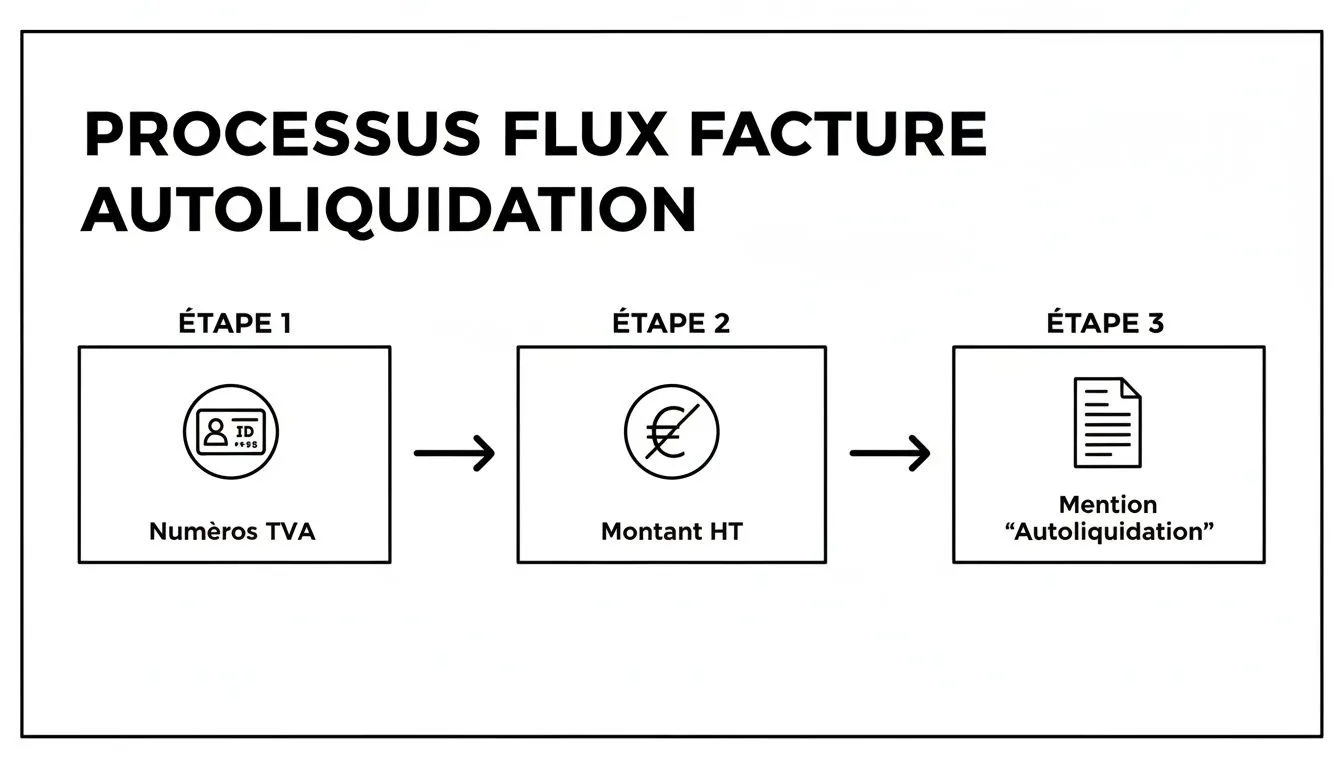
This visual reminds us that everything starts with a properly drafted invoice. It’s the essential foundation for the mechanism to work.
Here’s where you need to report the amounts on your CA3 return:
- The net amount: it must appear on the “Intra-community acquisitions” line or another line dedicated to taxable transactions.
- The calculated VAT: you enter it both under collected VAT and under deductible VAT, on the corresponding lines.
Be careful — an oversight can be costly. In the construction sector, for example, an error on the subcontracting reverse charge can result in a fine of 5% of the VAT amount that should have been declared. An amount that can quickly hurt a project’s profitability.
Understanding this logic remains essential, even if you use an automation tool. A platform like Bizyness handles generating the correct entries and preparing your returns. But knowing how it works behind the scenes gives you the peace of mind to manage your accounting with confidence.
Understanding it better with practical cases for online businesses
Theory is one thing. Real-world practice is another. To truly master VAT reverse charge, nothing beats a few concrete examples drawn from the daily life of businesses selling online. Every day, thousands of e-commerce sellers and marketplace sellers on platforms like Amazon carry out these operations, sometimes without even realizing it.
Let’s dive together into three typical situations that Bizyness customers encounter almost every day. These practical cases will help you develop the right reflex: spotting the transaction, checking the invoice, and understanding how automation can save you a huge amount of time.
The Amazon FBA seller and advertising fees in Europe
This is the textbook case for anyone using the FBA (Fulfilled by Amazon) program who wants to give their sales a boost.
Imagine: you’re a French company, you sell your products on Amazon.fr, and to stand out, you launch advertising campaigns directly from the platform. The invoice you receive for these advertising fees doesn’t come from Amazon France. Most often, it’s issued by a European entity, such as Amazon Europe Core S.à r.l., based in Luxembourg.
So what should you do when this invoice lands in your inbox?
- Identify the transaction: it’s a purchase of a service (advertising) from another professional (B2B) located in another EU country (here, Luxembourg). Bingo — it’s a reverse-charge case.
- Check the invoice: the document must be issued net of tax. It must also include your French intra-community VAT number and Amazon Europe’s. A mention such as “Reverse Charge” must be clearly visible.
- Take action: you need to calculate French VAT (generally 20%) on the net amount. This amount will then be both declared and deducted on your VAT return. The result? The operation is neutral for your cash flow.
This mechanism is at the heart of B2B trade in Europe. It saves suppliers like Amazon from having to register for VAT in every country where they have customers. It’s therefore the French customer who takes over, becoming legally liable for the VAT, which they collect and deduct at the same time.
The Shopify store and its app subscriptions
Different ecosystem, same principle. If you run a Shopify store, you probably use several apps to manage marketing, logistics, or customer reviews.
There’s a good chance the developers of these apps aren’t based in France. Let’s take the example of a French Shopify store paying a monthly subscription for a great customer review management app, billed from Ireland.
Every month, the subscription invoice comes in. The process is exactly the same as with Amazon:
- Diagnosis: it’s a recurring purchase of a service from a European B2B supplier.
- Quality check: is the invoice indeed net of tax? Does it contain all the information needed for the reverse charge (both VAT numbers, the legal mention)?
- Accounting action: French VAT is reverse-charged on the CA3 return.
VAT reverse charge is truly a pillar that simplifies life for companies selling digital services or software B2B within the European Union. To dig deeper into the topic, the official French government portal offers very detailed information.
Commissions paid to Stripe or PayPal
This last case almost certainly applies to you: transaction fees charged by the payment giants. Whether you use Stripe, PayPal, or another gateway, their services are rarely billed from France.
Stripe, for example, bills its commissions from its Irish entity for all its European customers. In practice, every sale you make on your site triggers a micro-transaction subject to the reverse charge: the commission Stripe deducts.
At the end of the month, Stripe sends you an invoice summarizing all these commissions, with no VAT.
- The problem: the volume can quickly become unmanageable. Trying to manually handle the reverse charge for hundreds, or even thousands, of micro-commissions every month is an open door to errors and a monumental waste of time.
- The solution: this is exactly where automation shifts from a “nice-to-have” to a “necessity.”
A platform like Bizyness, connected to your Stripe or PayPal account, completely changes the game. It automatically retrieves these invoices, identifies that they’re subject to the reverse charge, calculates the VAT on your behalf, and generates the appropriate accounting entries, without you having to lift a finger. Your VAT return is correctly pre-filled, and your tax compliance is ensured, effortlessly.
Securing your tax compliance through automation
Manually handling every reverse-charge VAT invoice is a bit like juggling eggs: it’s technical, stressful, and the slightest misstep can be costly. Between checking VAT numbers, applying the right accounting rules, and filling out the return, human error is never far away. And a simple omission can quickly turn into financial penalties and an administrative headache.
Faced with this complexity, automation is no longer a nice-to-have — it’s a genuine necessity. It turns this regulatory constraint into a smooth, reliable process that’s almost invisible day to day.
How an invoicing platform changes the game
A solution like Bizyness is specifically designed to take over these repetitive, technical tasks. By connecting to your sales and payment tools (Shopify, Amazon, Stripe, PayPal), the platform works behind the scenes like a smart tax co-pilot.
The way it works is both simple and powerful:
- Automatic identification: does a new transaction come in, like Amazon advertising fees or a Stripe commission? The system instantly recognizes it as a transaction subject to the reverse charge.
- Data verification: the platform makes sure all the key information, particularly the VAT numbers, is present so the transaction is valid. No more back and forth.
- Generating accounting entries: no more wrestling with debits and credits. Bizyness automatically creates the double VAT entry (due and deductible), ensuring perfectly balanced accounting.
- Pre-filling the return: when it’s time to file your VAT return, the amounts are already calculated and placed in the correct boxes on the CA3 form. All that’s left is to check and validate.
Automation shifts you from the role of technical operator entering data to that of strategic pilot. You no longer handle the details — you oversee a system that works for you.
Freeing up time for what really matters: growth
Beyond simple compliance, automating reverse charge invoicing has a direct impact on your productivity. All the time you used to spend chasing invoices, doing calculations, or fixing errors is now yours. You can reinvest it where it has the most value: developing your products, refining your marketing, and accelerating your company’s growth.
By delegating these processes to an expert system, you gain above all peace of mind. You know your tax management is in good hands, allowing you to focus on what you do best. To go further and lighten your workload even more, discover how to automate your administrative tasks and boost your efficiency.
Frequently asked questions about the reverse charge
Even though the reverse charge mechanism is fairly logical on paper, it raises quite a few practical questions on a day-to-day basis. Let’s clarify the most common ones here so everything becomes crystal clear.
What should I do if my EU supplier charges me VAT by mistake?
This is a classic case: you receive an invoice from a European supplier that includes VAT from their country. First and most important reflex: do not pay this invoice! This foreign VAT cannot be recovered on your French VAT return.
The procedure is simple. Contact your supplier without delay. Calmly explain that this is a B2B transaction between two EU countries and that the invoice should therefore be issued net of tax, applying the reverse charge. You’ll need to ask them for a corrected invoice (often a credit note to cancel the first one, followed by a new, correct invoice) with no VAT, but clearly showing both of your intra-community VAT numbers.
Paying an invoice with an incorrect foreign VAT charge means signing up for a real administrative headache. You’d have to initiate a VAT refund procedure with your supplier’s country’s tax authorities. It’s long, often complex, and frankly, you have better things to do.
The only sensible reflex is to act quickly to obtain a compliant invoice. That’s the key to correctly applying reverse charge invoicing and keeping clean accounts.
Does this concern me if I’m under the VAT exemption scheme?
Yes, absolutely. It’s even a critical point of attention, especially for micro-entrepreneurs. Even if you don’t charge VAT to your own customers, you still need to reverse-charge VAT on certain purchases.
- For purchases of goods within the EU: if the total of your purchases over the year exceeds the €10,000 threshold, you must reverse-charge the VAT.
- For purchases of services within the EU: here, there’s no threshold. You’re concerned from the very first euro spent.
In practice, this means you must apply for an intra-community VAT number from your local tax office (SIE). Rest assured, getting this number doesn’t make you lose the benefit of the exemption scheme for your sales in France. It’s simply essential for your purchases of services from abroad to be compliant.
How do I know if my European partner’s VAT number is valid?
Before doing business with a new customer or supplier in Europe, there’s an essential check to perform: verifying the validity of their VAT number. It’s your best protection against fraud attempts and a sine qua non condition for applying the reverse charge.
Fortunately, the European Commission has set up a simple, free online tool for this: the VIES (VAT Information Exchange System). You just need to enter your partner’s VAT number to check within seconds whether it’s active.
Get into the habit of doing this check systematically and keeping a record, such as a screenshot. It’s a small step that greatly secures your transactions and proves your good faith in the event of an audit.
By eliminating manual tasks and making every transaction reliable, Bizyness turns the complexity of the reverse charge into a simple, automatic process. Discover how our platform can save you time and peace of mind at https://www.bizyness.fr.
