

 Français
 Sole trader invoicing and VAT: Complete guide and practical tips
Everything you need to know about sole trader (auto-entrepreneur) invoicing and VAT: calculation, obligations and simple templates.
As a sole trader (micro-entrepreneur), you’ve probably heard of the VAT exemption scheme (franchise en base de TVA). By default, this is the scheme that lets you invoice your clients without VAT. A real advantage when starting out! In practical terms, it means you don’t have to collect VAT for the State, nor declare it.
In exchange, a specific mention must appear on all your invoices: “VAT not applicable, art. 293 B of the French General Tax Code (CGI)”. This is proof that you’re operating within the rules.
What exactly is the VAT exemption scheme?
Think of the VAT exemption scheme as a kind of administrative “pass”. It was specifically designed to lighten the paperwork for sole traders and let them focus on what matters most: finding clients and growing their business. By not charging VAT, you greatly simplify your bookkeeping.
There’s also a commercial advantage. For an individual client, your displayed price is net, without the 20% VAT that a standard company would have to add. You’re therefore more competitive from the start. For your business clients, who reclaim VAT, it doesn’t change much, but you can offer a lower pre-tax rate, which is always a plus.

VAT thresholds: your dashboard
Of course, this advantageous scheme isn’t unlimited. To benefit from it, your annual revenue must stay below certain thresholds. Think of them as the limits you must not cross to keep this simplification. It’s therefore essential to keep them in mind and monitor your revenue very closely.
The principle is simple: as long as you don’t exceed the caps, everything’s fine. You keep invoicing without VAT. It’s a mechanism that accompanies the natural growth of your micro-business.
Keeping a close eye on your revenue will save you a lot of headaches. Anticipating a threshold breach means ensuring a smooth transition to the VAT regime, since the consequences for your invoicing are immediate.
Here’s a summary table to make things clearer, with the up-to-date thresholds.
Summary of VAT thresholds for sole traders
This table shows the revenue thresholds (cap and increased threshold) that determine whether the VAT exemption scheme applies.
| Type of activity | Exemption threshold (no VAT to charge) | Increased threshold (tolerance) | Sole trader status cap |
|---|---|---|---|
| Commercial activities (sale of goods, items, supplies and food for takeaway or on-site consumption, or provision of accommodation) | €91,900 | €101,000 | €188,700 |
| Services (professional and craft activities) | €36,800 | €39,100 | €77,700 |
The exemption threshold is the main limit, while the increased threshold offers a small margin of tolerance for one year before you must switch over.
Stable caps, but an eye on the future
As a reminder, the overall sole trader status caps are €188,700 for commercial activities and €77,700 for services. But as you can see, the VAT exemption thresholds are much lower.
The topic is actually a sensitive one. In 2025, the government had considered sharply lowering these exemption thresholds. Such a reform would have pushed nearly 200,000 micro-entrepreneurs to manage VAT much earlier. Faced with an outcry, the plan was put on hold, but it’s a reminder that the rules of the game can change. To learn more about the general caps, this analysis from l-expert-comptable.com is very thorough.
The exemption scheme is therefore a great boost when starting out, but it requires vigilance. To make sure everything’s in order on your invoices, feel free to read our guide on the mention VAT not applicable.
Invoicing without VAT: the practical guide to a rock-solid invoice
When you’re under the VAT exemption scheme, every invoice is much more than a simple piece of paper. It’s a showcase of your professionalism, proof for your client, and an official document for the tax authorities. In other words, it needs to be flawless.
Drawing up a sole trader invoice without VAT isn’t just about skipping a tax line. There are rules to follow, including mandatory mentions that explain why your rates are tax-free.
A small oversight can be costly. A non-compliant invoice exposes you to a fine of €15 per missing or incorrect mention. It’s best to build good habits from the start to secure your business.
The basic information, like an ID card
Think of your invoice as a checklist. For it to be valid, every box must be ticked. Here’s the basic information that absolutely must appear on it.
On your side:
- Your identity: First and last name.
- Your business address: Where your micro-business is registered.
- Your SIREN number: The unique registration number for your business.
On your client’s side:
- Their identity: The name of their company, or their first and last name for an individual.
- Their address: Their registered office or home address.
- Their intra-community VAT number: Only if they’re a business based in the European Union — this is crucial for cross-border transactions.
These initial elements set the framework: who is selling what to whom. It’s the basis of everything.
The short phrase that changes everything
Beyond this identifying information, one very specific mention is at the heart of your VAT-free invoice. It’s what makes your special tax status official.
“VAT not applicable, art. 293 B of the CGI”
This phrase isn’t optional — it’s mandatory. It signals to your client, but above all to the tax authorities, that you fall under the VAT exemption scheme, as provided for by article 293 B of the French General Tax Code. It’s your fiscal “doctor’s note”. Without it, your invoice is incomplete, and therefore non-compliant.
Its absence could also raise doubts with a business client, who would expect to be able to reclaim VAT. By stating it clearly, you reassure them and avoid back-and-forth or correction requests. In short, it smooths the relationship.
The body of the invoice: clarity above all
Once everyone is properly identified and your VAT status is clear, you need to detail what you’re invoicing. Precision is your best ally to avoid any dispute later on.
Here’s what the core of your invoice must contain:
- The issue date: The day you produce the document.
- An invoice number: It must be unique and follow a chronological logic (for example, 2024-001, 2024-002…). No gaps allowed!
- The details of the service or product: Precisely describe each product or service, stating the quantity and the unit price excluding tax (net).
- The total amount due: Since there’s no VAT, the total to be paid is simply the sum of the net amounts. Don’t hesitate to specify “Total due excl. tax” to remove any ambiguity.
- The payment due date: And, if applicable, any early-payment discount terms.
Also remember to mention the late-payment penalties that apply if your client doesn’t pay on time. The law imposes a minimum rate, and stating it on the invoice has a deterrent effect.
Using a tool like Bizyness makes life much easier. The software generates flawless invoices for you, with the right numbering and all the legal mentions. It’s a huge time saver and, above all, real peace of mind.
Managing the VAT threshold breach
Crossing the famous VAT thresholds isn’t bad news — quite the opposite! It’s actually a sign that your business is doing well and your revenue is growing. But watch out: this good news comes with new tax obligations. It’s best to anticipate them to avoid unpleasant surprises.
To understand properly, you need to know that the threshold mechanism works on two levels: the exemption threshold (€36,800 for services, €91,900 for sales) and an increased threshold, also known as the tolerance threshold (€39,100 for services, €101,000 for sales). How you cross these levels determines exactly when VAT must start appearing on your invoices.
A poorly managed transition can quickly become a headache. Imagine having to catch up on several months of uncharged VAT… It can hurt your cash flow and complicate your client relationships. Good preparation is therefore key.
Scenario 1: you exceed the exemption threshold but not the increased threshold
This is the most common, and fortunately the most flexible, case. Let’s say your revenue for the current year (N) falls between the exemption threshold and the increased threshold. For example, you’re a service provider and you generate €38,000 in revenue.
Here, you benefit from a tolerance period.
- For the current year (N): Nothing changes. You keep invoicing without VAT until December 31, keeping the mention “VAT not applicable, art. 293 B of the CGI” on your invoices.
- For the following year (N+1): This is when the change takes effect. You become liable for VAT starting January 1, regardless of how your revenue evolves that year.
This rule gives you time to get organized, to warn your clients that your rates are going to change, and to complete the administrative steps without rushing.
Scenario 2: you exceed the increased threshold
Here, on the other hand, the situation is more urgent. If your revenue breaks through the increased threshold cap (€39,100 or €101,000) during the year, the switch to VAT is immediate.
Moving to VAT is no longer optional — it becomes mandatory from the first day of the month in which the threshold is exceeded. There’s no tolerance period in this case.
Concretely, if you’re a craftsperson and you sign an invoice that pushes you past the €39,100 mark on June 15, all invoices you issue from June 1 onward must include VAT. This means you may even need to urgently reissue corrective invoices for those already sent between June 1 and June 15.
This decision tree summarizes your VAT status very simply.
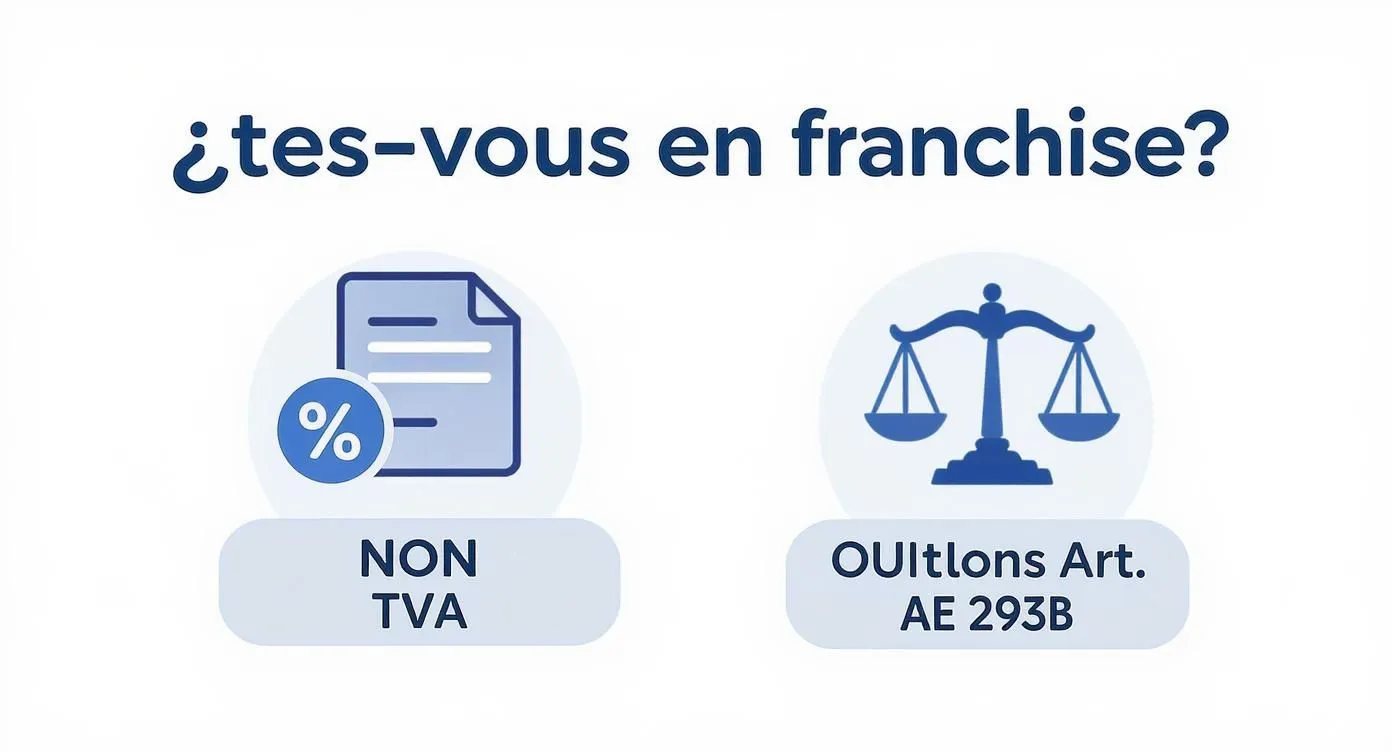
This visual clearly shows that the first question to ask is whether you’re still under the exemption scheme. That answer dictates the legal mention to put on your invoice.
Administrative steps to complete
As soon as you know you’re going to become liable for VAT, don’t wait. The very first step is to contact the Business Tax Office (Service des Impôts des Entreprises, SIE) you depend on.
You must notify them of this change so they can activate your intra-community VAT number.
- Contact your SIE: The easiest way is through the secure messaging of your professional account on impots.gouv.fr.
- Request your VAT number: This number is essential. It’s unique and is built from your SIREN (for example: FR XX 123456789).
- Choose your declaration regime: Your SIE will ask you to opt for the simplified real regime (annual declaration) or the standard real regime (monthly or quarterly declaration).
To start with, the simplified regime is often the best fit, as it reduces paperwork. To dig deeper into the topic, you can explore all the subtleties of VAT for micro-businesses in our full guide.
Once you have your VAT number, you must make sure it appears on all your new invoices. Forgetting to do so can make your documents non-compliant. Fortunately, invoicing tools like Bizyness let you set up this change in just a few clicks so your documents are always up to date, without you having to think about it every time.
How to adapt your invoicing to the VAT regime
Here you are. Your sole proprietorship is growing and the switch to VAT is becoming a reality. It’s an important step, a little intimidating at first, I’ll grant you. Your invoicing, which used to be so simple, will need to adapt with new rules and new mentions. But look on the bright side: it’s a sign of good health for your business and it opens new doors, such as the ability to reclaim VAT on your own business expenses.
You’ll need to get familiar with a new trio of concepts: the net amount (excluding tax), the gross amount (including all taxes), and, of course, the famous VAT rates. A well-crafted sole trader invoice with VAT isn’t just a legal obligation — it’s also proof of your professionalism. Don’t worry, once you understand the mechanism, everything becomes simpler.
Determining the right VAT rate
The very first question is this: what VAT rate should I apply? In France, there isn’t just one rate, but several, each tied to specific types of products or services. This is a crucial step, since a mistake on the rate can be costly in the event of an audit.
Here are the main rates you’ll encounter most often:
- Standard rate of 20%: This is the default, most common rate. It applies to the majority of goods sales and services. If your business doesn’t fall into a special case, this is the one you’ll use.
- Intermediate rate of 10%: Found in the restaurant industry, takeaway food sales, certain renovation work, or passenger transport.
- Reduced rate of 5.5%: This covers basic necessities such as water and a large part of food products, books, gas and electricity subscriptions, or cinema tickets.
- Special rate of 2.1%: Very rare, reserved for very specific cases such as medicines reimbursed by the French social security system.
To find yours, you just need to correctly identify the nature of your service. A marketing consultant will apply 20% to their fees, while a craftsperson renovating a bathroom in a home over two years old can invoice their services at 10%.
Output VAT and input VAT: the balancing act
Moving to VAT brings you into a new world with two fundamental concepts: output VAT (collected VAT) and input VAT (deductible VAT). This may be the biggest change in your bookkeeping, but it’s also where a significant benefit lies.
Picture a set of scales.
On one side, you collect VAT on behalf of the State on everything you sell. This money doesn’t belong to you — you’re holding it temporarily. On the other side, you can deduct the VAT you yourself paid on your business purchases: computer, software, raw materials, etc.
The amount you’ll need to pay to the tax authorities is simply the result of this subtraction: output VAT − input VAT. And if the result is negative (you paid more VAT than you collected), the State refunds you the difference. This is known as a VAT credit, which is very useful if you’re making major investments in your business.
The concrete impact on your prices and invoices
Applying VAT inevitably changes your selling prices. A service you used to invoice at €100 under the exemption scheme will now need to be displayed at €120 gross (with 20% VAT) for you to keep the same earnings. This is an essential point to communicate clearly to your clients, especially individuals, who cannot reclaim this VAT.
For your business clients, on the other hand, the impact is neutral. They will deduct the VAT you charge them, so for them the real cost remains your net price. Your invoice must therefore be crystal clear so they can make this deduction without any issue.
Let’s look at a before/after example for a €500 service:
- Before (under exemption): Total due = €500. The invoice carries the mention “VAT not applicable, art. 293 B of the CGI”.
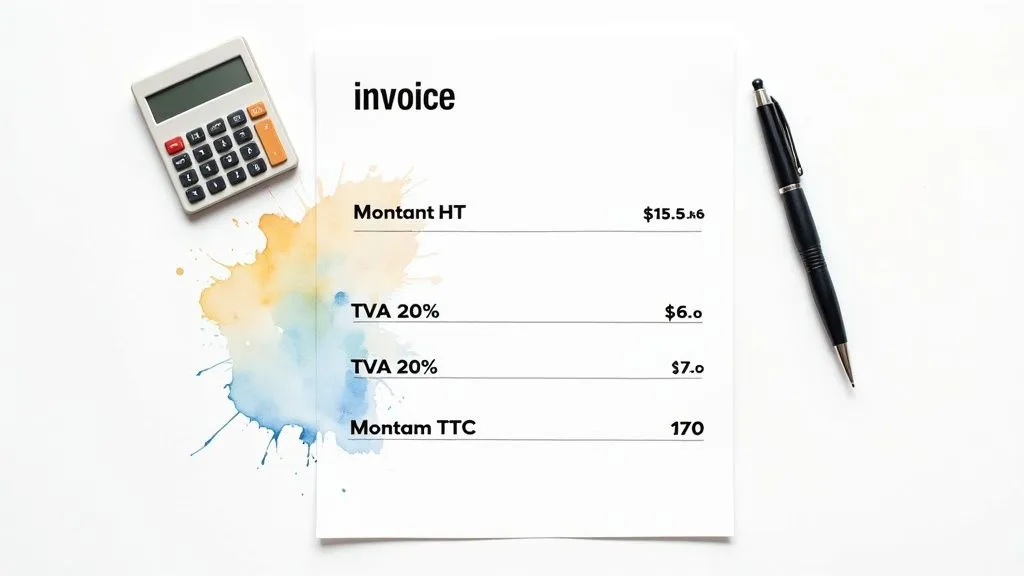
- After (under the real regime): Net amount = €500. VAT rate (20%) = €100. Gross amount = €600. And of course, your intra-community VAT number must appear.
Your new invoices must clearly display these three elements:
- The total net amount (excluding tax)
- The VAT rate applied and the resulting VAT amount
- The total gross amount (including all taxes)
To manage this transition smoothly and without risk of error, the ideal solution is to equip yourself with an invoicing tool like Bizyness. In just a few clicks, you can configure your account to handle VAT. The software then takes care of everything: it automatically calculates the correct amounts, adds the mandatory legal mentions, and guarantees compliant invoices, with total peace of mind.
Mastering your VAT declaration and payment
There you go, you’re now charging VAT. A new stage begins: you now need to declare it and remit it to the State. This obligation might seem a bit intimidating at first, but once the mechanism is properly understood, it becomes a simple administrative routine. After all, it’s just a matter of returning to the tax authorities the money you collected on their behalf.
For this, two declaration regimes exist. The choice between the two will depend on your volume of activity and, let’s be honest, how much you want to simplify your life.
Choosing between the simplified real regime and the standard real regime
When you switch to VAT, the tax authorities will ask you to choose a tax regime. This choice will dictate how often you file declarations and make payments.
The simplified real regime (RSI)
This is often the most logical and gentlest option for a sole trader discovering VAT.
- A single declaration per year: You fill out the CA12 form once a year to summarize all the VAT for the past year.
- Payment by installments: You pay two installments during the year, in July and December, based on what you paid the previous year.
- Less stress: The advantage is clear — less paperwork and a lighter mental load day to day.
The standard real regime (RN)
This regime is aimed more at businesses with a higher volume of transactions.
- Monthly declaration: By default, this is the standard pace. Each month, you declare and pay the previous month’s VAT via the CA3 form.
- Quarterly option: If the annual amount of VAT you owe is less than €4,000, you can request to file this declaration only every quarter.
- More precision: The advantage is that you stay very close to your actual business activity. It also lets you reclaim faster the VAT you paid on your own purchases (the famous input VAT).
For a smooth start, the simplified real regime is generally the sensible choice. It gives you time to get familiar with these new obligations without pressure every month.
How to file concretely on impots.gouv.fr
Whichever regime you choose, everything is done online. The first step, if not already done, is to create and activate your professional account on the tax website. This is your new dashboard for everything related to VAT.
The first declaration may seem daunting, but the logic is always the same.
- Log in: Go to your professional account on impots.gouv.fr.
- Head to VAT: Find the section dedicated to VAT declaration.
- Fill out the form: Whether it’s the CA12 (annual) or the CA3 (monthly/quarterly), you’ll need to state your total net sales, the VAT you collected, and the VAT you paid on your business expenses.
- Automatic calculation: No need to worry about the math — the site calculates the difference itself: the amount you need to pay.
- Validation and payment: Once everything’s correct, you validate and pay directly by bank transfer from your professional bank account.
The golden rule: be uncompromising about keeping your invoices, whether for sales or purchases. They’re the essential evidence needed to fill out your declaration and justify your figures in the event of an audit.
A calendar to plan ahead to avoid penalties
Miss a declaration or payment deadline, and a late-payment penalty is guaranteed. To avoid these unpleasant surprises, the key is anticipation. Note these dates carefully in your calendar or set up reminders.
This administrative rigor is all the more crucial as the regulatory framework tightens. For example, electronic invoicing will become mandatory for everyone starting September 2026, with a fine of €15 per non-compliant invoice. Add to that the rise in social security contributions, and it’s clear that tight management is essential. To better understand these changes, you can discover what the future holds for sole traders on nouvelleviepro.fr.
Equipping yourself with a good tool like Bizyness can really change your life. It centralizes your invoices, automatically calculates VAT for you, and generates clear summaries that make declaring much simpler. It’s the best way to turn this tax obligation into a mere formality.
Your frequently asked questions on invoicing and VAT as a sole trader
Diving into the intricacies of VAT as a sole trader can quickly feel dizzying. And that’s perfectly normal! This FAQ is here to give you clear, concrete answers, without unnecessary jargon, so you can manage your invoicing with peace of mind.
Under the exemption scheme, can I deduct VAT on my purchases?
No, and that’s the whole principle of this simplified scheme. The VAT exemption scheme works on a simple balance: you don’t charge VAT to your clients on behalf of the State, so in exchange, you can’t reclaim the VAT you pay on your own business expenses.
This is a crucial point to understand. Concretely, if you buy a computer for €1,200 gross (which includes €200 of VAT), it will actually cost you €1,200. An entrepreneur under the real regime, on the other hand, would have paid €1,000 net, since they could have deducted that €200 of VAT. This deduction benefit only opens up to you once you switch to the real VAT regime.
My business client insists on getting an invoice with VAT — what should I do?
This is a fairly common situation. A business client, used to deducting VAT from their own expenses, may be puzzled when seeing your invoice. If this happens to you, don’t panic — your role is simply to explain the situation.
Explain to them that your sole trader status places you under the VAT exemption scheme, which formally prohibits you from charging VAT. To reassure them and validate your invoice, make sure it carries the mandatory legal mention: “VAT not applicable, art. 293 B of the CGI”. The displayed price is therefore the net amount due, full stop.
I exceeded the threshold and kept invoicing without VAT — how do I fix it?
To err is human, especially in the heat of the moment. Imagine: you cross the increased threshold in the middle of the month and, out of habit, you issue one or two more invoices without VAT. The rule of thumb: react quickly to correct the situation.
Best practice is to issue a corrective invoice for each affected invoice. This new document must clearly state that it cancels and replaces the original invoice (specifying its number). Of course, this new version must include VAT. Contact your client promptly to explain the process. Clarifying things quickly is essential to avoid any misunderstanding with the tax authorities.
Can I charge VAT even if I don’t exceed the thresholds?
Absolutely! This is a perfectly valid option, and sometimes even a strategic decision. A sole trader can choose to voluntarily give up the exemption scheme to switch to the real VAT regime, at any time.
This process is called “opting in for VAT payment”. It becomes particularly worthwhile if you’re planning major investments (equipment, a vehicle…) or if you have a lot of heavily taxed business expenses. By becoming liable for VAT, you’ll then be able to deduct VAT on all these expenses, which can significantly reduce your costs.
Be careful, this decision shouldn’t be taken lightly. It commits you to more rigorous administrative management, with VAT declarations to fill out and submit periodically. Weigh the pros and cons carefully.
Does sole trader status really pay off?
The question of income is obviously central. In 2025, France counts between 2.5 and 2.7 million micro-entrepreneurs. While the average monthly income has risen to between €590 and €670, this figure masks a very mixed reality. In fact, half of sole traders report earning less than €340 per month.
For many, this status remains a supplementary income or a stepping stone to test an idea. One reason is that social security contributions, around 22% to 25%, don’t allow for the deduction of actual expenses such as fuel, supplies, or equipment. To dig deeper into the topic, feel free to discover how much a sole trader earns on average in France on Hiscox.fr.
Managing your invoicing and VAT shouldn’t be an obstacle to your growth. Once you’ve picked up the right habits and have an effective tool, these administrative tasks become a mere formality. That’s precisely the mission Bizyness has set for itself: to simplify your life so you can focus on what really matters — your craft.
Take it to the next level and discover how Bizyness can automate your invoicing while guaranteeing your compliance.
