

 Français
Sole trader invoices: the ultimate practical guide
Master your sole trader invoices from A to Z. Discover the mandatory mentions, VAT management and tips for error-free invoicing.
Drawing up proper sole trader (micro-entrepreneur) invoices isn’t just an administrative formality. It’s above all an essential pillar that secures your cash flow and strengthens your credibility. It’s the proof that a service actually took place, a document that protects your client, the tax authorities, and above all, you.
The basics of invoicing for a sole trader: where to start?
Getting into invoicing can seem a bit complex at first, but rest assured, it’s a very logical process. A well-made invoice is much more than a simple payment request. It’s the showcase of your professionalism and a legal document that covers you in case of trouble or dispute. Every detail matters, from your SIREN number to the payment deadline.
The idea is to turn this task into a simple routine, not a chore. By adopting good habits from the start, you’ll see it quickly becomes second nature. That leaves you more time for what really matters: finding new clients and growing your business.
A popular status, with rules to know
The sole trader (micro-entrepreneur) status is booming in France. Every year, thousands of new independents launch their business, which makes mastering invoicing rules more important than ever.
A record was broken with the creation of 1,111,200 businesses in France, a 5.7% increase in one year. Of that total, 64.5% (i.e. 717,200) were micro-enterprises. This figure shows just how appealing this status is. To dig deeper, take a look at the key figures on entrepreneurship published by LegalPlace.
This underlying trend confirms it: more and more freelancers and craftspeople need to get familiar with the basics of business management. And flawless invoicing is really the starting point of a healthy, sustainable business.
To help you avoid forgetting anything, I’ve prepared a quick summary of the information that must absolutely appear on your invoices. Keep it handy, it’s a kind of cheat sheet to make sure you don’t slip up.
Checklist of essential mentions for your invoices
This table gives you a quick, visual overview of the information you must never omit to comply with French legislation.
| Item | Specific detail | Why it’s crucial |
|---|---|---|
| Issuer’s identity | Name, surname, registered address, SIREN number. | Allows unambiguous legal identification of your micro-enterprise. |
| Numbering | Unique, chronological number with no gaps. | Ensures traceability of your accounting documents for the tax authorities. |
| Key dates | Issue date and date of sale/service. | Define the starting point for payment deadlines and tax obligations. |
| Service details | Precise description, quantity, unit price excl. VAT. | Justifies the total amount and avoids any ambiguity for the client. |
| VAT mention | ”VAT not applicable, art. 293 B of the French Tax Code” (if VAT-exempt). | Clarifies your tax regime and justifies the absence of VAT on the invoiced amount. |
By following this framework, you’re already off to an excellent start for creating professional, compliant sole trader invoices. It’s the guarantee of starting and running your business with peace of mind.
Decoding the mandatory mentions on your invoices
An invoice isn’t just a piece of paper with an amount to pay. It’s a legal document that seals your business relationship. Every line, every number matters. If we take the time to understand why each mention is there, we not only stay compliant, but we also build a real relationship of trust with our clients. And between us, it greatly simplifies day-to-day management.
So let’s forget the simple checklist. Let’s dive together into the essential details so that creating your sole trader invoices becomes second nature, without the headache.
First things first: clearly identify who is who
The foundation of any transaction is knowing who is selling what, and to whom. It may seem obvious, but it’s the bedrock of your invoice’s validity. A mistake here, and everything can be called into question.
On the issuer’s side (you):
- Your full identity: Your first and last name. If you’ve given your micro-enterprise a trade name, you can add it, but your civil identity must take precedence.
- Your business address: This is the official address of your registered office, the one you declared to URSSAF.
- Your SIREN number: This famous 9-digit number is your business’s ID card. No need to include the SIRET (which has 14 digits), the SIREN is more than enough on invoices.
On the recipient’s side (your client):
- Their identity: First and last name for an individual, or the company name for a business.
- Their billing address: Be careful, it may differ from the delivery address or the place where the service was performed. A small tip: always ask for confirmation to avoid back-and-forth.
This clarity is your best ally in case of follow-up or, hopefully never, a dispute. It’s above all proof of professionalism that reassures.
Structure and dating: details that matter enormously
Once everyone is identified, you need to set the framework. For the tax authorities, traceability is king, and that requires a flawless structure.
First, the word “Invoice” must appear in black and white. This is what legally distinguishes it from a quote or a purchase order. Simple, but essential.
Next, numbering. This is a critical point. Every invoice number must be unique and part of an uninterrupted chronological sequence. The slightest gap can raise suspicion during an audit.
A simple, effective tip many entrepreneurs adopt: using a prefix with the year, such as F2024-001, F2024-002, etc. This lets you start fresh each year while keeping an unbeatable logic.
Finally, two dates are absolutely crucial:
- The issue date: The day you generate the document.
- The date of the service or sale: The day the work was completed or the product delivered.
These dates are the starting point for calculating payment deadlines and applying any late payment penalties. To dig deeper, our complete guide on the mandatory mentions on sole trader invoices will give you all the keys.
At the heart of the invoice: service details and terms
Now we get to the heart of the matter: what exactly are you selling? Here, precision is your best friend. It avoids misunderstandings and justifies every euro you’re asking for.
For each product or service, make sure to indicate:
- A clear description: Avoid generic terms. Instead of “Consulting service,” write “2-hour marketing strategy consulting session.”
- The quantity: Whether in hours, days, or items, be precise.
- The unit price excluding VAT: This is the rate for a single unit.
In most cases, as a sole trader, you fall under the VAT exemption scheme. It is therefore essential to add the mention: “VAT not applicable, article 293 B of the French Tax Code”. This little magic phrase informs your client and the tax authorities of your tax status.
To wrap things up nicely, clarify the payment terms:
- The due date: Specify the payment period (“Payment on receipt,” “Payment within 30 days,” etc.).
- Late payment penalties: Mention the applicable rate in case of delay, even if you don’t intend to apply it. It’s mandatory.
- The flat-rate compensation of €40: For your business clients, this mention is mandatory. It covers collection costs in case of non-payment.
This information protects your cash flow and gives you a solid legal framework to gently follow up with a client if needed. A well-made invoice is the signature of a serious, organized entrepreneur.
Understanding VAT rules as a micro-entrepreneur
VAT management… now there’s a topic that can quickly become a headache for sole traders. Yet, at the start, everything is designed to make your life easier. The default regime is the VAT exemption scheme (franchise en base). In concrete terms, that means you don’t have to charge it or declare it.
This is actually one of the major advantages that explains the success of this status. To give you an idea, in a single month alone, we saw the creation of 58,960 new micro-enterprises in France. A figure that clearly shows this simplified regime, launched in 2009, is still just as appealing.
As long as you’re in this situation, all your invoices must absolutely carry a small magic phrase.
The mention never to forget under VAT exemption
For your invoices to be fully compliant, you must state clearly: “VAT not applicable, art. 293 B of the French Tax Code”.
This simple line of text isn’t just there to look nice. It’s essential for several reasons:
- It’s clear for your client: They immediately understand why the amount is “excl. VAT” and that there’s no VAT to add.
- You’re compliant: In front of the tax authorities, you show that you know your regime and apply it correctly.
- It simplifies your calculations: The price you announce is the price your client pays, full stop. No VAT calculation, which makes your quotes and invoices much more straightforward.
Forgetting this mention is a classic mistake, but such an easy one to avoid. Get into the habit of including it in your invoice template from day one.
Pro tip: On a tool like Bizyness, add this mention directly in the footer of your invoice template. It will then appear automatically on every new document. No need to think about it anymore!
The infographic below clearly shows the visual difference between an invoice without VAT and an invoice with VAT. It’s a good summary of the changes to expect.
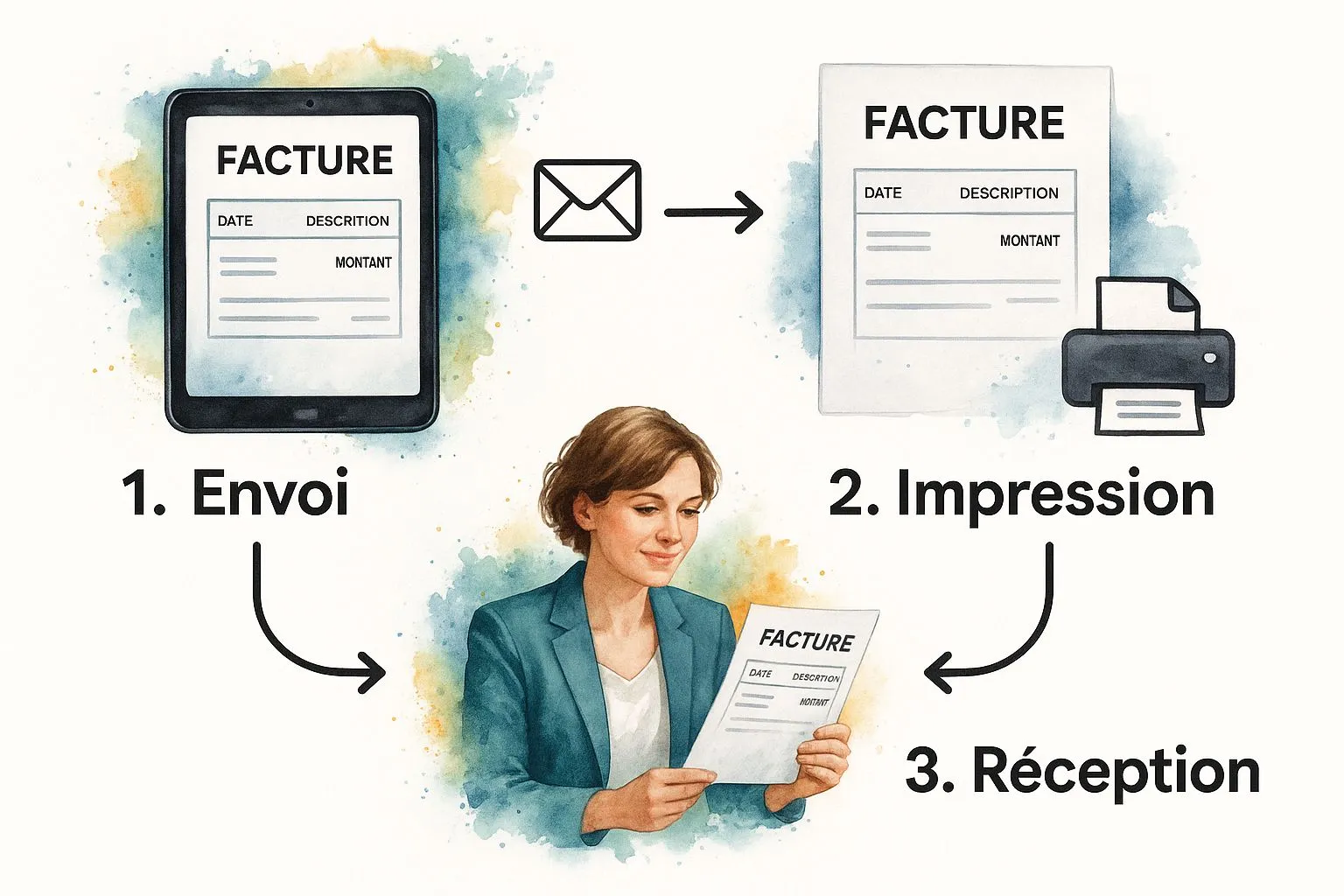
We can clearly see that moving to VAT isn’t just one extra line. It’s your entire accounting management that evolves.
The tipping point: when thresholds are exceeded
VAT exemption isn’t forever. It depends on revenue caps. Once you exceed them, you’re required to charge VAT.
Think of it as good news: your business is growing! But it does require a bit of anticipation so the transition goes smoothly. Here are the thresholds to keep in mind (2025 figures, always check each year):
-
Base threshold: €36,800
-
Increased threshold: €39,100
-
Base threshold: €91,900
-
Increased threshold: €101,000
You switch to VAT as soon as you exceed the increased threshold within a year, or the base threshold two years in a row. And be careful, it applies from the first day of the month in which the threshold is exceeded.
Let’s take a concrete example to make this clearer.
Scenario: The example of a freelance developer
Imagine a developer who invoices an average of €4,000 per month. By the end of September, their cumulative revenue is €36,000. They’re on alert, close to the threshold. In October, they land a new project worth €5,000. Their annual revenue then climbs to €41,000. That’s it, they’ve just exceeded the increased threshold of €39,100.
The consequence? From October 1st, they must charge VAT. Their €5,000 invoice will no longer be €5,000, but must include 20% VAT. The final amount will therefore be €6,000 incl. VAT (€5,000 excl. VAT + €1,000 of VAT).
How to manage the transition to VAT invoicing properly
As soon as you sense you’re going to exceed the threshold, you need to act quickly. Here are the steps:
- Contact your local Business Tax Office (SIE): You need to notify them so they can assign you an intra-community VAT number.
- Update your invoice templates: The “VAT not applicable” mention must disappear. You’ll now need to display the amount excl. VAT, the VAT rate (often 20%) and the amount incl. VAT.
- Communicate with your clients: Let your regular clients know that your invoices are going to change. Simply explain that your rates excl. VAT remain the same, but that the law now requires you to add VAT.
This is a key stage in the life of your micro-enterprise. To dig deeper, feel free to read our complete guide on managing VAT for sole traders and invoicing. The secret is anticipation. Good preparation will save you a lot of stress.
Organizing your invoicing to save time
Having compliant invoices is good. But building an invoicing system that runs on its own is even better. The goal isn’t just to produce paperwork; it’s about building a smooth process that saves you precious time. Time you can reinvest where it really counts: your craft.
Good organization is the key to saying goodbye to administrative stress and keeping a peaceful eye on your cash flow.
Many sole traders, understandably, start with a simple spreadsheet template. It’s free, accessible, perfect for getting started. Except this method very quickly shows its limits… You make mistakes in numbering, forget a mandatory mention, tracking payments becomes a real headache. What seemed simple quickly turns into a nightmare.
Fortunately, there are tools designed for you.
Choosing the right tool for your sole trader invoices
The entrepreneurship scene in France is booming. Recently, we saw more than 98,000 businesses created in a single month, a 6% increase year over year! Sectors like transport even jumped by 20.5%. To learn more, you can check the latest statistics on business creation in France.
This momentum shows one thing: independents need efficient management tools more than ever. Faced with this need, choosing your invoicing tool becomes a real strategic lever.
- Spreadsheets (Excel, Google Sheets): Perfect for starting out on a budget. It’s a good exercise that forces you to really understand how an invoice is built. The main pitfall is human error, especially on that famous number sequence which must never have a gap.
- Dedicated invoicing software: Here, you move up a level. Solutions like Bizyness are designed for sole traders. They automate the tasks that waste your time, make sure your documents are always compliant, and centralize your client and financial information in one place.
Betting on specialized software is an investment that quickly pays for itself through the time saved and the peace of mind regained. To dig deeper, our guide on the best invoicing software for sole traders details the features that really change everything.
Creating an invoice template that reflects you
Whether you’re starting from a spreadsheet or software, take the time to customize your invoice template. It’s not a minor detail, it’s an extension of your brand image.
Make sure to include these three key elements:
- Your logo: This is the foundation for reinforcing your identity and looking professional.
- A consistent visual identity: Reuse the colors and fonts of your website or business cards. Consistency builds trust.
- Clear information: Your contact details and payment terms should jump out at a glance.
A well-designed template isn’t just prettier. It’s easier for your client to read and, trust me, it encourages them to pay you faster.
On a tool like Bizyness, customization takes just a few clicks, as you can see here.
The interface is designed to organize all the information and produce a professional invoice without the hassle.
Setting up solid payment tracking
An invoice sent isn’t yet an invoice paid. Tracking is the crucial step for the health of your micro-enterprise. A well-oiled system lets you see at a glance who owes you money, since when, and who has settled up.
A follow-up isn’t a confrontation. It’s a normal administrative step. A simple professional reminder that protects your cash flow while maintaining a good relationship with your client.
For thorough tracking, here’s a simple, effective method:
- D+7 after the due date: Send a first reminder email. Courteous, friendly. Most of the time, it’s simply an oversight.
- D+15: A second, slightly more formal reminder. Gently restate the payment terms and late payment penalties shown on the invoice.
- D+30: Pick up the phone. Direct contact is often the most effective way to resolve a situation.
The big advantage of software is that it can automate these reminders for you. A real relief for a task often seen as thankless.
Digital archiving: a legal obligation not to be taken lightly
The law is clear: you must keep all your invoices, both issued and received, for 10 years. This rule, set out in article L123-22 of the French Commercial Code, is your best protection in case of a tax audit or dispute.
So forget the big binders gathering dust and moisture. Digital archiving is today the simplest and safest solution.
To stay organized, create a logical folder structure on a secure cloud service:
- A main folder, for example “Accounting 2024.”
- Subfolders: “Client Invoices,” “Supplier Invoices,” “Expense Reports.”
- And name your files in a standardized way:
F2024-001_ClientName.pdf.
With this structure, you’ll find any document in three clicks. Invoicing software like Bizyness handles this archiving for you, automatically. It’s the guarantee of always being compliant, without even thinking about it.
Handling special cases: quotes, deposits and credit notes
The life of a sole trader is rarely a smooth ride. Neither is your invoicing. Between projects starting, evolving, and small errors that sometimes creep in, your management needs to be flexible and responsive.
Fortunately, for every situation, there’s a simple, perfectly legal accounting solution. Knowing how to juggle quotes, deposits and credit notes simply means giving yourself the means to run your business professionally, whatever the unforeseen circumstances.
Quote and invoice: what’s the real difference?
This is a question that keeps coming up, and rightly so. A quote and an invoice are two distinct documents, with completely different roles and legal implications. Confusing the two can quickly lead to misunderstandings with your clients, or even complicated situations.
The quote is your commercial proposal. It details a service or sale and estimates its cost. Think of it as a contract offer. It only binds your client once they accept it, generally by signing it with the famous mention “Approved” (“Bon pour accord”). On your side, the quote commits you to the prices and terms you stated in it.
The invoice comes afterward. It’s the accounting document that certifies the service was actually performed or the sale actually made. It’s an official payment request that closes the transaction. Unlike the quote, it has genuine legal and tax value.
To put it simply, the quote is the before, the promise. The invoice is the after, the confirmation. A signed quote becomes a contract, and the invoice is its financial execution.
How to properly handle a deposit request
For large-scale projects or ones that stretch over time, requesting a deposit is not only common practice, but also very sound. It’s an advance on the total amount that secures both your commitment and your client’s. A real sign of seriousness.
But be careful, a deposit isn’t requested informally. It must be formalized with a deposit invoice. This document must follow the same rules as a regular invoice, but with a few specifics:
- It must clearly state that it is a “Deposit invoice.”
- It must reference the original quote number to link the two documents.
- The amount corresponds to a percentage of the total, for example 30% of the overall amount.
Once this deposit is collected, it will of course need to be deducted from the final invoice, also known as the balance invoice.
Let’s take the concrete example of a graphic designer creating a logo for €1,000 excl. VAT.
- They issue a quote D2024-015 for €1,000 excl. VAT.
- Once the quote is accepted, they create a deposit invoice FA2024-001 for €300 excl. VAT (30%).
- Upon delivery of the logo, they issue the final invoice F2024-042. On it, they detail the service at €1,000 excl. VAT, then add a line “Deposit paid on invoice FA2024-001” of -€300 excl. VAT. The balance due is therefore €700 excl. VAT.
This method is transparent for the client and absolutely impeccable from an accounting standpoint.
To err is human: correcting an invoice with a credit note
The classic scenario: you’ve just sent an invoice and you notice a pricing error, a typo in the client’s name, or a miscalculated quantity. Your first instinct might be to edit it. Definitely not! Once issued, an invoice is set in stone. You can no longer modify it or delete it.
The law is very clear on this to guarantee the integrity of accounting. The only clean, legal solution is to issue a credit note, also called a credit memo.
A credit note is simply a document that cancels, fully or partially, a previous invoice. It must contain the same mandatory mentions as an invoice, but with a few crucial additions:
- The clear mention “Credit note”.
- An explicit reference to the invoice it cancels (for example: “Refers to our invoice F2024-042”).
- The amounts must be negative or preceded by the mention “Amount to deduct.”
After issuing the credit note to “neutralize” the erroneous invoice, you can then create a new, correct invoice, with a new number that follows your chronology. This is the only method that guarantees you remain fully compliant. Tools like Bizyness automate this process, which greatly reduces the risk of error and guarantees you follow the correct procedure without even thinking about it.
Frequently asked questions about sole trader invoices
Invoicing as a micro-entrepreneur, especially when starting out, is often a hotbed of questions. To wrap up this guide, I’ve gathered the questions that come up most often. The idea is to give you clear, direct answers so you can manage your sole trader invoices with peace of mind.
Can you invoice without a SIRET number?
The answer is a firm, definitive no. Issuing an invoice without being officially registered is simply illegal. Your SIREN/SIRET number isn’t just a random string of digits; it’s the legal proof that your micro-enterprise exists. It’s even one of the most important mentions on your documents.
You must therefore absolutely wait to receive your official number from the authorities after declaring your business. Any invoice issued before this step has no value and exposes you to problems.
Think of it as your business’s driving license. Without it, you’re not allowed to “drive” commercially. It’s better to wait a few days and start on solid ground.
This short wait guarantees everything will be clean and traceable from day one.
What should you do if you forget a mandatory mention on an invoice?
To err is human, that’s a fact. But in accounting, it needs to be corrected properly. If you realize crucial information is missing from an invoice already sent to the client, forget the first instinct: you NEVER edit a document that has already been issued. A sent invoice is set in stone.
So how do you handle it? Here’s the correct procedure:
- Issue a credit note: This document, also called a credit memo, officially cancels the invoice containing the error. Be sure to clearly reference the original invoice number.
- Create a new invoice: Once the client has received the credit note, you can issue a brand-new, correct invoice. It will carry a new number, following the logical sequence of your other invoices.
This two-step method is the only valid one from an accounting standpoint. It’s what ensures you stay compliant in case of an audit.
Is an invoice sent by email valid?
Of course! An electronic invoice, most often a simple PDF, has exactly the same legal value as a paper invoice. In fact, it has become the norm in most sectors. It’s faster, simpler, more eco-friendly.
For it to be fully valid, it just needs to tick two boxes:
- Contain all the mandatory legal mentions, without exception.
- Guarantee its authenticity and integrity. A non-editable PDF does the job perfectly.
Electronic invoicing will in any case become mandatory for everyone starting in 2026. Getting started now simply means getting ahead of the curve.
How do you invoice a client abroad?
Invoicing internationally requires a bit more care, mainly because of VAT. The situation isn’t the same depending on whether your client is in the European Union or outside it.
For a business client in the EU:
- You must absolutely include their intra-community VAT number on the invoice.
- If you yourself are liable for VAT, it’s the client who handles it in their own country — this is known as the reverse charge mechanism.
For a client outside the EU (whether business or individual):
- In general, the service is not subject to French VAT.
- You must add a specific mention: “VAT exemption - Article 262 1° of the French Tax Code”.
One last practical tip: remember to invoice in your client’s currency or in euros, but state it clearly in black and white to avoid any misunderstanding.
Ready to create flawless invoices in just a few clicks and put your management on autopilot? Discover how Bizyness simplifies life for sole traders. Try Bizyness for free and save precious time!
