

 Français
The tax handbook for sole traders (micro-entrepreneurs)
Your tax handbook for sole traders. Master deadlines, rates and filings for simplified, stress-free tax management.
Managing your taxes when you’re self-employed is a bit like preparing a route map before a long trip. That’s exactly what a tax handbook is: an essential document that brings together all the key information you need to stay on track. Think of this guide as your co-pilot, designed to help you steer your finances with confidence and focus on what really matters: your business.
Mastering your tax obligations as a sole trader
Getting to grips with micro-entrepreneur taxation can feel intimidating at first. Yet a well-organised handle on your deadlines is the secret to a healthy business. It’s not just about complying with the law; it’s a genuine strategy for protecting your cash flow and dodging penalties that can quickly become a real headache.
This guide is designed as a practical tax handbook, easy to consult to find the information you need, exactly when you need it. Each section aims to clarify one specific point of your obligations so you can make the right decisions without hesitation.
Why this guide will change the way you work
Think of this document as your personalised annual calendar. It’s been designed to help you anticipate and plan ahead, turning administrative chores into a smooth, well-oiled routine. The goal is clear: save you time and bring you peace of mind. For a complete picture of all the levies involved, it’s essential to understand the different taxes and charges faced by sole traders.
Managing your taxes isn’t just about paying what you owe. It’s above all about understanding what you’re paying, why, and — crucially — when. Anticipating is the best reflex for keeping your micro-business in good financial shape.
Here are the main chapters we’ll explore together:
- Income Tax (IR): We’ll see how to declare it and, above all, how to choose the option that suits you best.
- The Corporate Property Tax (CFE): We’ll break down this local tax to understand who has to pay it and how to benefit from possible exemptions.
- Value Added Tax (VAT): A crucial point to know when it applies to you and how to manage it day to day.
- Social contributions: The basics of your monthly or quarterly filings with URSSAF.
Each of these points will be covered in a direct, practical way, with concrete examples and tips to guide you step by step throughout the year.
Your tax and social calendar: the dates you must never miss
As a sole trader, juggling tax and social security deadlines can quickly become a real headache. To help you see things more clearly, nothing beats a well-oiled tax handbook. Think of this section as your annual route map, designed to help you anticipate every important date, without the stress.
The golden rule is never to be caught off guard. Whether it’s declaring your revenue or paying your contributions, every month (or quarter) has its own requirements. Good organisation is your best ally — not only to dodge late-payment penalties, but above all to stay in control of your cash flow with peace of mind.
To give you an overview, here are the key moments of your tax year.
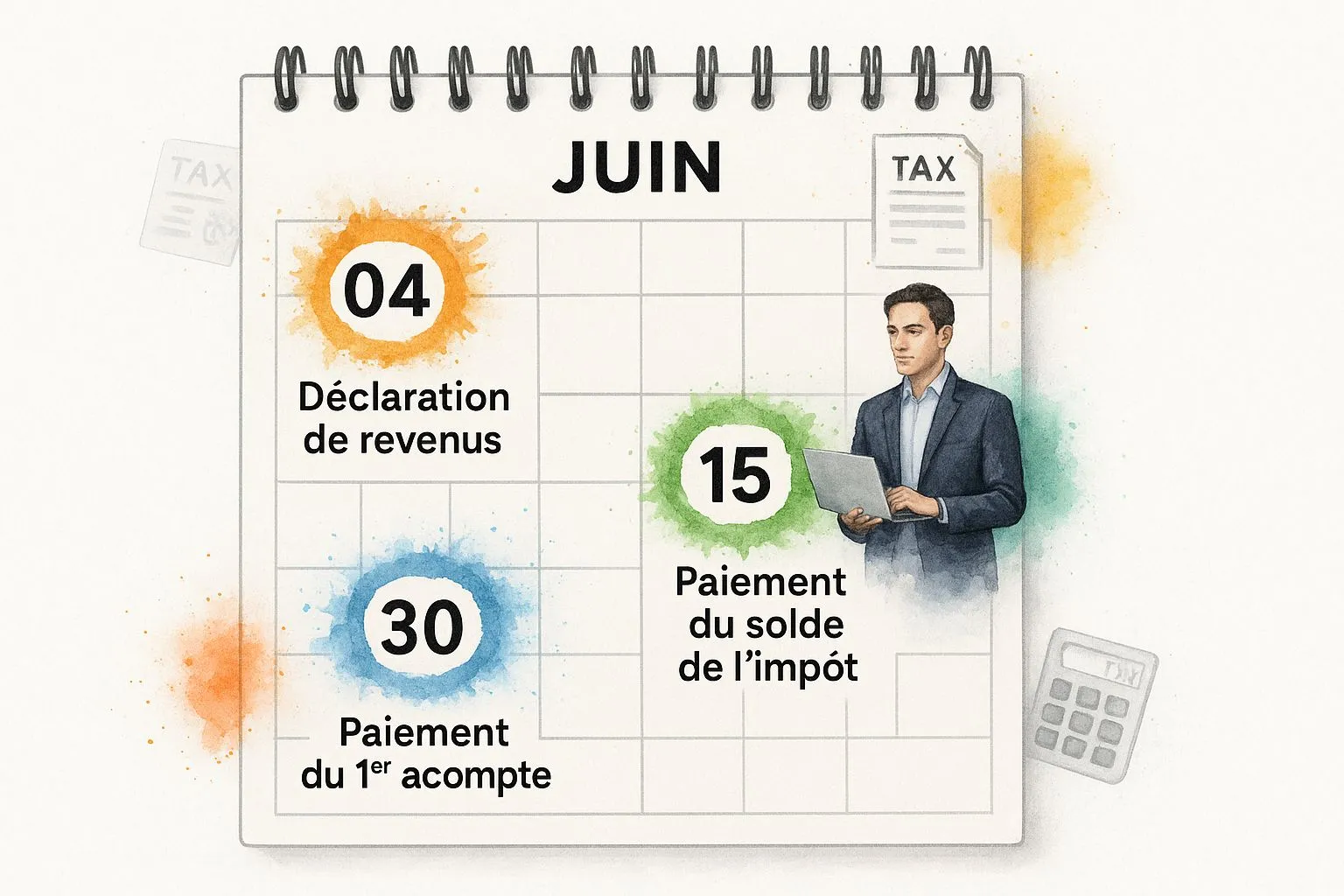
As you can see, managing your micro-business is a marathon, not a sprint. Regular attention is needed to stay on track.
To help you visualise these obligations concretely, here’s a summary table of the key dates to add to your diary.
Calendar of key tax and social security deadlines
This table summarises the important filing and payment deadlines for sole traders. It will serve as a quick reference throughout the year.
| Deadline | Tax/Social Obligation | Frequency | Action Required |
|---|---|---|---|
| End of each month | Filing and payment of social contributions | Monthly | Declare the previous month’s revenue before the end of the current month. |
| 30 April | Filing and payment of social contributions | Quarterly | Declare Q1 revenue (January, February, March). |
| April - June | Annual income tax return | Annual | Complete form 2042-C PRO for the previous year’s income. |
| 31 July | Filing and payment of social contributions | Quarterly | Declare Q2 revenue (April, May, June). |
| 31 October | Filing and payment of social contributions | Quarterly | Declare Q3 revenue (July, August, September). |
| 15 December | Payment of the Corporate Property Tax (CFE) | Annual | Log in to your professional account on impots.gouv.fr to pay the CFE. |
| 31 January | Filing and payment of social contributions | Quarterly | Declare Q4 revenue (October, November, December). |
Keep this calendar close at hand. The simplest approach is to set reminders on your phone or computer so nothing slips through the cracks.
URSSAF’s recurring deadlines
Your most frequent appointment is undoubtedly with URSSAF. It’s through this revenue declaration that your social contributions are calculated. When you set up your business, you had to choose a filing frequency: monthly or quarterly.
- If you chose monthly filing: It’s simple — each month you declare the revenue from the previous month. For example, May’s revenue must be declared by 30 June at the latest.
- If you opted for quarterly filing: The deadlines are fixed and fall on 30 April, 31 July, 31 October and 31 January for the quarter that has just ended.
One essential point to remember: even if your revenue is €0, filing remains mandatory. Missing it, even with zero revenue, can result in a penalty. Payment of your contributions follows immediately after your online filing.
The major tax dates of the year
In addition to your regular URSSAF filings, two major dates punctuate your tax year. They require a bit of forward planning to be approached calmly.
1. The annual income tax return
Spring, generally between April and June, means income tax return season. You must declare all the income of your tax household, of course including income from your micro-business. Everything is done online on impots.gouv.fr.
- What you need to do: You’ll need to complete the main return (form 2042) as well as the appendix dedicated to self-employed professions, the well-known 2042-C PRO form.
- A point of caution: The online filing deadline isn’t the same for everyone — it depends on your department of residence. Remember to check the official calendar each year so you don’t miss it.
2. Payment of the Corporate Property Tax (CFE)
The CFE is a local tax that almost all sole traders must pay. There are some exemption cases, notably during your first year of business, but it then becomes an unavoidable deadline.
- The deadline: Payment of the CFE must be made before 15 December each year.
- How to pay? No more paper! The tax notice is no longer sent by post. You need to log in to your professional account on the tax authority’s website to check the amount due and pay it directly online.
Getting ahead and noting these dates in your diary is the best way to guarantee sound management and flawless compliance.
Understanding and filing your income tax
Income tax (IR) is an unavoidable step in the life of a sole trader, and it’s a central point of your annual tax handbook. It’s important to distinguish it clearly from your social contributions: while the latter are deducted directly from your revenue, income tax is calculated on your profit. To do this, the tax authority applies a flat-rate allowance whose rate depends on the nature of your business.

Two paths are open to you, each with its own subtleties. Believe me, the choice between these schemes is not trivial and can genuinely change the final amount of your tax. It’s therefore crucial to weigh the pros and cons to make the wisest choice.
The default micro-fiscal scheme
This is the base option, the one that applies automatically if you don’t request anything else. The principle is fairly simple: the tax authority takes your annual revenue and applies a flat-rate allowance to simulate your business expenses, without you having to justify anything.
The allowance rates are as follows:
- 71% for buying and reselling goods, or for accommodation services.
- 50% for other services classified as BIC (industrial and commercial profits).
- 34% for professional/liberal activities, which fall under BNC (non-commercial profits).
The income obtained after this allowance is added to the other income of your tax household. It’s this total that will then be subject to the progressive income tax scale. The advantage is that if your household isn’t taxable, you won’t pay any tax at all on your sole trader income.
Since the French tax system is progressive, not everyone pays income tax. To give you an idea, in 2023, out of 40.7 million tax households in France, only 44.7% were taxed, with an average amount of €4,663 per household. To dig deeper into the topic, the figures published by La Finance Pour Tous are very insightful.
The final withholding option (versement libératoire)
The final withholding payment is a whole different ball game. It’s a very appealing option, but be careful — it’s subject to income conditions. The idea here is to pay your income tax at the same time as your social contributions, on a rolling basis, each month or each quarter.
The calculation is straightforward: a fixed percentage is applied to the revenue you collect.
- 1% for the sale of goods (BIC).
- 1.7% for services (BIC).
- 2.2% for liberal/professional activities (BNC).
This option is often an excellent choice if you are taxable. It lets you spread the tax burden over the whole year and tie it directly to your actual business activity. But watch out for the flip side: if you are not taxable, you’ll still pay tax you wouldn’t have owed under the standard scheme.
To be eligible, your reference tax income from year N-2 must not exceed a certain ceiling, which is also reassessed each year.
Filling in your annual 2042-C PRO return
Whichever scheme you choose, one thing is certain: declaring your revenue is an annual obligation that takes place in spring. For this, you’ll need the supplementary 2042-C PRO form.
Today, everything is done online from your personal account on the tax authority’s website. You simply enter your gross annual revenue, without applying the allowance yourself — the tax authority takes care of that. To guide you step by step, don’t hesitate to check out our full guide on filing taxes as a sole trader.
Managing VAT as a micro-entrepreneur
When starting out as a micro-entrepreneur, managing VAT can seem complex, but it’s actually quite logical. At the outset, most sole traders benefit from a very convenient scheme: the VAT exemption threshold (franchise en base). In practice, this means you don’t have to charge VAT to your customers, nor declare or remit it to the State. A real administrative relief!
As long as you’re under this scheme, a specific mention must appear on all your invoices: “VAT not applicable, art. 293 B of the French Tax Code”. This simplicity is one of the great advantages of the status, but be careful — it depends on revenue thresholds that need close monitoring.
Understanding the VAT exemption thresholds
Keeping an eye on your revenue is crucial so you’re not caught off guard. There are two thresholds to know:
- The base threshold: If you exceed it over a full calendar year, you switch to VAT starting 1 January of the following year.
- The increased threshold: If you cross this ceiling during the year, the change is immediate. You must start charging VAT from the first day of the month in which you exceed it.
Imagine an IT consultant. If they exceed the increased threshold in June, they’ll have to reissue all the invoices sent in June to add VAT. Responsiveness is therefore essential. For exact, up-to-date amounts, our full guide on VAT for sole traders is an essential resource.
Moving to the simplified real VAT regime
Once the thresholds are exceeded, your tax management changes. You’re no longer exempt and you move to what’s called the simplified real VAT regime (régime réel simplifié). This changes quite a few things in your day-to-day, notably your invoicing and bookkeeping.
See the switch to VAT not as a burden, but as a natural stage in the growth of your business. It’s also at this point that you can start reclaiming VAT on your own business purchases — a financial benefit that can make a real difference.
Two concepts then become central to your tax handbook:
- Output VAT (collected): This is the tax you add to your selling prices (most often at a rate of 20%) and collect on behalf of the State.
- Input VAT (deductible): This is the VAT you pay on your business expenses (equipment purchases, software subscriptions, etc.). Good news: you can deduct it from the amount you owe the tax authorities.
The amount to pay is therefore simple: output VAT - input VAT. Filing is done directly from your professional account on impots.gouv.fr. Depending on your situation, it can be annual (with instalments to pay during the year) or monthly if the amount of VAT you handle becomes larger.
The Corporate Property Tax (CFE): what you need to know
The Cotisation Foncière des Entreprises, better known by its acronym CFE, is a local tax that often raises a lot of questions among sole traders starting out. It replaced part of the former business tax (taxe professionnelle) and is an important line in your tax handbook. It’s essential to understand it well so you’re not caught off guard.
Put simply, the CFE is owed by almost every individual or entity carrying out a self-employed professional activity in France. Whatever your legal status, as a sole trader you’re affected.
Its amount is based on the rental value of the real estate you dedicate to your business. A question that comes up often: “What if I work from home?” Even in that case, a minimum base applies. It’s the municipality where your micro-business is registered that sets it.
Who can be exempt from CFE?
The good news is that there are cases of full exemption from this tax. These situations are valuable, so it’s worth knowing them well.
- First-year exemption: This is the golden rule for all business founders, sole traders included. You don’t pay CFE for your first calendar year of activity.
- Activity-related exemptions: Certain trades benefit from a permanent exemption. Think of craftspeople (under certain conditions), farmers, or author-photographers.
- Geographic exemptions: If your business is located in certain specific zones, such as Urban Free Zones (ZFU) or Rural Revitalisation Zones (ZRR), you may also be exempt.
One crucial point not to forget: even if you’re exempt in the first year, you must still file an initial CFE declaration (the well-known form no. 1447-C-SD). You have until 31 December of your year of business creation to do so. This is what informs the tax authorities of your existence.
My advice: don’t see the CFE as just another charge. Its calculation and exemption conditions can genuinely affect your cash flow. Anticipating is the key to avoiding unpleasant surprises.
How to view and pay your CFE notice?
Today, everything happens online. Forget paper notices — the process is fully digital.
- Activate your professional account: If you haven’t already, this is the essential first step. Go to impots.gouv.fr to create your account.
- Find your notice: Every year, in autumn, your tax notice is made available in this online account.
- Pay before the deadline: The deadline is set at 15 December each year. Make sure to note it in your diary!
To dig deeper into the topic, our article explaining whether every business is liable for the CFE will give you all the keys to mastering the subtleties of this tax. By anticipating this deadline, you’ll avoid late-payment penalties and a big dose of year-end stress.
Let’s now talk about a central topic for every sole trader: social contributions. This isn’t a tax, but rather what funds your social protection. In practice, these payments cover your health insurance, validate quarters towards your pension, and give you access to other benefits. It’s all managed through a simplified system, the micro-social regime, designed to be proportional to your actual income.
The principle is as simple as it is effective: no revenue, no contributions. You only pay charges on money you’ve actually collected. It’s one of the biggest advantages of the status, as it avoids draining your cash flow, especially when you’re starting out. You can choose to pay monthly or quarterly, an option you set when you create your business.
Micro-social regime rates
The amount you pay is calculated by applying a fixed rate directly to your gross revenue. This rate depends on the nature of your business — an essential point of your tax handbook.
Here are the rates to know:
- Sale of goods (BIC): 12.3%
- Commercial or craft services (BIC): 21.2%
- Liberal/professional activities (BNC): 21.1%
- Unregulated liberal professions under CIPAV: 21.2%
Let’s take a concrete example: a marketing consultant (classified under liberal BNC activity) who bills €2,000 in a given month will have to pay €422 in social contributions (€2,000 x 21.1%).
The whole process, from filing to payment, is done online on URSSAF’s site dedicated to sole traders.
It’s on this official portal that you’ll make all your filings. This site becomes your one-stop shop for declaring your revenue and paying your contributions in just a few clicks.
A helping hand to get started: ACRE
The Aide à la Création ou à la Reprise d’une Entreprise, better known as ACRE, is a very appealing scheme for lightening your charges in the first year. If you meet the conditions (for example, if you’re a jobseeker), your contribution rates are reduced by 50% for the first four calendar quarters.
Think of ACRE as a real financial springboard. This significant saving on your social contributions gives you breathing room to build up your cash flow or reinvest in your project.
Be careful — you must apply within 45 days of creating your micro-business to benefit from it. To give a wider perspective, the State’s overall tax revenue keeps growing. In the first half of 2025, the DGFiP collected €258 billion, up 3.8% year-on-year. This increase is notably due to energy taxes and corporate tax. For more details, you can check the tax revenue collection statistics on impots.gouv.fr.
Optimising your taxes and avoiding the most common mistakes
Managing the taxes of your micro-business isn’t just about paying your taxes on time. It’s a real discipline that, well mastered, can not only lighten your charges but above all secure the future of your business. For your tax handbook to be truly useful, you need to learn to anticipate and make the right strategic choices.
One of the first key decisions concerns your income tax. The choice between the default micro-fiscal scheme and the final withholding option can radically change the outcome for your cash flow. Take the time to carefully analyse your personal situation. For example, if your tax household isn’t taxable, staying on the standard scheme is almost always the best solution. Conversely, if you are taxable, the final withholding option lets you spread the tax throughout the year, which is often more comfortable.
Unfortunately, even the most well-thought-out strategy can be undermined by simple slip-ups. The good news? Most of these missteps are easy to avoid with a minimum of organisation.
Classic mistakes to never make again
To help you see things more clearly, here’s a quick overview of the pitfalls many fall into, and above all, how to avoid them.
-
Forgetting to declare zero revenue: This is the classic beginner mistake. Even if you haven’t billed anything at all during a period, filing with URSSAF (monthly or quarterly) remains mandatory. Missing it, even with a nil amount, results in a flat-rate penalty. The solution: Block out a recurring slot in your diary for each deadline, without exception.
-
Getting caught out by VAT thresholds: Exceeding the increased VAT threshold during the year has an immediate consequence: you must start charging VAT from the first day of the month in which you exceed it. A lack of tracking can quickly become a headache with your customers and the tax authorities. The solution: Keep a dashboard, even a simple one, to track your cumulative revenue. This will let you anticipate the switch well in advance.
-
Neglecting the Corporate Property Tax (CFE): Many sole traders forget about it after the first-year exemption. They discover too late that they needed to create their professional account on impots.gouv.fr to receive the notice and pay. The solution: Create your professional account as soon as you launch your business and note the 15 December deadline in your calendar.
Managing your cash flow well to face deadlines with confidence
Well-managed taxes go hand in hand with healthy cash flow. To put an end to the end-of-month or end-of-quarter stress, there’s one simple but incredibly effective habit.
Get into the habit of setting aside, ideally in a separate account, the percentage of each payment received that corresponds to your social contributions and, where applicable, your tax.
With this method, the money is already set aside when the deadline arrives. Payment is no longer a source of anxiety, but a simple administrative formality. You free your mind for what really matters: growing your business.
It can’t be said enough: having the right links and forms on hand is the key to stress-free administrative management. This section is designed as your personal toolbox — one you’ll bookmark so you never waste time again looking for information on a government website.
Think of these resources as valuable shortcuts. They’ll help you not only with your mandatory filings, but also with anticipating your charges and better managing your cash flow. It’s a simple habit to adopt that makes all the difference.
The official portals to know
For every sole trader, two sites are absolutely essential. They’re the pillars of your day-to-day management.
- Impots.gouv.fr: This is your one-stop shop for everything tax-related. You’ll create your professional account here to declare your income tax (via the 2042-C PRO form), but also to manage and pay your CFE. If you’re liable for VAT, this is also where it happens.
- Autoentrepreneur.urssaf.fr: Here, we’re talking social security. This is the portal where you declare your revenue each month or quarter and pay your social contributions. It’s a recurring task, so it’s worth mastering the platform.
Useful forms and simulators
Certain documents and tools will be indispensable, whether at start-up or for steering your business over time.
Having the right forms on hand and using the simulators isn’t just good practice — it’s a real asset. It turns anticipation into a management lever, helping you avoid unpleasant surprises and move forward with confidence.
Here are a few resources not to overlook:
- Form P0 PL (or P0 CMB): This is the official Cerfa form for declaring the start of your business activity. It’s the document that gives birth to your micro-business.
- URSSAF simulators: URSSAF’s website offers very handy tools to estimate your social contributions based on your revenue. Perfect for forecasting your charges.
- Income tax simulator: Directly on impots.gouv.fr, this simulator helps you assess the impact of your business income on your annual tax bill.
Even at the scale of a micro-business, you contribute to the collective effort. To give an idea of the weight of corporate taxation, corporate tax revenue in France has risen by nearly 40% in ten years, going from €59 billion in 2012 to around €82 billion in 2023. If you’re interested in these figures, you can check the detailed data on corporate tax revenue in France.
Your frequently asked questions about the tax handbook
Still have a few questions? That’s completely normal. Here are the answers to the most common questions to help you get a clearer picture and finish getting to grips with your handbook.
What should I do if I haven’t received my tax handbook?
Don’t panic, this happens more often than you’d think. Normally, after creating your micro-business, the Business Tax Office (SIE) sends you this famous tax handbook by post within 15 days to a month.
If you still haven’t received anything after that period, the letter may have been lost. The simplest option is to contact the SIE you depend on directly. A phone call or a message via the secure messaging system in your professional account on impots.gouv.fr is usually enough to request a new copy.
How do I know which VAT regime I’m under?
This is one of the key pieces of information you’ll find in your handbook, under the heading “Your tax obligations”. There are three possible scenarios:
- VAT exemption threshold (franchise en base): This is the default regime for the vast majority of sole traders starting out. In practice, you don’t charge VAT.
- Simplified real VAT regime: You’ve exceeded the exemption thresholds and have therefore become liable for VAT.
- Standard real VAT regime: This regime applies to businesses with higher revenue.
If in doubt, this document is the reference. It confirms in black and white the tax options that apply to your business since your registration.
Does nil revenue need to be declared?
Yes, absolutely. It’s a golden rule for micro-businesses. Even if you haven’t collected anything at all during the month or quarter, you must still file your declaration with URSSAF, indicating €0 revenue.
Watch out: forgetting this declaration, even with zero revenue, results in a flat-rate penalty. It’s an easy mistake to avoid: get into the habit of always declaring, no matter what, at every deadline.
Is the final withholding option always advantageous?
Not systematically, no. The final withholding of income tax is a very convenient option, but it isn’t profitable for everyone. It’s mainly worthwhile if your tax household is already taxable on other grounds.
Conversely, if you’re not taxable (thanks to your other income or your family situation), choosing the final withholding option would force you to pay tax you wouldn’t have owed under the standard scheme. It’s best to run a quick simulation on the tax authority’s website before deciding.
So these questions no longer need to be a source of stress, Bizyness can automate your filings and monitor your thresholds for you. Free yourself from paperwork to focus on what really matters: your business. Discover how to simplify your management today.
