

 Français
VAT Amount in France 2026: A Quick Guide for E-commerce
Discover the VAT amount in France for 2026: rates, net/gross calculations and OSS/IOSS rules to boost your e-commerce business.
The amount of VAT you charge in France isn’t set in stone — it depends directly on what you sell. There are mainly four rates at play: the standard rate of 20%, which applies to most goods, an intermediate rate of 10% for sectors like catering, a reduced rate of 5.5% for products deemed essential, and a very specific rate of 2.1% for items such as the press.
VAT for your e-commerce business: the basics to master

If you run an e-commerce business, Value Added Tax (VAT) is far more than just a line on your invoices. It’s an essential cog in your operations that impacts your prices, your margins and your legal compliance. Believe me, burying your head in the sand about VAT can cost you dearly, both financially and legally.
Fortunately, understanding the VAT amount in France isn’t as daunting as it seems. The principle is simple: it’s an indirect tax paid by the end customer. Your role, as a business, is to collect it and remit it to the State. You’re essentially acting as an intermediary for the tax authorities.
Why is VAT so important in France?
VAT is quite simply the backbone of French public finances. It’s the State’s largest source of revenue, well ahead of income tax, which says a lot about its weight in the national economy.
To give you an idea, VAT generated a colossal €206.3 billion in 2024, representing around 7.3% of GDP. This figure shows just how much household and business spending fuels the State budget.
The different VAT rates to know
The French system doesn’t apply a single rate. It’s structured around several tiers, each targeting specific categories of goods or services. Identifying them correctly is key to fair invoicing and stress-free bookkeeping.
The table below gives you a clear overview of the rates in force for 2026.
Overview of VAT rates in France for 2026 This table summarizes the four main VAT rates applicable in France and the categories of products or services concerned.
| VAT rate | Rate type | Examples of products and services |
|---|---|---|
| 20% | Standard | Most goods and services: clothing, tech, cosmetics, consulting services. |
| 10% | Intermediate | On-site dining, passenger transport, renovation work, museums and zoos. |
| 5.5% | Reduced | Basic necessities (food), books (print/digital), energy subscriptions. |
| 2.1% | Super-reduced | Medicines reimbursed by Social Security, press publications registered with the CPPAP. |
As an online seller, your job is to precisely determine the right rate for every item in your catalog. A mistake can either make you less competitive (if the rate is too high) or expose you to a tax reassessment (if it’s too low).
Note also that some businesses, particularly at start-up, may be exempt from VAT thanks to the VAT exemption scheme (franchise en base de TVA). If you’re launching your business, it’s worth learning how the VAT exemption scheme works to check whether you qualify.
Identifying the right VAT rate for your products
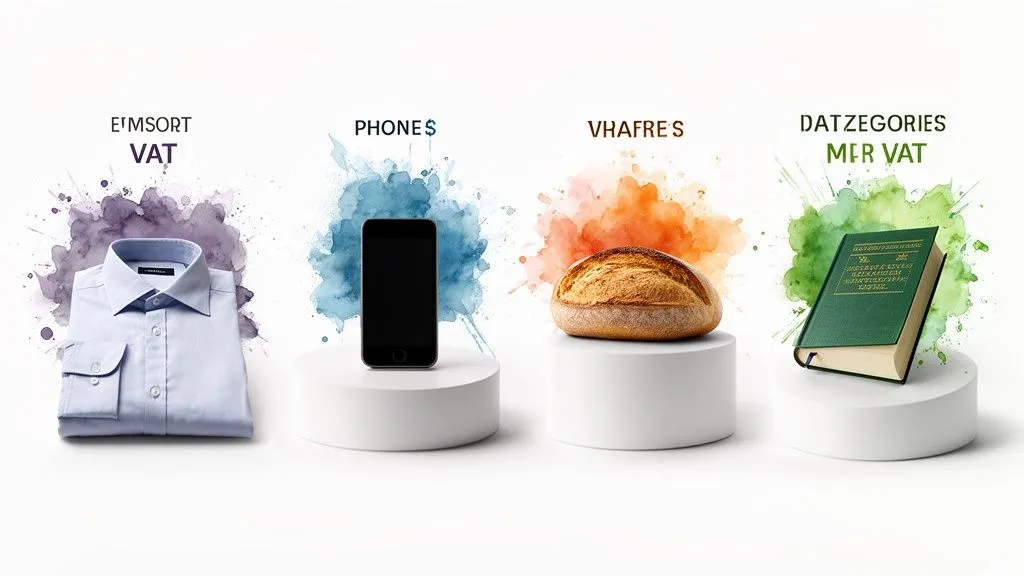
Assigning the correct VAT rate to every item in your catalog is a crucial step for any online seller. Let’s be honest — a small mistake can quickly become costly, whether through a tax audit or poor price positioning that hurts your competitiveness. The goal isn’t to memorize the French General Tax Code by heart, but to grasp the logic behind each rate.
The basic principle is fairly simple. Most consumer goods and services you sell day to day are subject to the standard rate of 20%. If your business relies on selling clothing, electronics, cosmetics or decorative items, this rate will be your main benchmark.
Where things get more complicated is that many products benefit from reduced rates. These rates are designed to make goods deemed essential or cultural more accessible.
Reduced rates for specific categories
The real mental gymnastics begin when your catalog mixes products from different categories. Knowing how to tell them apart is key to applying the correct VAT amount in France and avoiding unpleasant surprises.
To help you see things more clearly, here are a few concrete benchmarks:
-
Reduced rate of 5.5%: This covers basic food staples (fruit, vegetables, meat…), books (physical and digital), and feminine hygiene products. If you sell gourmet gift baskets, be careful: each product may carry a different rate!
-
Intermediate rate of 10%: Mostly found in food-for-immediate-consumption catering. In e-commerce, this typically applies to the delivery of ready-cooked meals. This rate also applies to some passenger transport and renovation work, which is less common for a typical online shop.
Watch out for the mixed-basket trap: A classic e-commerce pitfall. Imagine selling a gift box containing a bottle of wine (taxed at 20%), foie gras (5.5%) and a recipe book (5.5%). Your invoicing system absolutely must be able to calculate VAT for each product line separately.
Handling special cases and digital products
With digital, new rules of the game emerge. Selling digital products, subscriptions or online services is an area where classification mistakes are common.
As a general rule, SaaS software or subscriptions to online content are subject to the standard rate of 20%. On the other hand, good news for e-book sellers: they benefit from the reduced rate of 5.5%, just like their paper counterparts.
To rest easy, rigorous configuration of your shop (whether on Shopify, WooCommerce or another platform) is essential. Every product and every service must be linked to the right VAT rate. Tools like Bizyness can even automate this task based on the nature of the product and the buyer’s location, which secures your tax compliance.
Correctly applying the rates is only the first step. To go further, we’ve prepared a complete guide to help you see things even more clearly. Feel free to check out our article on the different VAT rates in France, which explores many other specific cases. Mastering these nuances means securing stress-free tax management.
Mastering VAT calculations like a pro
VAT formulas can quickly give you a headache. Yet they’re tools you’ll use every day. Let’s forget complex calculations: the goal is to turn these operations into genuine reflexes.
The idea is simple: to make you fully self-sufficient and confident in managing your figures. Let’s go through the three essential formulas for running your business smoothly, with concrete examples for each situation.
Calculating a gross selling price from the net price
This is the basic calculation, the one you’ll do most often. You start from your net selling price (excl. VAT), which includes your purchase cost and margin, and you need to add VAT to display the final price your customer will pay.
The formula to know is as follows: Gross price = Net price x (1 + VAT rate)
- The coefficient to apply is therefore 1.20 (i.e. 1 + 0.20).
- The calculation: €100 x 1.20 = €120.
- Your selling price displayed to the customer will be €120 incl. VAT.
Isolating the VAT amount from a gross price
This calculation is essential for your bookkeeping. Every time you make a sale, you need to know exactly what share of the price goes to the State. It’s also very useful for checking VAT on your suppliers’ invoices.
Here’s how to extract the tax amount from an all-inclusive price: VAT amount = Gross price - (Gross price / (1 + VAT rate))
- The calculation: €77 - (€77 / 1.055) = €77 - €73.
- The VAT share in this sale is €4. Your net base, on which you calculate your margin, is €73.
Finding the net price from a gross price
This last calculation is your best ally for analyzing your real margins. It’s common to set your prices starting from a psychological or competitive gross price. You then need to do the reverse calculation to find out what you actually keep in your pocket.
The formula is very simple: Net price = Gross price / (1 + VAT rate)
- The calculation: €36 / 1.20 = €30.
- The revenue you actually generate on this sale is €30 excl. VAT.
To visualize the impact of the different rates, nothing beats a comparison table. Let’s take a base product at €100 excl. VAT and see how the final price changes.
Examples of VAT calculations for a €100 (excl. VAT) product This table concretely illustrates the impact of the different VAT rates on the final price paid by the consumer and the tax amount collected by the seller.
| Net price | VAT rate | VAT amount | Gross price |
|---|---|---|---|
| €100 | 20% | €20.00 | €120.00 |
| €100 | 10% | €10.00 | €110.00 |
| €100 | 5.5% | €5.50 | €105.50 |
| €100 | 2.1% | €2.10 | €102.10 |
You can clearly see that for the same base price, the tax collected can range from €2.10 to €20, which radically changes the price shown to the customer.
Pro tip: the rounding rule For impeccable bookkeeping, the VAT amount must always be rounded to the nearest cent. The official rule is simple: if the third digit after the decimal point is 5 or higher, round up. Otherwise, round down. It’s a small detail that guarantees the accuracy of your filings.
Mastering these calculations is a great way to understand how VAT works. In practice, doing many manual calculations increases the risk of error, especially with a high order volume. A solution like Bizyness saves you precious time by automating these calculations, securing your invoices and preparing your filings without you having to think about it.
Selling internationally: how do you manage VAT without getting lost?
Do you dream of seeing your products fly beyond our borders? It’s an excellent growth strategy, but be careful: managing the VAT amount in France gets significantly more complex as soon as your parcels cross borders. Fortunately, mechanisms have been put in place to turn what looks like a tax headache into a smooth, well-oiled process.
The first thing to know is that the rules of the game change as soon as you sell to individuals in other European Union countries. Gone are the days of juggling distance-selling thresholds for each country. Since 2021, a single rule has (finally!) simplified things.
The key threshold to remember: €10,000 If the total amount of your sales to individuals (B2C) across all EU countries, excluding France, exceeds €10,000 in a year, you must charge VAT at the rate of the country where your customer lives.
This single threshold is a real relief for online sellers. As long as you stay below this €10,000 mark, you can keep applying French VAT to all your sales. But as soon as you exceed it, you need to adapt your setup to stay compliant.
Simplify your filings with the OSS and IOSS one-stop shops
Exceeding the threshold doesn’t mean you’ll have to register for VAT in the 26 other EU countries. To avoid this administrative nightmare, the OSS (One-Stop Shop) and IOSS (Import One-Stop Shop) schemes are your best allies.
-
The OSS one-stop shop: This is your tool for B2C sales within the EU. It lets you declare and pay everything at once, from France. Specifically, if you sell €5,000 worth of goods in Germany (VAT at 19%) and €3,000 in Spain (VAT at 21%), you declare everything on the French OSS portal. The French administration then takes care of passing on the correct share to its German and Spanish counterparts. Simple, right?
-
The IOSS one-stop shop: This one is for you if you import low-value goods (under €150) from outside the EU, a typical case in dropshipping. Thanks to IOSS, you collect VAT at your customer’s country rate directly at the point of purchase. The result: the parcel clears customs without unpleasant surprises or extra fees for your buyer. A much smoother customer experience.
How does the VAT reverse charge work?
The reverse charge is a somewhat particular mechanism that flips the roles. Normally, it’s the seller who collects VAT. Here, it’s you, the buyer, who declares and deducts it at the same time on your VAT return. The operation is therefore neutral for your cash flow, but it’s mandatory from a bookkeeping standpoint.
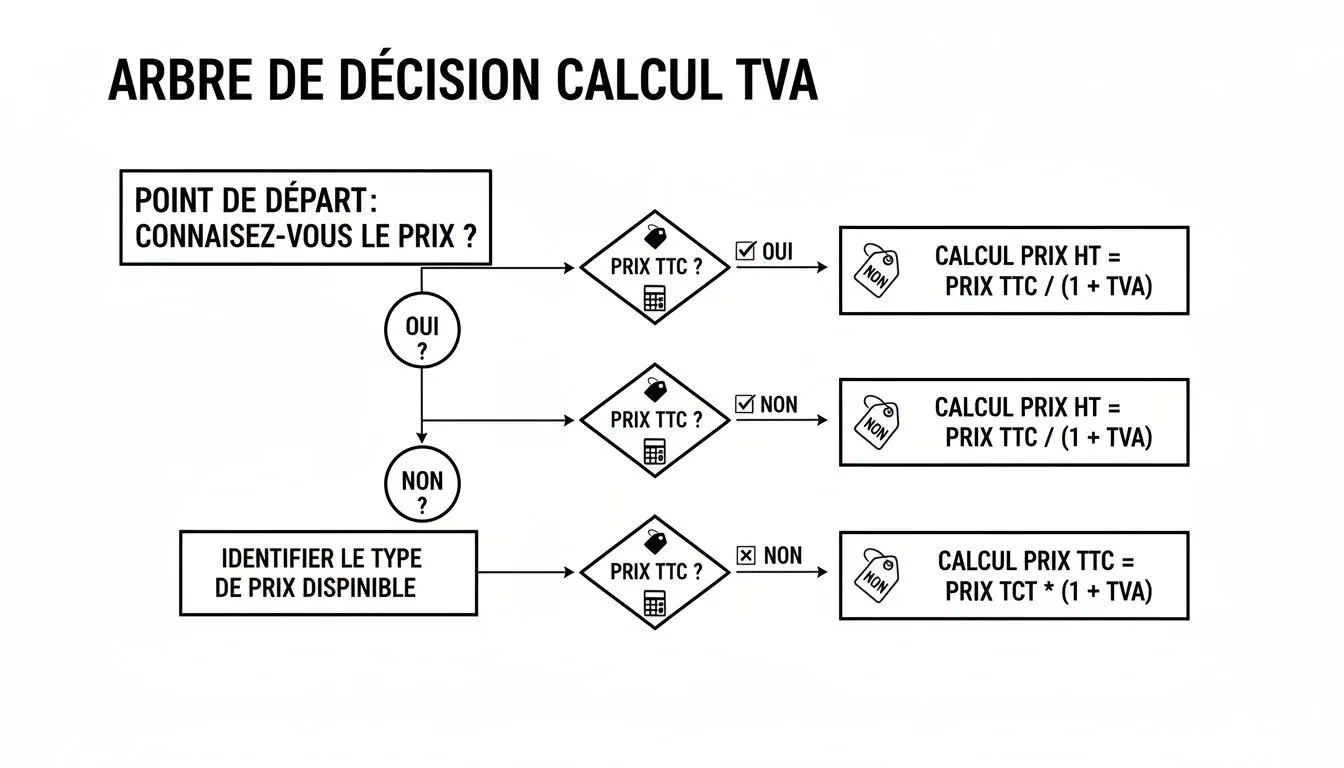 This diagram clearly shows that, regardless of your starting point (a net or gross price), the calculation formulas are straightforward and let you easily find every element of the final price.
For an online seller, the reverse charge mainly comes into play in two situations:
-
When you buy services abroad: Do you pay for Facebook or Google ads (based in Ireland)? Do you subscribe to American software? You’ll receive an invoice excluding tax. It’s up to you to reverse-charge French VAT: you add it to your VAT collected, then immediately deduct it from your deductible VAT.
-
When you sell to a business in the EU: If your customer is a VAT-registered business in another EU country, you send them an invoice excluding tax. Be sure to add the mention “VAT exemption - Article 262 ter I of the CGI” (French Tax Code). It will then be up to them to reverse-charge VAT in their own country.
Mastering these international tax rules is essential. To give you an idea of the stakes, VAT generated €210.7 billion for the State in 2024, representing 38% of its revenue. If you sell on marketplaces like eBay, where sales can quickly become complex and multichannel, a tool like Bizyness becomes a real co-pilot. It automatically handles these rules, including OSS/IOSS, and prepares your filings without risk of error. To go further on this mechanism, feel free to check out our complete guide on the VAT reverse charge.
Managing your VAT returns without stress
Once you’ve collected VAT on your sales, one crucial step remains: declaring it to the tax authorities. For many, this word is a bit scary. Yet with a little organization and the right information at hand, filing a VAT return can become a simple formality, almost a routine.
The goal is simple: turn this legal obligation into a smooth, well-managed process. That way, you can focus on what really matters: growing your business.
Which VAT scheme applies to your e-commerce business?
The first step, and not the least important, is knowing which VAT scheme you fall under. Your revenue is the main criterion, but your own choices can also come into play. In France, you have three options, each with its own rules.
-
The VAT exemption scheme (franchise en base de TVA): This is the perfect scheme to get started. As long as you don’t exceed certain thresholds (for example, €91,900 in revenue for selling goods), you’re exempt. In practice, you don’t charge VAT to your customers. The downside? You also can’t reclaim VAT on your own business purchases.
-
The simplified real regime (RSI): Is your business growing and exceeding the exemption thresholds? You’ll typically move to this scheme. As the name suggests, it aims to simplify management with a single annual return (via form CA12), accompanied by two half-yearly instalments. It’s an excellent compromise for a fast-growing business.
-
The normal real regime (RN): Reserved for businesses with a larger volume of business, this scheme requires a bit more rigor. Filing becomes monthly (or quarterly by option) using form CA3. It’s more demanding, but it gives you a much more detailed and regular view of your VAT-related cash flow.
Choosing the right scheme is not a decision to take lightly. It directly impacts the frequency and complexity of your administrative tasks.
Understanding how the return works
Whatever your scheme, the logic behind the VAT return is always the same. It’s a fairly simple calculation that weighs the VAT you’ve charged against the VAT you’ve paid.
The principle of neutrality is the cornerstone of VAT. For your business, it’s a wash. You act as a collector on behalf of the State: the tax you receive from your customers doesn’t belong to you, and the tax you pay to your suppliers is, in principle, refunded to you.
The calculation on your return therefore comes down to: VAT payable = VAT collected (on your sales) - Deductible VAT (on your business purchases)
If the balance is positive, you pay that amount to the State. If it’s negative, congratulations, you have a VAT credit. You can then either carry it forward to your next returns or request a direct refund.
This tax system can sometimes hold surprises. In 2025, for example, VAT receipts fell short of government expectations, posting a decline of 0.9% to reach just €98.1 billion, a shortfall of several billion euros. For online sellers, whether on WooCommerce or PrestaShop, these broad trends are a reminder of just how essential rigorous management is. To better understand the stakes behind these forecasts, you can read this analysis on public finances on Le Monde.fr.
Mandatory information on your invoices
It’s a detail that’s often underestimated, but one that can be costly: invoice compliance. For everything to be in order, and especially so your business customers can deduct VAT, several pieces of information are absolutely mandatory:
- Your intra-community VAT number.
- Your customer’s VAT number, if they’re a business based in the EU.
- The VAT rate applied to each product or service line.
- The total VAT amount due.
Missing any of these can lead to your customers rejecting the invoice or, worse, expose you to penalties in the event of an audit.
Fortunately, you don’t have to manage all this complexity manually. Tools like Bizyness are here to support you. The platform automates the preparation of your filings by analyzing your sales and their destination. It applies the right rates, generates 100% compliant invoices and prepares the reports you need. A considerable time saver, with a good dose of peace of mind on top.
Frequently asked questions about VAT in e-commerce
Even with the best explanations, VAT always raises very practical questions once you get your hands dirty. Let’s go through the most common questions from online sellers to clear up the last points that might be bothering you.
Do I have to charge VAT from the very first euro earned?
No, not necessarily. To get started, you can benefit from the VAT exemption scheme. In practice, you don’t have to charge or declare VAT as long as your revenue stays below a certain ceiling. For selling goods, this threshold is €91,900 per year (value through 2026).
It’s a great option for starting out, as it lets you offer more attractive prices. The flip side is that you also can’t reclaim VAT on your own expenses (stock, ads, etc.). Plan ahead for the moment you’ll exceed the threshold, as the switch can hurt if you’re not prepared for it.
How do I handle VAT if I sell a product in France, then another in Germany?
This is a very common scenario. For the customer in France, it’s simple: you apply the French VAT rate, generally 20%.
For the individual customer in Germany, it all depends on your sales volume in Europe. As long as the total of your sales to individuals across the whole EU (excluding France) doesn’t exceed the €10,000 threshold for the year, you can keep charging French VAT. Beyond that threshold, you must charge VAT at the customer’s country rate, i.e. 19% for Germany.
The simplest solution is then to go through the OSS one-stop shop. It lets you file a single return in France for all the VAT collected in other EU countries.
Pro tip: Set up your online shop to automatically recognize the buyer’s country and apply the right VAT rate. Tools like Bizyness do this very well and save you from tearing your hair out over calculations and filings for each country.
Can I reclaim VAT on my Facebook ads?
Yes, absolutely! It’s even a crucial reflex to have to protect your cash flow. Since Facebook is a company based in Ireland, it invoices you for its services excluding tax. This is what’s known as the VAT reverse charge.
In practice, it’s up to you to calculate and declare this VAT to the French tax authorities on your return (the famous CA3). You enter it both in the “VAT collected” box and the “deductible VAT” box. The operation is therefore neutral for your wallet, but it’s mandatory from a bookkeeping standpoint.
What happens if I get the VAT rate wrong on an invoice?
A rate error is never trivial. If you charge too low a rate, the tax authorities can claim the difference from you, plus penalties. If you charge too high a rate, you shortchange your customer (who can demand a refund) and you lose competitiveness.
The safest approach is to correctly classify every product in your catalog from the start. This is where good invoicing software really proves its worth: it automatically applies the correct rates and secures your day-to-day management. That way you can run your business with peace of mind.
Automate your VAT and focus on what really matters: your growth
Understanding the rules around the VAT amount in France is one thing. Spending hours on it every month is another. Manually managing VAT isn’t just time-consuming — it’s also a source of stress and opens the door to mistakes that can be costly in the event of an audit.
Let’s be clear: the goal for an entrepreneur isn’t to become an accountant. It’s to surround yourself with the right tools to secure your business and give yourself the means to grow. Calculating rates, checking invoices or preparing filings are repetitive, low-value-added tasks. They can and should be automated.
This is exactly where specialized platforms change the game, turning this administrative chore into a simple, well-oiled cog in your business.
Let technology take over your tax compliance
Imagine a financial co-pilot that never gets tired. By connecting directly to your sales channels (whether Shopify, Amazon or Stripe), a good automation solution handles the entire VAT cycle for you.
Specifically, it will:
- Apply the right rate without you having to think about it, whether you’re selling a product in France, in Germany via the OSS one-stop shop, or an imported item via IOSS.
- Create flawless invoices for every order, with all the legal mentions, regardless of the destination country.
- Prepare the VAT reports you need for your filings, in France and across Europe. No more manual data entry or crashing spreadsheets.
The idea is simple: hand off tax complexity to technology. Your time is far more valuable when you use it to innovate, build your brand, or simply talk to your customers.
The ultimate goal is to free up your mind so you can focus on what truly drives your e-commerce business forward. By putting your financial management on solid rails, you build strong foundations to support your growth, in France and internationally, without paperwork ever holding back your ambition.
Don’t let bookkeeping slow down your growth any longer. Discover how Bizyness automates your financial management so you can focus on what matters most. Get started on Bizyness.fr.
