

 Français
VAT exemption scheme for e-commerce: the complete guide to get started
Discover the complete guide to the VAT exemption scheme for online sellers. Learn how to manage thresholds, invoicing, and anticipate the switch to standard VAT.

The VAT exemption scheme (“franchise en base de TVA”) is a tax mechanism that simply allows you not to charge VAT to your customers. You are therefore exempt from declaring and paying it to the State. It’s a real boost, especially when starting out, since it lightens the paperwork and lets you offer more competitive prices.
A strategic springboard for launching your e-commerce business
Think of the VAT exemption scheme a bit like training wheels on a child’s bike. At first, they’re essential for finding your balance, picking up speed, and not being intimidated by the complexity of the road. Once you’re up and running, you can take them off and shift into a higher gear.
For an online seller just starting out, whether on their own Shopify store or via a marketplace like Amazon, this simplicity is a huge advantage. Rather than drowning in different VAT rates, returns, and payment deadlines, you can focus on what really matters: finding your first customers, refining your product pages, and growing your revenue.

The concrete benefits when starting out
Specifically, what does opting for the VAT exemption scheme change for your online store when you’re just starting?
- More attractive prices. Since you don’t charge VAT, you have two options: either offer lower prices than competitors who are subject to VAT, or keep the same pricing and pocket a more comfortable margin. It’s a significant competitive lever for winning over your first customers.
- Lighter administrative management. No more stress over monthly or quarterly VAT returns. Your invoicing is much simpler: all your products are sold tax-free (net of VAT). Just add a small legal notice on your invoices, and you’re done.
- Healthier cash flow from the start. You don’t have to collect VAT on behalf of the State, so there’s no need to advance it. That money stays in your cash register, available to invest in stock, marketing, or improving your website.
In short, the VAT exemption scheme acts as a real accelerator. It gives you the breathing room to build your business foundations with fewer administrative and financial constraints, leaving you time to grow your business with peace of mind.
Be careful though, this scheme isn’t a permanent solution. It’s designed to support you at launch, but it requires you to keep a close eye on your revenue. As you grow, you’ll inevitably approach the thresholds that will push you into the standard VAT regime.
This transition is a normal stage in the life of a successful business. The key is to understand it clearly from the outset so you can anticipate it without stress. That’s exactly what we’ll cover in the following sections: the thresholds not to exceed and what to do when it happens.
How does the VAT exemption scheme actually work?
Think of the VAT exemption scheme as a helping hand at the start of your business. Instead of diving straight into the complexity of collecting and declaring VAT, this scheme gives you a grace period to launch with peace of mind. It’s a simplification designed for entrepreneurs just starting out, letting them focus on the essentials: growing their business.
For an online seller, the most direct benefit shows up on the price tag. Since you don’t charge VAT, your prices are net for the end customer. This can give you a significant competitive edge over more established players who have to add 20% to their selling price. Your invoicing is also much simpler: you sell a product for €50, you invoice €50. No rate calculations, no headaches.
The flip side to keep in mind
Be careful, this simplicity comes at a cost. The main drawback, and it’s a significant one, is the inability to deduct VAT on your own business purchases. This is the well-known double-edged sword of the exemption scheme. All the VAT you pay on your expenses becomes a definitive cost, impossible to recover.
Think about all the costs inherent to e-commerce:
- Subscriptions to your tools (Shopify, your email marketing platform, or accounting software like Bizyness).
- Purchasing your stock from suppliers.
- Your advertising budgets on Google Ads or Meta Ads.
- Your computer, smartphone, website hosting…
On all these expenses, you pay VAT that directly eats into your margin, since you can’t deduct it from anything.
This administrative simplification largely explains the appeal of this scheme, especially with the explosion in the number of micro-entrepreneurs. The latest statistics show that the number of businesses benefiting from the VAT exemption scheme has jumped by 6.6%. For many founders, at launch, this advantage outweighs the non-deductibility of VAT. To learn more, you can check the key VAT figures on the French tax authority’s website.
A mandatory notice on all your invoices
A crucial and non-negotiable point: you must inform your customers that you don’t charge VAT. Every invoice issued must therefore include a very specific legal notice.
VAT not applicable, art. 293 B of the French Tax Code (CGI)
This short sentence is essential. It formalizes your status with your customers and the tax authorities. In the event of an audit, its absence can cost you dearly. Make sure to set up your invoicing software so it’s added automatically.
The infographic below, provided by Bpifrance Création, summarizes the ins and outs of the scheme well.
This visual makes it clear: the exemption applies by default below certain thresholds, but it means invoicing tax-free and giving up the ability to recover VAT on your expenses. You’re therefore facing a real strategic choice: should you prioritize simplicity or opt for the standard regime if your purchases and investments are significant?
Mastering the revenue thresholds not to exceed
The VAT exemption scheme is a genuine head start, but it’s directly tied to your revenue. You shouldn’t see these caps as barriers to your growth, but rather as key milestones in your company’s life. Knowing how to anticipate them is crucial for managing your taxes and avoiding unpleasant surprises.
The principle is simple on the surface: as long as your annual revenue stays below a certain threshold, you’re exempt from charging VAT. If you cross it, you must start collecting it. Where things get a bit more complicated is that these thresholds change depending on the nature of your business.
Sale of goods or provision of services: the caps aren’t the same
The tax authorities draw a clear distinction between two broad categories of activity, and each has its own rules.
- Sale of goods, items, or food to take away or consume on site: This covers most e-commerce sellers (if you sell physical products, do dropshipping…) and accommodation activities.
- Provision of services: This category includes liberal professions, the sale of digital products (online courses, templates), subscription software (SaaS), or consulting.
This distinction is fundamental, since the thresholds vary by a factor of two. A T-shirt seller on Shopify is not in the same boat as a creator of Notion templates.
Think of your revenue tracking not as an administrative burden, but as a strategic dashboard. It’s the indicator that tells you your business is about to cross a tax milestone. Ignoring these thresholds is a bit like driving with your eyes closed: the risk of veering off course is very real.
To help you visualize whether this scheme is suited to your situation, this infographic gets straight to the point.
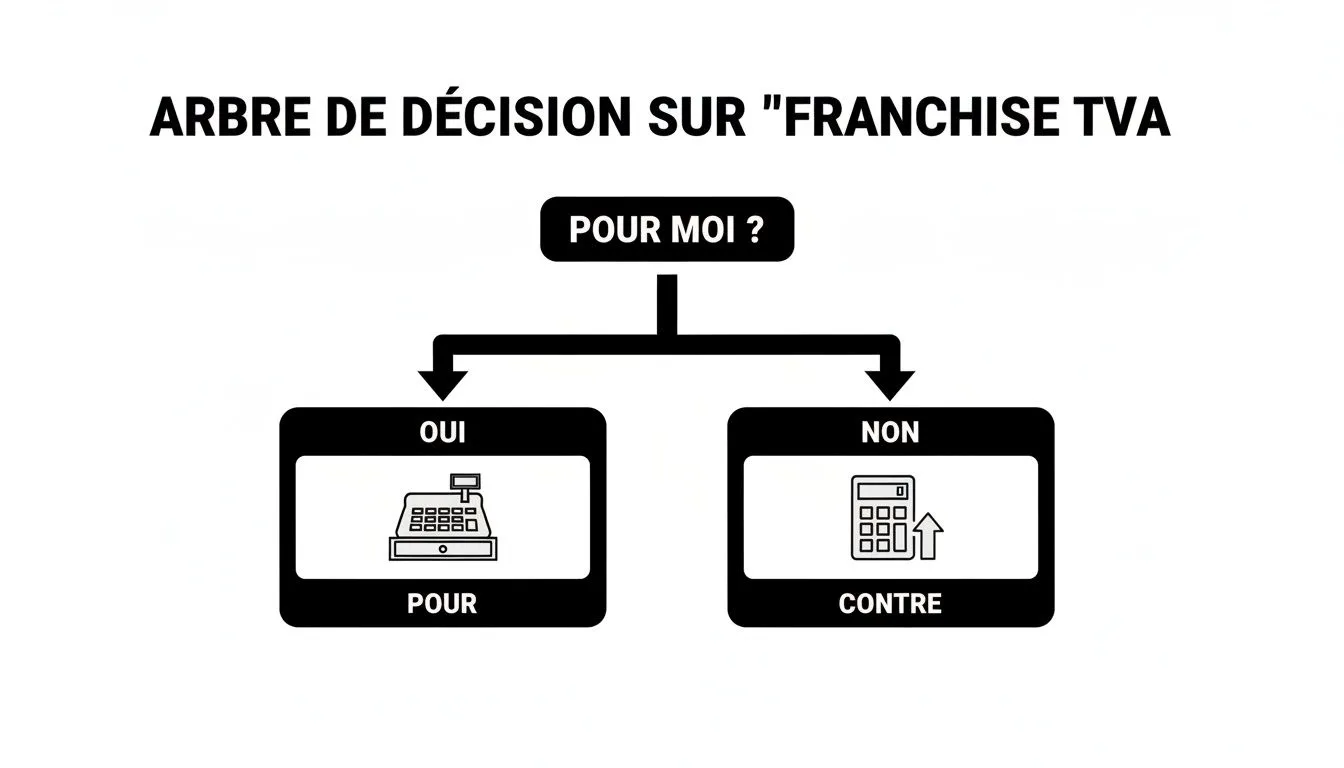
This diagram perfectly summarizes the choice to make: the simplicity of the exemption scheme versus the calculations and obligations of the standard regime. The final decision will always depend on your revenue and your cost structure.
Understanding the base thresholds and the increased thresholds
For each type of activity, there isn’t just one but two thresholds to keep in mind: the base threshold and the tolerance threshold, also called the increased threshold. Their mechanics are subtle but entirely logical.
To stay within the exemption scheme, your revenue for the previous year (N-1) must be below €91,900 for the sale of goods or €36,800 for services. But if, during the current year (N), you exceed the increased thresholds of €101,000 (sale of goods) or €39,100 (services), you immediately switch to the standard VAT regime, effective from the first day of the month in which the threshold was exceeded. You can find these official amounts in the information provided by Bpifrance Création.
Here’s a table to make things clearer.
VAT exemption scheme caps by activity
This table summarizes the revenue thresholds to respect in order to benefit from the exemption scheme, as well as the increased thresholds that trigger an immediate exit from the scheme.
| Type of activity | Base threshold (revenue N-1) | Increased threshold (revenue for the current year) |
|---|---|---|
| Sale of goods (e-commerce, dropshipping) | €91,900 | €101,000 |
| Provision of services (template sales, SaaS) | €36,800 | €39,100 |
The two-threshold mechanism is designed to provide a certain flexibility while avoiding abuse.
Specifically, what does this mean for you?
- Scenario 1: Your annual revenue exceeds the base threshold (for example, €95,000 for the sale of goods) but stays below the increased threshold of €101,000. Good news: you remain within the exemption scheme until December 31. However, you’ll have to charge VAT starting January 1 of the following year.
- Scenario 2: Your revenue exceeds the increased threshold. The exit from the exemption scheme is immediate. You become liable for VAT from the first day of the month in which the threshold was exceeded.
Let’s take a concrete example:
Clara sells handmade jewelry on Etsy. During the month of October, her cumulative revenue since January reaches €39,500. She has just exceeded the increased threshold of €39,100. As a result, she must start charging VAT on all her sales from October 1. This means she’ll have to review and correct all the invoices she issued during that month to add VAT.
Watch out for the special case of the pro-rata calculation
A crucial point of vigilance if you set up your business partway through the year! The thresholds we just covered are annual. For your first year, they must be recalculated pro rata to your actual time in business.
The formula is simple: (Annual threshold / 365) x Number of days in business.
A consultant who launches on July 1, for example, won’t have a €36,800 cap, but roughly half of it. The threshold therefore becomes much easier to reach. This is actually one of the most common reasons for exceeding the VAT threshold as a sole trader, a topic we’ve covered in detail in another article. Rigorous tracking is therefore essential from day one.
Anticipating and managing the exit from the exemption scheme
Exceeding the thresholds of the VAT exemption scheme isn’t a failure, quite the opposite! It’s often a sign that your business is growing. But be careful, this transition needs to be well prepared to avoid unpleasant surprises, both administratively and financially.
Specifically, there are two ways to exit this scheme: either you exceed the caps, or you decide yourself to start charging VAT.
Exceeding the thresholds is the most common scenario. As we’ve seen, as soon as you cross the increased threshold, the switch is immediate: you become liable for VAT from the first day of the month in which the threshold was exceeded. You then need to react quickly to update your invoicing.
The other route is the voluntary option. It’s a strategic lever that’s often overlooked. You can decide at any time to switch to the standard regime, even if your revenue is far from the caps. This decision commits you for two years, so it should be carefully considered.
The concrete implications of switching to VAT
Whether you chose to exit the exemption scheme or were forced to, the consequences are the same and will significantly change your day-to-day management. You’re entering a new tax landscape, with new rules, but also new opportunities.
What changes in your routine:
- Charging VAT: You must apply the correct VAT rate on all your new invoices. For most online selling activities, this will be the standard rate of 20%.
- Filing VAT returns: You’ll need to file periodic returns (monthly or quarterly) to remit to the State the VAT collected from your customers.
- Keeping stricter accounts: Tracking the VAT you charge (collected) and the VAT you pay (deductible) requires much tighter bookkeeping.
This change may seem like a burden, but it unlocks a huge advantage that can seriously boost your cash flow.
The superpower of recovering VAT on your expenses
The main benefit of switching to the standard regime is undoubtedly the ability to recover VAT on all your business purchases. All the VAT you pay on your stock, advertising costs, software subscriptions, or IT equipment becomes deductible.
In plain terms, the VAT you collect on your sales “offsets” the VAT you paid on your purchases. You only pay the State the difference. And if you’ve paid more VAT than you’ve collected (which often happens during major investments), the State refunds you! This is what’s known as a VAT credit.
This recovery can quickly add up to thousands of euros in savings per year and significantly lighten the cost of your investments.
Opting for VAT: a genuine strategic choice
So why complicate things and choose to charge VAT before you’re required to? The voluntary option is a very smart management decision in several situations:
- You’re planning major investments: Purchasing significant stock, overhauling your online store, launching a big-budget ad campaign… Opting for VAT lets you immediately recover the 20% of VAT on these expenses.
- Your customers are mostly businesses (B2B): For them, whether you charge VAT or not makes no difference, since they recover it on their end. Charging VAT even boosts your credibility and makes life easier for them.
- You want to anticipate strong growth: If you sense your business is about to take off, it’s better to opt for VAT at the start of the year. This will save you from having to manage an urgent transition in the middle of a busy period.
Anticipating is all the more important as European rules evolve. Starting in 2025, a new directive will harmonize exemption thresholds across the EU. We’re talking about a cap of €85,000 for sales within your own country and a global threshold of €100,000 for sales in other EU countries. To better understand the different VAT regimes and how they’re evolving, it’s crucial to stay informed.
The key steps to switching to the standard VAT regime
The transition takes a few fairly simple steps that shouldn’t be neglected:
- Notify the tax authorities: Simply send an option letter to your local Business Tax Office (SIE). This simple letter formalizes your choice.
- Get an intra-community VAT number: Once your option is validated, the SIE will assign you this number. It’s essential for all your transactions in Europe, whether with suppliers or customers.
- Configure your sales tools: This is the crucial step on the ground. Whether you use Shopify, Stripe, or WooCommerce, you’ll need to enable tax management, configure the correct rates, and make sure your invoice templates comply with the law.
- Set up real accounting tracking: This is the ideal time to adopt a tool like Bizyness. It can automate the retrieval of your VAT data, prepare your returns, and ensure every euro is properly tracked.
Managing VAT for international sales and on marketplaces
The VAT exemption scheme is a real comfort for getting started, but be careful, its magic stops at France’s borders. If you sell online, whether through your own site or platforms like Amazon, Etsy, or Cdiscount, things change radically as soon as you ship abroad.
When you sell to individuals (B2C) in other European Union countries, your French exemption scheme no longer applies. A specific, much lower threshold comes into play: €10,000 of annual revenue for all your intra-community distance sales combined. As soon as this cap is exceeded, you’re required to charge VAT, and not just any VAT: your customer’s country’s VAT.
The OSS one-stop shop, a mandatory step
As soon as you cross this €10,000 threshold, no more tax-free invoices for your European customers. The solution? Register for the VAT one-stop shop, better known as the OSS (One-Stop Shop).
This system was designed to spare e-commerce sellers a lot of hassle. Rather than registering for VAT in every country where you sell, the OSS lets you centralize everything from France.
In concrete terms, how does it work? You file a single quarterly return through your professional account on the French tax authority’s website. You simply detail the revenue generated in each member country and the VAT you’ve collected. The French administration then handles redistributing the amounts to the correct countries.
While the tool simplifies the process, it requires strict discipline. You must know and apply the correct VAT rate for each destination country. Without good invoicing software, this can quickly become a headache. To help you, our guide on calculating intra-community VAT will give you concrete examples to make things clearer.
And what about marketplaces in all this?
Marketplaces like Amazon or Etsy play a somewhat particular role, which can be both a help and a source of confusion. Since July 1, 2021, the rules have evolved to make them more accountable.
In certain cases, particularly for sales of goods imported from non-EU countries worth less than €150, the marketplace itself is considered the deemed buyer-reseller. In plain terms, it’s the marketplace that collects and remits VAT on your behalf.
For you, as a seller, the consequences are twofold:
- An apparent simplification: you don’t have to worry about VAT on these specific sales.
- Added accounting complexity: you absolutely must separate, in your books, the sales where the marketplace handled VAT from those where it’s up to you to do so.
It’s therefore vital to carefully read the terms and conditions of each platform you operate on. Understanding how they manage VAT internationally is the key to avoiding double taxation or, worse, an oversight that could cost you dearly in the event of an audit.
Automate your VAT management to focus on what really matters: growth
Juggling the VAT exemption scheme, monitoring thresholds, anticipating the exit… It’s often a real obstacle course. Between manually tracking revenue, the risk of an error on an invoice, and the complexity of upcoming returns, it’s easy to feel overwhelmed. All that time spent on admin is time you’re not spending on your real goal: growing your e-commerce business.
Fortunately, technology is here to take over. By entrusting your VAT management to an automated system, you win on every front: you secure your tax position and, above all, you free up precious time to focus on your core business.
Getting a clear view by centralizing your sales
The first step is to bring everything together in one place. An online seller often navigates between multiple channels: their Shopify store, their Amazon sales, payments coming in via Stripe or PayPal… Trying to manually track each stream isn’t just a huge waste of time, it’s also an open door to errors.
A financial management tool like Bizyness connects directly to these platforms. It pulls in and centralizes every order automatically. The result? You get a single dashboard that consolidates your revenue in real time, without any manual entry.
This overall view is the foundation of stress-free tax management. No more fog, you know exactly where you stand.
Setting up smart alerts on thresholds
The biggest trap of the exemption scheme is exceeding the caps without realizing it. One good month, a deal that takes off, and you can find yourself pushed into the standard VAT regime. Without anticipation, the tax consequences can be painful.
With automation, this risk turns into a simple notification. Good software constantly monitors your cumulative revenue and sends you an alert as soon as you approach the critical thresholds, whether that’s the base threshold or the increased threshold.
This active monitoring lets you anticipate the transition smoothly. You’ll have time to prepare the switch to VAT, whether to notify your customers or adjust your pricing strategy.
Generating compliant invoices, without even thinking about it
As soon as you switch to the standard regime, invoicing rules change radically. You need to apply the correct VAT rates, add the mandatory legal notices, and make sure every document is flawless.
Here again, automation is your best ally. A well-designed system can:
- Automatically create a compliant invoice for every new order.
- Apply the correct VAT rate based on the product and the customer’s destination country.
- Update your legal notices to reflect your new status, including your intra-community VAT number.
This automatic process eliminates data-entry errors and guarantees consistently flawless invoicing, including for the more complex management of international sales via the OSS one-stop shop.
Ultimately, the idea is simple: delegate repetitive, low-value tasks to tools built for that purpose. To see exactly what this can change, discover how to automate administrative tasks to boost your productivity. By adopting this approach, you turn an administrative burden into a smooth, secure process, finally giving yourself the freedom to fully focus on growing your business.
Your frequently asked questions about the VAT exemption scheme
The VAT exemption scheme is a great springboard for getting started, but it raises plenty of very practical questions, especially in e-commerce. Let’s break down the points that often trip people up so everything is perfectly clear.
Can I charge VAT if I’m under the exemption scheme?
The answer is no, and it’s a firm, final no. If you’re under the exemption scheme, you must invoice tax-free (net of VAT). Full stop. Attempting to collect VAT without being authorized to is playing with fire: the tax authorities consider this fraud, and the penalties can be severe.
To do things properly, every invoice you issue must carry the notice: “VAT not applicable, art. 293 B of the CGI.” This short sentence is crucial, as it justifies the absence of VAT to both your customers and the tax authorities.
The whole point of the exemption scheme is to place you outside the VAT system. Charging the tax would amount to collecting a tax on behalf of the State without the right to do so, which is strictly prohibited.
What happens if I exceed a threshold at the end of the year?
It all depends on which threshold you cross.
If your revenue rises above the base threshold (€91,900 for the sale of goods) but stays below the increased threshold (€101,000), you can breathe easy. You keep the benefit of the exemption scheme until December 31. You’ll start charging VAT from January 1 of the following year.
On the other hand, if you blow past the increased threshold, even on the very last day of the year, the change is immediate. You must apply VAT from the first day of the month in which the threshold was exceeded. Yes, that means you’ll have to go back and correct all the invoices from that month to add VAT. A bit of a headache to plan for!
Is the exemption scheme always the best option for starting out?
In most cases, yes. It’s the simplest option for getting started, it lightens the paperwork, and it lets you display more attractive prices than competitors who have to add 20% VAT. It’s a real plus for your cash flow at the start.
But be careful, it’s not a hard-and-fast rule. Imagine you’re launching a store that requires major upfront investment: significant stock, costly ad campaigns, photo equipment… In that case, voluntarily choosing the standard VAT regime can be a stroke of genius. Why? Because you’ll be able to recover VAT on all these business purchases, which can add up to substantial savings and boost your profitability from the start.
The right decision really depends on your business plan and your growth ambitions.
To move from manual management to worry-free tax compliance, Bizyness centralizes your sales and automates your accounting, alerting you as you approach thresholds and preparing your returns. Focus on your growth, let us handle the complexity by visiting the Bizyness website.
