

 Français
 VAT return for sole traders: a clear guide and tips
Simplify your sole trader VAT return: find out when to file, how to proceed, and how to avoid common mistakes.
As a sole trader (micro-entrepreneur), the VAT return isn’t something you need to worry about when starting out. It’s one of the great advantages of the status: by default, you benefit from the VAT exemption scheme (franchise en base). In practice, this means you don’t charge VAT to your customers. A refreshing bit of administrative simplicity when you’re just getting started! But this situation changes as your business grows.
When VAT enters the sole trader’s life
At the start of your journey, everything is simple. The VAT exemption scheme lets you be more competitive, especially if your customers are individuals. They pay the displayed price, without an extra 20% tax on top.
The downside is the flip side of that coin: you also can’t reclaim the VAT you pay on your own business purchases (equipment, software, supplies, etc.). It’s a trade-off worth keeping in mind.
Your revenue: the real indicator
Moving to VAT isn’t a punishment — quite the opposite! It’s a sign that your business is doing well and growing. The key is not to be caught off guard by this change, but to anticipate it. For that, there’s one simple habit: keep a close eye on your revenue.
This regular monitoring is what will save you from last-minute stress. Moving to VAT also means you’ll be able to start deducting this tax from your expenses. For instance, it’s crucial to get a good grasp of the process for deducting and reclaiming VAT on your business expenses in order to optimize your cash flow.
Expert tip: Don’t fly blind. Set up an alert (on a simple spreadsheet or an invoicing tool like Bizyness) when you reach 80% of the threshold. That will give you several weeks to prepare calmly, both administratively and mentally.
Two thresholds, two timelines to master
The VAT system for sole traders is built around two revenue thresholds. It’s essential to tell them apart clearly, because the consequences are not the same.
- The exemption threshold: This is your annual reference ceiling. As long as your revenue stays below it, you’re in the clear — the exemption applies for the current year and carries over to the next.
- The increased threshold: This is a tolerance threshold. If you exceed the first threshold but stay below this second one, you get some flexibility. You keep the exemption until December 31, but you already know you’ll have to charge VAT from January 1 of the following year.
This distinction is what allows you to plan ahead. However, if you cross the increased threshold during the year, the effect is immediate. You must start charging VAT from the first day of the month in which the threshold was exceeded.
Understanding this mechanism gives you everything you need to approach this transition not as an obstacle, but as a natural, well-managed step in your growth.
When do you become liable for VAT? Understanding the thresholds to plan ahead
When you launch your micro-entreprise, the VAT exemption scheme is a real boost. No tax to charge, simplified management… it’s ideal. But this scheme has its limits, and it’s your revenue that sets the rules.
Rather than seeing VAT thresholds as a constraint, I’d encourage you to view them as growth indicators. Mastering them means steering your business with peace of mind and avoiding unpleasant surprises.
The two thresholds to watch: exemption and increased
In practice, there isn’t one but two ceilings to watch closely. Each has quite different consequences for your timeline and obligations.
- The exemption threshold: This is the “standard” limit. As long as your annual revenue stays below it, all is well. You keep the benefit of the exemption for the current year and the following one.
- The increased threshold: This is a kind of tolerance ceiling. If you exceed the first threshold (exemption) but stay below this one (increased) over a year, you only move to VAT starting January 1 of the following year.
This distinction is critical. It gives you valuable room to prepare for the change without rushing.
Exceeding the thresholds: two scenarios, two reactions to have
To make this clearer, let’s look at two concrete examples I see often.
Imagine a freelance web developer whose business is booming. By October, his revenue reaches €38,000. He has clearly exceeded the exemption threshold, but he stays below the increased threshold. The result? He can finish his calendar year without charging VAT. However, he already knows that from the following January 1, he’ll have to apply VAT. So he has a good two months to adjust his rates, notify his clients, and configure his invoicing software.
Now let’s look at the case of an online seller who sells handmade creations. November turns out to be exceptional, and her annual revenue climbs to €101,000. She has just blown past the increased threshold. Here, the effect is immediate: she becomes liable for VAT from the first day of the month in which the threshold was exceeded, i.e. November 1. Every invoice she issues from that date must include VAT.
The absolute point of vigilance: Exceeding the increased threshold is the trickiest case. It forces you to change your invoicing mid-stream and to urgently contact your local Business Tax Office (SIE) to obtain your intra-community VAT number. Anticipation is your best ally for avoiding stress.
To help you find your way around easily, here’s a small decision tree that sums up the logic.
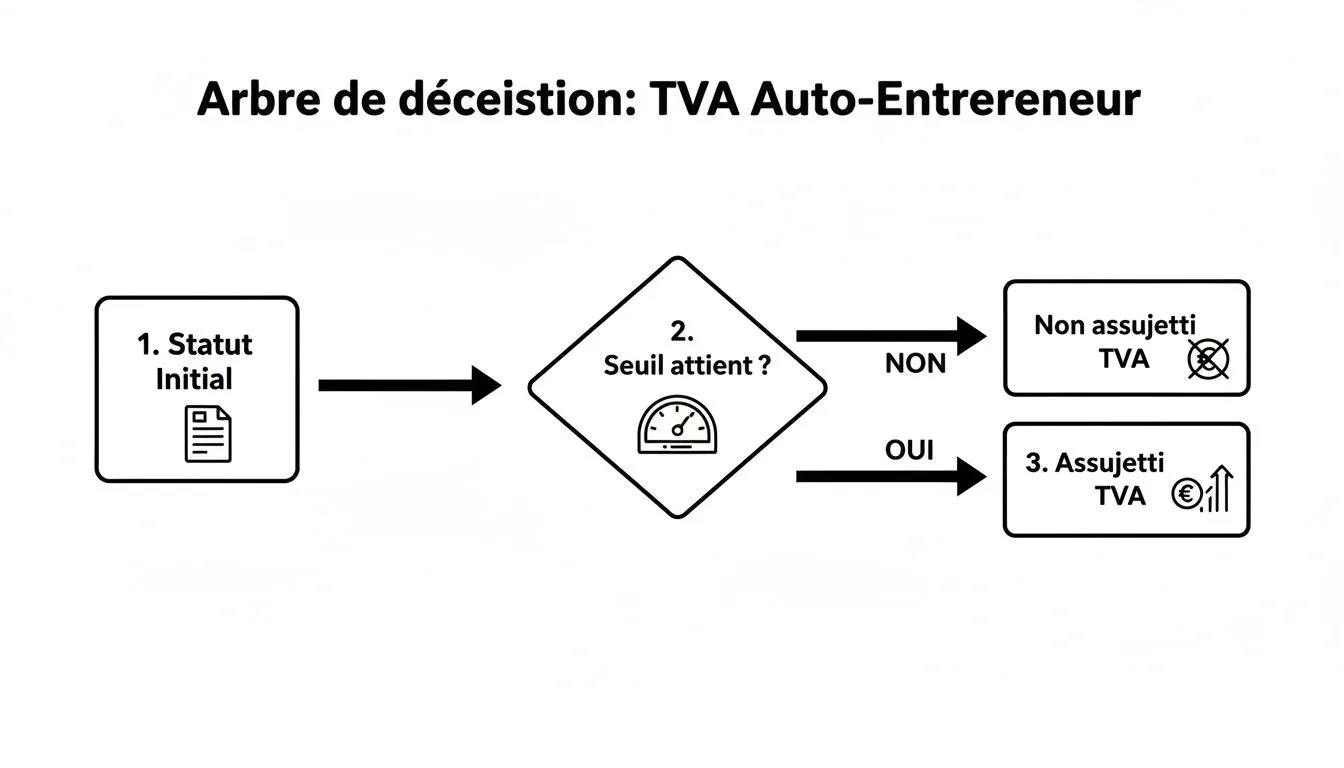
This diagram shows clearly that crossing the first threshold isn’t a disaster, but a turning point — one that can be handled smoothly or urgently, depending on your revenue level.
The figures to know and their impact on your strategy
VAT thresholds have been stable for a few years now, which makes tracking them easier. Here’s a summary table to help you plan ahead.
Summary of VAT thresholds for sole traders
This table summarizes the revenue thresholds (base and increased) for the VAT exemption scheme, depending on your activity, and the direct consequences of exceeding them.
| Nature of activity | Exemption threshold | Increased threshold | Consequence of exceeding it |
|---|---|---|---|
| Services (BNC and BIC) | €36,800 | €39,100 | Becomes liable for VAT on January 1 of year N+1 (if revenue is between the two thresholds) or from the 1st day of the month it’s exceeded (if revenue > increased threshold). |
| Sale of goods, catering, accommodation | €91,900 | €101,000 | Becomes liable for VAT on January 1 of year N+1 (if revenue is between the two thresholds) or from the 1st day of the month it’s exceeded (if revenue > increased threshold). |
These figures are your tax compass. Tracking them means you don’t have to endure the change — you can prepare for it. To learn everything about this scheme, feel free to check out our complete guide explaining the status of a business exempt from VAT.
Anticipating this move to VAT is the key to experiencing it as a step of growth rather than an administrative race against the clock. That also means thinking about your prices. If your customers are individuals, they can’t reclaim VAT, so a 20% increase in your rates needs to be well prepared and justified. It’s often the ideal opportunity to reconsider your positioning and better communicate the value of what you offer.
Getting your VAT number and choosing the right tax scheme
The verdict is in: your revenue has exceeded the famous thresholds. Far from being bad news, this is above all a sign that your business is really taking off. It’s now time to take action to get compliant. The first, and far from least important, step: formalize your move to VAT and obtain your intra-community VAT number.
Rest assured, it can all be done online. The process takes place directly with your local Business Tax Office (SIE), via the secure messaging system in your professional account on the impots.gouv.fr website.
The process for activating your VAT online
The procedure is fairly simple, but it’s best to be precise to avoid back-and-forth with the tax authorities. Once logged into your professional account, go to your “Messagerie” and click “Écrire” (Write).
Here, the choice of subject for your message is crucial. You need to select the form “TVA et taxes annexes” (VAT and related taxes), then the option “Je formule une option” (“I am submitting an option”). This is a critical point: many people get it wrong by choosing “Je demande un numéro de TVA intracommunautaire” (“I am requesting an intra-community VAT number”), which is not the right path for an initial activation and risks slowing down your file.
In the body of the message, be clear and concise. You need to include two essential pieces of information:
- The start date of your VAT liability: This is either the first day of the month in which you exceeded the increased threshold, or January 1 if you crossed the tolerance threshold the previous year.
- The tax scheme you’re choosing: This is a strategic decision that will shape all your future management.
Once the message is sent, the SIE processes your request and activates your VAT number, generally within about a week. If you want to dig deeper into the topic, our complete guide on obtaining a VAT number for sole traders will give you even more detail.
Choosing between the simplified real scheme and the standard real scheme
Choosing your VAT scheme is far from a minor detail. It’s what determines the frequency and rules for your sole trader VAT return. You have two options.
The simplified real scheme (RSI)
Its name sounds appealing, but in practice it can quickly become a headache. This scheme works on a system of semi-annual installments, calculated on the VAT you paid the previous year. Everything is then adjusted once a year via a reconciliation return (form CA12).
For a sole trader discovering VAT, this system is often a source of confusion. Above all, it can create significant cash-flow mismatches, since the installments don’t necessarily correspond to your actual current business activity.
The standard real scheme (RN)
This is the option we recommend in almost all cases. It’s clearer, more predictable, and much simpler to manage day to day.
- Monthly return (form CA3): Each month, you declare and pay the VAT you have actually collected and deducted. It’s precise, free of surprises, and perfect for tight tracking.
- Quarterly return (an available option): If the annual amount of VAT you pay to the government is below €4,000, you can request to file your returns only every three months. It’s a good compromise for lightening the administrative load a bit while keeping excellent visibility.
Our expert tip: Without hesitation, opt for the standard real scheme with a monthly return. You stay in step with the reality of your business, spare yourself the unpleasant surprises of the annual reconciliation, and smooth out your cash outflows. It’s the best way to master your sole trader VAT return from the very start.
Let’s take a concrete example. Imagine a freelance graphic designer on the simplified scheme. In July, he’ll have to pay an installment calculated on year N-1, even though his business was very quiet at the start of year N. With the standard scheme, he would simply have declared the small amount of VAT collected in June. It’s much fairer and healthier for his cash flow. This initial choice really shapes how smoothly your financial management will run for months and years to come.
The practical guide to your first online VAT return
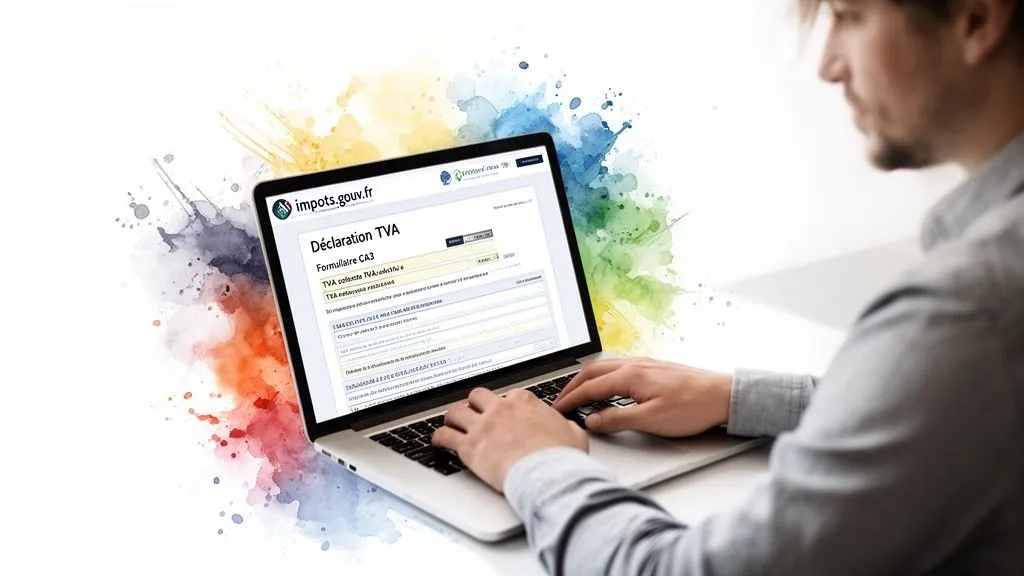
Here we go, the big leap! You are now officially liable for VAT. The next step is to declare it and, of course, pay it over to the government. At first glance this can seem a bit scary, but the process on the impots.gouv.fr website is actually much simpler than it looks.
Let me walk you through it step by step so this new obligation becomes a simple formality. The first thing to do is log into your professional account, your new tax dashboard.
Finding your way around the impots.gouv.fr professional account
Once logged in, the thing to do is look for the “TVA” section. That’s where everything happens. You’ll find the schedule of your returns there and, for each period, the form to fill in. Most often, this will be form CA3, used for monthly or quarterly returns under the standard real scheme.
You’ll then see a line appear for the relevant period, with a deadline. One piece of advice: stick to it scrupulously to avoid penalties. Even if your revenue is zero for the period, filing the return remains mandatory.
A seasoned tip: As soon as you receive the tax office’s email letting you know a new return is available, don’t wait until the last minute. Take a few minutes to prepare it. You’ll spare yourself a good deal of stress and possible oversights.
How do you fill in the CA3 form without making mistakes?
The CA3 form looks a bit intimidating with all its boxes, but as a sole trader, you’ll only need to fill in a few of them. Let’s focus on what really matters for you.
The principle is quite simple: on one side, you declare the VAT you’ve charged to customers (VAT collected), and on the other, you deduct the VAT you’ve paid on business purchases (deductible VAT).
VAT collected: what you owe the government
This is the VAT you’ve collected on behalf of the Treasury. In most cases, only one line will concern you:
- Line 01 (or A1): This is where you must enter the total excluding tax (HT) amount of your sales or services subject to the standard rate of 20%. The site will automatically calculate the corresponding VAT amount. It’s magic!
Deductible VAT: what you get back
This is the most interesting part! You’ll be able to reclaim the VAT paid on your business expenses. The key line for you is the following:
- Line 20 (or B2) “Other goods and services”: Enter here the total amount of VAT you’ve paid on your purchases (your new computer, software, supplies, etc.). Be careful, this refers to the VAT amount alone, not the total including-tax (TTC) amount of the invoice.
To make sure you don’t forget anything and get your calculations right, feel free to take a look at our complete guide on calculating VAT. It’s packed with concrete examples.
Final calculation and payment: the moment of truth
Once the boxes are filled in, the form does the calculation for you:
VAT collected − Deductible VAT = VAT payable (or a VAT credit!)
- Is the result positive? That’s the amount you owe the government. All that’s left is to confirm payment online. It will be made by direct debit, via the SEPA mandate you’ve normally already set up.
- Is the result negative? Good news! It means you’ve paid more VAT than you’ve collected. You have a VAT credit. Two options: request a refund (under certain conditions) or carry it forward to your next return to reduce your future tax.
Let’s take a concrete example: a web developer invoiced €3,000 excl. tax worth of services during the month. He therefore collected €600 of VAT (3,000 x 20%). That same month, he treated himself to a new professional monitor on which he paid €200 of VAT. On his CA3 return, he’ll enter €3,000 on line 01 and €200 on line 20. The site will calculate a balance due of €400 (600 − 200).
Setting up a tax calendar to stay stress-free
The key to managing VAT without stress is organization. For a sole trader on the standard real scheme with a monthly return, the routine quickly becomes second nature.
Here’s a small calendar to help you visualize the deadlines.
Typical tax calendar for VAT (simplified real scheme)
An example schedule for a sole trader on the simplified real scheme, including the key dates for installments and the annual return.
| Deadline | Action required | Details and tips |
|---|---|---|
| Between the 15th and 24th of each month | Filing and payment of the previous month’s VAT | The exact date varies slightly. Rely on the one shown in your professional account — that’s the only one that matters. |
| Early January | Review of the previous year’s VAT | This is the right time to total up the VAT collected and deducted for year N-1. It gives you a good overall picture. |
| End of each quarter | Check on the VAT credit | If you have a credit building up, ask yourself: do I request a refund now, or keep carrying it forward? |
By following this kind of routine, the sole trader VAT return goes from a dreaded chore to just another simple administrative task on your to-do list. It’s all a matter of habit and anticipation.
Bizyness to the rescue: automate your VAT with total peace of mind
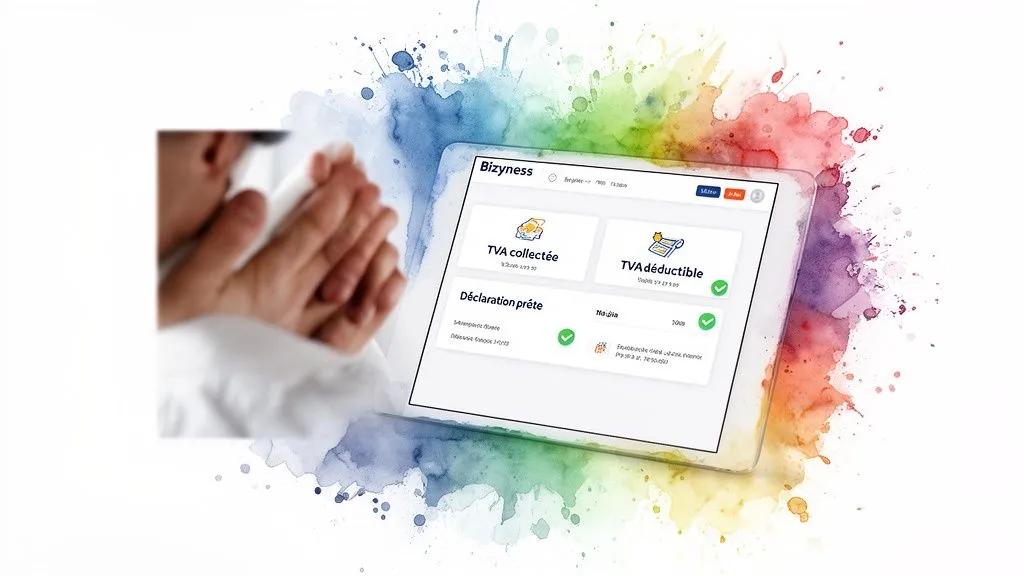
Let’s be honest: managing VAT by hand is often an obstacle course. Between spreadsheets that quickly turn into unwieldy monsters, rounding calculations that never quite add up, and the fear of forgetting an invoice, it eats up a huge amount of time and precious energy.
And yet, this tax obligation can become a simple formality, almost invisible in daily life. That’s the whole point of a tool designed for freelancers and sole traders like Bizyness. The idea is simple: move from the fear of making a mistake to total confidence in your numbers, so you can focus on what really matters — your business.
Automatic calculations and ready-to-use reports
The secret of Bizyness is its smart automation. Every time you issue an invoice or log an expense, the software works for you behind the scenes.
It instantly sorts and calculates:
- VAT collected on each of your sales, applying the correct rate without you having to think about it.
- Deductible VAT on your purchases, based on the invoices or receipts you import in just seconds.
No more manually checking every line on a spreadsheet at the end of the month! Bizyness centralizes everything and generates a clear VAT report. This document gives you the exact amounts to enter on your CA3 or CA12 return, box by box. It’s as simple as that.
In practice, what used to take hours of tedious checking turns into just a few clicks to get the key figures for your sole trader VAT return.
A copilot to anticipate the unexpected and rule changes
Tax law is never set in stone. We saw this clearly with the 2025 reform proposal that planned to change the VAT thresholds. In the end, this measure was abandoned to protect micro-entreprises, but this episode showed one thing: being well equipped is crucial.
A tool like Bizyness, which syncs your transactions and generates always up-to-date reports, keeps you from getting lost in the twists and turns of the law. It ensures your returns stay compliant, no matter what happens. To learn more about this abandoned reform, you can check out the details on the evolution of legislation for sole traders.
Two concrete examples to help you visualize it
To see how this plays out in practice, let’s look at two very different profiles.
The freelance graphic designer
Julien works with about ten clients a month. His expenses are varied: software subscriptions, font purchases, computer equipment… Without a tool, he would have to meticulously collect every invoice, calculate VAT for each one, and compile everything for his monthly return. With Bizyness, he simply takes a photo of his receipts. The app reads the amounts, calculates the VAT, and prepares the report on its own. On filing day, all he has to do is copy over the figures.
The e-commerce seller and her creations
Sophie, meanwhile, runs an online shop with hundreds of sales every month. Tracking VAT manually would be a full-time job! By connecting her shop to Bizyness, every order is recorded automatically. The VAT collected is calculated instantly for each item sold. Her sole trader VAT return becomes a simple, reliable process, even with a large volume of transactions.
In both cases, Bizyness acts as a true tax copilot. It makes sure every euro of VAT is correctly accounted for, protecting you from the oversights and penalties that can cost you dearly.
Your frequently asked questions about VAT as a sole trader
Moving to VAT, especially for the first time, raises quite a few questions. That’s entirely normal. To help you see things more clearly, we’ve compiled the most common questions here, along with our answers, with no unnecessary jargon.
The idea is to clear up your last doubts so that the sole trader VAT return becomes a simple formality for you.
If I’m under the exemption scheme, can I deduct VAT on my purchases?
The answer is straightforward: no. That’s the very principle of the VAT exemption scheme.
Since you don’t collect VAT on your sales, the tax authorities don’t allow you, in return, to reclaim it on your business expenses. It’s a zero-sum game.
That said, this rule deserves a bit of strategic thought. Imagine you need to invest heavily: a powerful computer, expensive software, equipment specific to your trade… In that case, voluntarily opting for the real VAT scheme can turn out to be very worthwhile. You could then reclaim the VAT on these major purchases and significantly reduce the bill.
What happens if I miss a VAT return deadline?
Let’s be clear: the tax authorities don’t take delays lightly. Forgetting a return leads to almost automatic penalties.
In general, expect a 10% surcharge on the VAT you owe. On top of that come late-payment interest, calculated at 0.20% per month. That may sound small, but the bill climbs fast.
The best advice I can give you is to plan ahead. Set alerts in your calendar, use an app that sends you reminders… In short, don’t leave any room for forgetting. It’s the simplest way to avoid fees that are, by definition, 100% avoidable.
Consistency is really your best friend for staying on good terms with the tax authorities and protecting your cash flow.
How does my invoicing need to change once I’m liable for VAT?
The moment you switch over, your invoices need to change. This isn’t just a recommendation, it’s a legal requirement.
Make sure the following details appear clearly:
- Your intra-community VAT number: This is your new tax ID card in Europe.
- The VAT rate applied: Specify the correct rate (20%, 10%, 5.5%…) for each product or service.
- The breakdown of amounts: For each line, you now need to show the amount excluding tax (HT), the corresponding VAT amount, and the total including all taxes (TTC).
Check that your invoicing tool handles this change properly. It should let you switch from “not liable” to “liable” status in one click, so your invoices are compliant from the very first one issued.
Do I need to file a VAT return if I didn’t invoice anything during a month?
Yes, absolutely. It’s a classic trap! Even if your revenue is zero, the obligation to file remains.
Once you’re on a VAT filing schedule (monthly or quarterly), you must submit a return for every period, without exception. If you had no activity at all, you’ll fill in what’s known as a “nil” return.
You simply need to enter “0” in the collected VAT and deductible VAT boxes. Forgetting to do so, even with no activity, is a mistake. The tax authorities will see it as a failure to comply and may send you reminders, or even apply penalties.
Juggling bookkeeping, invoice tracking, and the sole trader VAT return can quickly become a real headache. With Bizyness, these tasks are automated, letting you focus on what really matters: growing your business. Save time and gain peace of mind. To see how, take a look at https://www.bizyness.fr.
