

 Français
 VAT Reverse Charge: A Practical Guide for Online Sellers
Simplify VAT reverse charge with our guide. Understand how it works, when it applies, and how to secure your tax compliance online.
VAT reverse charge — what exactly is it? It’s a somewhat unusual tax mechanism that flips the usual roles. Instead of the seller collecting VAT to pay it over to the tax authority, it’s you, the business customer, who takes over. You declare and pay that VAT directly to the tax administration.
This system, also known as “reverse charge” internationally, has become unavoidable, especially for transactions between businesses across Europe or for certain specific operations in France.
Understanding the VAT reverse charge mechanism
In the standard VAT circuit, everything is simple: a business sells a good, charges VAT to its customer, collects the full amount, and then pays over the VAT it collected to the tax authority. The reverse charge mechanism does the opposite. The seller sends you an invoice excluding tax, and it’s up to you, the buyer, to calculate, declare that VAT, and, most often, deduct it at the same time on your own return.
For the purchasing business, the cash-flow impact is generally nil. Why? Because the VAT you must declare (“VAT due”) is immediately offset by the VAT you can reclaim (“deductible VAT”). The main advantage is not having to advance any money, which is particularly valuable when buying from foreign suppliers. No more headache of paying VAT to a business in another country only to then have to request a refund — a process that can quickly become long and tedious.
To better visualize the difference, here’s a simple comparison table.
Comparing standard VAT and reverse charge VAT
This table highlights the key differences in the VAT collection, declaration, and payment process between the standard system and the reverse charge mechanism.
| Process step | Standard VAT regime | Reverse charge regime |
|---|---|---|
| Invoicing | The seller invoices with VAT (excl. tax + VAT = incl. tax). | The seller invoices without VAT (excl. tax). |
| Payment | The buyer pays the VAT-inclusive amount to the seller. | The buyer pays only the VAT-excluded amount to the seller. |
| VAT collection | The seller collects VAT from the buyer. | No collection between the parties. |
| Declaration | The seller declares the VAT collected. The buyer declares deductible VAT. | The buyer declares both the VAT due and the deductible VAT. |
| Payment to the tax authority | The seller pays the collected VAT to the tax administration. | The buyer performs a set of offsetting entries (the operation is often neutral). |
In short, the reverse charge shifts tax responsibility from seller to buyer, simplifying financial flows, especially internationally.
But why does this system exist in the first place?
It’s not just accounting gymnastics. This mechanism was created to address two very real problems:
- Simplifying international trade: it avoids, for example, a German business having to register for VAT in France just to sell you products or services.
- Securing tax revenue: it’s a very effective weapon against certain complex frauds, since it makes the local buyer directly responsible for collection.
The system is in fact a direct response to sophisticated fraud schemes, such as the infamous “VAT carousel fraud,” which have cost European states billions of euros. An anecdote even circulates about a recovery notice of €600 million issued to a single company in France. The amount was so colossal that agents had to write it out by hand, because the tax administration’s software wasn’t designed to handle such a figure!
The reverse charge is an inversion of who owes the tax: the customer becomes the tax collector instead of the seller. That’s the very foundation of this mechanism.
The accounting logic behind the mechanism
From an accounting standpoint, VAT reverse charge is above all a set of offsetting entries. When you receive an invoice from a European supplier without VAT, you must record three things:
- The tax-excluded amount of your purchase in your expenses.
- The corresponding French VAT as “VAT due.”
- That same VAT amount as “deductible VAT.”
The effect is immediate: the VAT due and the deductible VAT cancel each other out. Your cash flow is not impacted, nor is the final VAT amount payable to the tax authority — at least if your business allows you to deduct the full amount of VAT.
For any business selling online and sourcing from abroad, whether in e-commerce or via marketplaces, mastering this concept is absolutely crucial. For those who want to dig into the legal aspects, our article on the legal basis of VAT reverse charge under Article 283 of the French Tax Code will give you all the keys. This system is now the norm for a large number of B2B transactions.
Knowing when to apply the reverse charge
Identifying operations that fall under VAT reverse charge is the first, and most crucial, step to staying compliant. This mechanism isn’t a simple box to tick — it’s a legal obligation in very specific situations. For an online seller, knowing how to spot these cases is the best insurance against a tax reassessment.
The principle is fairly simple at heart. As soon as a transaction with another business goes beyond the purely France-to-France scope, the reflex should be to ask the question. The most common cases? Purchases of goods or services from partners based outside France, whether within the European Union or beyond.
To make things clearer, here’s a small decision tree that sums up the logic to follow to know whether you’re dealing with standard VAT or reverse charge VAT.
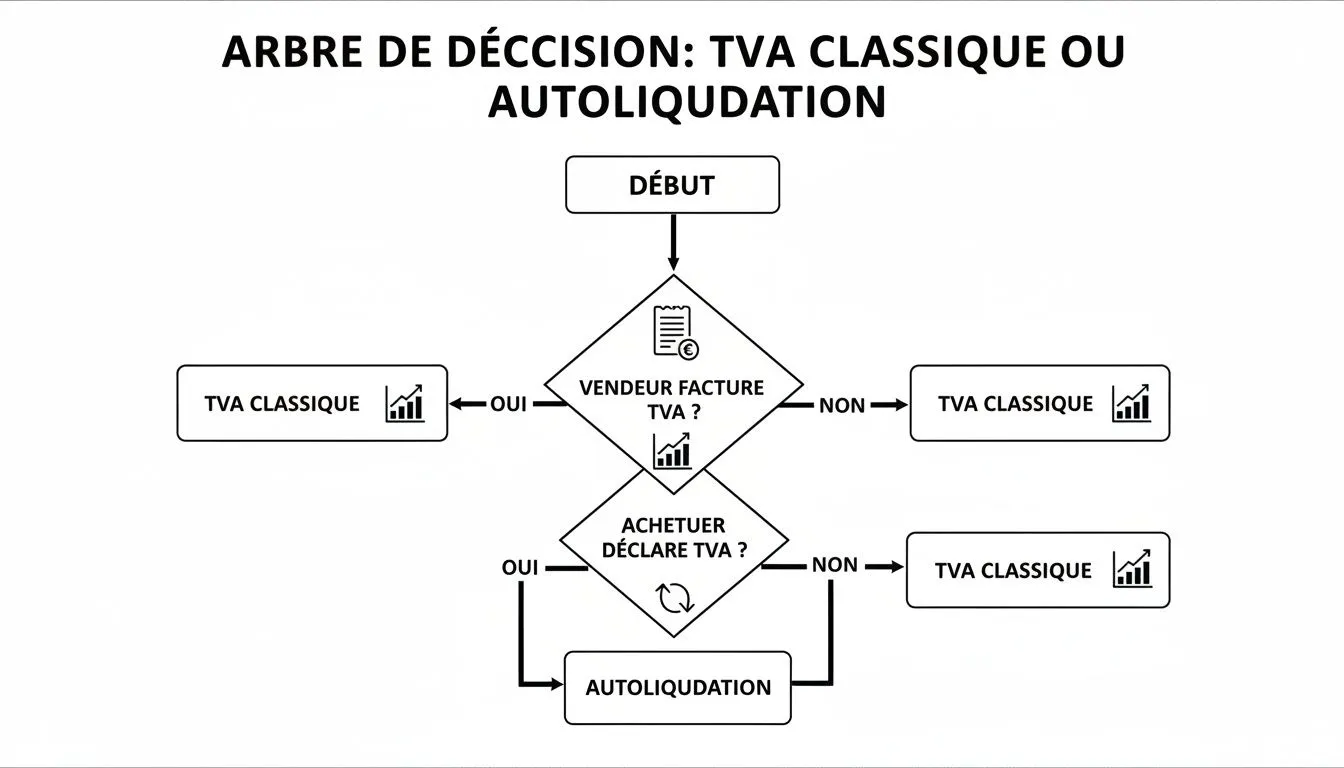
This diagram makes it clear: the cornerstone of the system is the transfer of responsibility. When the seller doesn’t charge VAT, it’s up to you, the buyer, to declare it while deducting it immediately. Let’s now look at the concrete situations you’ll inevitably encounter.
Intra-community B2B acquisitions
This is the classic scenario for any online store. You stock up with a supplier in Germany, Spain, or Italy. As a VAT-registered business in its own country, that supplier will issue you a tax-excluded invoice. This is the standard procedure for an intra-community delivery.
But watch out — for this mechanism to be valid, two conditions are mandatory:
- You are both businesses registered for VAT in your respective countries.
- Your intra-community VAT numbers are valid and must absolutely appear on the invoice.
In this setup, you’re required to reverse-charge French VAT on the amount of your purchase. In concrete terms, you’ll calculate the VAT that would have applied had the purchase taken place in France, and then report it on your return.
Concrete example Your online store buys €10,000 excl. tax worth of goods from a wholesaler in Portugal. After verifying your French VAT number, the wholesaler sends you an invoice for €10,000, with no VAT. On your side, you’ll need to declare and simultaneously deduct €2,000 (i.e. €10,000 x 20%) on your CA3 VAT return. The operation is therefore entirely neutral for your cash flow.
Importing goods from non-EU countries
Since January 1, 2022, the rules of the game have changed and been simplified. If you import products from a country outside the European Union (such as China, the United States, or the United Kingdom), reverse charging import VAT is now automatic and mandatory.
This measure, which today represents around 15% of VAT returns, is a real relief. Gone are the days of having to advance VAT to the carrier or freight forwarder at customs clearance, then waiting to recover it. Now everything is handled directly on your VAT return, and the amounts are often even pre-filled by the tax administration. To give a sense of scale, in 2024 economic VAT revenue in France reached €209 billion, and the share coming from the one-stop shops jumped by 27.4%, proof of how effective these centralized systems are. You can find more details on DGFIP’s statistics if you want to dig deeper.
Buying services from foreign providers
This scenario is omnipresent in the daily life of an online business. Think of all your intangible expenses:
- Subscriptions to SaaS software (such as Shopify, your marketing tools, etc.).
- Online advertising purchases (Google Ads, Meta Ads).
- Work assigned to freelancers (developers, designers) based abroad.
Whether the provider is established in an EU country or outside it, the rule remains the same. The foreign business sends you a tax-excluded invoice, and it’s up to you, as the French customer, to reverse-charge the VAT.
The role of marketplaces
When selling via platforms like Amazon or Cdiscount, things get a bit more complex. With the major e-commerce VAT reform of July 2021, marketplaces are often treated as the “deemed reseller.”
What does that mean? For certain transactions, particularly sales to consumers (B2C) or those made by sellers based outside the EU, it’s the marketplace itself that’s responsible for collecting and remitting VAT. That’s a real plus that simplifies life for sellers, but you still need to stay vigilant. It’s essential to understand the terms of each platform to avoid declaring VAT that’s already been handled by a third party.
Mastering invoicing under reverse charge
In the event of a tax audit, a well-drafted invoice is your best insurance. It’s the material proof of your transaction and the justification for VAT reverse charge. Think of it as a contract: every detail matters and must be flawless.
Issuing an invoice under reverse charge requires particular rigor. It’s not just about leaving out VAT — you need to prove that this omission is perfectly legal. Every mandatory mention is a building block that reinforces the soundness of your accounting.

The mandatory mentions for a bulletproof invoice
For your invoice to be unassailable, it must include key elements, in addition to the usual mentions (date, number, identity of the parties, etc.). A single omission, and the tax administration could reclassify the entire operation.
Here are the points of attention never to overlook:
- Intra-community VAT numbers: yours and your customer’s (if you’re selling) or your supplier’s (if you’re buying). This is what proves the exchange is indeed between two VAT-registered businesses.
- A total amount excluding tax: simply put, the invoice must show no VAT amount at all. The total payable is the tax-excluded amount, full stop.
- The right legal mention: this is the heart of the matter. Your invoice must clearly state why this regime applies.
The simplest and most effective mention remains “Reverse charge” (“Autoliquidation” in French). It’s understood by every tax administration in Europe and avoids any confusion.
That said, for greater precision, you can absolutely add the legal reference that matches your situation.
Which legal reference to add on the invoice?
While the mention “Reverse charge” generally does the job, specifying the relevant article of law is a real plus that strengthens the credibility of your document. The right article depends on the nature of the transaction.
- For an intra-community acquisition (purchase of goods within the EU): state “Reverse charge — Article 283, 1 of the French Tax Code.”
- For an intra-community supply of services: add “Reverse charge — Article 196 of Directive 2006/112/EC.”
- For subcontracting work in the construction sector: the correct mention is “Reverse charge — Article 283, 2 nonies of the French Tax Code.”
These references aren’t mere administrative details. They clearly tell the tax administration which legal framework you’re operating under, leaving no room for doubt.
The crucial step: validating the VAT number
Before completing a transaction, making a habit of checking your European partner’s VAT number is absolutely essential. Don’t blindly trust what your customer or supplier gives you — an active check is required.
For this, the official tool is the VIES (VAT Information Exchange System) service, provided by the European Commission. It’s free, online, and in just a few clicks you can confirm the validity of a VAT number in any EU country.
Remember to keep proof of this check, such as a dated screenshot. In the event of an audit, this simple step demonstrates your good faith and the seriousness with which you manage your compliance. To go further, our complete guide on invoicing under reverse charge gives you access to templates and other practical tips.
Integrating reverse charge into your VAT return
Once you have a good grasp of the VAT reverse charge mechanism, it’s time to move on to practice: the declaration. This whole process takes shape in your monthly or quarterly return, the famous CA3. This is where theory takes root in the reality of your numbers.
Rest assured, this step isn’t just another administrative formality. It’s essential to guarantee the tax neutrality of the operation and to make sure you stay compliant. The logic is relentless: everything starts with a precise accounting entry that then flows into well-defined boxes on your return. At first it takes a bit of concentration, but with practice it becomes second nature.
The set of accounting entries for reverse charge
Even before opening your VAT return, everything happens in your accounting software. As soon as you receive an invoice subject to reverse charge, you must record a set of entries that concretely reflect the “reverse charge” principle.
Let’s take a common case: you buy €1,000 excl. tax worth of online advertising from a provider based in Ireland. The French VAT rate of 20% applies, meaning €200 of VAT to handle.
Here’s how this translates into accounting:
- Debit the expense account (e.g. 623000 - Advertising) for €1,000.
- Debit the deductible VAT account (e.g. 445662 - Intra-community deductible VAT) for €200.
- Credit the supplier account for €1,000 (you only pay them the tax-excluded amount — that’s the whole point!).
- Credit the VAT due account (e.g. 445200 - Intra-community VAT due) for €200.
The result? The VAT due and deductible VAT accounts cancel each other out. Your cash flow is not impacted at this stage at all. It’s a “wash” operation that lets the state collect VAT while sparing you from having to advance it.
Filling out the CA3 VAT return step by step
The CA3 return is ultimately just a reflection of these accounting entries. It’s your way of telling the tax administration: “I have understood and correctly applied the mechanism.” The classic mistake to avoid is declaring only the deductible VAT while forgetting to collect it. That’s the shortest path to a tax reassessment.
To make this clearer, let’s take a look at the boxes to fill in on the form.
The principle is simple: the tax-excluded amount of your reverse-charge operations must appear twice, once on the “VAT collected” side and once on the “deductible VAT” side.
Let’s go back to our example of a €1,000 excl. tax purchase:
-
Box A - Amount of operations carried out: on line 03 “Intra-community acquisitions,” enter the tax-excluded amount of your purchase, i.e. €1,000.
-
In the “Gross VAT” section, line 2B (“Intra-community acquisitions”) is often filled in automatically from line 03. The VAT due of €200 appears here.
-
In the “Deductible VAT” section, on line 19 “Of which VAT on intra-community acquisitions,” manually report that same €200.
The cash-flow impact is enormous. You never advance the VAT, since you deduct it at the very moment you declare it. Some experts, as explained in an article on the history and potential of VAT on paulduvaux.com, even believe that generalizing this system could simplify the tax by 90% and drastically reduce fraud. For an online seller, it’s above all one less layer of complexity in managing international operations.
How it connects with other declarations
Watch out: reverse charge isn’t limited to the CA3. It interacts with other declarations, in particular the former Declaration of Trade in Goods (DEB), now split between the statistical survey (EMEBI) and the VAT summary statement.
When you make intra-community acquisitions of goods, you must report them on your CA3, but also detail them in this summary statement. This is what allows customs to track the flow of goods within the European Union.
This double declaration is crucial. The tax administration doesn’t hesitate to cross-check data between the CA3 and the summary statement. The slightest inconsistency between the two can trigger a request for clarification, or even a tax audit. The key is therefore to be rigorous and make sure that the amounts declared on each document match perfectly for the same period.
Avoiding common mistakes with our checklist
VAT reverse charge is an incredibly useful mechanism, but it doesn’t forgive approximation. A small mistake, a simple oversight, and it opens the door to complications that can be costly. Let’s be frank: a tax reassessment is never good news, especially when it could have been avoided with a bit of method.
Let’s go through the most common pitfalls together so you can dodge them. Then I’ll share a concrete, step-by-step checklist with you. The idea is simple: turn this tax obligation into a simple, well-mastered, stress-free formality for your business.
The most common mistakes to never make
Certain mistakes come up again and again during tax audits. Knowing them is already a big step toward never making them again.
- Forgetting the “Reverse charge” mention on the invoice: this is the silliest mistake, yet the most common. Without this mention, your invoice isn’t compliant. Period. The tax administration can then challenge your right to deduct VAT, even if everything else is perfectly in order.
- Not checking the partner’s intra-community VAT number: invoicing under reverse charge to a business whose VAT number isn’t valid is a serious mistake. It invalidates the whole mechanism and exposes you to a reassessment, since you become liable for the VAT that should have been charged.
- Reporting amounts in the wrong place on the CA3 return: the classic error is entering the deductible VAT without declaring the matching collected VAT. This imbalance sets off a big red flag in the administration’s systems and can be interpreted as an attempt to cheat on the tax.
The consequences shouldn’t be taken lightly. We’re not talking about a simple warning, but penalties for incorrect declarations that can climb up to 10% of the amounts concerned, not counting late-payment interest. Rigor isn’t optional.
In tax matters, form matters as much as substance. A flawless invoice or return is your best armor in the event of an audit.
Your reverse-charge compliance checklist
To help you set up good habits and never let anything slip, here’s a highly practical checklist to use for every operation. Think of it as your safety net for peace of mind.
Before you even start the transaction
- Check the validity of your partner’s VAT number: make it a habit to use the online VIES tool from the European Commission. It’s free, instant, and should become automatic before any invoice.
- Keep proof of this check: a simple dated screenshot, saved with the customer’s file, is enough. In the event of an audit, it will prove your good faith.
- Confirm the nature of the operation: are you certain the transaction (purchase of goods in the EU, service from a foreign provider, subcontracting in construction…) really falls under reverse charge? When in doubt, check.
When issuing your invoice (if you’re the seller)
- Issue an invoice without VAT: the total amount payable must be the tax-excluded amount. No more, no less.
- State both VAT numbers: yours and your customer’s must appear in black and white.
- Add the “Reverse charge” mention: this is the magic phrase that justifies the absence of VAT collected on the invoice.
When you receive an invoice (if you’re the buyer)
- Check the invoice’s compliance: make sure it’s tax-excluded and includes the “Reverse charge” mention as well as both VAT numbers.
- Reject an incorrect invoice: if a foreign supplier charges you VAT by mistake, do not pay it! Ask them immediately for a corrected invoice. If you pay that VAT, it simply won’t be deductible in France.
During your VAT return (the famous CA3)
- Enter the amount twice: the tax-excluded amount of the operation must be reported both in the “taxable operations” section (which generates the VAT collected) and in the calculation of your “deductible VAT.” One offsets the other.
- Ensure data consistency: for purchases of goods, check that the amounts declared on the CA3 match those on your VAT summary statement (the former DEB).
By following this checklist point by point, you turn a procedure that seems complex into a simple, well-oiled routine. You reduce the risk of errors to almost zero and gain invaluable peace of mind regarding your tax obligations.
Automation: your best ally for stress-free VAT management
Managing VAT reverse charge manually is a bit like trying to navigate the open sea with just a compass. It’s repetitive, takes a huge amount of time and, let’s be honest, the risk of getting it wrong is significant. A simple mistake on an invoice, an oversight in the accounting entries, or an approximate entry on the CA3 return can quickly turn into a tax headache and weigh on your cash flow.
Fortunately, faced with this complexity, technology today offers remarkably effective solutions. By adopting an automated tool, you turn this tax burden — often a source of stress — into a clear and secure process. The idea? Free your mind to focus on what really matters: finding new customers, refining your products, and growing your business.
How automation changes the game for your VAT
A good financial management tool goes well beyond simple invoicing software. Think of it more as a dedicated tax co-pilot for your online business.
Take a platform like Bizyness, for example, designed for the realities of online sellers. Once connected to your sales channels (like Shopify or Amazon) and your payment solutions (Stripe, PayPal), it breaks down each transaction in real time.
Automation is no longer a luxury — it’s a necessity for any online business looking to grow without burning out. It can eliminate up to 90% of manual VAT-related tasks, drastically reducing the risk of human error.
Very concretely, here’s how such a system makes your daily life easier:
- Automatic identification: the software immediately knows whether a transaction is subject to reverse charge. Whether it’s a stock purchase in Germany or an advertising invoice from Google Ireland, it sorts it out for you.
- Flawless invoicing: it generates compliant invoices, systematically adding the “Reverse charge” mention and checking that intra-community VAT numbers are correct.
- Preparing accounting entries: no more headaches figuring out which account to debit or credit. The platform prepares the accounting entry for VAT due and deductible VAT, ready to be sent to your accountant.
- Help with the declaration: the amounts are already calculated and sorted into the right boxes. Filling out your VAT return becomes much simpler, and the risk of forgetting something is almost zero.
A concrete example of automation in action
Imagine your Shopify store sources from a manufacturer in Spain. Without a tool, the process is heavy: you need to check the invoice, calculate the VAT to reverse-charge, post the entry manually, then carefully report the amounts on the CA3 return.
With an automated solution, everything becomes seamless. You place your order, the supplier’s invoice is captured, and a tool like Bizyness handles the rest behind the scenes. Your only involvement is to validate the already pre-filled information. The time saved is huge, and your tax compliance is ensured without you having to constantly think about it.
To better grasp the impact of these tools, take a look at our guide on automating administrative tasks to unlock your growth potential.
Frequently asked questions about VAT reverse charge
Even with the best explanations, VAT reverse charge brings its share of very concrete questions. That’s entirely normal. Let’s dive into the most frequent practical cases to clear the ground and secure your day-to-day operations.
Think of each situation as an opportunity to strengthen your compliance and avoid the pitfalls. It’s by asking the right questions that you make progress.
What should I do if a foreign supplier charges me VAT by mistake?
This is a classic situation, and one more common than you might think. A European supplier sends you a VAT-inclusive invoice, even though you did provide them with your French intra-community VAT number. The golden rule? Do not pay that VAT under any circumstances.
The right move is to contact them immediately. Calmly explain that this operation falls under the reverse charge mechanism in France. They must issue you a corrected invoice, showing only the tax-excluded amount and the “Reverse charge” mention. If you pay that foreign VAT, you’re shooting yourself in the foot: not only will it not be deductible in France, but it will also create a real accounting headache.
Does reverse charge apply with the United Kingdom?
Since Brexit, the cards have been reshuffled. With the UK no longer part of the European Union, the rules of the game have changed. Two cases need to be distinguished:
- For transactions with Great Britain (England, Scotland, Wales), we’re no longer talking about intra-community operations but about imports or exports. Reverse charging import VAT has become mandatory and happens automatically at customs clearance.
- Northern Ireland has a somewhat special status. For trade in goods, it’s still treated as an EU country. The standard reverse charge, as we know it for intra-community acquisitions, therefore remains the norm.
How do I correct a mistake on a VAT return?
To err is human, even in accounting. If you realize you forgot to reverse-charge an invoice or made a mistake on your CA3 return, don’t panic. The solution is to file a corrected VAT return for the period in question.
This new return will simply overwrite the previous one. Let’s say you omitted an intra-community acquisition. You’ll need to add it on line 03, then report the corresponding VAT amount as both collected (line 2B) and deducted (line 19). The most important thing is to act quickly. By taking the initiative, you show your good faith to the tax administration, which significantly limits the risk of penalties.
A small piece of experienced advice: it’s always better to correct a mistake yourself than to wait for a tax audit to do it. It shows that you manage your business with rigor.
Keeping these few reflexes in mind will let you handle the subtleties of international VAT with much greater peace of mind.
Don’t let tax complexity hold back your growth any longer. With Bizyness, automate your invoicing and VAT returns so you can focus on your core business. Discover how Bizyness simplifies life for online sellers at bizyness.fr.
