

 Français
VAT reverse charge mention: a practical guide to understanding and writing it
Learn when and how to write the VAT reverse charge mention with our clear, practical guide.
The VAT reverse charge can seem a bit obscure at first glance. Yet the principle is fairly straightforward: it simply reverses who is responsible for paying the tax. Instead of the seller, it’s the buyer who takes care of it. This mechanism explains why you sometimes receive invoices with no VAT, but with a very specific legal mention.
Understanding the VAT reverse charge mechanism
Fundamentally, the reverse charge was introduced for two main reasons: to streamline international trade and, let’s be honest, to make life harder for fraudsters. Imagine the headache if every foreign company had to register for VAT in France for the smallest sale. It would be a genuine administrative obstacle course.
The system therefore flips the problem around. The seller simply issues a tax-free (net of VAT) invoice. It’s then up to the buyer, if they are indeed liable for VAT in France, to calculate and declare this tax on their own side.
What is the impact on your cash flow and returns?
For the buyer, the good news is that the operation is completely neutral in cash-flow terms. It’s simply an accounting entry. Here’s how it plays out concretely in their VAT return (the well-known CA3 form):
- On one hand, they declare the VAT due on the purchase, as if they had collected it themselves.
- On the other, they immediately deduct that same amount of VAT, just like any other business expense.
Bottom line: the collected VAT and the deductible VAT cancel each other out perfectly. The company never needs to actually pay out any money, which is a real plus for cash flow.
The goal is simple: make the transaction transparent while ensuring the State still collects the tax, without the buyer having to make any cash advance.
This mechanism is particularly effective in fighting sophisticated fraud schemes, such as “VAT carousel fraud,” which has cost billions in the past. By requiring the French buyer to handle the tax themselves on intra-EU transactions, it closes the door on foreign suppliers who might be tempted to collect VAT without ever remitting it to the tax authorities.
Of course, for all this to work smoothly, the invoice must be flawless. Not only must it be net of VAT, but it must also carry the VAT reverse charge mention that matches the situation. To dig into the legal basis of this mechanism, our article on the fundamentals of Article 283 of the French General Tax Code governing the reverse charge will give you all the keys. Mastering this logic is the first step to securing your invoices, whether you work in construction subcontracting, goods importation, or international services.
Knowing when the VAT reverse charge is required
To master invoicing, you first need to know precisely when the “reverse charge” mention must appear on your invoices. The rule can seem complex at first, but it follows a well-defined logic that depends on the nature of the transaction, your industry, and the location of your business partners. Knowing how to identify these scenarios is the first step toward flawless compliance.
Far from being a textbook case, the reverse charge concerns far more businesses than you might think, sometimes without them even realizing it. Think of your subscriptions to foreign software, purchases of equipment from a European supplier, or your involvement in a construction project.
This decision tree illustrates the path VAT takes in a reverse-charge scenario, showing how responsibility for the tax shifts from the seller to the buyer.
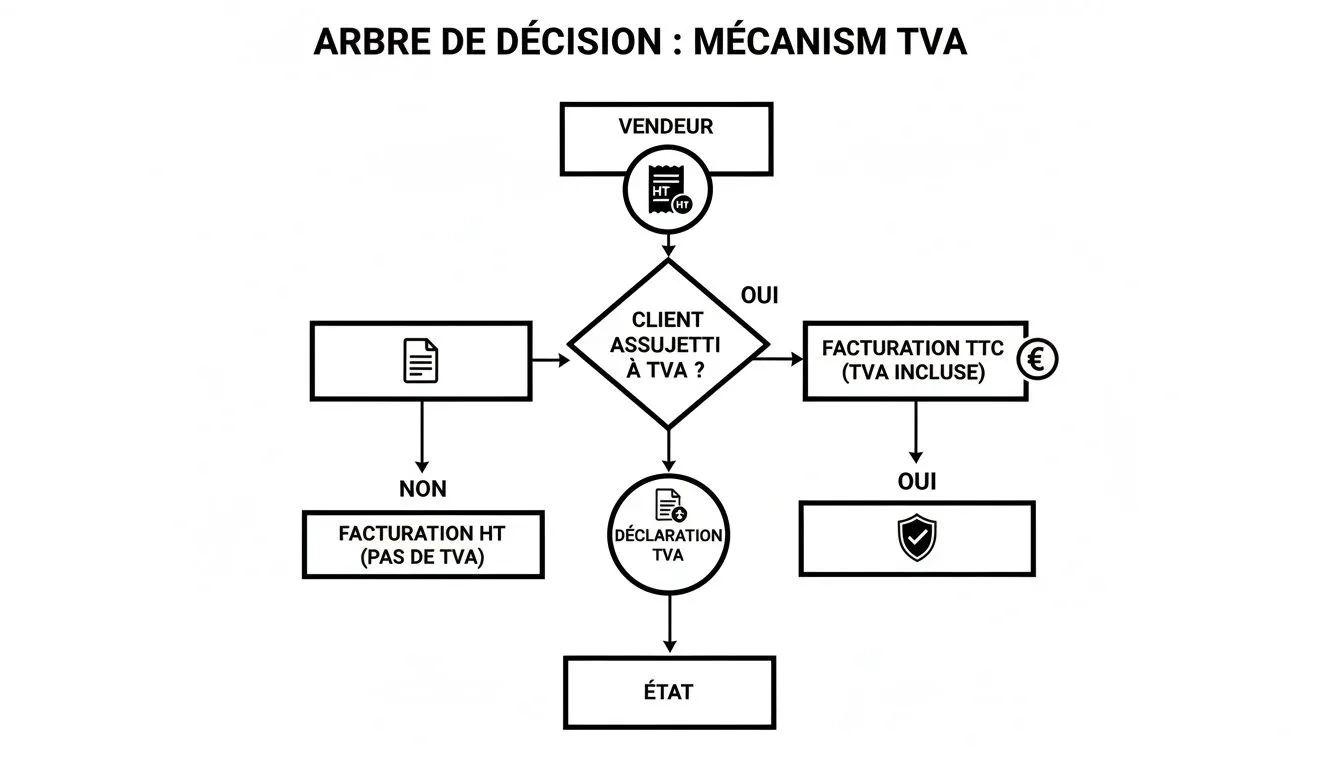
It clearly shows that the seller issues a tax-free invoice, while the buyer handles the entire reporting cycle. For the latter, the operation is completely neutral in cash-flow terms.
The case of services between EU professionals
This is probably the most common scenario, especially for digital businesses and freelancers. As soon as you purchase a service from a company based in another European Union country, the reverse charge principle applies.
Let’s take a concrete example: your web agency uses design software published by a company based in Ireland. The invoice you receive will be tax-free. It will be up to you to calculate, declare, and simultaneously deduct the corresponding French VAT. The same principle applies if you buy advertising on a major European platform.
A word of caution: For this mechanism to apply, both companies (yours and your supplier’s) must be liable for VAT and hold a valid intra-community VAT number. Make it a habit to always check your partners’ VAT numbers through the European Commission’s VIES online service.
Subcontracting in the construction industry
Construction is another major area of application, but with its own set of rules. If a main contractor hires a subcontractor for work on a construction site in France, the subcontractor’s invoice must be issued tax-free.
It is then the main contractor, the client, who is responsible for applying the reverse charge to the VAT. The purpose of this measure is simple: to secure the collection of the tax in a sector where chains of parties involved can be particularly long.
For this to apply, the following conditions must be met:
- The subcontractor is a company established in France or abroad.
- The client is liable for VAT in France.
- The construction work concerns real estate located in France.
For example, a plumber working for a general construction company on a renovation site will invoice their hours and materials without VAT, taking care to add the legal reverse-charge mention on their invoice.
Purchases of goods and imports
The reverse charge also applies to intra-community acquisitions of goods. If your company buys equipment from a supplier in Germany, for example, that supplier will send you a tax-free invoice. It’s then up to you to apply the reverse charge for French VAT on your return.
And since 2022, the mechanism has become automatic and mandatory for import VAT on goods coming from countries outside the EU. This is excellent news, as it considerably simplifies customs procedures and eases the burden on cash flow. Gone are the days when you had to advance VAT at the time of customs clearance.
How to correctly write the reverse-charge mention on your invoices
Once you know your transaction is subject to the reverse charge, it’s time for concrete action: invoicing. Watch out, this is where rigor is essential. A simple approximation or a small mistake in the VAT reverse-charge mention on your invoice can make it non-compliant in the eyes of the tax authorities and create a lot of hassle for you.

The fundamental rule is simple: the invoice must always be issued net of VAT. That’s the baseline. You don’t collect any VAT, because your client will take care of it. Responsibility for calculating and paying the tax is transferred entirely to them.
In addition to the net amount, two pieces of information then become absolutely crucial for your document to be valid:
- Your own intra-community VAT number.
- Your client’s, the buyer’s.
These two numbers prove that you are indeed dealing with another VAT-liable professional, an essential condition for the reverse-charge mechanism to apply.
The legal wording you need to know
As is often the case in accounting, the devil is in the details. Here, the detail that changes everything is the exact wording of the legal mention on your invoice. It must be perfectly clear, leave no room for doubt, and above all reference the correct article of the French General Tax Code (CGI). Precise communication is key, and moreover, to keep your exchanges always clear, mastering good professional communication techniques is a real asset.
To help you find your way around, here is a table summarizing which mention to use for each situation.
Which reverse-charge mention for which situation?
This table summarizes the legal wording required on an invoice depending on the type of transaction subject to the VAT reverse charge.
| Type of transaction | Recommended legal mention on the invoice | Reference article of the CGI |
|---|---|---|
| Intra-community supply of services | ”Reverse charge by the recipient, Article 283-2 of the CGI” | Article 283-2 |
| Intra-community supply of goods | ”VAT exemption, Article 262 ter I of the CGI” | Article 262 ter I |
| Construction subcontracting | ”Reverse charge, Article 283-2 nonies of the CGI” | Article 283-2 nonies |
| Import (VAT due on import) | “Reverse charge, Article 293 A of the CGI” | Article 293 A |
Choosing the right legal reference is more than a mere formality. It’s what tells your client (and the tax authorities) the legal basis for the transaction, justifying why no VAT was collected. It’s a guarantee of transparency.
Pro tip: Save time and avoid mistakes by building these mentions directly into your invoice templates. Most invoicing software can automatically add the correct mention based on the client’s profile (their country, VAT number, industry, etc.). A little initial setup that will bring you real peace of mind.
Why is this rigor so important?
Don’t take invoice writing lightly, because a mistake can be costly. For you, the seller, the risk is being asked to pay the uncollected VAT during a tax audit. For your client, an incorrect or missing mention could jeopardize their right to deduct the VAT they themselves declared.
It’s therefore a shared responsibility, where one party’s compliance depends on the other’s rigor. Every invoice is an official supporting document that must be flawless. To go further, you can check out our complete guide detailing all the mandatory mentions on an invoice, beyond just the reverse-charge case.
By adopting these habits, you not only secure your transactions but also strengthen the trust relationship with your partners. Clear, precise invoicing is simply a reflection of your professionalism.
To eliminate errors, automate your VAT management
Managing the VAT reverse charge manually is a bit like playing with fire. At first, everything’s fine, but as transaction volume grows, the risk of oversight or error skyrockets. A simple omission of the VAT reverse-charge mention on an invoice, an incorrect accounting entry, and the door is wide open to complications during a tax audit.
Faced with this complexity, let’s be clear: automation is no longer optional, it’s a necessity for peace of mind. Tools like Bizyness are precisely there to turn this tax headache into a simple, reliable, effortless formality.
Setting up the reverse charge for your clients
Let’s take a concrete example. You have a regular client in Germany to whom you sell services. Rather than wondering with every invoice what the rule is or copy-pasting the legal mention, a well-configured piece of software will take care of everything.
Setting it up is child’s play:
- Create your client’s profile. Simply enter their country (Germany) and their intra-community VAT number. It needs to be valid, of course.
- Let the magic happen. The software immediately identifies that this is a B2B transaction within the EU and activates the reverse-charge rule for this client.
- Invoice with total peace of mind. From now on, every invoice you issue for this client will automatically be generated net of VAT, with the mention “Reverse charge by the recipient, Article 283-2 of the CGI” clearly in place.
It’s as simple as that. Automation ensures that every invoice is accurate and consistent, removing the risk of human error from the equation.
Managing your purchase invoices under the reverse charge
Automation is just as essential when you’re the one buying. Whether it’s a software license from an Irish company or equipment ordered from an Italian supplier, the accounting treatment must be flawless. A good financial tool is designed to recognize these situations.
When you record a purchase invoice from a European supplier, the system will:
- Identify the intra-community origin of the supplier.
- Verify that the invoice is indeed net of VAT, with no VAT collected by your seller.
- Prepare the appropriate accounting entry, the one that both collects and deducts the VAT.
This double entry guarantees that the transaction is neutral for your cash flow and automatically fills in the correct boxes on your VAT return (the well-known CA3 form). The time saved is enormous, and the peace of mind, priceless. If you want to dig deeper into the logic of this mechanism, our article on automatic VAT calculation is an excellent place to start.
The goal of automation is simple: turn a complex tax rule into an invisible routine. Technology takes care of compliance, letting you focus on your core business.
This approach is all the more relevant for imports. Since January 1, 2022, the reverse charge for import VAT has become the standard, mandatory and automatic for every company registered for VAT in France. This regime, which nonetheless affects around 15% of returns, radically simplifies customs formalities. The tax is now reported directly on the CA3 return, avoiding the need to tie up cash at the time of customs clearance.
In short, adopting a tool like Bizyness means installing a safety net. The software acts as a smart safeguard, applying the right rules at the right time. It ensures that every VAT reverse-charge mention is exactly where it should be, whether you’re the seller or the buyer. It’s the key to finally reliable tax management, without having to think about it.
Your checklist for flawless compliance
Before clicking “send” on an invoice or finalizing your VAT return, one last check is in order. Think of this list as your safety net, a series of habits to develop so you can manage the VAT reverse charge with peace of mind and avoid any risk of an unpleasant surprise from the tax authorities.
With a bit of method, this check will quickly become routine, turning an obligation that can seem complex into a well-oiled habit.
Make sure of your business partners’ identity
Everything starts here. The validity of the reverse charge depends entirely on the status of your client or supplier. This is the foundation of everything.
- Run the VAT number through VIES: This is a non-negotiable habit. Before anything else, use the European Commission’s VIES online service to verify that your European partner is indeed liable for VAT in their country. If the number isn’t valid, the reverse charge falls apart.
- Confirm the B2B relationship: The reverse charge is a matter for professionals. The transaction must necessarily take place between two VAT-liable businesses. If you’re dealing with an individual, the rule is simple: you charge VAT, full stop.
Scrutinize your invoices
The invoice is the proof. It’s the document that serves as evidence. Every detail matters and must be flawless.
A small mistake on an invoice can quickly snowball. For you, it’s the risk of having the transaction reclassified by the tax authorities. For your client, it’s the threat of losing their right to deduct the VAT they themselves declared. Rigor really is a shared responsibility.
Check these elements carefully:
- Invoicing net of VAT: Verify that the total amount is indeed net of VAT. There should be no VAT, neither on the line items nor on the total. Zero.
- The correct reverse-charge mention: Is the legal mention there? And above all, is it the right one? An invoice for construction subcontracting has nothing to do with an intra-community service. Each has its own legal reference.
- Both parties’ VAT numbers: Your intra-community VAT number and your client’s (or supplier’s) must appear in full on the document. This is a prerequisite for justifying the mechanism.
Correctly report everything on your VAT return
The work isn’t done until the return is filled out. This is where everything comes together. A single mistake at this stage and all your previous efforts are wasted.
- The double-entry game: Did you remember to report the VAT amount in both the collected VAT box and the deductible VAT box? This is the accounting entry that makes the transaction neutral for your cash flow. It’s the heart of the mechanism.
- A place for everything: The net amounts and their corresponding VAT must be entered in the lines provided for that purpose. Intra-community acquisitions, imports, subcontracting… each transaction has its own box on the return (generally the CA3 form). Don’t get the line wrong.
By following this checklist for every transaction, you build a wall against the most common mistakes. It’s the best guarantee for smooth, worry-free tax management.
Frequently asked questions about the VAT reverse charge
Even with the best guide in the world, you often run into practical cases that leave you puzzled. I’ve gathered here the questions I get asked most often, to give you direct answers, the kind that help when you’re in the thick of it.
What should I do if my client’s VAT number isn’t valid?
This is a classic case. You enter your European client’s VAT number into the VIES tool, and… nothing. No validation. The rule here is simple and non-negotiable: no reverse charge.
In this situation, you have no choice. You must invoice with French VAT applied, exactly as you would for a client in France. Think of it as a safeguard. Without that valid number, you have no official proof that your client is indeed a VAT-liable professional, which is the basic condition for the mechanism to apply.
Is the reverse charge possible for an individual client?
The answer is a categorical no. The reverse-charge mechanism is strictly reserved for transactions between professionals, the well-known B2B.
If you sell to an individual (B2C), whether in France or in the European Union, you must charge VAT. The “reverse charge” mention has absolutely no place on an invoice intended for an individual.
How do I correct an invoice sent without the correct mention?
It happens, even to the best of us. You realize an invoice went out without the mandatory reverse-charge mention. Don’t panic, but you do need to act. The only clean solution is to issue a corrective invoice.
This new invoice cancels and replaces the previous one. It must contain exactly the same information, but this time with the correct legal mention and, of course, a total amount net of VAT.
A pro tip: responsiveness is your best ally. Don’t wait for a tax audit to fix the mistake. Let your client know about the error and send them the corrected document promptly. This maintains trust and ensures both sets of accounts are in order.
A brief note of explanation to your client is usually enough to clarify the situation. Transparency is always appreciated and avoids a lot of misunderstandings.
For those running an online business, juggling these VAT rules can quickly become a headache and a source of errors. Tools like Bizyness are precisely designed to automate all invoicing and accounting. The software applies the right VAT rules and legal mentions all by itself, whether your clients are in France or on the other side of the world. If you want to secure your tax compliance, take a look at their official website.
