

 Français
 VAT Threshold for Sole Traders: A Quick Guide to the Transition
VAT threshold for sole traders: discover the implications and the steps to switch over stress-free.

Crossing the VAT threshold as a sole trader (micro-entrepreneur) is a bit like a rite of passage. Instead of seeing it as a burden, you should really see it as a sign that your business is taking off. It’s true, it marks the end of the VAT exemption scheme and the start of new obligations, like invoicing with VAT. But with a little preparation, this transition happens without the slightest stress.
Crossing the VAT thresholds: a turning point for your micro-business
Exceeding the VAT ceiling is a pivotal moment. Far from being a failure, it’s the most concrete proof that your revenue is growing steadily. Yet this step often causes anxiety: people immediately picture a mountain of paperwork, the need to raise prices, heavier day-to-day management… These fears are perfectly normal, but they’re usually bigger than reality.
Think of this guide as your GPS. The goal is simple: turn this legal obligation into a real opportunity for your business. We’ll break down the whole mechanism together so that this transition, well anticipated, even becomes an asset.
The starting point: the VAT exemption scheme
When you start out as a sole trader, you benefit by default from what’s called the VAT exemption scheme (franchise en base de TVA). In practice, it’s a simplified regime that lets you invoice your clients without adding VAT. That’s why you have to include the well-known mention “VAT not applicable, art. 293 B of the French Tax Code” on your invoices. Your prices are therefore net, excluding tax.
This system was designed to lighten the load on small businesses, and its advantages are clear:
- Ultra-simple management: No VAT return to fill in, which is a real time saver.
- More attractive prices: A big plus if you work with private individuals, since your rates aren’t inflated by 20%.
The flip side is that you can’t recover VAT on your own professional purchases at all. Whether it’s equipment, software, or raw materials, you pay full price, including tax.
The switch to VAT isn’t a punishment. It’s a logical progression. It simply signals that your business is moving up a category and that it’s time to adapt so it keeps growing steadily.
Why this guide will really help you
Becoming liable for VAT completely changes the game. By far the biggest transformation is that you’ll finally be able to deduct VAT on all your expenses. For example, a computer bought for €1,200 including tax? It contains €200 of VAT that you’ll be able to recover. Its real cost to your business becomes just €1,000 excluding tax.
This guide will walk you through:
- Precisely identifying the thresholds to keep an eye on so you can anticipate the switch.
- Completing the right administrative steps without making mistakes.
- Updating your invoicing the right way.
- Turning this “constraint” into a lever to improve your profitability.
By following our advice, you’ll see that exceeding the VAT threshold can be managed with great peace of mind. You’ll be ready to take your business to the next level.
Understanding VAT thresholds and how they work
For a sole trader, VAT thresholds are a bit like traffic lights for your revenue. It’s a fairly simple system that helps you know exactly when you’ll need to start charging VAT. Mastering this logic is the first step to handling exceeding the VAT threshold as a sole trader without stress.
There are two main thresholds to watch, and each triggers quite different consequences. Ignoring them means risking administrative mistakes that can prove costly.
The exemption threshold and the increased threshold
Think of these two thresholds as a progressive alert system. They map out three very clear scenarios for your business.
-
The exemption threshold (green light): As long as your annual revenue stays below this level, you remain under the VAT exemption scheme. In practice, you don’t charge VAT to your clients and therefore have nothing to declare. This is the default operating mode for a sole trader.
-
The tolerance zone (orange light): If your revenue exceeds the exemption threshold but stays below the so-called “increased” threshold, you enter a tolerance phase. Nothing changes for the current year. However, if the situation repeats the following year, you’ll become liable for VAT from January 1st of the year after that.
-
The increased threshold (red light): Here, if you cross this ceiling, the change is immediate. You become liable for VAT from the first day of the month in which the threshold was exceeded. There’s no more tolerance at this point.
This decision tree perfectly summarizes the path to follow: are you still exempt, or do you need to switch to VAT?
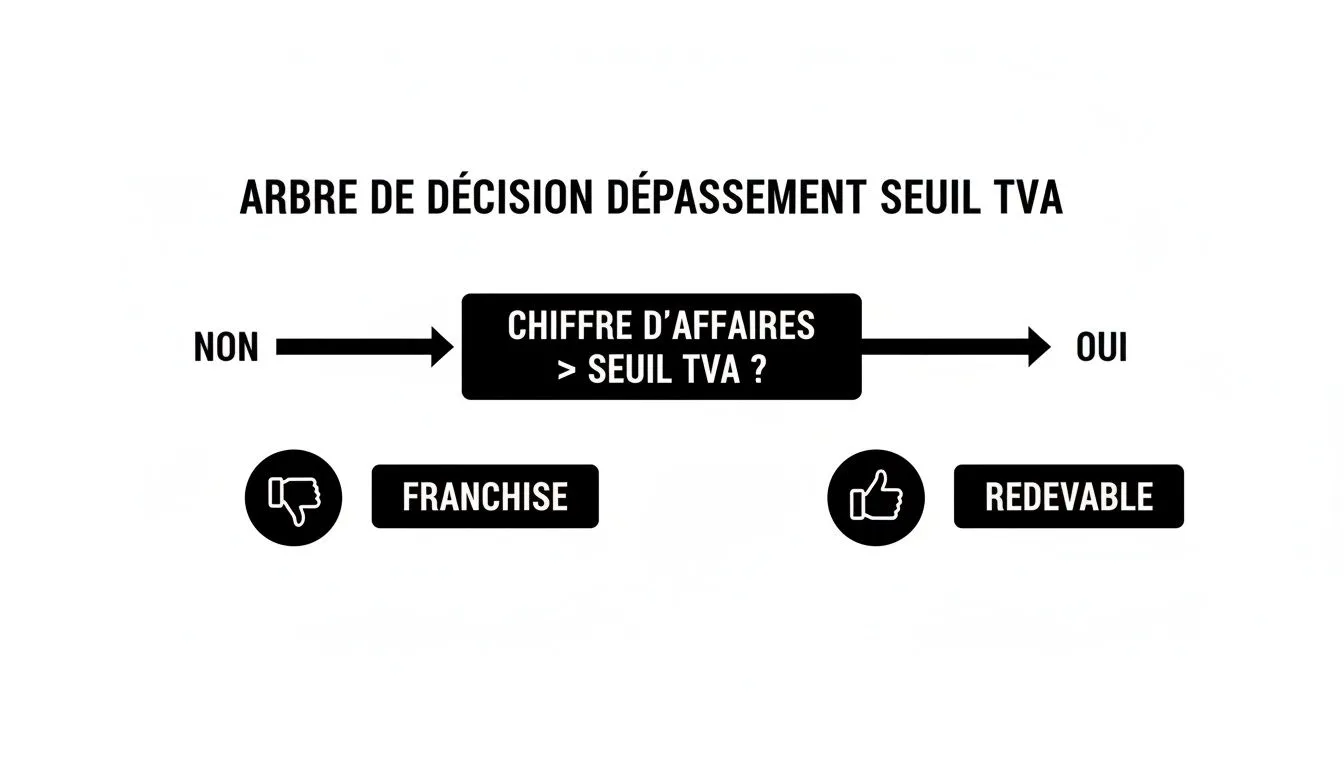
You can clearly see that exceeding the first threshold doesn’t automatically mean VAT applies immediately, unless the second one, the increased threshold, is also crossed.
The current thresholds to know
Be careful not to confuse the VAT thresholds with the revenue ceilings of the sole trader (micro-entrepreneur) regime, which are much higher. Here are the VAT thresholds currently in force:
| Type of activity | Exemption threshold | Increased threshold |
|---|---|---|
| Sale of goods, catering, accommodation | €91,900 | €101,000 |
| Services (BIC and BNC) | €36,800 | €39,100 |
The switch to VAT is a pivotal moment for a sole trader, marking a transition from simple, tax-excluded invoicing to collecting tax on behalf of the State. This is a step that has existed since the status was created, even though the thresholds have evolved over time. In 2020, for example, the exemption threshold for services was €34,400 and the increased threshold was €36,500.
The special case of pro-rata calculation
A big point of caution if you created your sole proprietorship partway through the year: the VAT thresholds need to be adjusted. You don’t benefit from the full thresholds in your first year. The calculation is done on a pro-rata temporis basis.
The rule is simple: the annual thresholds are recalculated based on the number of days remaining in the year from your business start date.
Let’s take a concrete example:
You’re a web developer (a service provider) and you started your business on July 1st. There are 184 days left in the year.
- Your adjusted exemption threshold will be: (€36,800 / 365 days) x 184 days = €18,535
- Your adjusted increased threshold will be: (€39,100 / 365 days) x 184 days = €19,700
This small calculation is essential to avoid a surprise threshold breach in your very first year. To put VAT management and obligations in another sector into perspective, you can explore a guide on VAT management for training organizations.
Your action plan after exceeding the VAT threshold
There you go, you’ve crossed the threshold. Far from being bad news, it’s really a sign that your micro-business is growing! But this switch to VAT marks a real turning point. For the transition to go smoothly, you need to act quickly and in an organized way. Here’s a simple, clear roadmap so nothing gets missed.
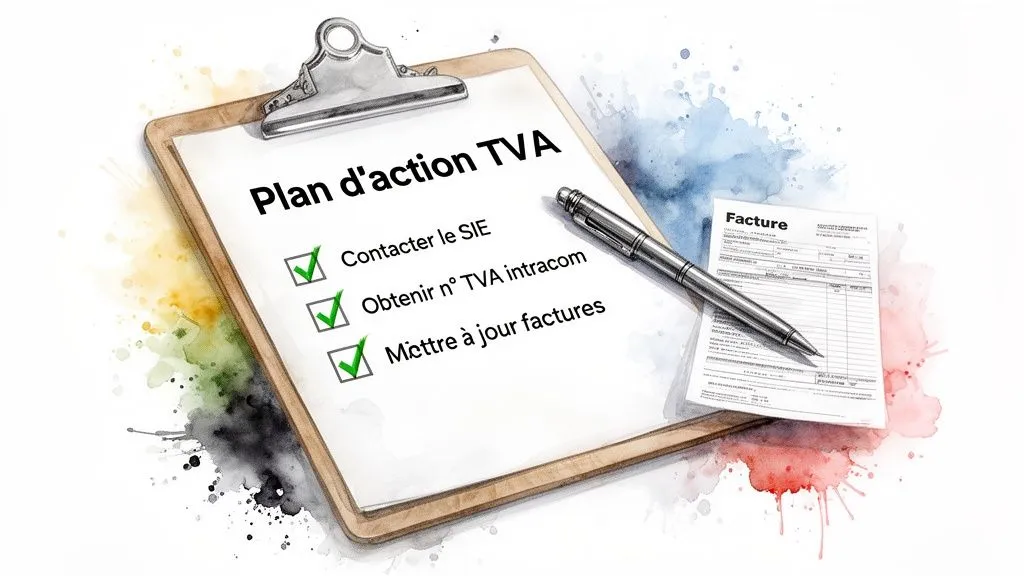
The very first thing to do, and the most urgent, is to get in touch with the tax authorities. This step is what will officially formalize your change of status and let you meet your new obligations.
Step 1: Contact your local business tax office (SIE)
The SIE becomes your main point of contact for everything related to VAT. Don’t waste any time, they need to be informed of your situation as soon as possible.
Everything happens online, via the secure messaging system in your professional account on impots.gouv.fr. Be careful, this isn’t just about requesting a number, it’s about actively choosing a VAT regime.
A small but crucial technical detail: in the messaging form, be sure to select the option “I am opting in” (Je formule une option). Above all, do not click on “I am requesting an intra-community VAT number.” This small detail is what ensures your file is processed correctly by the SIE.
In your message, remember to clearly state the date from which you are liable for VAT (the first day of the month in which you exceeded the increased threshold) and the tax regime you’ve chosen.
Step 2: Choose your VAT return regime
Two paths are open to you. Your choice will have a direct impact on your day-to-day management and your cash flow.
- The simplified real regime: The idea of a single annual return with two half-yearly installments might seem appealing. In practice, it can make cash flow tracking quite complex and lead to major adjustments.
- The standard real regime: This is the option I almost always recommend for clear tracking. The return is filed monthly (or quarterly if your annual VAT doesn’t exceed €4,000). This regular rhythm helps you avoid unpleasant surprises and gives you a clear picture, month after month.
Choosing the standard monthly real regime is often the wisest option for getting off to a good start. You know exactly where you stand with the VAT collected and the VAT you can deduct. To dig deeper into the topic, our full guide on VAT returns for sole traders is an excellent resource.
Step 3: Obtain and use your intra-community VAT number
Once the SIE has validated your option, you’ll receive your precious intra-community VAT number. It’s absolutely essential and must appear on all your invoices as soon as you become liable for VAT.
The time it takes to receive it can vary from a few days to a week. But don’t panic, you don’t have to wait until you have it in hand to invoice with VAT. You can perfectly well issue your invoices while adding the mention “VAT number pending assignment.” You’ll simply need to update them once you receive it.
This number is key to:
- Invoicing legally to your clients, in France as well as in the EU.
- Recovering VAT on your professional expenses.
- Filing your VAT returns.
Step 4: Update your invoice templates
The switch to VAT requires you to revise your invoices immediately. It’s a legal obligation, one you can’t skip.
Your new invoices must now clearly show:
- Your intra-community VAT number.
- The VAT rate applied to each product or service line.
- The total amount excluding tax.
- The total VAT amount.
- The total amount including all taxes.
Of course, the old mention “VAT not applicable, art. 293 B of the French Tax Code” needs to disappear for good. One tip: take the time to inform your clients, especially private individuals, since the final price they pay is going to increase. Transparent communication is the best way to preserve a good business relationship. There you go, your game plan is ready, all that’s left is to put it into action.
Learning to calculate and invoice VAT like a pro
Knowing how to calculate and invoice VAT is much simpler than it looks. Once you’ve crossed the threshold, this skill just becomes another string to your entrepreneur’s bow. The idea here is to give you concrete tools and clear examples so you can handle VAT without a headache.
Switching to VAT isn’t just a formality. This change has a direct impact on how you set your prices and present your invoices. But look on the bright side: it’s also the moment you’ll be able to start recovering VAT on your professional expenses. A significant advantage!
Identifying the right VAT rate for your business
In France, there isn’t just one VAT rate, but several. The one you’ll apply depends directly on the nature of your services or products. It’s really crucial not to get this wrong, since a rate error can catch the tax authorities’ attention and lead to a tax reassessment.
Here are the main rates to know:
- The standard rate of 20%: This is the most common, the default rate. It applies to the vast majority of goods and services. If you’re a consultant, developer, graphic designer, or if you sell non-food products, chances are this is your reference rate.
- The intermediate rate of 10%: Often found in catering, renovation work on older housing, or passenger transport.
- The reduced rate of 5.5%: This covers essential goods such as food, books (print and digital), or energy subscriptions.
For most sole traders providing services or running e-commerce, the applicable rate will be 20%.
Calculating the VAT to charge the client
The basic principle is child’s play. You start with your usual price, which becomes your price excluding tax, and you add VAT to it. The final amount your client pays will be the price including all taxes.
The formula to remember:
Total including tax = Amount excluding tax x (1 + VAT rate)
Let’s take a concrete example for a service:
Imagine you’re a web copywriter and you’re invoicing a job at €500 excluding tax.
- VAT calculation: €500 x 20% (that is, 0.20) = €100
- Total including tax: €500 + €100 = €600
Your invoice must therefore clearly show these three amounts: the total excluding tax (€500), the VAT amount (€100), and the total including tax (€600).
The hidden advantage: calculating deductible VAT
This is where switching to VAT really becomes interesting. You can now recover VAT on all your professional purchases. This deductible VAT is subtracted from the VAT you’ve collected from your clients before you remit it to the State.
Imagine you buy a new computer for your business at €1,200 including tax. The VAT rate on this type of equipment is 20%.
- To find the VAT amount, you calculate as follows: €1,200 / 1.20 = €1,000 excluding tax. The deductible VAT is therefore €1,200 - €1,000 = €200.
- The real cost of this computer for your business is now only €1,000.
At the end of your reporting period, if you’ve collected €100 of VAT on your sales but you have €200 of VAT to deduct on your purchases, you won’t owe anything to the State. Even better, you’ll have a VAT credit of €100! To dig deeper into the topic, our guide on calculating VAT will give you all the keys.
Becoming liable for VAT completely changes your outlook on expenses. Every business purchase that includes VAT suddenly costs you less, which can seriously boost your profitability, especially if you regularly invest in equipment or software.
Impact of the switch to VAT on invoicing and margin
To visualize the impact of this change clearly, let’s compare the same €500 service before and after the switch to VAT.
| Item | Before exceeding the threshold (Exemption scheme) | After exceeding the threshold (Liable for VAT) |
|---|---|---|
| Price charged to client | €500 | €600 including tax (€500 excl. tax + €100 VAT) |
| Revenue collected | €500 | €500 |
| VAT collected | €0 | €100 |
| VAT to remit to the State | €0 | €100 (before deduction) |
| Ability to deduct VAT | No | Yes |
This table highlights an essential point: to keep the same margin, the final price for your client has to go up. It’s a strategic choice you need to make: either you raise your prices including tax so your revenue excluding tax stays the same, or you decide to absorb part of the VAT, which will mechanically reduce your margin.
Mistakes to avoid when switching to VAT
Switching to VAT is a sign that your micro-business is growing, but be careful, the path is often full of pitfalls. A simple oversight can quickly turn into an administrative and financial headache. Better to know these common traps to avoid them and calmly handle your VAT threshold breach as a sole trader.
The switch to VAT can’t be improvised. It requires much greater rigor around your invoicing, your returns, and your deadlines. Burying your head in the sand and ignoring these new rules, even without bad intentions, can cost you dearly in penalties and complicate your relationship with the tax authorities.
Forgetting to request your VAT number
This is the most common mistake, and also the most critical. As soon as you cross the increased threshold, you must charge VAT. Full stop. Yet many sole traders, poorly informed or a bit lost, keep invoicing as before, without VAT, while waiting to receive their number. That’s a very bad idea.
From the first day of the month in which you exceed the threshold, VAT must appear on your invoices, whether or not you’ve already received the number.
The tip to get through this: if you’re still waiting for your number, don’t panic. Invoice normally while clearly showing VAT, and simply add the mention “VAT number pending assignment.” All you’ll need to do is update your invoices once the local business tax office (SIE) has sent it to you.
This small sentence shows your good faith and immediately puts you in compliance. If you keep invoicing without VAT, you risk a tax reassessment. The authorities will then consider that your prices were tax-inclusive, meaning they’ll ask you to remit the VAT to them… straight out of your margin. That hurts.
Getting the VAT rate wrong
Another classic mistake: applying the wrong VAT rate. The standard rate of 20% applies to most activities, that’s true, but there are exceptions. Certain services, such as renovation work or catering, benefit from reduced rates of 10% or 5.5%.
Applying too low a rate is taking a big risk. In the event of an audit, you’ll be asked for the difference, plus late penalties on top. And if you apply too high a rate? You make your clients pay more for nothing and become less competitive.
To be sure of yourself, adopt these two habits:
- Systematically check the rate that corresponds to each product or service you sell.
- Break down your invoices clearly if you combine services with different rates.
Missing a filing deadline
With VAT, a new tax calendar enters your daily life. Depending on your regime (standard or simplified real), you’ll have returns to file each month, each quarter, or each year. Missing a deadline, even by a single day, is never a good idea.
Missed deadlines automatically trigger penalties and surcharges that, before you know it, can add up quickly. The only defense is flawless organization.
- Write down all your deadlines in your calendar as soon as you know your regime.
- Set reminders on your phone or computer to make sure you don’t forget anything.
- Consider a management tool like Bizyness, which can automate reminders and help you prepare your returns in just a few clicks.
In the end, the best strategy remains anticipation. Keeping a close eye on your revenue lets you see the threshold breach coming, start the process without stress, and avoid the costly mistakes that always happen when you’re rushed.
Anticipating the transition with the right management tools
Crossing the VAT threshold as a sole trader can be a bit intimidating. You immediately picture a mountain of paperwork. Yet with the right tools, this administrative step becomes much simpler, even a real lever for structuring your business. The idea is no longer to endure the change, but to steer it.
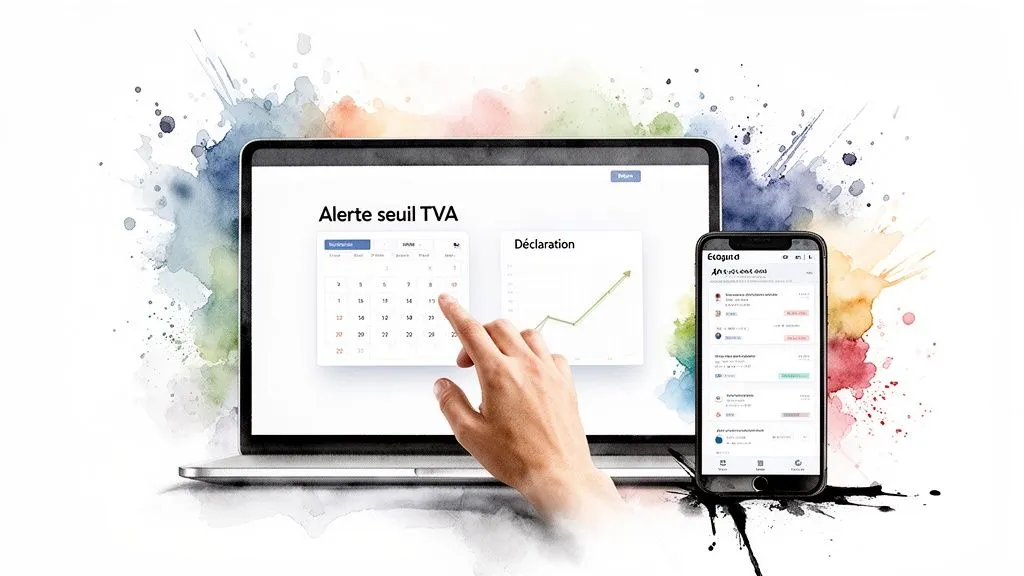
Think of a modern management tool as a kind of copilot for your micro-business. It doesn’t just issue invoices; it keeps a constant eye on your revenue and sends you an alert well before the thresholds come into view. This anticipation is the key: it gives you time to prepare, without stress.
Automation, your best ally for staying calm
The main advantage of specialized software is that it takes care of all the somewhat complex, repetitive tasks related to VAT. It puts an end to manual calculations and oversights that can end up costing you in penalties.
In practice, a good tool will help you:
- Monitor thresholds in real time: You get an ultra-clear dashboard showing where you stand relative to the base threshold and the increased threshold. It even accounts for the pro-rata calculation if you started your business partway through the year.
- Automatically adapt your invoices: As soon as the threshold is crossed, the software updates your invoice templates. No more exemption mention, instead the required information: your VAT number, the applicable rate, and of course the amounts excluding and including tax.
- Prepare your returns in a few clicks: The tool gathers all the data you need: the VAT you’ve charged (collected) and the VAT on your professional purchases (deductible). It can then generate a ready-to-use report that makes your monthly or quarterly return much easier.
Using a management tool for VAT is a bit like switching from a road map to a GPS. Both get you to your destination, but the GPS warns you about traffic jams, recalculates the route, and lets you focus on the road, not the map.
Save time and lighten your mental load
Switching to VAT clearly demands more administrative rigor. Trying to manage everything on a spreadsheet quickly becomes a source of stress and a breeding ground for errors. Software designed for this frees you from a huge burden.
By entrusting these tasks to a tool, you protect your position with the tax authorities, but above all, you get precious time back. Time you can reinvest where it really matters: growing your client base, refining your offers, or simply catching your breath. It’s a small investment that has a direct impact on your productivity and quality of life.
If you want to explore the different solutions available to you, our guide to the best accounting software for sole traders reviews the most interesting options. By choosing the right technology partner, exceeding the VAT threshold goes from being a dreaded ordeal to a mastered stage of your growth.
Your frequently asked questions about exceeding the VAT threshold
The switch to VAT is a step that always raises a lot of questions. That’s perfectly normal! Here are clear, direct answers to the most common questions to help you get a better handle on exceeding the VAT threshold as a sole trader.
What actually happens if I exceed the threshold during the year?
It all depends on which threshold you cross. If your revenue rises above the base threshold but stays below the increased threshold, you benefit from a tolerance period. In practice, nothing changes for the current year. You’ll only switch to VAT on January 1st of the following year, provided the situation happens again.
However, if you exceed the increased threshold, the effect is immediate. You must start charging VAT to your clients from the first day of the month in which the threshold was exceeded. There’s no tolerance in this case.
Do I need to wait for my VAT number before I start invoicing?
Definitely not! This is a classic mistake that can be costly. From the moment you become liable, VAT must appear on your invoices, whether or not you’ve received your number yet.
While waiting for the tax authorities to assign your intra-community VAT number, simply add the mention “VAT number pending assignment” to your invoices. This simple sentence puts you in compliance and shows your good faith.
How are the thresholds calculated in the first year of business?
This is an essential point of caution. If you create your sole proprietorship partway through the year, you don’t get the full annual thresholds. The thresholds are adjusted so you don’t get an unfair advantage.
The calculation is done on a pro-rata temporis basis. In other words, the ceilings are recalculated based on the exact number of days your business has existed within the calendar year. This is a crucial rule to know so you don’t unintentionally exceed the threshold right from the start.
For example, if you launch a service business on July 1st, your exemption threshold will roughly be cut in half. It’s therefore essential to do this calculation to steer your business without unpleasant surprises.
Are there upcoming changes to the VAT thresholds?
Yes, and they’re significant. The regulatory framework is evolving and tends to be tightening. The 2025 Finance Bill plans to lower the exemption threshold to a single ceiling of €25,000 in annual revenue, which would apply to all activities starting March 1, 2025.
This measure, if confirmed, could directly affect nearly 250,000 sole traders according to the FNAE, who will need to anticipate this major change. To dig deeper into the topic, you can read the analysis of the consequences of this threshold reduction on the FNAE website.
Managing your switch to VAT shouldn’t be a source of stress. With Bizyness, you can track your thresholds in real time, generate compliant invoices in one click, and simplify your returns. Take back control and focus on what really matters: your craft. Discover how Bizyness can change your life.
