

 Français
 Where to find your intra-community VAT number easily
Practical guide: where to find your intra-community VAT number and how to verify it on VIES, for entrepreneurs and administrative needs.
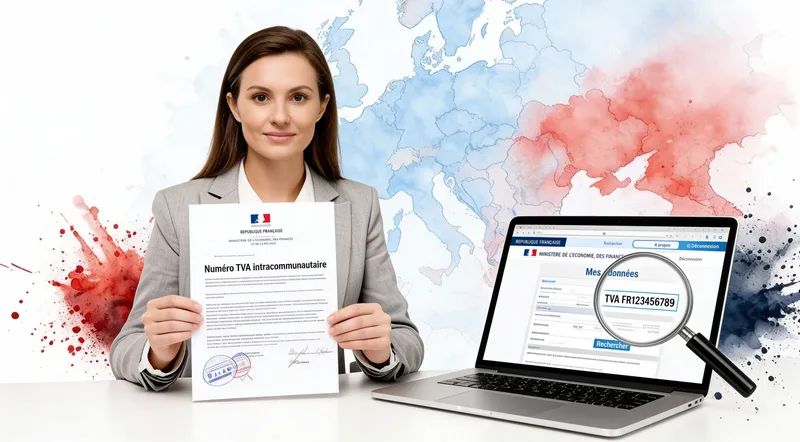
Let’s get straight to the point. The intra-community VAT number isn’t just another administrative formality on your invoices. It’s simply your company’s passport for working smoothly with partners across the European Union. Knowing where to find it and how to verify it is a basic skill for invoicing your European clients correctly and establishing your credibility.
Why is this tax number so important?
This well-known intra-community VAT number is the unique identifier that each tax authority assigns to a company subject to VAT within the EU. Its purpose? To simplify and secure trade between member states. Without it, the smallest transaction with a European client or supplier turns into an obstacle course, with a very real risk of costly mistakes.
Underestimating its importance means taking a risk with your cash flow and business relationships. Poorly managed invoicing can lead to a tax reassessment, where the tax authorities will claim the VAT you should have charged. And let’s be honest, a business partner who has to chase you for this essential identifier will quickly start doubting your professionalism.
An everyday essential for your business
Beyond the purely legal aspect, properly managing this number brings very concrete benefits. It’s the key to the VAT reverse charge mechanism, a principle that considerably simplifies the financial and administrative management of European trade.
Specifically, it serves three essential purposes:
- Invoicing tax-free (excl. VAT): It lets you issue invoices without VAT to your business clients based in another EU country. It’s simpler for them, and makes you more competitive.
- Completing your returns: It’s mandatory information for your declarations of trade in goods (DEB) or services (DES), ensuring you stay compliant.
- Boosting your credibility: Providing a valid VAT number proves that your company genuinely exists and is recognized by the tax authorities. An immediate sign of professionalism.
Put simply, knowing and correctly using your intra-community VAT number isn’t optional. It’s a vital obligation for any company doing business in Europe.
This guide was designed to make your life easier. We’ll walk through, step by step, clear methods for finding and validating a VAT number, whether it’s yours, a client’s, or a supplier’s. The goal is to turn this administrative task into a reflex that secures and streamlines your day-to-day activity.
And your own VAT number, where is it hiding?
Before diving into verifying your business partners’ numbers, a quick refresher is in order. Do you know where to easily find your own intra-community VAT number? It’s often simpler than it seems, since it’s printed on documents you probably look at every day.
The first, most obvious lead is to go back to when your company was created. The Business Tax Office (Service des Impôts des Entreprises, SIE) normally sent you this valuable number right after your registration. A quick look through your paper or digital archives might be enough.
The key places to look for your number
If that initial letter from the tax authorities has gone missing, no need to panic. Your VAT number is repeated in many places.
Here’s a short list of the most reliable sources:
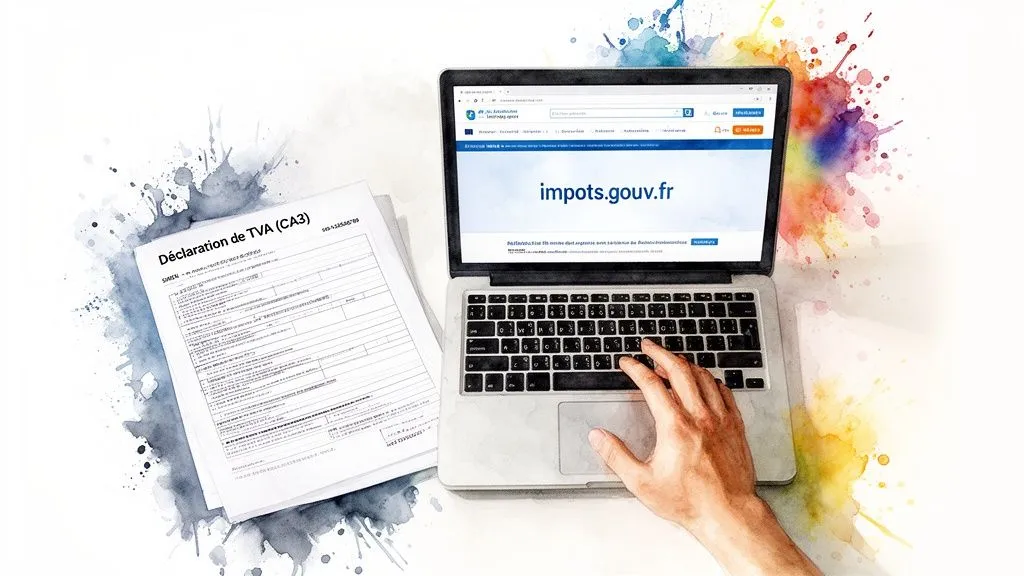
- Your VAT returns: This is probably the safest place. Whether you’re under the standard regime (CA3 form) or the simplified regime (CA12), your number appears prominently.
- Your business account on impots.gouv.fr: Once logged in, check your tax summary (mémento fiscal). It’s a recap of all your company’s identification information, including the VAT number.
- Your sales invoices: If you’ve already issued invoices, you should (normally) have included it. It’s a legal requirement, but also an excellent habit for always having it on hand.
For reference, the French format is fairly easy to identify. It always starts with the country code FR, followed by a two-digit key, then your nine-digit SIREN number. For example: FR 12 345678901.
Keeping this number close at hand is more than good practice, it’s a necessity. Even a VAT-exempt sole trader (auto-entrepreneur) may need it to purchase services within the EU. Being able to find it in a few seconds can save you from blocking a transaction at the worst possible moment.
The special case of sole traders
If you’re a sole trader (auto-entrepreneur) benefiting from the VAT exemption scheme, be careful: this number is not assigned to you automatically when you set up your business. You need to specifically request it from your local tax office (SIE).
This step becomes essential as soon as you deal with professionals based in other EU countries. To dig deeper into the topic, our guide on the VAT number for sole traders explains in detail when and how to request it.
One tip: plan ahead! Start the process as soon as you anticipate your first intra-community transactions so you’re not caught off guard.
How to find and validate the VAT number of your European partners?
Before sending a VAT-free invoice to a client based in another EU country, there’s one step you absolutely cannot skip: verifying that their intra-community VAT number is indeed valid. This is far from a simple administrative formality. It’s an obligation that protects you, because in the event of an incorrect number, the tax authorities could claim the French VAT you failed to collect. A reassessment risk no one wants to take.
Fortunately, there’s an official, simple, and effective tool for this verification.
The VIES reflex: verification in one click
The go-to tool for any company trading in Europe is the VIES online service (for VAT Information Exchange System). Provided by the European Commission, it’s directly connected to the tax databases of each member state. It’s free, instant, and gives you proof of your checks.
Using it is a breeze:
- You select your client’s country from the dropdown menu.
- You enter their VAT number (without the country prefix, like “FR” or “DE”).
- You click “Verify.”
The interface is very clean, as you can see here.
Within seconds, VIES tells you whether the number is valid. In most cases, it even shows the company’s name and address, letting you confirm it really is your client. Once you have this confirmation, you can invoice using the VAT reverse charge with complete peace of mind.
Expert tip: Always take a screenshot of a positive VIES result. Archive it alongside the corresponding invoice. In the event of a tax audit, this small image becomes rock-solid proof that you carried out your verification on the date of the transaction.
Other ways to find a missing VAT number
Your client didn’t give you their VAT number? No need to panic. Before following up with them, there are a few places where this information often hides.
Here are the first places to check:
- On their website: Explore the “Legal Notice,” “Contact,” or even the terms and conditions of sale pages. It’s the classic spot for this kind of legal information.
- In their documents: If you’ve already received a quote or a purchase order from them, their VAT number is almost always included.
- In their email signature: Many professionals include their VAT number in their email signature, right next to their contact details.
If, after these quick searches, the number is still nowhere to be found, the simplest method is often the best: just ask for it directly. A short email is perfectly professional and shows that you’re rigorous in your management. Your client will appreciate that you take compliance seriously.
Understanding the VAT number format
Knowing the structure of a VAT number can help you spot an obvious error at a glance. Each EU country has its own format, which always follows the same pattern: a two-letter country code, followed by a series of digits or characters.
To help you navigate, here’s an overview of the formats for the main EU trading partners.
Intra-community VAT number format by country
| Country | Country Code | Number Format (after country code) |
|---|---|---|
| France | FR | 11 digits |
| Germany | DE | 9 digits |
| Spain | ES | 9 characters (digits or letters) |
| Italy | IT | 11 digits |
| Belgium | BE | 10 digits (preceded by a ‘0’) |
| Netherlands | NL | 12 characters (digits and letter ‘B’) |
| Luxembourg | LU | 8 digits |
This structure is a good baseline, but validation via VIES remains the only 100% reliable method.
Knowing how to identify and validate these numbers is an essential skill for working in Europe. If you want to go further and understand how the exemption applies, feel free to check out our full article on calculating intra-community VAT, where we break down the reverse-charge mechanisms.
What to do if a VAT number is invalid or cannot be found?
You entered your partner’s VAT number into the VIES system and the verdict falls: “Invalid.” Before panicking or imagining the worst, take a deep breath. This is a much more common situation than you’d think, and it doesn’t always hide an attempt at fraud.
Often, the explanation is very simple. A basic typo when copying the number, it happens to everyone. It could also be that the company was just registered; its number is then brand new and hasn’t yet had time to reach the European VIES database. Another equally plausible possibility is that your client simply isn’t subject to VAT.
The action plan to follow when a number doesn’t validate
Faced with a stubborn number, the secret is to stay calm and methodical. Your goal is twofold: clarify the situation as quickly as possible, while keeping a record of all your steps. This precaution will be valuable for proving your good faith in the event of a tax audit.
Here’s how I’d recommend proceeding, step by step:
- Verify the information at the source: The first thing to do is to contact your partner again. Calmly explain that the number they gave you isn’t recognized by the VIES system and ask them to check it on their end. This is often the chance to fix a small typo.
- Request supporting documentation: If your client confirms that their number is indeed correct, ask them for a VAT liability certificate. This is an official document, issued by their tax authority, that proves in writing their status and the validity of their identifier.
- Keep everything in writing: Document every exchange without exception. Keep the emails, your client’s replies, and above all, take a screenshot of the negative VIES result. This file will be your best defense.
This little diagram sums up the idea well: validating a VAT number is a process with two clear outcomes.
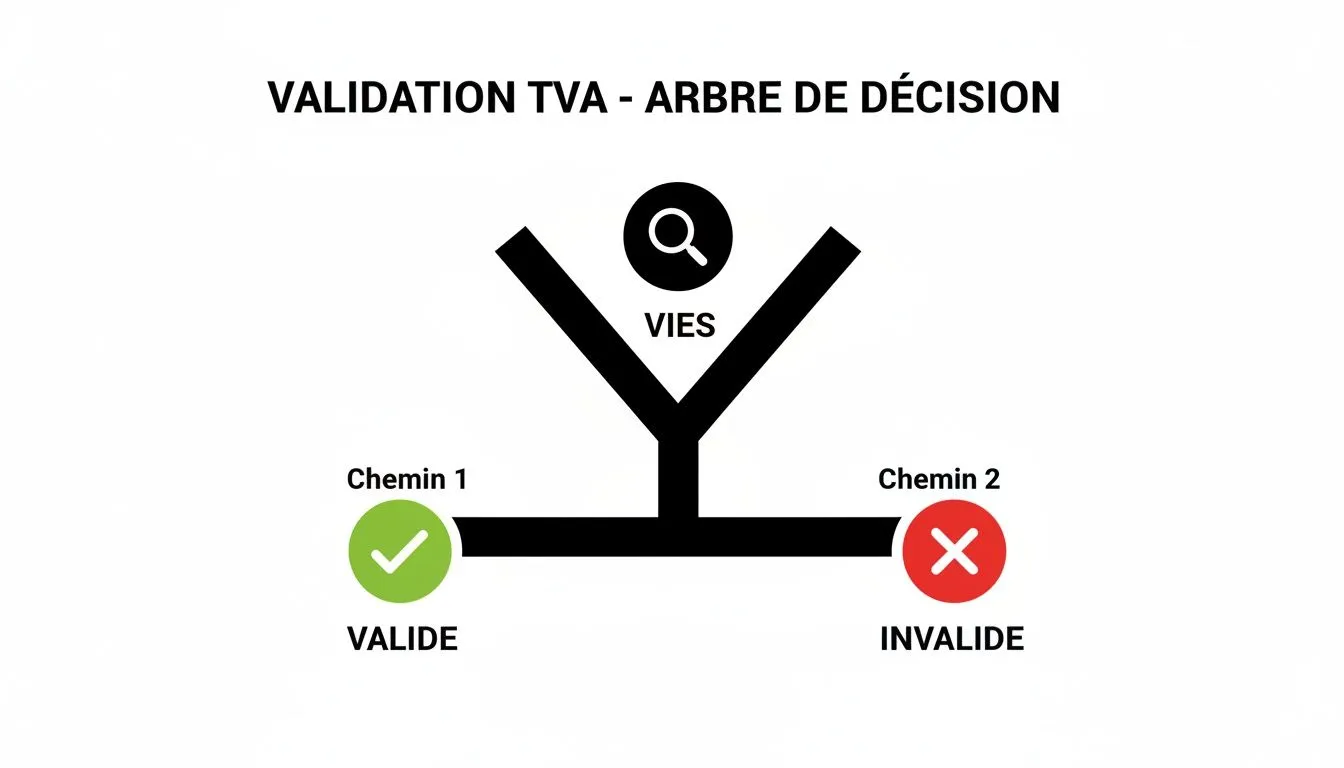
You can see clearly that an “invalid” result isn’t a dead end, but simply the start of a specific verification procedure.
The golden rule when doubt persists
If, after all these steps, you still don’t have a valid, verifiable VAT number in hand, the tax rule is clear and final: you cannot apply the VAT exemption.
Your only option to stay compliant is to invoice with French VAT applied, exactly as if it were a French client. The transaction must be treated as a domestic sale.
This decision may surprise your client, who logically expected a tax-free invoice. Communication is therefore essential. Take the time to explain that, without a valid intra-community VAT number, the law requires you to collect VAT. Make clear that you followed the procedure to the letter to protect both your companies. This transparency is key to preserving a good business relationship, even when things get a little complicated.
Build VAT verification into your invoicing routine
Looking up a VAT number by hand is doable. Doing it systematically? That quickly becomes a different story. Once you start scaling transactions with European clients, every new invoice turns into a mini administrative investigation.
That’s where smart management tools, like Bizyness, come in and make all the difference. They take this legal obligation and turn it into a simple formality, fully integrated into your invoicing process.
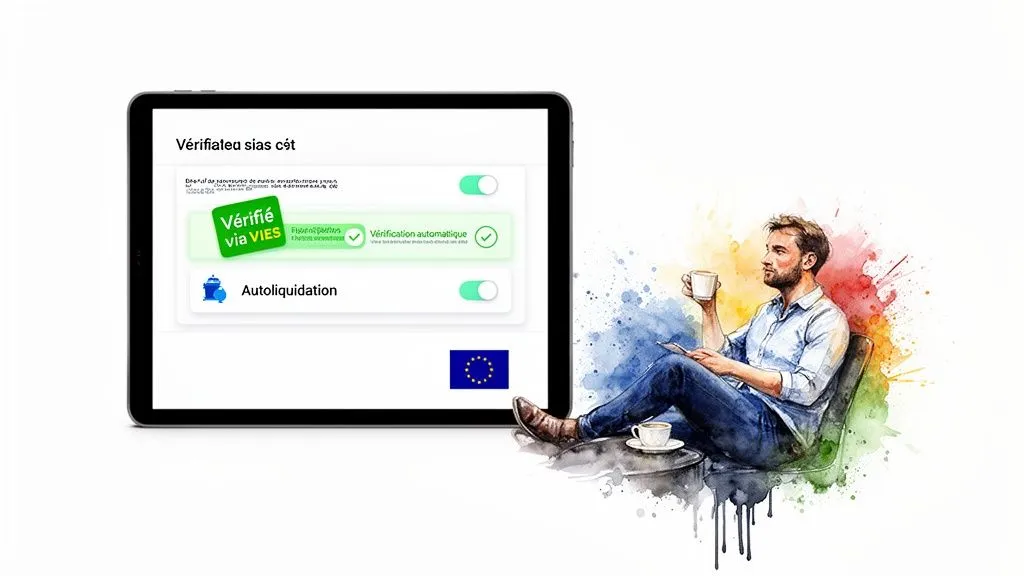
Automation, your best ally for staying compliant
Picture this: you create a record for a new client. You enter their VAT number and, instantly, the software connects to the VIES service to validate it. No more juggling browser tabs, copying and pasting information, or taking screenshots for your records.
Once the number is confirmed valid, the system automatically applies the correct invoicing rules. For example, for a business client based in Spain, it generates a VAT-free invoice (reverse charge) and adds the mandatory legal mentions. You don’t even have to think about it anymore.
For an entrepreneur, the benefit is immediate and shows up on three fronts:
- Precious time saved: No more repetitive, time-consuming manual checks.
- Increased reliability: Automation eliminates the risk of data-entry errors or oversights.
- Peace of mind: Your invoices are always compliant, with no effort on your part.
When every minute counts, turning administrative tasks into automated processes isn’t a luxury, it’s a genuine strategic advantage. You reclaim precious time that you can reinvest where it really matters: growing your business.
A particularly critical issue for online commerce
The importance of this automation is even more obvious in the world of e-commerce and digital services. With the rollout of the VAT One-Stop Shops, tax authorities are paying particularly close attention to how remote transactions are managed.
The numbers speak for themselves. VAT collected through these one-stop shops jumped by 1.7 billion euros, a 27.4% increase. As highlighted in a report from the French tax authority (DGFIP), this shows just how much remote sales have become a growth driver for small and medium-sized businesses.
Having a billing system that natively handles this complexity has therefore become a necessity. To go further and make sure all your documents are fully compliant, take a look at our guide on mandatory invoice mentions.
Your frequently asked questions about the intra-community VAT number
Intra-community VAT can quickly become a headache, especially once you start trading with our European neighbors. To help clear things up, we’ve compiled the questions that come up again and again among entrepreneurs, with direct, experience-based answers.
I’m a VAT-exempt sole trader (auto-entrepreneur). Do I really need a number?
Yes, absolutely. This is one of the biggest misconceptions. Even if you’re under the VAT exemption scheme in France — and therefore don’t charge VAT to your French clients — the intra-community VAT number becomes mandatory in certain specific cases.
You won’t be able to avoid it if:
- You sell services to a business client in another EU country.
- You purchase services from a supplier based in the EU, regardless of the amount.
- You purchase goods from European partners for more than €10,000 over the year.
In these situations, this number is the key to managing the VAT reverse charge and, above all, to making sure your invoices are fully compliant.
How long does it take to get one?
That depends on your status. For a standard company like an SAS or SARL, the number is generally assigned automatically by your local tax office (SIE) a few days after registration. It arrives at the same time as your other tax identifiers.
On the other hand, if you have to request it afterward, as is the case for a sole trader, the timeframes are more unpredictable. It can take anywhere from a few business days to several weeks, depending on how responsive and busy your local tax office is.
A friendly tip: plan ahead! As soon as you expect to sign with a European client or supplier, submit the request via your business account on impots.gouv.fr. That will save you from blocking an important invoice when the time comes.
How do I find a VAT number from a SIRET number?
Here’s a handy trick worth remembering. The French intra-community VAT number is directly linked to your SIREN number (the first 9 digits of your SIRET).
The structure is always the same:
- The country code: FR
- A two-digit computer key, calculated by the tax authorities.
- Your SIREN number.
Even though we know the logic, only the number provided by the SIE is the correct one. Don’t try to “calculate” the key yourself, it won’t work.
Is the VIES service really reliable?
Yes, VIES is the ultimate reference. It’s the official tool that pulls information live from the tax databases of each member state. It’s hard to get more reliable than that.
That said, there are a few small nuances to keep in mind. There can be a slight delay: a freshly created number sometimes takes a little time to appear. Another scenario: if a country’s database is under maintenance, VIES won’t be able to give you an answer for that country.
The right habit to adopt? Always take a screenshot of the verification, whether positive or negative. In the event of an audit, it’s irrefutable proof that you did your part of the job.
Don’t let VAT paperwork hold back your expansion into Europe any longer. With a tool like Bizyness, VAT number verification is automated and your invoices are always compliant, with no effort on your part. Discover how to simplify your management today on Bizyness.fr.
