

 Français
Obligation to Issue an Invoice to a Consumer: 2026 Guide
Obligation to issue an invoice to a private customer: everything you need to know in 2026 and the steps to follow to avoid mistakes.
In France, the rule seems simple at first glance: there is no systematic obligation to provide an invoice to a private customer. In practice, however, and especially for an online seller, the situation is far more nuanced. For you, every online sale is a specific case that triggers this well-known obligation.
Let’s take a closer look.
When must you provide an invoice to a private customer?
Let’s dive right in. Invoicing a private customer isn’t automatic. For most everyday purchases in a physical store, a simple receipt is enough. But for a business owner, and particularly in e-commerce, certain scenarios require you to step up and issue a proper invoice.
This is a fundamental distinction. Think of it as a commercial highway code: most of the time, the road is clear. But in specific situations, a “Stop” sign appears and forces you to create an invoice.
The situations that trigger the obligation
To make things clear, here are the situations where you simply cannot avoid it:
- Distance sales: This is the case that concerns you most as an online seller. Every order placed on your site, whether through Shopify, a marketplace, or your own store, requires you to generate an invoice.
- A customer request: It’s their right. If a customer asks you for an invoice, you’re obligated to provide one, regardless of the amount or nature of the transaction.
- Service provision: As soon as a service exceeds €25 including tax, an invoice becomes mandatory.
- Certain business sectors: Fields such as home improvement work, for example, have their own rules and require systematic invoicing for every job.
An invoice is not just a piece of administrative paper. It’s the foundation of trust between you and your customer. It formalizes the transaction, serves as proof of purchase, and becomes essential for managing a warranty or a return.
To help you quickly visualize your obligations, here’s a summary table.
Summary of invoicing obligations for a private customer
This table summarizes the cases where issuing an invoice to a private customer is mandatory or optional, offering a quick overview of the main rules.
| Type of sale or situation | Invoice mandatory? | Conditions and notes |
|---|---|---|
| Distance sale (e-commerce, phone, etc.) | Yes | Systematic, regardless of order amount. |
| Explicit customer request | Yes | The seller must provide it upon simple request from the private customer. |
| Service provision | Yes | Mandatory if the total amount is above €25 including tax. |
| In-store sale (cash) | No | Unless the customer requests it. A receipt is sufficient. |
| Home improvement work | Yes | Systematic obligation, regardless of the amount. |
This summary gives you the keys to know when to act. Following these rules is essential to staying compliant and building a lasting relationship of trust with your customers.
The impact of the 2026 reform
And that’s not all. The major e-invoicing reform, expected in 2026, will also change things. Even though the obligation to issue invoices in electronic format will only apply to business-to-business (B2B) transactions, your sales to private customers (B2C) will indeed be affected by a new requirement: e-reporting.
In practice, you’ll need to transmit data for all your B2C sales to the tax administration. The stakes are high: we’re talking about an annual volume of more than 20 billion B2C transactions in France, a much larger flow than the 2 billion B2B invoices. To better understand the ins and outs of this transition, analyses on electronic invoicing are available.
And for a complete overview of how to invoice properly, this practical guide to invoicing a customer is an excellent resource.
Identifying the situations where an invoice is mandatory
Let’s move from theory to practice. To stay compliant, it’s crucial to know precisely when you must issue an invoice to a private customer. If you run an e-commerce business, this question isn’t just a formality — it’s at the heart of your day-to-day management.
The basic rule is fairly simple to remember: as soon as a transaction is not a physical, face-to-face sale with immediate payment, the invoicing obligation comes into play. Each type of sale follows its own logic, and some systematically lead to the issuance of an invoice.
This flowchart summarizes the process well for a sale to a private customer (B2C).
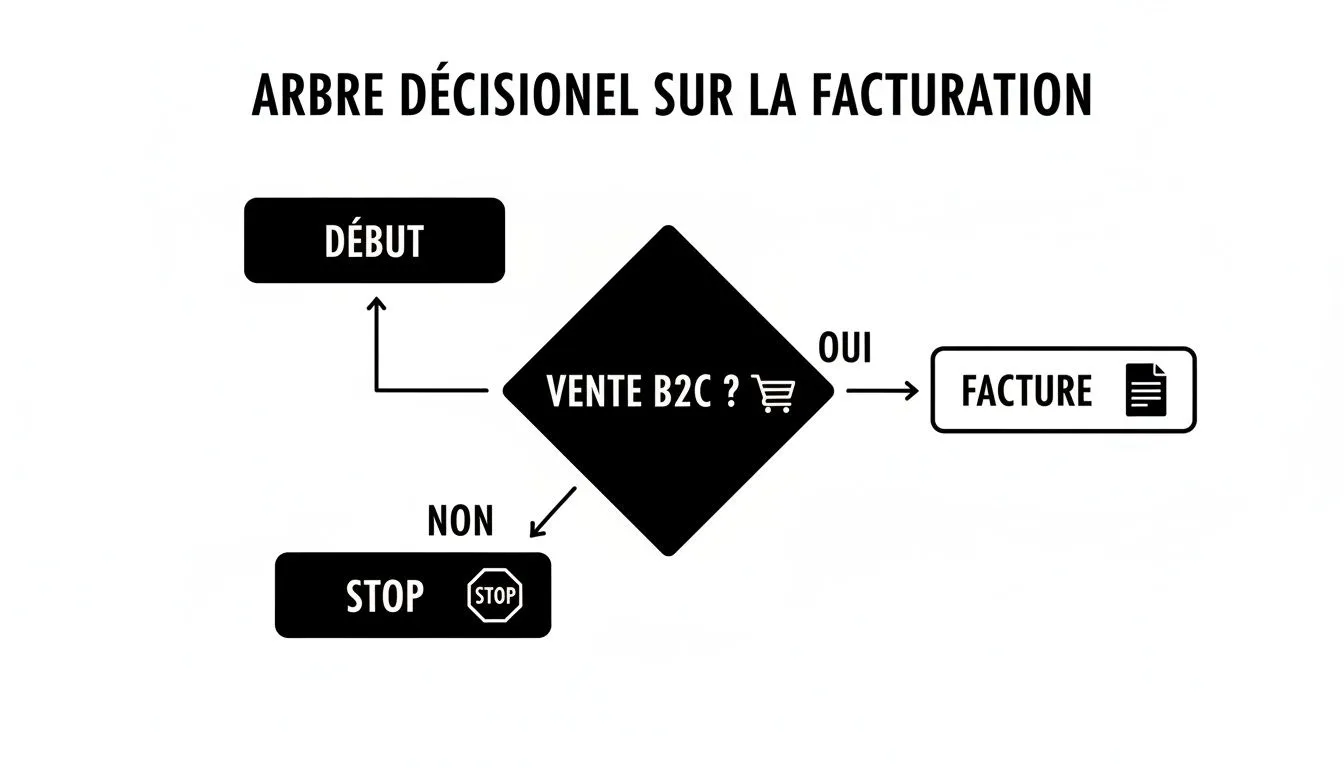
In short, for online commerce, the conclusion is clear: every sale to a private customer must be accompanied by an invoice.
Distance selling: the unavoidable rule
This is the most common case for online businesses, and also the strictest. Distance selling covers all transactions where you and your customer are not physically in the same place at the same time.
In practice, this means you must issue an invoice for every order, with no exception based on amount, if you sell through these channels:
- Your own online store: regardless of the platform (Shopify, WooCommerce, PrestaShop…).
- Marketplaces: every sale on Amazon, Etsy, Cdiscount, or eBay must result in an invoice.
- Phone or mail-order sales: even these more traditional channels are affected.
Imagine: a customer orders an item on your Shopify site. As soon as they click “Pay,” the transaction is legally considered “concluded at a distance.” At that moment, you’re obligated to provide them with an invoice. It’s their official proof of purchase, essential for the warranty.
Service provision above €25
Now let’s talk about services. Are you a coach, graphic designer, repair technician, or do you sell online courses? Here, it’s not the sales channel that matters, but the amount.
Issuing an invoice becomes mandatory as soon as the total service amount reaches or exceeds €25 including tax. That’s a very low threshold, so it’s quickly crossed in most cases.
For example, a customer books a €50 consulting session. You must provide them with an invoice. However, for a small job billed at €20, the invoice isn’t automatic. But be careful — it becomes mandatory if your customer requests it.
An explicit request from the customer
This is a fundamental right for every consumer. Regardless of the nature of the sale, the location, or the amount, if a private customer asks you for an invoice, you’re obligated to provide it.
This rule applies even for a small in-store purchase of a few euros, where a receipt would normally have sufficed. Refusing is an offense.
For an online seller, this is a rare situation, since invoicing is the norm anyway. Still, it’s good to know that this right exists and that you must be able to respond to it without delay.
Special cases in certain sectors
Finally, be careful: certain trades have their own rules, often stricter ones. Invoicing there is systematic, regardless of the amount.
The home improvement work sector is a perfect example. Whether you’re a tradesperson replacing a faucet or a renovation company, every job at a private customer’s home must be documented with a detailed invoice.
Other activities, such as moving services or home repair, fall under the same rules. The goal is always the same: to ensure perfect traceability and protect the consumer. So make sure to check the specific practices in your sector to avoid unpleasant surprises.
Invoice, note, or receipt: how to choose the right document for your private customers?
When selling to private customers, you quickly find yourself juggling several types of documents: invoice, note, receipt… Which one should you choose? Do you need to create one every time? This is a crucial question, because behind each document lie very specific legal and accounting obligations.
What you need to understand is that the choice isn’t trivial. It depends directly on the nature of your sale. A quick in-store transaction won’t have the same requirements as an online sale or a somewhat larger service provision.
The differences to know between a full invoice, a note, and a receipt
At first glance, these three documents may seem similar, but they don’t have the same value or the same role. The full invoice is the most formal document. It’s the true backbone of your accounting, the only document that lets you handle VAT correctly and that’s mandatory for most distance sales.
The note, also called a simplified invoice, is a lighter version. It can be used for low-amount sales. It contains less information but remains an official document. Finally, the receipt is mainly proof of purchase for your customer. For you, its accounting value is limited; it’s the register closing report (the “Z report”) that serves as the official record.
Don’t make the mistake of confusing an invoice with a simple receipt. An invoice is a legal document that formalizes the sale, transfers ownership, triggers warranties, and serves as a reference in case of dispute. For an e-commerce seller, knowing how to issue one properly isn’t optional — it’s an obligation.
By the way, to get the sales cycle off to a good start, a clear and professional quote is often the first step. To help you, you can take inspiration from this free Excel quote template.
Comparison of sales documents for private customers
For a clearer picture, nothing beats a comparison table. Here’s a summary of the characteristics of each document to help you decide which one to use depending on the situation.
| Element | Full Invoice | Simplified Invoice / Note | Receipt |
|---|---|---|---|
| Use case | Distance sales, services > €25, customer request. | Services < €25 (if not requested), sales of goods < €300 excl. tax. | In-store cash sales. |
| Legal value | High. Complete legal and accounting document. | Medium. Proof of the service or sale. | Low. Mainly proof of payment for the customer. |
| Required details | All mandatory details (full identity, VAT, etc.). | Simplified details (seller’s name, date, description, total incl. tax). | Minimal information (seller’s name, date, total paid). |
| Retention | 10 years by the business. | 10 years if used as an accounting record. | Not mandatory for the business (summarized via the Z report). |
| Usefulness | Essential for accounting, VAT, and warranties. | Useful for tracking small services. | Quick proof of payment for the customer. |
In short, if you sell online, the question barely arises: the obligation to issue an invoice to a private customer is systematic. The full invoice is your default document. The note and the receipt are exceptions, mostly reserved for physical stores or very small services. Ignoring this hierarchy exposes you not only to tax penalties but also to serious headaches in the event of an audit or a customer complaint.
How to write an invoice for a private customer the right way
Issuing an invoice for a private customer might seem trivial. Yet even a single missing or incorrect detail is enough to render it invalid in the eyes of the administration. And the bill can add up fast: in the event of an audit, the fine is €15 per incorrect invoice.
Rather than seeing invoicing as a chore, think of each invoice as proof of your professionalism. Let’s look together at how to turn this obligation into an automatic process, for always-compliant B2C documents.
Identification information: who’s selling to whom?
The first step is clearly identifying the parties. This is the foundation of your invoice, the information that proves who is involved in the transaction. It’s absolutely non-negotiable.
- On your side: Your first and last name (or company name if you’re incorporated), your postal address, and, most importantly, your SIREN number. It’s essentially the ID card of your business.
- On your customer’s side: Their full name and address are essential. If you deliver the product to a different address, be sure to specify that as well.
This data ensures perfect traceability. It’s crucial for managing a warranty, a return, or a potential dispute.
The document’s structure: the key elements
Once the parties are identified, you need to tackle the structure of the document itself. Every field matters for your accounting and compliance.
The invoice number is the first point to watch. It must be unique and belong to a continuous chronological sequence (for example, F2024-051, F2024-052…). Any gap in the sequence could alert the administration, which might see it as an attempt to conceal revenue.
The issue date is just as critical, as it marks the starting point of your accounting obligations. Also remember to mention the date of sale or service if it doesn’t coincide with the invoicing date.
An invoice isn’t just a simple payment request. It’s a legal document that formalizes a sale, formalizes your claim, and serves as a record for your accounting and your customer’s. Every mandatory detail is a building block that strengthens its legal value.
The heart of the invoice: product details and VAT
This is where we get to the core of it: what exactly did you sell? Precision is your best ally to avoid any misunderstanding, whether with your customer or the tax authorities.
For each product or service line, you must list:
- The clearest possible description (name, reference, details)
- The quantity
- The unit price excluding tax
Next comes the tax calculation. You must clearly display the VAT rate applied, the total VAT amount, and of course the total price including tax to be paid. To learn more about this topic, feel free to check out our full guide on mandatory details on an invoice.
If you sell to private customers in other European Union countries, VAT management becomes more complex. You’ll need to apply your customer’s country’s rate and declare it via the one-stop shop (OSS/IOSS). A good invoicing software can thankfully automate all of this for you.
Specific details required for private customers
Finally, a few details are specifically required when selling to a consumer. They’re meant to protect the customer or clarify your own status.
If you’re a micro-entrepreneur under the VAT exemption scheme, it’s essential to include the mention: “VAT not applicable, art. 293 B of the French Tax Code.” Forgetting it is a classic mistake, but it can be costly and lead to a tax reassessment.
For the sale of goods, you must also inform the customer of the existence and duration of the legal guarantee of conformity. For new products, its duration is a minimum of two years. This is crucial information for the consumer, which must be stated clearly.
E-invoicing, your asset for simplified management
Switching to e-invoicing for your private customers is no longer optional — it has become a given. Far from being just a trend, digitalization is a real lever to lighten your workload, reduce your costs, and, above all, ensure you stay compliant.
And don’t worry, the transition is often simpler than you’d imagine. For your online sales, for example, the customer’s consent to receive an invoice by email is generally obtained through acceptance of your Terms and Conditions of Sale at the time of purchase. It’s simple and effective.
The financial impact of digitalization
One of the most immediate benefits of e-invoicing is the savings it generates. The numbers speak for themselves: the full processing of a single paper invoice (printing, enveloping, postage, archiving) is estimated to cost between €14 and €20. By comparison, its digital version costs only €0.40 to €2.
Let’s do a quick calculation for a Shopify seller who issues 500 invoices a month. By dropping paper, the annual savings can climb dramatically, ranging from €42,000 to €120,000. Platforms like Bizyness, which convert every order into a compliant invoice, allow you to achieve these gains without even thinking about it. To dig deeper into the subject, you’ll find more details on the economics of e-invoicing.
Securely storing your invoices
One of the biggest headaches when it comes to providing an invoice to a private customer is storage. The law is clear: you must keep a copy of every invoice for 10 years. For digital invoices, this archiving must be done under conditions that guarantee their integrity and readability throughout that entire period.
Be careful — a simple folder on your computer is absolutely not enough. Imagine a hard drive failure, a ransomware attack, or a simple handling error… You risk losing everything and finding yourself in violation of the law. A reliable, secure archiving system is non-negotiable.
This is where automation really pays off. Tools designed for e-commerce handle this burden for you. The principle is simple: every sale on your store is turned into an invoice, which is then stored in a digital vault, safe from accidents and accessible at any time.
Here’s an example of an interface where all your documents are centralized, ready to be viewed in just a few clicks. This overview gives you full control over your invoicing, without the manual, repetitive tasks that come with it.
Automation to fuel your growth
Automation isn’t limited to creating a PDF. Modern solutions like Bizyness connect directly to your everyday tools, whether that’s your sales platform (Shopify, Amazon…) or your payment gateways (Stripe, PayPal).
In practice, this connection allows you to:
- Create a compliant invoice as soon as an order is placed, with all mandatory details included.
- Apply the correct VAT rate based on your customer’s country, a task that can quickly become a nightmare internationally (OSS/IOSS management).
- Send the invoice by email to the customer without you having to lift a finger, improving their experience.
- Archive every invoice in a safe place for the legally required 10 years.
By handing these tasks to a specialized tool, you don’t just save time. You protect your business from errors and penalties, and you free up energy to focus on what matters most: growing your business. If you’re a micro-entrepreneur, our dedicated article on e-invoicing for sole traders will give you tailored advice.
Automating your invoicing to protect yourself from penalties
Not providing an invoice to a private customer isn’t just an administrative oversight. It’s a mistake that can cost you dearly, not only in penalties, but also by creating real chaos in your cash flow.
Believe me, the penalties provided for by law aren’t there for show. They’re designed to be a deterrent, and every missing or poorly made invoice adds up, creating a very real financial risk.
What are the financial risks, concretely?
To put it simply, the tax administration doesn’t take invoicing rules lightly. Every small mistake can cost you. Consider this: it’s a fine of €15 per missing or incorrect detail on a single invoice. If you send hundreds of invoices every month, the total can add up quickly.
But that’s only the tip of the iceberg. In the most serious cases, such as a total and repeated failure to invoice, the penalties become criminal. We’re talking about a fine of up to €75,000 for your business. Faced with such figures, it quickly becomes clear that manual management is no longer a viable option.
Far from being a luxury for big companies, automation has become life insurance for any e-commerce business. It’s the essential tool for securing your growth without fear of a tax audit.
Managing your invoices manually exposes you to human error: an oversight, a typo, an incorrect VAT rate applied… It’s a risky bet. The only way to ensure total, stress-free compliance is to let a specialized system handle it.
Take back control with a solution like Bizyness
Imagine an assistant that handles your invoicing in the background, 24/7, without ever making a mistake. That’s exactly what a tool like Bizyness offers you, designed specifically for online sellers. In just a few minutes, you connect your Shopify, Amazon, or WooCommerce store.
From there, everything happens automatically with each new order, without you having to lift a finger.
- The invoice is created instantly. The system generates a flawless PDF with all the order information, without any action on your part.
- VAT is managed intelligently. The tool identifies the buyer’s country and applies the correct VAT rate, including for international sales via the one-stop shop (OSS/IOSS). No more headaches over European rates!
- The customer receives their invoice by email. It’s immediate, professional, and improves the purchasing experience.
- Everything is archived safely. The invoice is stored in a digital vault, where it remains accessible and compliant for the legally required 10 years.
This approach virtually eliminates the risk of error. No more worrying about sequential numbering, up-to-date legal details, or tax calculations. You free up valuable time and, most importantly, gain peace of mind that’s priceless. Your administrative management finally becomes as solid as your business strategy.
FAQ: your questions about invoicing private customers
Even with the rules in mind, practical questions often remain. Let’s go over the most common ones to clear things up.
Can a private customer really demand a paper invoice?
That’s an excellent question. In theory, yes, a customer can refuse an email and request a paper version. But in the reality of e-commerce, this is extremely rare.
Why? Simply because, by confirming their order, your customer has checked the box “I accept the Terms and Conditions of Sale.” If your terms state that all communications, including invoices, are digital, then they’ve given their consent. The key, then, is to make sure your terms and conditions cover this point thoroughly.
Do you need to issue an invoice for a refund?
Yes, and it’s non-negotiable. A refund is never recorded “randomly” in your accounting. You must issue a credit note (also called a credit memo).
This document is the accounting counterpart of the original invoice: it cancels it, in whole or in part. To keep everything transparent, it must absolutely reference the number of the sales invoice it corrects. Good invoicing software handles this automatically, creating credit notes linked to the original invoices for perfect traceability.
A credit note isn’t a mere formality — it’s an obligation. It’s proof that every financial flow, including a merchandise return, is properly documented in your books.
What are the specific rules for a micro-entrepreneur?
The basic obligations apply to you too. The main difference is VAT. If you’re under the VAT exemption scheme, your invoices must never, under any circumstances, show VAT.
You’re required to include the mention: “VAT not applicable, art. 293 B of the French Tax Code.” Forgetting it is a classic mistake, but it can be costly in the event of an audit. For everything else (numbering, identification of the parties…), the same rules apply.
And of course, archiving is just as crucial. Be sure to check how long to keep various invoices so you can rest easy.
Don’t let invoicing hold you back any longer. With Bizyness, every order automatically generates a compliant invoice, which is then sent and archived for you. You never have to think about it again. Discover how Bizyness secures your e-commerce business at https://www.bizyness.fr.
